

The Opportunity
Everyone Knew Google Ads. Almost Nobody Knew What Else Existed.
Brian Muriu spent some time asking a simple question: where are Kenyan brands spending their marketing budgets, and is anyone helping them spend it better?
The answer he kept getting was the same. Betting companies, FinTech startups, iGaming platforms – they were all spending heavily, and almost all of it was going to Google Ads and Meta. Not because those platforms were working particularly well, but because they were familiar. No one had introduced them to the alternative.
"Most people are not exposed to programmatic the way we'd expect. From a FinTech or iGaming standpoint, most are just too familiar with Google Ads and Meta Ads. That's it."

The gap wasn't technical. It was educational. These brands had budgets, urgency, and growth targets. What they lacked was a guide – someone who understood media buying at a serious level and could walk them through what programmatic actually meant in practice, not in theory.
BreakRoom was built to be that guide. Not an agency doing everything at once, but a focused media buying partner – one that could sit alongside clients, show them a different kind of infrastructure, and build their confidence in a channel most of them had never touched.
The Strategy
Deliberately Not an Agency
The distinction matters to Brian, and he makes it early in almost every conversation. The default path for a company doing what BreakRoom does would be to slide into a full-service agency model – taking on creative, strategy, reporting, and media buying all at once. He chose a different direction.
"We want to purely concentrate on the media buying aspect," he says. "That's the harder part. If we position ourselves correctly, we can hand-hold their entire programmatic journey – away from Google and Facebook."
That focus isn't just a business preference. It's a response to the market. In Kenya, many of the brands worth reaching are still founder-led. The person who started the company still controls the marketing budget. That means trust is built slowly, decisions take longer, and relationships can break quickly if a new vendor oversells or underdelivers.
"If you're not careful, you can break the relationship quite quickly when you're just trying to onboard them. So you have to go slowly until you find the right strategy."
BreakRoom's approach to this is deliberate. Test one campaign. Understand it properly. Only then move to the next. The goal isn't to impress clients with volume or complexity – it's to build a track record they can trust, one result at a time.
Why Epom
The Technology Was Table Stakes. The Relationship Was the Deciding Factor.
When Brian started evaluating DSPs, he wasn't just looking at feature lists. He'd spoken to others in the industry who had gone through similar searches – including a senior contact who had considered building a DSP from scratch before realising the capital and technical investment made it impractical. Epom came up as a platform worth taking seriously.
But the actual decision came down to two things that had nothing to do with product specs.
The first was white-label access. For BreakRoom to position itself as a trusted partner, rather than a reseller of someone else's tool, clients needed to interact with a platform that felt like BreakRoom's own. In a market built on personal relationships, a third-party brand in the background would have undermined the entire proposition.
The second was support quality. During testing, Brian found that when supply gaps came up or a campaign wasn't behaving as expected, the Epom account team, specifically his contact Inga, would go back to the traffic side and try to source better inventory. It wasn't always possible. But the effort was visible, and in a new market, that kind of hands-on partnership mattered more than any automated feature.
"Technology was not the only selling factor. It was the technology, plus the relationship and expertise to make that technology work for us."
He's direct about how he distinguishes Epom from the large platforms he's moved clients away from. Google Ads, he says, is a black box – bidding, inventory, and optimization logic that nobody fully sees. With a DSP built on transparent supply and open reporting, the team can understand what's happening, explain it to clients, and make decisions based on actual data rather than inferences.
The Market
Mobile-First. Sports-Driven. Moving Faster Than Anyone Expects.
Understanding the Kenyan internet means understanding that the desktop is almost irrelevant. The market went mobile-first before it ever had meaningful desktop infrastructure. That shapes everything about how programmatic works there – what inventory matters, which placements perform, and what kind of supply a DSP needs to have if it wants to be genuinely useful in the region.
For BreakRoom's clients, sports-related inventory is particularly critical. Betting companies in Kenya run their biggest campaigns around football seasons, and the demand for contextually relevant placements – sports sites, sports apps, sports-adjacent content – is real and growing. Brian has been actively working with Epom's traffic team to source more of this inventory, knowing that when supply catches up with demand in this vertical, the case for programmatic becomes much harder to argue against.
That urgency runs through how Brian thinks about the whole business. He isn't waiting for programmatic adoption to grow naturally in East Africa. He's trying to build the infrastructure for it – the knowledge, the relationships, the playbook – so that when the rest of the market catches up, BreakRoom is already there with a head start.
The Process
Learning in Public, One Campaign at a Time
BreakRoom is still early in its DSP journey, and Brian says that openly. The team is in the process of building a programmatic playbook – not inheriting one. That means some things take longer, some questions require going back to the support team, and some experiments don't work the first time.
"Test one campaign at a time. There's so much possibility inside the platform. Don't set up a hundred campaigns and expect to figure it all out in one go."
He also talks about asking questions without embarrassment – something he says is genuinely hard in an industry where everyone performs expertise. "In this marketing world, everyone wants to look like they know what they're doing. Everyone is an expert. Until they're not."
The reason that patience pays off isn't just personal. It's structural. When Brian eventually brings other people onto accounts, they won't inherit uncertainty – they'll inherit a process. A tested campaign structure, a set of optimizations that are known to work, a set of mistakes already made and documented. That's what makes the business scalable, not just adding headcount.
What is Next
The Second Half of the Year Is When It Gets Real
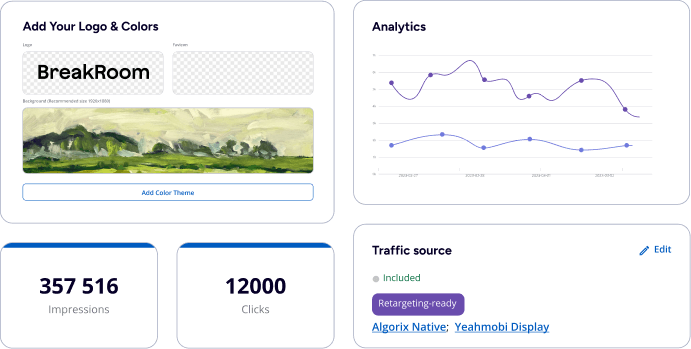
BreakRoom has spent its first months on the platform running awareness campaigns – impressions, clicks, reach – while the operational side with clients gets sorted. Conversion tracking is still being set up. Retargeting hasn't been activated yet. The platform's audience targeting tools are on the list, not yet deployed.
Brian is clear-eyed about why. His primary client is a large betting company that's rebuilding its analytics infrastructure from scratch. Until that's stable, there are things BreakRoom simply can't do – not because of the DSP, but because the client side isn't ready. He expects that to change within a month or two, at which point retargeting becomes the immediate priority.
The larger shift he's preparing for is seasonal. The new football season in the second half of the year is when his clients' spend and ambition will both increase significantly. That's when performance campaigns – not just awareness – will be the ask. He wants to have enough months of learning behind him by then that the transition isn't a scramble.
"By July, August – that's when the pressure for growth campaigns really comes. I want to make sure we've learned as quickly as possible over the next few months so we're ready for it."
When asked how confident he is that BreakRoom will hit its goals this year, Brian says 70%. The 30% gap is one thing: local supply. The technology is there. The relationship with Epom is solid. The market is moving. More mobile and sports inventory for East Africa is the last piece – and the one he's watching most closely.
It's not a complaint. It's a gap he intends to close.