
TL;DR:
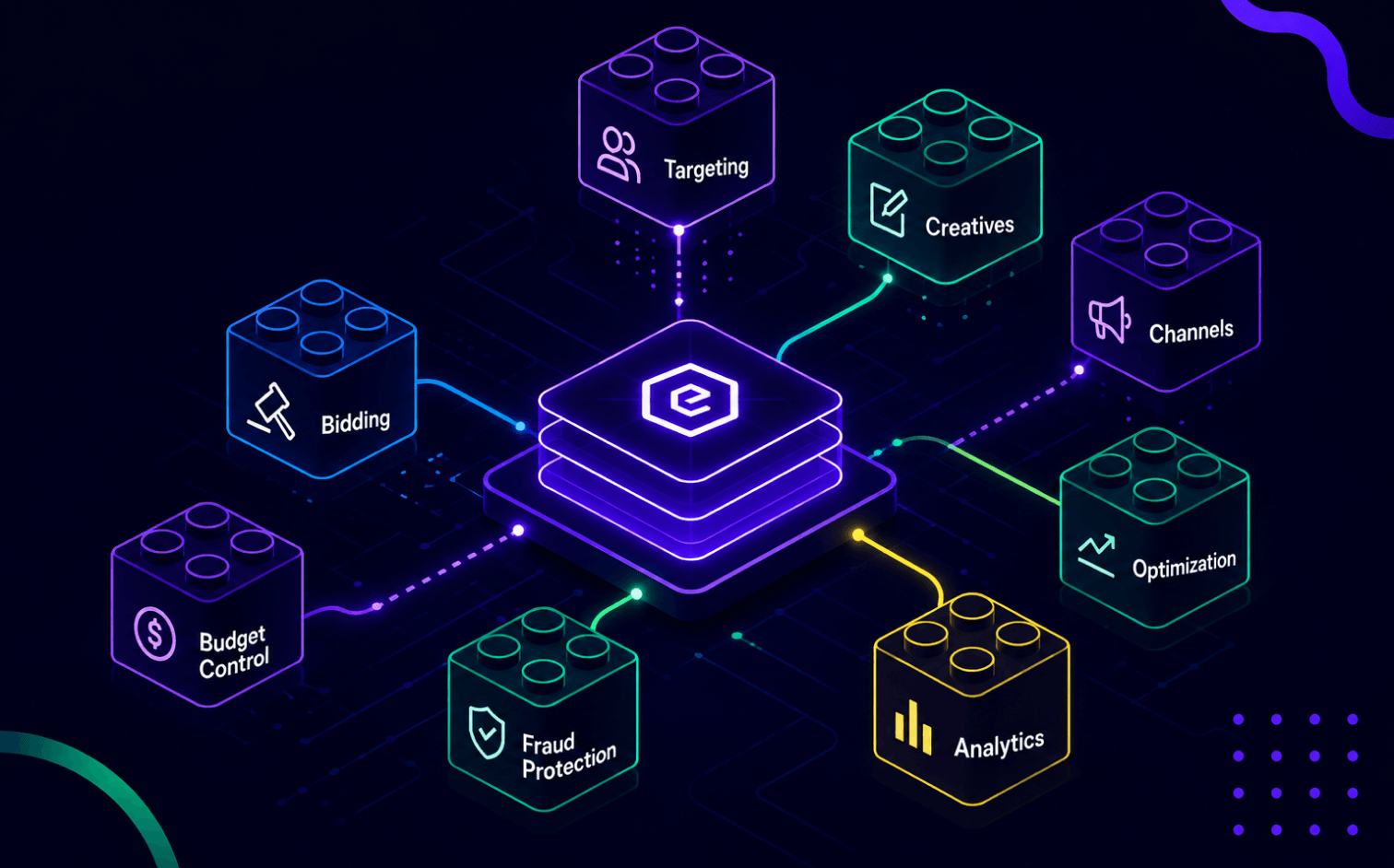
Self-serve advertising technology is the infrastructure that lets brands, agencies, and media buyers run campaigns without handing control to a managed service. You set the targeting, budget, bidding logic, and optimization rules. The platform executes. In turn, there are major operational gaps that most teams don't see until they're already in it. In such a context, self-serve platforms give you full control, but only if your team knows what to do with them. This guide covers how self-serve ad technology works, where it can create ad campaigns that deliver real advantages, and how to match the right platform to your business's needs.
"Half the money I spend on advertising is wasted. The trouble is, I don't know which half."
John Wanamaker said that in the 1800s. More than two centuries later, the number of teams that could say the same thing about their programmatic campaigns would surprise you.
Today, there is less room for guesswork. Self-serve advertising technology exists to show you where ads run, what each placement costs, which audiences respond, and where budget should move next.
- You see where every dollar goes.
- You see which placements converted and which ones burned budget quietly for three weeks.
- You see the bidding rules, the audience logic, and the supply path.
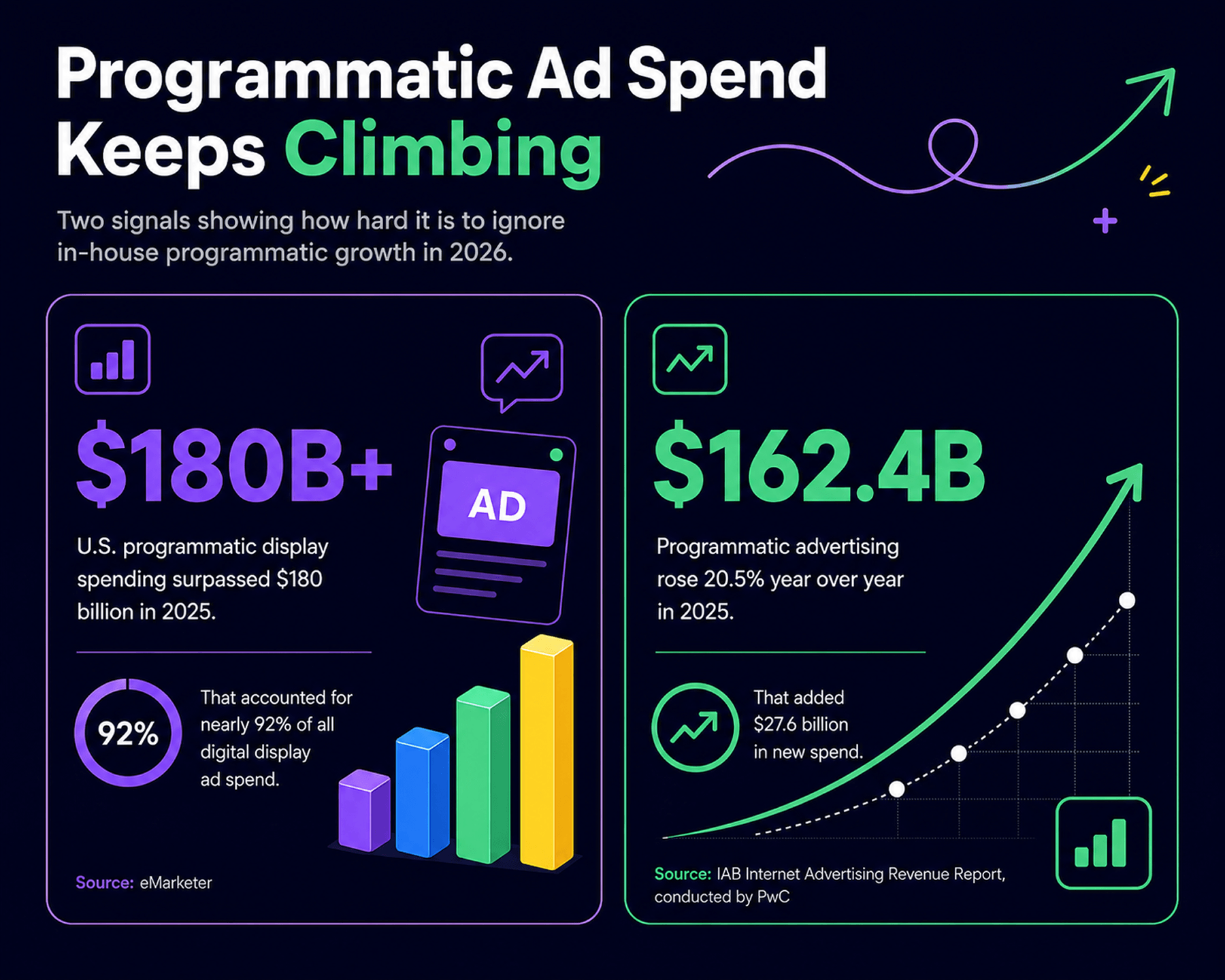
In 2026, that trade-off is harder to justify. US programmatic display spending surpassed $180 billion in 2025, accounting for nearly 92% of all digital display ad spend, according to eMarketer.
Programmatic advertising rose 20.5% year-over-year (YoY) to $162.4 billion in 2025, gaining $27.6 billion in new spend, according to the IAB Internet Advertising Revenue Report, conducted by PwC.
Most of the aforementioned money moved through platforms where someone, somewhere, was either watching the data closely or wasn't. The teams watching it closely were the ones running their own campaigns.
This guide is for teams past the "what is programmatic" stage. Questions here are more specific: What does self-serve advertising technology actually require to work well? And how do you choose the right platform for how your business actually operates?
What Self-Serve Advertising Technology Actually Means
Self serve advertising technology is any ad platform where the advertiser directly controls campaign setup, targeting, budget allocation, bidding, and optimization. The key thing: There is no intermediary managing those decisions on their behalf.
The category is wide. Self service platforms include everything from Google Ads, video ads, TikTok ads, and everything, along with a white-label demand side platform built for a single agency. The common thread is that the controls are yours. You set who sees the ad, when, on what inventory, at what price, with what creative.
That sounds straightforward. In practice, the gap between having the controls and using them well is where most teams underperform.
NB: Self-serve doesn't mean unsupported! In Epom Self-Serve DSP, users get self-paced guides, campaign controls, reporting, and manager help when needed. Teams that want Epom to handle daily setup, campaign changes, and reporting can add Managed Services later.
- In managed, the operator decides.
- In self-serve, you decide, and the platform executes.
The difference is not “support versus no support.” The difference is control. In self-serve, you own the campaign settings and budget decisions. With Managed Services, Epom handles day-to-day work inside the same DSP while you keep strategy, budget, and final approval.
Self-Serve and Managed Services Are Two Ways to Use the Same DSP
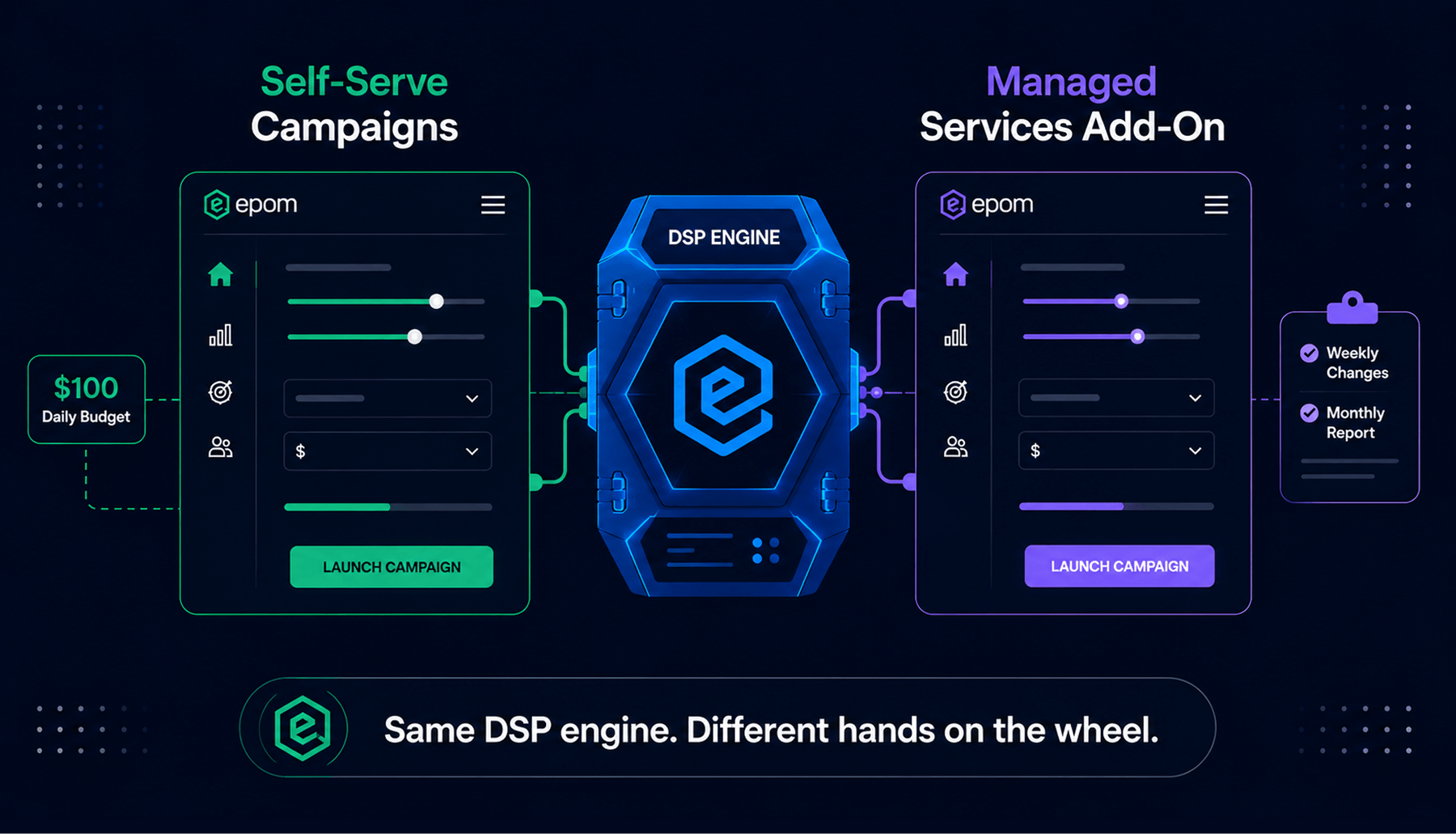
Self-serve and managed services should not be treated as enemies. In Epom DSP, there are two operating modes for different team setups.
Self-serve fits teams that want to launch campaigns themselves, set targeting, control bids, and read reports directly. Managed Services is for teams that want programmatic results but do not have enough time or in-house skills to run daily campaign work.
Both models can use the same DSP engine. The practical choice is about who handles daily execution.
| Area | Self-Serve DSP | Managed Services Add-On |
|---|---|---|
| Campaign setup | You create campaigns yourself. | Epom sets up campaigns with your approval. |
| Targeting decisions | You set targeting rules. | Epom recommends and applies settings you approve. |
| Budget control | You control budgets directly. | You keep budget control. Epom manages daily pacing. |
| Campaign improvement | You set rules and adjust campaigns. | Epom handles weekly campaign changes inside your DSP account. |
| Reporting access | You view reports anytime. | You view reports anytime and receive weekly and monthly summaries. |
| Cost structure | $100 minimum deposit. No monthly fee at the self-serve level. | $750/month service fee plus $2,000/month minimum ad spend. |
| Best fit | Teams ready to run campaigns themselves. | Teams that want help without hiring a programmatic specialist. |
Self-serve lowers the entry barrier because you can start with a $100 deposit and no monthly platform fee. Managed Services add a service layer when you need help with setup, campaign changes, and reporting. The choice depends on your team’s time, skill, and budget, not on one model being better than the other.
The Core Benefits: What You Actually Gain
Control is the obvious answer. But control over what, specifically? Three things matter most at the operational level.
#1. Speed and Direct Access
Picture this:
It's 9 pm on a Friday. Your e-commerce client just launched a flash sale that wasn't on the calendar. The creative running in their campaign promotes full-price inventory. In a managed service setup, that's a weekend ticket that gets picked up Monday morning. By then, the sale was over, and the mismatch ran for 60 hours.
In a self-serve environment, you open the ad campaign dashboard, swap the creative, and the updated ad campaign is live in under ten minutes. No approvals. No waiting for someone else's business hours.
That's not an edge case. For media buyers running time-sensitive verticals, events, seasonal e-commerce, sports betting, news-adjacent content, this is Tuesday. The ability to act on what's happening right now, without a queue between you and the platform, is what makes self-serve worth the learning curve.
#2. Targeting and Audiences You Set
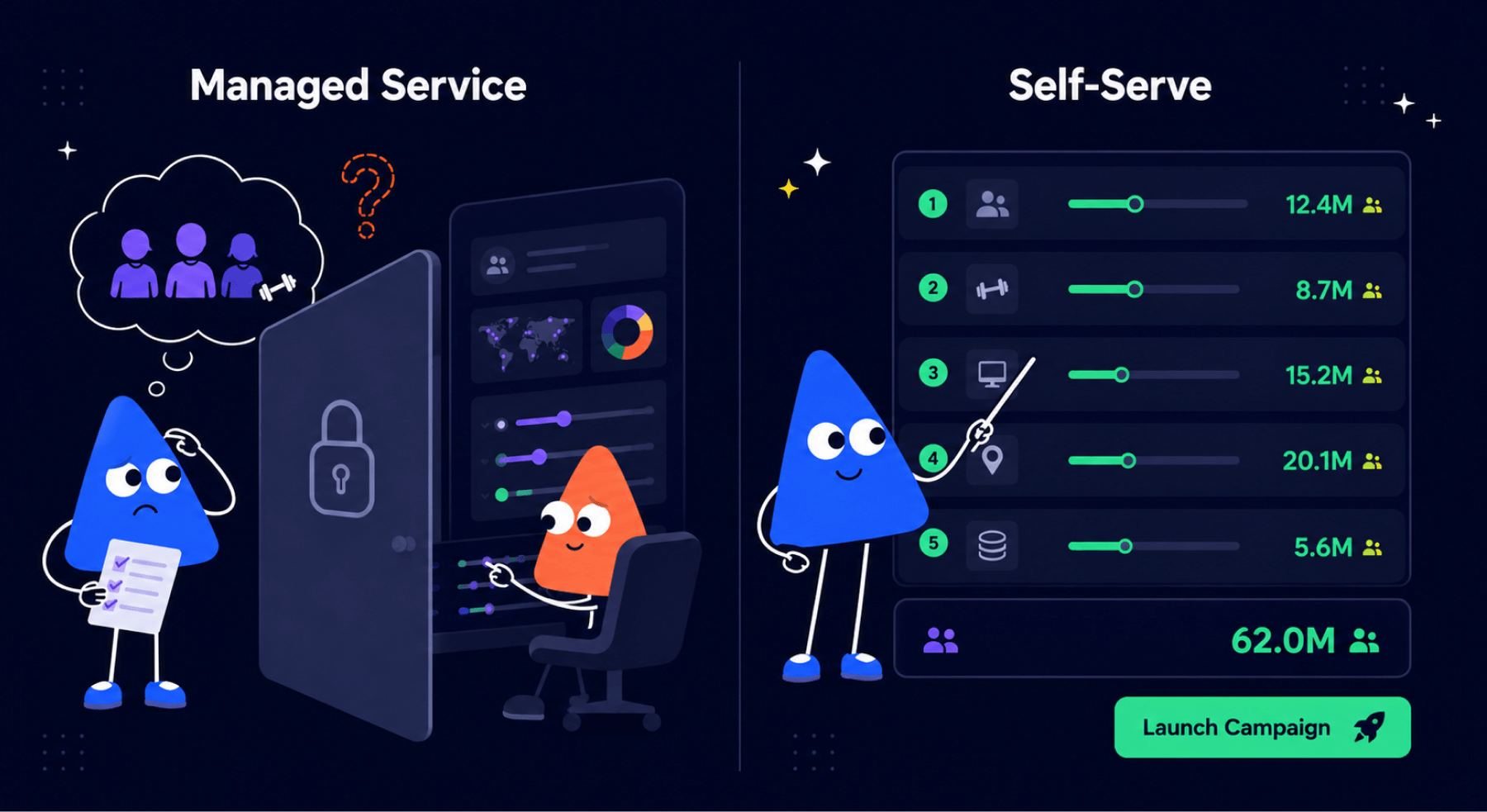
Most managed service providers use their own audience logic. You brief them on who you want to reach. They interpret that brief, apply their own segment definitions, and execute. The gap between "women 25-34 interested in fitness" as you meant it and how the platform defined it is often significant, and invisible.
Self-serve ad platforms put that definition in your hands. Demographics, interests, geolocation, device type, browsing behavior, first-party data segments from your own CRM, you build the segment, you see the estimated reach, you decide whether it's right before a single impression runs. There's no intermediary deciding what "close enough" looks like.
#3. Budget You Can See and Adjust in Real Time
Here's a scenario most performance marketers have lived. A campaign runs for two weeks. The managed service report lands on Thursday. Three of those fourteen days, budget concentrated on two placements that converted at three times your target CPA. You find out ten days after it happened.
In a self-serve environment, you see that on day two. You pause the placements, reallocate the budget, and the remaining twelve days run on the sources that are actually working. The programmatic advertising logic is the same; you're just the one watching it.
Real-time dashboards aren't a feature. They're the mechanism that makes self-serve worth using. Without them, you have controls you can't operate intelligently. With them, every budget decision is based on what's happening now, not what happened last week.
Sidebar CTA:
Still choosing a platform?
Compare the 20 best self-serve ad platforms by pricing, traffic access, reporting depth, and campaign control.
Who Self-Serve Advertising Technology Fits
Not every team needs the same setup. A brand, an agency, and an affiliate buyer can all use self-serve digital advertising, but they typically prioritize different controls.
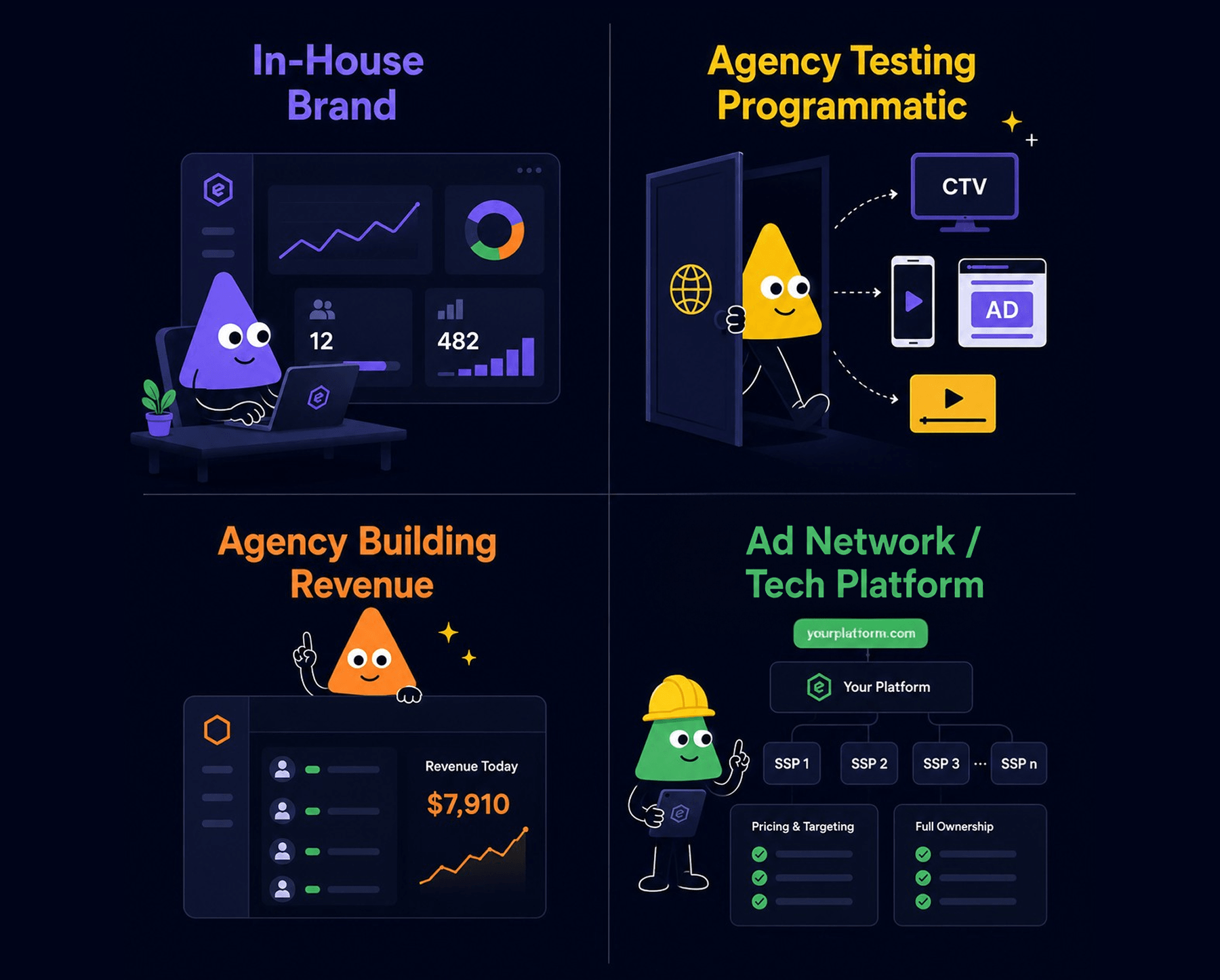
Advertisers and In-House Marketing Teams
Advertisers and in-house marketing teams use self-serve DSPs when they want to test programmatic beyond Google and Meta without losing control over spend, targeting, and reporting. This works best when one person owns the campaign setup and performance review.
Agencies
Agencies use self-serve DSPs to add programmatic to client campaigns without building an ad ops department first. They can test display, video, native, mobile, in-app, and CTV inventory, then decide whether to keep self-serve buying or move into a branded setup later.
Affiliates and Performance Buyers
Affiliates and performance buyers use self-serve DSPs when they need fast launch, tight bid control, and placement-level reporting. For this group, the appeal is simple: start small, test sources, pause weak placements, and raise spend only when the numbers work.
Teams that later need branding, markup tools, or client dashboards can move from Self-Serve to Branded DSP without changing the platform. The main point is to choose against your operating model, not the longest feature list.
How Epom Self-Serve DSP Works in Practice
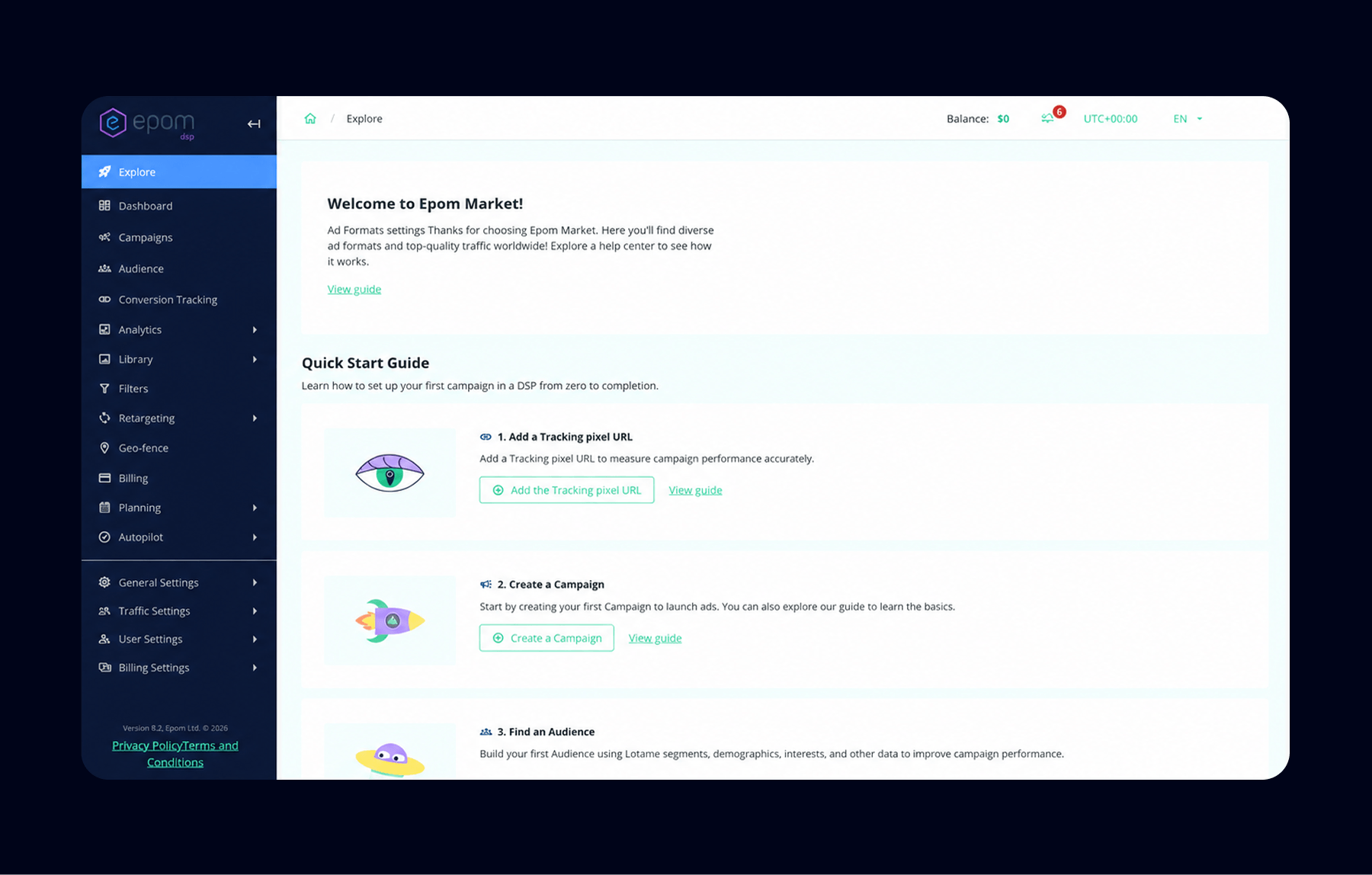
At this stage, the useful question is not “what is a self-serve DSP?” It is “what can my team actually control after signup?”
Epom Self-Serve DSP gives you campaign controls across supply, targeting, bidding, budget, formats, reporting, and fraud filtering. You can start with a $100 deposit, launch from one interface, and inspect performance by site, app, format, device, and GEO.
1. Traffic Sources You Can Inspect
Epom DSP connects you to 50+ pre-connected traffic sources across web, mobile, in-app, and CTV. You do not need custom integrations before your first campaign. You choose targeting, set bids, and review performance by source.
Example: If one app source spends budget but does not meet your CTR or CPA target, you can cut bids or pause it. You do not have to wait for a monthly report.
2. Rule-Based Campaign Changes You Control
Epom DSP lets you set rules based on CTR, CPA, conversions, and spend pace. The platform adjusts bids when placements fall outside your rules. You can still review and change those settings yourself.
Example: If CTR drops below your target on a placement, the platform can lower the bid or pause that source based on your rule. You see the logic instead of guessing what changed.
3. Audience Setup With Lotame and Your Own Data
Epom DSP includes ready-made audience segments through Lotame. You can also use first-party CRM data and pixel audiences for retargeting. This gives brands and agencies a way to test open-web campaigns against audiences they already understand.
Example: A brand can start with a broad interest segment, then build retargeting pools from users who clicked or visited the landing page.
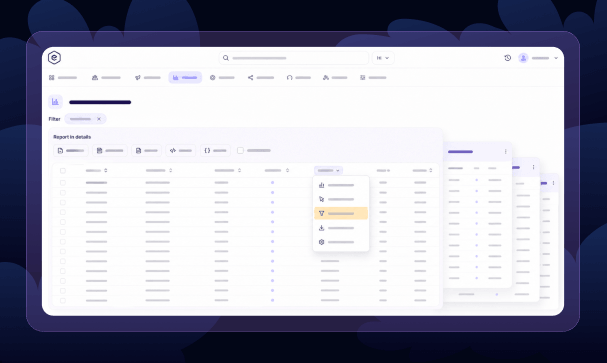
4. Reporting by Site, App, Format, and Device
Programmatic waste still creates a real budget problem. ANA reported $26.8 billion in wasted programmatic spend in its Q2 2025 benchmark update. Source
Epom DSP reports campaign performance by site, app, format, device, and GEO. This matters because campaign totals often hide the exact source that wastes budget.
Example: If native ads perform better on mobile web than in-app traffic for one campaign, you can move budget toward the better source while the campaign still runs.
For a side-by-side view of reporting depth across platforms, use the self-serve ad platforms comparison.
5. Fraud Filtering and Traffic Quality Checks
Epom DSP uses Pixalate verification to keep invalid traffic below 2%. This matters for self-serve buyers because direct control only helps if the traffic itself can pass basic quality checks. A transparent dashboard should show where traffic comes from and give you the tools to stop buying from sources that do not work.
6. Growth Path for Agencies
Self-serve works well when an agency tests programmatic for one or several clients. When the agency needs client logins, branded dashboards, markup tools, and a custom domain, it can move to Branded or White-Label DSP. The campaign workflow stays familiar. The business layer changes.
How to Choose Your Epom DSP Setup
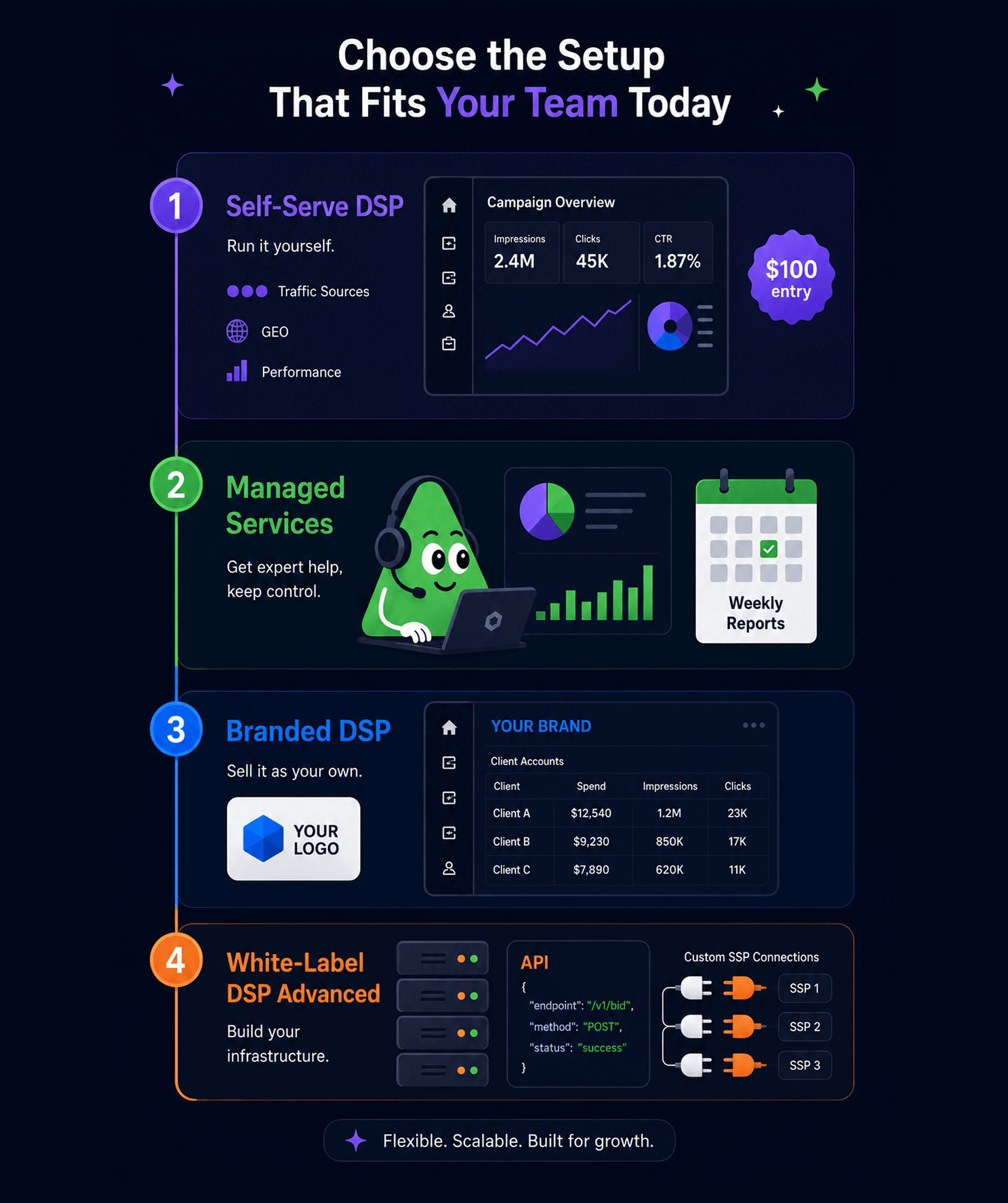
The practical choice is not “self-serve or managed forever.” It is the setup that fits your team today.
Choose Self-Serve DSP if you want to control campaigns yourself, test programmatic with a low entry cost, and learn from real performance data. Add Managed Services if you want Epom’s AdOps team to handle setup, campaign changes, and reporting while you keep strategy and budget control. Move to Branded or White-Label DSP if your agency needs client dashboards, markup tools, branded reports, or a custom domain.
| Setup | Best Fit | What You Get |
|---|---|---|
| Self-Serve DSP | Brands, agencies, and affiliates ready to run campaigns themselves. | $100 entry, direct campaign setup, 50+ traffic sources, reporting by site, app, format, device, and GEO. |
| Managed Services | Teams that want programmatic without hiring a specialist. | $750/month service fee plus $2,000/month minimum ad spend, account manager, weekly campaign changes, weekly reports, and monthly reports. |
| Branded DSP | Agencies ready to package programmatic as their own service. | Custom logo, domain, client dashboards, markup tools, and multi-client management. |
| White-Label DSP Advanced | Agencies or tech teams that need deeper setup control. | Custom SSPs, REST API, custom development, and dedicated infrastructure. |
For the “who it’s for and how to choose” part, the safer angle is not switching away from managed work. The better angle is choosing the right Epom DSP setup for your current team size, campaign skill, and client model.
"Self-serve doesn't mean self-sufficient from day one. It means you own the controls and your team builds the expertise over time. The platforms that work long-term are the ones that show you what's happening clearly enough to learn from it."

See how self-serve campaign management works in Epom DSP.
What's Changing in Self-Serve Ad Technology
The self-serve category is developing fast in three directions worth watching.
More retail players are launching self-serve programmatic ad platforms, decentralizing ad access while driving innovation in campaign personalization, according to industry analysis from 2026. Retail media networks are adding self-serve layers, allowing advertisers to reach high-intent shoppers on e-commerce properties without going through managed buying desks.
CTV inventory is becoming self-serve accessible. Programmatic advertising for Connected TV continues to grow, and platforms that previously required managed service agreements to access premium streaming inventory are opening self-serve buying tiers. For performance marketers who haven't run CTV campaigns yet, this is the entry point.
AI-assisted optimization is moving into the self-serve layer. The distinction worth understanding: AI that shows you what it's doing and lets you override it is a self-serve feature. AI that makes decisions you can't inspect is a managed service with better branding. As you evaluate platforms, this is worth asking directly: Can you see every optimization rule the platform applied to your campaign in the last 24 hours?
The Bottom Line on Self-Serve Advertising Technology
Self-serve advertising technology is not a beginner option or a cheap version of managed buying. At its best, it gives advertisers and agencies direct visibility into what campaigns are doing and the controls to act on that data while it still matters.
The best platforms show where ads ran, what each source cost, which targeting rules shaped delivery, and which changes affected performance. They also offer support when your team needs it. Self-serve should mean control, not isolation.
Ready to launch your first campaign?
Create your Epom DSP account, deposit from $100, choose your targeting, and start buying traffic from 50+ sources.