
TL;DR:
- Ad frequency is impressions divided by reach: how many times one person sees your ad. There is a sweet spot, and most campaigns never set it deliberately.
- Set caps by goal: roughly 2–4 a week for awareness, 1–3 for cold prospecting, 3–8 for retargeting — then adjust to your creative and your data.
- Frequency is two controls, not one: the cap limits how many times, recency sets the minimum gap between views. Most buyers only use the first.
- Epom's team experience says that 2 per 24 hours is a solid non-aggressive starting point for most programmatic campaigns. 3 per day is workable but pushes harder.
- Refresh creative every three to five views. Fatigue is a creative problem as much as a frequency one.
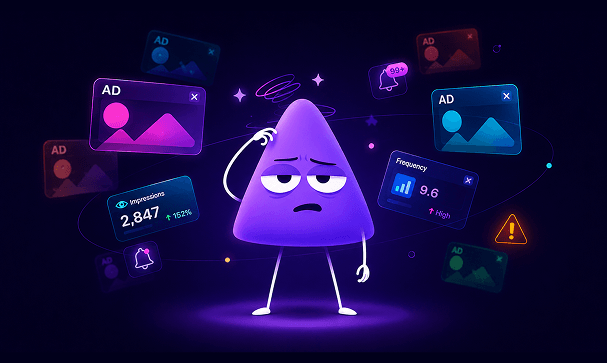
Think of a brand you have stopped liking for no clear reason. There is a fair chance you saw its ad too many times over a short stretch until the association turned negative. That reaction has a name.
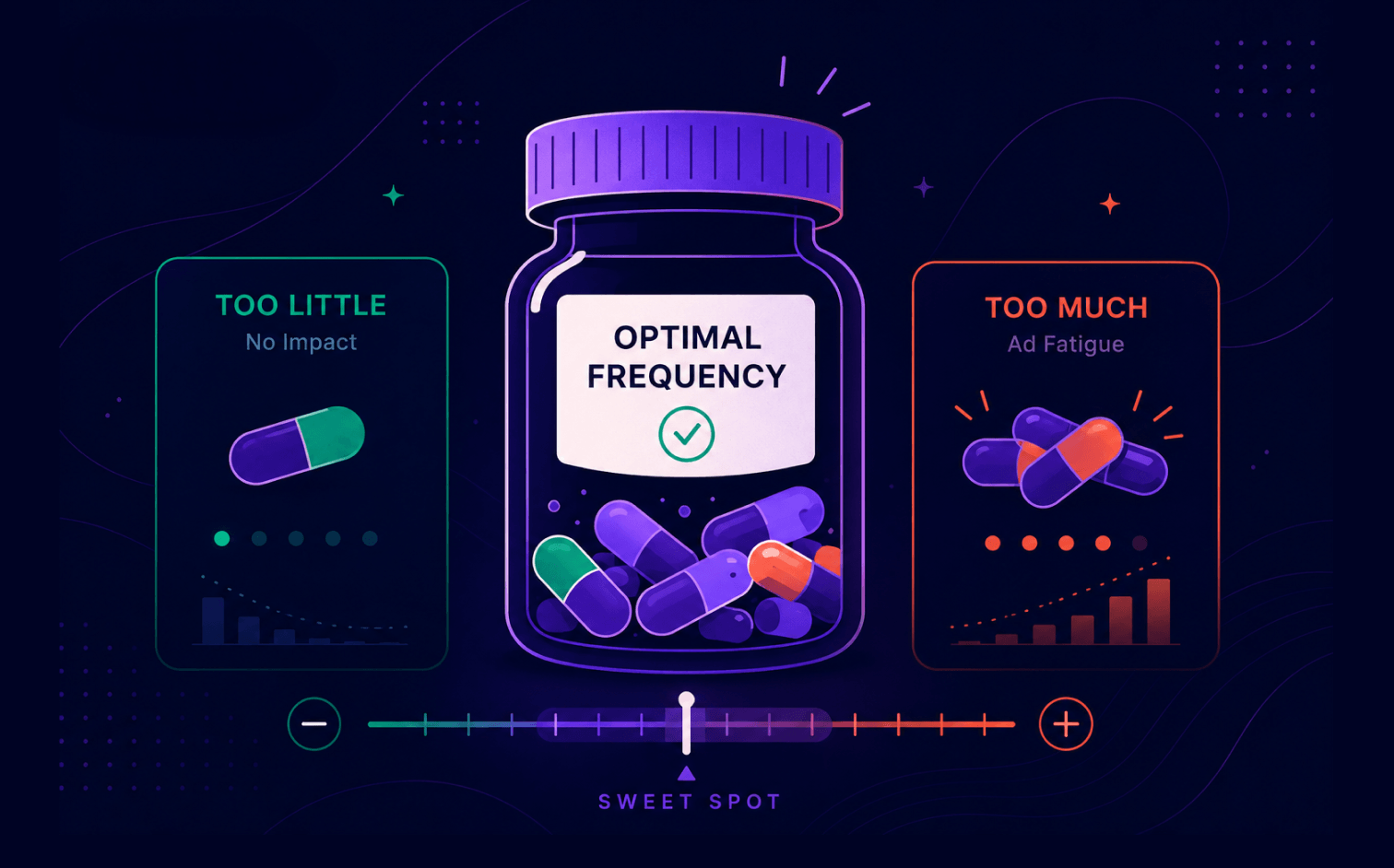
In 1968, psychologist Robert Zajonc showed that repeated exposure tends to build liking, but researchers including Daniel Berlyne later found that it works only to a point. Past that threshold, the same repetition reverses the effect.
Ad frequency is the setting that hands governance over exposure back to you. The problem is most buyers never adjust it deliberately. This guide covers the ad frequency best practices that change that — how to set caps by goal and channel, when the gap between views matters more than the total count, and how to manage both inside a demand-side platform.
Epom DSP allows you to control ad frequency with two simple levers: frequency and recency caps. If you want to follow along our tips using a real campaign, create your account now.
What Ad Frequency Measures
Ad frequency is the average number of times one person sees your ad over a set period. The formula: impressions divided by reach. Show your ad 90,000 times to 30,000 people and the average frequency is three.
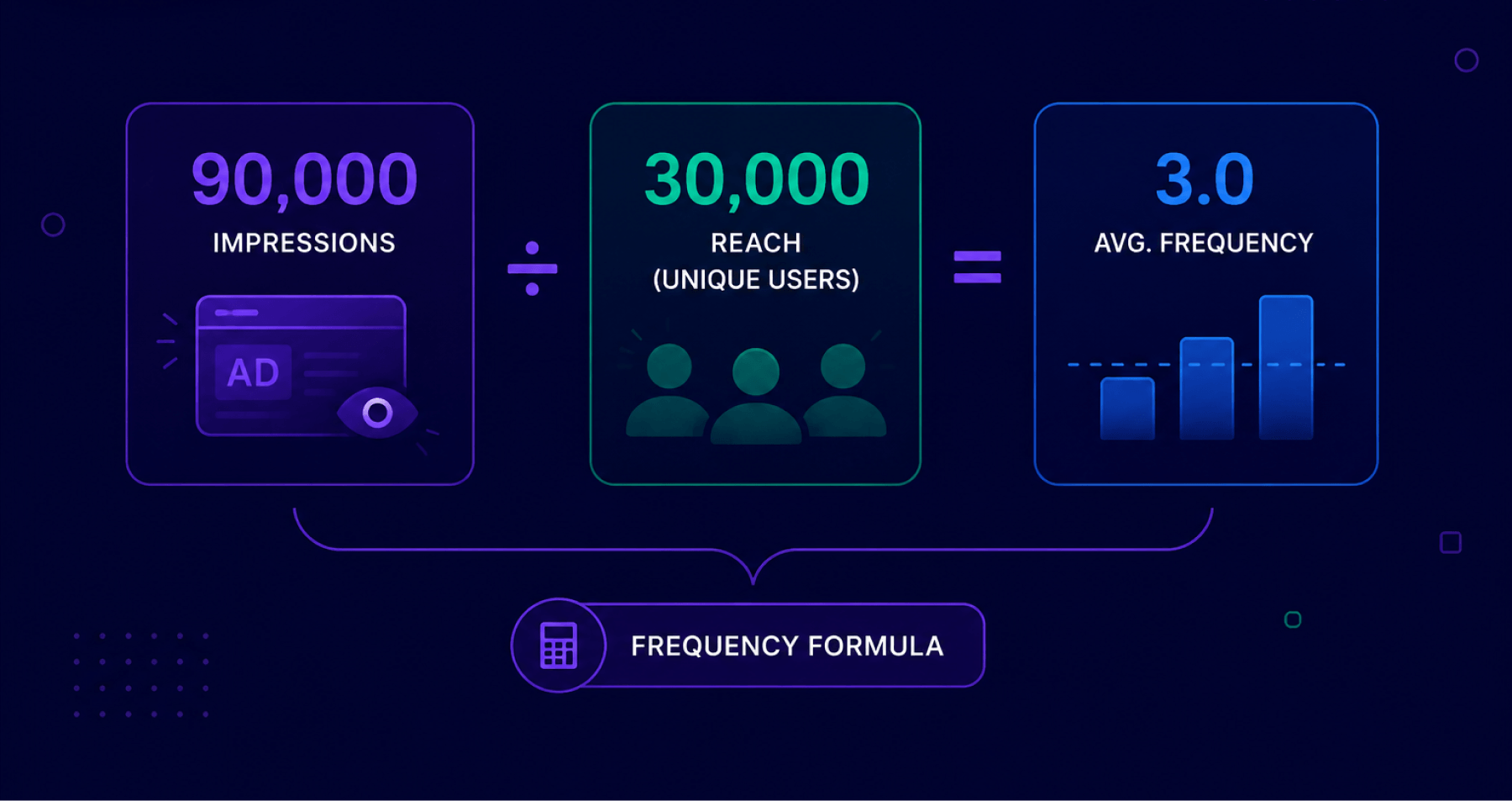
The average matters less than what sits underneath it. Most buyers set one campaign-level frequency cap and treat the job as done.
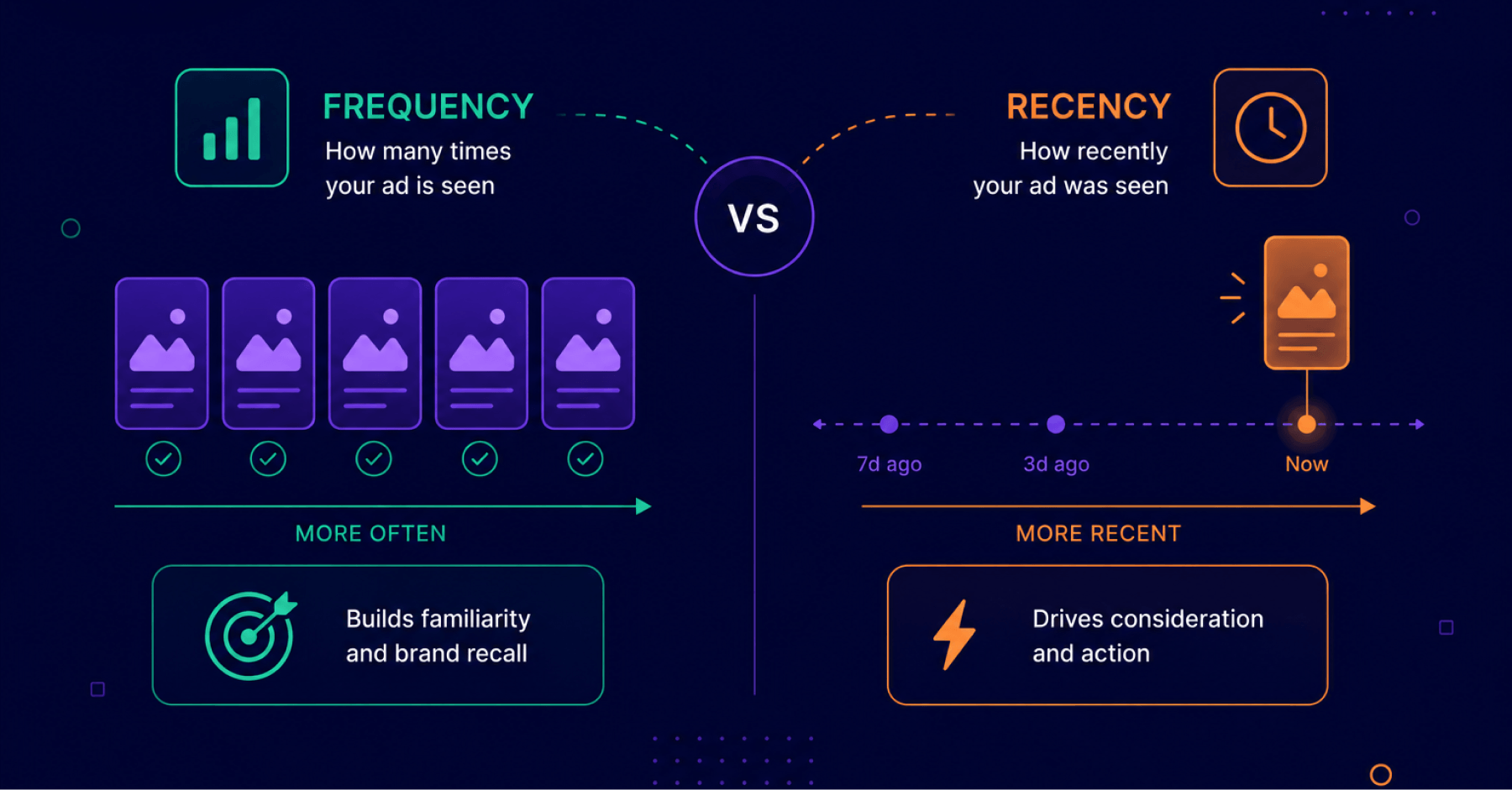
There are actually two settings responsible for ad frequency: the frequency cap limits how many times, and recency sets the minimum gap between those views.
Both are available in programmatic advertising setups and in most self-serve DSPs. Frequency is also just one control within wider media buying — it works best when paired with audience quality and creative rotation.
Ad Frequency vs. Frequency Capping vs. Recency Capping
Three terms get used interchangeably in most discussions of this topic, but they describe different things:
- Ad frequency is the metric: how many times, on average, one person saw your ad — calculated as impressions divided by reach.
- Frequency capping is the control on how many. It limits the number of views per person over a day, a week, or the full campaign. This is the core mechanism of ad frequency in digital advertising.
- Recency capping is the control on how far apart in time the ad is shown: it sets the minimum gap between those views.
Frequency is what you measure, while the two caps are what you set. Running both keeps a user in the productive range — enough views to build recall, spaced enough that it does not become irritating.
Here is what the difference looks like in money. Retargeting with no cap can end up serving the same person the ad more than 20 times, and on the 4th time those impressions rarely do more than erode goodwill. Set a cap of three a day with a few hours between exposures, and the budget shifts to people who have not seen the ad yet.
How Often Should Users See Your Ads? The Sweet Spot
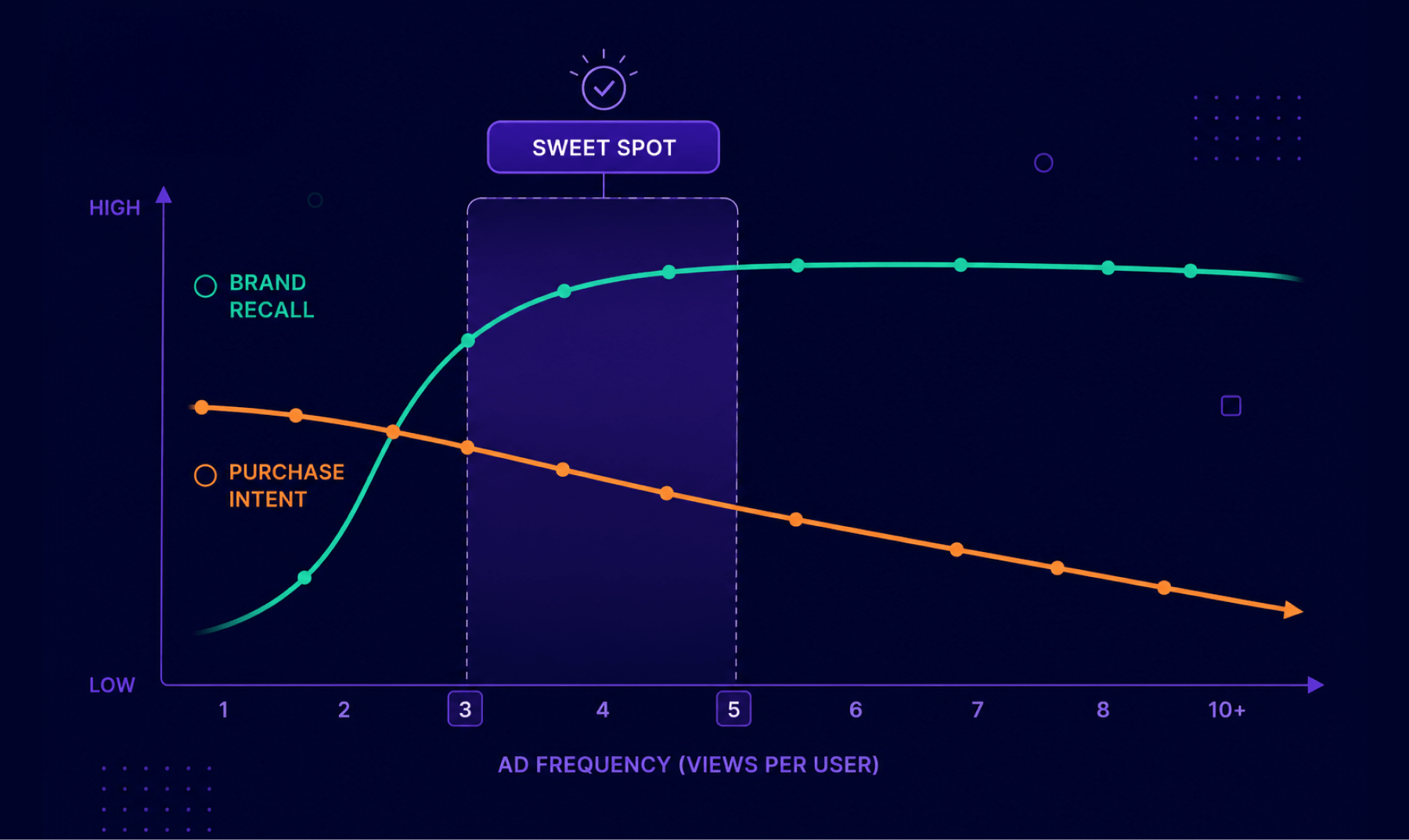
In 1972, Herbert Krugman argued in "Why Three Exposures May Be Enough" that the first view answers "what is it?", the second "what's in it for me?", and the third works as a reminder — after which extra views add very little.
Beyond that, repetition becomes wearout: the ad is easier to ignore, and a viewer who feels overexposed may hide it, block it, or quietly form a negative association with the brand.
The data shows where that turn happens. An MNTN CTV study found recall rising from about 64% after one view to 92% after six in a single session — but over the same range purchase intent fell 16% and brand affinity slipped. Recall keeps climbing past the point where the metrics that matter begin to fall. The distance between those two lines is where the ideal ad frequency sits.
The "three exposures" rule dates from an era of a few hundred ads a day; by 2026 that number runs into the thousands. There is no universal right number, but there is a workable rule: start from how warm the audience is, raise frequency as that warmth increases. The tables below apply that rule across campaign types and channels.
Ad Frequency Best Practices
Set Caps by Advertising Goal
What counts as enough depends on the campaign's objective. The table below draws on published benchmarks as a starting point; the right cap shifts based on creative quality, category, and your own data.
| Campaign type | Funnel stage | Audience temperature | Frequency starting point |
|---|---|---|---|
| Awareness / branding | Top | Cold, broad | 2–4 per week. |
| Cold prospecting | Top–Mid | Cold | 1–3 in 24h window. |
| Consideration | Mid | Warming | Slightly higher, but sequence the creative so each view adds something. |
| Warm retargeting | Mid–Bottom | Warm | 3–8 per week. |
| Hot retargeting | Bottom | Hot, high intent | Higher in a short burst, as long as CTR and CPA hold. |
| Niche B2B | Mid (long cycle) | Narrow, high value | Lower weekly cap, longer runway. Stay visible across a multi-month decision. |
The low end is well supported. A Nielsen meta-analysis Google commissioned found that brands can raise weekly frequency from one to three on YouTube with no loss in ROI, while TV ROI fell 41% once frequency exceeded six a week. For prospecting, less tends to produce more.
A cap of 2 per 24 hours is a solid non-aggressive starting point for most programmatic display campaigns. 3 per day is workable for warm retargeting or time-sensitive offers, but crosses into aggressive territory. For ongoing campaigns, the 30-day cap field can be left blank — the daily cap handles the work. If you want a hard monthly ceiling, set it separately based on your campaign length.

Three scenarios show how this plays out:
- Broad prospecting on display. Wide, cold audience. Set the 24h cap at 1–2 and spend budget on reach rather than repetition; the goal is a first impression at scale, not repeated persuasion.
- Remarketing to cart abandoners. Small, warm pool. A cap of 3 per day with a few hours of recency spacing reinforces intent without becoming noise. Small pools hit high frequencies quickly — watch this one closely.
- Niche B2B over a long cycle. Narrow list, months-long decision. Keep the daily cap at 1–2 but run longer. Forrester research puts the typical B2B brand touches needed before purchase at around 17, so the goal is steady familiarity rather than a rapid conversion.
Watch Recency, Not Just the Count
A cap of 3 per day still allows someone to see the same ad three times in thirty minutes. To them, that registers as being followed around. Recency capping fixes this by setting a minimum gap between views.
In Epom DSP, the recency cap is set in seconds, with a minimum of 60 seconds and a maximum of 3,600 seconds (one hour). For most campaigns, setting the gap at 600–1,800 seconds (10–30 minutes) keeps views spread across the day rather than bunching at delivery peaks.
The spacing matters as much as the count. Views bunched together land before anyone has had time to forget the earlier ones — so they do nothing. Space them out and each view earns its place. Match the gap to the purchase: quick decisions reward a tighter burst, bigger ones reward showing up across the full day.
Refresh the Creative Before It Goes Stale
A frequency cap delays wearout; new creative resets it. DoubleVerify's Samir Karpe argued in WARC in January 2026 that fatigue is increasingly a quality problem rather than a quantity one: repetitive, over-personalized ads wear people down regardless of how clean the caps are. Frequency and creative rotation are two sides of the same problem.
A single hero creative loses attention after roughly four views, but cycling three creatives can sustain a higher total frequency because each version reads as something new. Adobe's 2026 Creative Trends Report notes that around 70% of consumer decisions are driven by emotion — an ad people engage with survives more exposures than one they merely tolerate.
A practical habit: rotate creative every three to five views, or whenever CTR and conversions fall while frequency holds steady.
Cap by User, Not Just by Device
One person uses a phone, a laptop, and a TV, and a device-level cap treats each screen as a separate user. A limit of 3 a day per device can become 9 actual exposures for the same person. Where the platform supports it, cap at the user level so the limit follows the person across screens.
Use Both the Campaign Cap and the Creative Cap Together
In Epom DSP, frequency caps are available at two levels: the campaign level (Bidding Strategy → Capping) and the individual creative level (Advanced Options in the banner settings).
The creative-level cap overrides the campaign cap for that specific banner. This lets you run tighter control on a high-visibility creative while letting supporting banners run at the campaign default. Set the campaign cap as the outer limit, and use creative-level caps for any asset that needs finer control.
Want a second look at your current setup? Talk to a programmatic expert about reducing ad fatigue.
Ad Fatigue Warning Signs: When Frequency Is Too High
Overexposure shows up in the metrics you already track, usually as a pattern across several at once:
- CTR falling while impressions hold steady. Click-through rate dropping as exposures continue is the first sign of ad fatigue: the audience has seen the ad enough to stop noticing it.
- CPA rising on a stable audience. Extra impressions are reaching people who no longer convert, so each result costs more to produce.
- Negative signals rising: hides, skips, blocks, and mutes. On some channels this is the clearest indicator, because it affects brand perception beyond the campaign itself.
Any one of these in isolation can have other causes. Two or three together on the same source mean the cap needs tightening or the creative needs rotating.
Frequency Cap Reference Numbers
By Channel and Platform
The table below covers both programmatic channels and paid social. The numbers draw on Epom DSP internal data, The Trade Desk's frequency-cliff analysis across e-commerce brands, Google/Nielsen research for YouTube and platform benchmarks for social. Start here, then tune against your own data.
| Channel / Platform | Starting cap (per user / week) | Observations |
|---|---|---|
| Programmatic display — prospecting | 15-25 | High banner blindness; tolerates more exposures before fatigue. |
| Programmatic display — retargeting | 10-15 (max ~3/day) | Smaller pool; the same people overexpose quickly. |
| Programmatic online video | ~10 | Holds attention well, but skippable formats fatigue faster. |
| Programmatic audio | ~8 | Hard to skip, so a lower cap keeps it from becoming intrusive. |
| CTV / OTT | 4–6 per viewer | Interruptive by nature; usually few creatives in rotation. |
| Meta (Facebook / Instagram Feed) | 3–5 | Fatigue commonly sets in around 6–7 on a single creative. Meta's own data: ~2/week optimal for awareness. |
| Meta Stories / Reels | 2–4 | Higher-attention format; lower tolerance than Feed. Refresh when frequency exceeds 3.5 on cold audiences. |
| YouTube (pre-roll / mid-roll) | 2–4 | Google/Nielsen data: 1–3/week holds ROI without diminishing returns. |
| 1–2 | Lower session volume; overexposure happens fast on small professional audiences. | |
| TikTok | 3–4 | Rapid content consumption; creative freshness is critical. |
By Vertical and Intent
Fraud risk and purchase cycle length both shift the right frequency significantly by vertical. The ranges below draw on GCommerce (travel), AdAmigo/Growthfox (eCommerce), Improvado (B2B), AppsFlyer 2025 (iGaming), and Epom data (finance).
| Vertical | Prospecting cap | Retargeting cap |
|---|---|---|
| eCommerce (low-ticket, <$500) | 3–5/week | 5–7/week |
| eCommerce (high-ticket, >$500) | 2–3/week | 3–5/week |
| Finance / insurance | 2–3/week | 3–5/week |
| iGaming / sports betting | 3–5/week | 5–8/week |
| B2B SaaS / enterprise | 1–2/week | 3–4/week |
| Travel / hospitality | 2–4/week | 3–7/week |
| Gaming (mobile / casual) | 3–5/week | 5–10/week |
How to Set Frequency Capping and Recency in Epom DSP
Epom DSP does not choose a frequency for you — the right number is specific to your audience, your creative, and your goal. What it does is put both controls in one place with full visibility over how often each user is being reached.
Campaign-level Capping
Path: Campaigns → Edit → Bidding Strategy → Capping
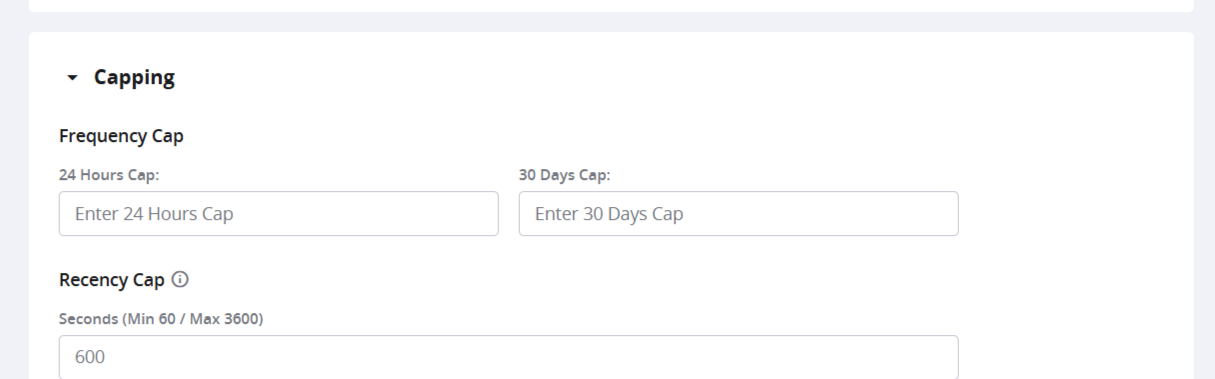
Frequency Cap: set a 24-hour cap and a 30-day cap independently. Both fields are optional; setting only the 24h cap is common for ongoing campaigns.
Recency Cap: set in seconds. Minimum 60 seconds, maximum 3,600 seconds (1 hour). A setting of 600 seconds (10 minutes) spaces views across the day without being restrictive; 1,800 seconds (30 minutes) is more conservative.
Creative-level Capping
Path: Campaigns → Creative → Banner → Advanced Options
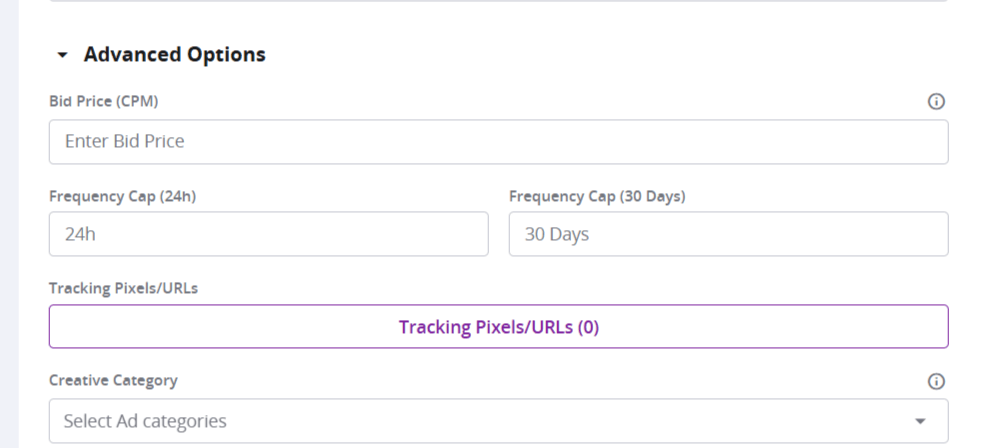
Frequency Cap (24h) and Frequency Cap (30 Days): override the campaign-level cap for this specific banner. Use this to put tighter limits on a high-visibility creative while letting supporting banners run at the campaign default.
If you are starting out, the platform is built to be testable before you commit to scale. The self-serve account opens at a $100 minimum deposit. The benefits of programmatic advertising only fully materialise when you control delivery directly.
Frequently Asked Questions About Ad Frequency
Ready to Take Control of Your Ad Frequency?
Frequency is one of the few settings that protects both budget and brand at the same time. Getting it right means the people you want to reach remember you without growing tired of you. What's even better,spend that would have gone to repeated views goes toward new audiences instead.
No platform determines the right frequency for you. The right number depends on your audience, your creative, and your campaign goal. What a good DSP provides is the controls and the visibility to work it out yourself.
Epom DSP gives you the cap, the recency gap, and the reporting to find your own sweet spot.
Create your self-serve account at Epom DSP to be in charge of your programmatic ad frequency.