
SmartyAds DSP has long been a go-to starting point for mid-market advertisers testing the programmatic waters. It is accessible, it requires minimal financial commitment to spin up, and historically, it offered a white-label tier for agencies.
But as of 2026, SmartyAds has spun off its white-label infrastructure into a new brand, and media buyers started actively searching for SmartyAds alternatives.
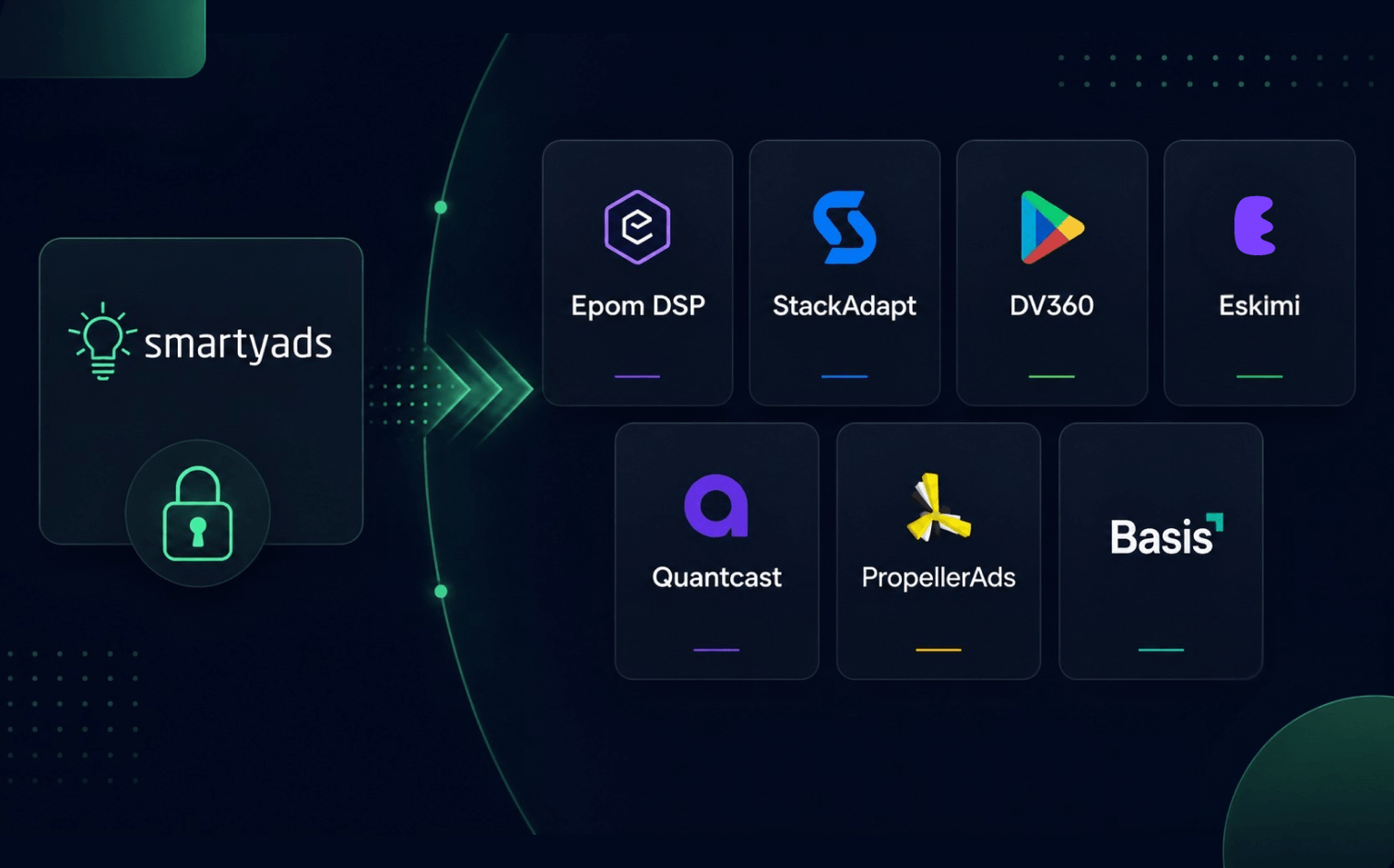
Check this breakdown of the seven most viable SmartyAds competitors that we compared across pricing, supply path optimization (SPO), and infrastructure capabilities so you can map out a logical migration path.
TL;DR:
- SmartyAds is a self-serve platform known for a low entry deposit (~$1,000), but it no longer offers white-label directly, having spun that tech out to the Teqblaze brand.
- The most common reasons buyers migrate: the friction of a corporate spin-off, opaque internal supply routing, and a lighter CTV footprint compared to enterprise alternatives.
- Epom DSP is the direct replacement for agencies requiring a unified white-label setup, allowing buyers to retain 100% of their media margin without navigating entities.
- StackAdapt is the default self-serve upgrade for mid-market teams focused on contextual targeting who do not need proprietary tech infrastructure.
- The right platform hinges on three levers: your requirement for margin control (BaaS), your monthly spend volume, and your dominant channel (e.g., CTV vs. retail media).
Before we tear into the mechanics: Epom provides DSP, SSP, and ad server infrastructure to 300+ clients in 70 countries. You can skip the research and contact our team to talk about the best setup for your use case.
What is SmartyAds DSP, and why are buyers looking for alternatives?
Founded in 2011, SmartyAds originally positioned itself as a full-stack programmatic provider, offering a DSP, an SSP, and a DMP. For advertisers, it is a highly accessible gateway into real-time bidding (RTB). You can activate a seat with a deposit of roughly $1,000 and maintain a spend floor as low as $100 per day. It connects seamlessly to major exchanges like Smaato, Pubmatic, AdColony, and InMobi.
Obviously, the core bidding technology is functional. So why are independent agencies and sophisticated media buyers actively evaluating the market?
The answers lie in corporate restructuring and supply-path mechanics.
The Teqblaze spin-off and the white-label gap
The structural shift in the mid-market DSP landscape recently came from SmartyAds reorganizing its tech. SmartyAds migrated the entire business of white-label solutions to a new standalone brand called Teqblaze.
For an agency, a white-label DSP is the difference between operating as a vendor and operating as a tech partner. Historically, SmartyAds pricing decks indicated their white-label bundle started around a $2,000/month basic package plus a sliding revenue share (typically 5% down to 3.75% at the $1/month tier).
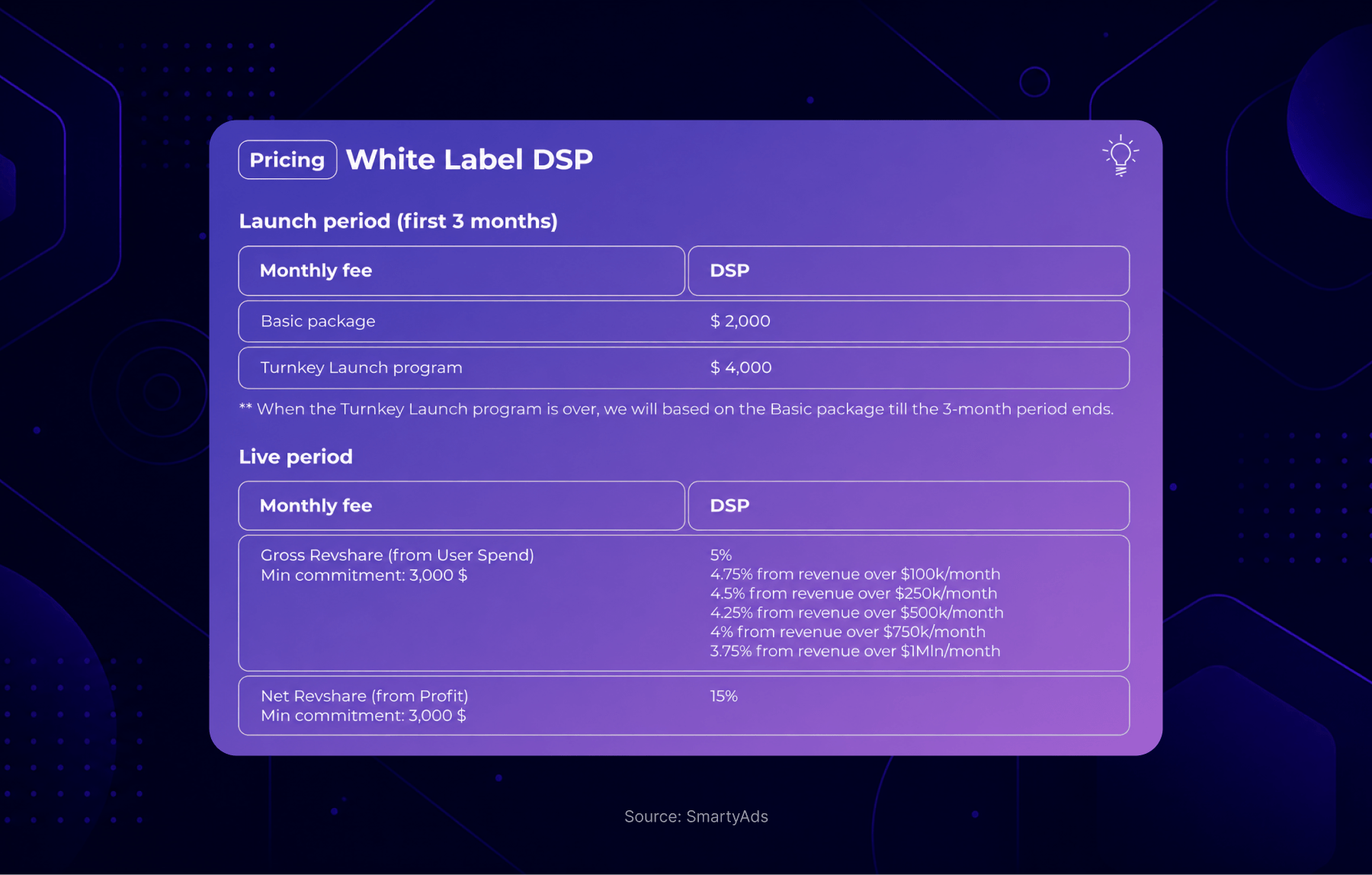
When a vendor spins a core product into a new company, agencies face a choice: endure the transition, renegotiate contracts with the new Teqblaze entity, or use the friction as an opportunity to upgrade to a unified, battle-tested Bidder-as-a-Service (BaaS) provider. Many are choosing the latter.
Supply-path opacity
SmartyAds operates both a demand-side and a supply-side platform. While having a proprietary SSP can reduce latency, it introduces friction for buyers who demand objective, transparent Supply Path Optimization (SPO).
When a vendor operates both sides of the transaction, algorithms naturally favor internal routing. If you want direct, unadulterated SPO paths to external SSPs to negotiate custom clear-prices, navigating an aggregated internal supply loop limits your control over the cost of media.
CTV and enterprise reach
SmartyAds is a mid-market platform. If your strategy revolves around premium connected TV (CTV) inventory or if you are managing six-figure monthly budgets, SmartyAds eventually hits a ceiling. Advertisers scaling into those brackets assess win-rates against enterprise-grade logic built into platforms like Google DV360 or The Trade Desk.
How we evaluated the SmartyAds alternatives
We scored these seven DSPs against five architectural criteria on which a media buying team actually operates:
- Spend floor and accessibility: What is the actual financial barrier to entry?
- Channel coverage: Display, video, CTV, streaming audio, native, DOOH, and in-app.
- SPO and inventory transparency: Do you get direct SSP relationships, or are you buying through a black-box aggregator?
- White-label and BaaS availability: Can you rebrand the UI, control your QPS allocation, and keep the DSP margin?
- Pricing models: Are you paying a flat SaaS fee, a standard CPM take rate, or dealing with hidden arbitrage?
The 7 best SmartyAds DSP alternatives in 2026
1. Epom DSP
Best for: Agencies utilizing the SmartyAds/Teqblaze transition to secure a unified White-Label or BaaS infrastructure, and teams that demand to own their media margin.
| Feature | SmartyAds | Epom DSP |
|---|---|---|
| Minimum Budget | $1,000 | $100 |
| AM Support | All plans | From $2,000+ spend |
| Analytics Depth | SSP-level only | Site/domain-level |
| White-Label DSP (BaaS) | No (Spun off to Teqblaze) | Yes |
| Channels | Audio, CTV/OTT, DOOH, In-App, Mobile, Web | CTV/OTT, In-App, Mobile, Web |
Epom DSP (that’s us!) is the infrastructural answer for buyers who require the agility of a self-serve platform but want to scale into proprietary tech ownership within one connected system. Epom’s stack is modular: Ad Server → Epom DSP → Unative. All interoperable and owned by one entity. No quarterly spend floor — you fund your account (starting with a $100 initial deposit for standard self-serve) and start bidding.
But the White-Label Bidder-as-a-Service (BaaS) tier is where Epom actively wins.
📖 Relevant reading: Learn more about the mechanics of White-Label vs Self-Serve DSPs here.
If you are tired of migrating between splintered tech products, Epom allows you to host, brand, and integrate a DSP under your own domain. Clients own their platform, data, and logic—no hidden intermediaries. Instead of paying a 20% take rate to a managed DSP, you pay a predictable SaaS fee, connect your own SSP seats directly, and bring your own algorithms (BYOA).
👉Case study in question: A global media-buying network recently migrated from local managed campaigns to Epom's White-Label DSP and grew their monthly revenue by 130%+ in year one simply by retaining the margins they were previously surrendering to platform fees.
Epom has been an official member of the IAB and a Google AdX partner since 2013. If you're dealing with IVT (Invalid Traffic) blowouts, built-in Pixalate kills fraud before you bid on it, and integrates Lotame for audience data enrichment.
- Pricing: SaaS or CPM-based model; scalable with business growth.
- SPO control: Direct connections to 80+ pre-integrated SSPs.
- ❌ Not for: Buyers strictly dependent on walled-garden Google/YouTube inventory.
2. StackAdapt
Best for: Mid-market performance teams that want a highly polished, multi-format UI and are willing to clear a $5,000 minimum spend.
| Feature | SmartyAds | StackAdapt |
|---|---|---|
| Minimum Budget | $1,000 | $5,000 |
| AM Support | All plans | From $5,000+ spend |
| Analytics Depth | SSP-level only | Package-level |
| White-Label DSP | No | No |
| Channels | Audio, CTV/OTT, DOOH, In-App, Mobile, Web | Audio, CTV/OTT, DOOH, Email, In-Game, Mobile, Web |
StackAdapt is currently the darling of the independent agency scene. It provides access to native, display, video, CTV, audio, and DOOH through a beautiful, though not the simplest one to learn, user interface.
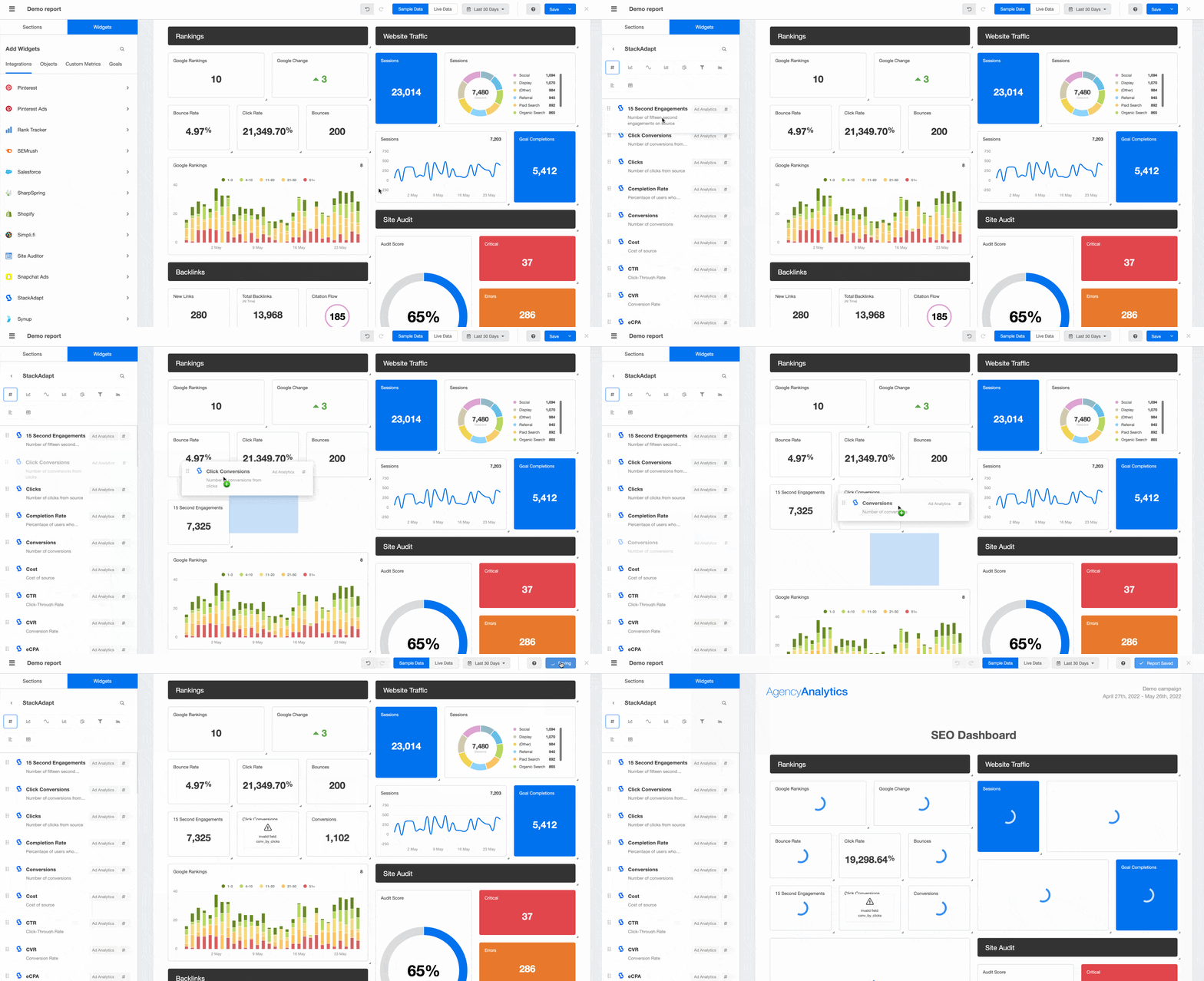
StackAdapt is not like legacy platforms that rely on third-party cookies or complex identity graphs. It leans into contextual targeting. This makes it highly resilient to ongoing signal loss across browsers and mobile operating systems.
However, the "accessibility" narrative requires a reality check. While SmartyAds requires $1,000, StackAdapt requires a $5,000 minimum budget to play, and account management support doesn't kick in until you cross that threshold.
- ❌ Not for: Buyers who require raw log-level data, custom SPO paths, or white-label infrastructure.
3. Google Display & Video 360 (DV360)
Best for: Advertisers structurally embedded in the Google Marketing Platform who require YouTube access and Ads Data Hub (ADH) analytics.
| Feature | SmartyAds | Google DV360 |
|---|---|---|
| Minimum Budget | $1,000 | ~$50,000/mo (via Partners) |
| Account Manager Support | All plans | Enterprise / Authorized Partner |
| Analytics Depth | SSP-level only | Domain-level / Ads Data Hub |
| White-Label DSP | No | No |
| Channels | Audio, CTV/OTT, DOOH, In-App, Mobile, Web | Display, Video, CTV, YouTube (Exclusive) |
DV360 represents the enterprise walled garden. Its definitive advantage is YouTube — it is the only DSP with programmatic access to Google's owned-and-operated video inventory. For brands where video consumption is a primary KPI, DV360 is mandatory.
The platform excels at connecting ad exposure to on-site conversions via Google Analytics 360. However, DV360 algorithms inherently favor Google Ad Manager (GAM) supply. If you are migrating from SmartyAds to find a neutral SPO, Google won't solve your transparency problem.
- ❌ Not for: Independent agencies seeking customized bidding algorithms or neutral inventory routing.
4. Eskimi
Best for: Brands targeting emerging markets, leveraging Telco data, or exploring In-Game advertising formats.
| Feature | SmartyAds | Eskimi |
|---|---|---|
| Minimum Budget | $1,000 | $5,000 |
| Account Manager Support | All plans | Managed only |
| Analytics Depth | SSP-level only | Site/domain-level |
| White-Label DSP | No | No |
| Channels | Audio, CTV/OTT, DOOH, In-App, Mobile, Web | Audio, CTV/OTT, DOOH, In-Game, Mobile, Web |
Eskimi frequently appears alongside SmartyAds, but the architectural and business models are different. Eskimi works with highly specific geos (APAC, EMEA, emerging markets) and features niche targeting parameters like Telco data and unique ad formats like In-Game video. Unlike SmartyAds' restrictive SSP-level reporting, Eskimi provides true site/domain-level analytics.
It is heavily gated, though. You are looking at a $5,000 minimum budget, and Eskimi operates strictly on a "managed only" account structure. If you want hands-on-keyboard control to execute your own trading strategies, this isn't the platform for you.
- ⚠️ Support model: Managed service only.
- ❌ Not for: Self-serve traders or lean SMBs who need a low financial entry point.
5. Quantcast
Best for: Agencies leaning heavily into cookieless targeting and predictive AI audience building.
| Feature | SmartyAds | Quantcast |
|---|---|---|
| Minimum Budget | $1,000 | $0 |
| Account Manager Support | All plans | From $50,000+ spend |
| Analytics Depth | SSP-level only | Package-level |
| White-Label DSP | No | No |
| Channels | Audio, CTV/OTT, DOOH, In-App, Mobile, Web | Audio, CTV/OTT, Mobile, Web |
Quantcast’s core differentiation lies in its proprietary AI predictive analytics, AI audience building, and native cookieless targeting modules.
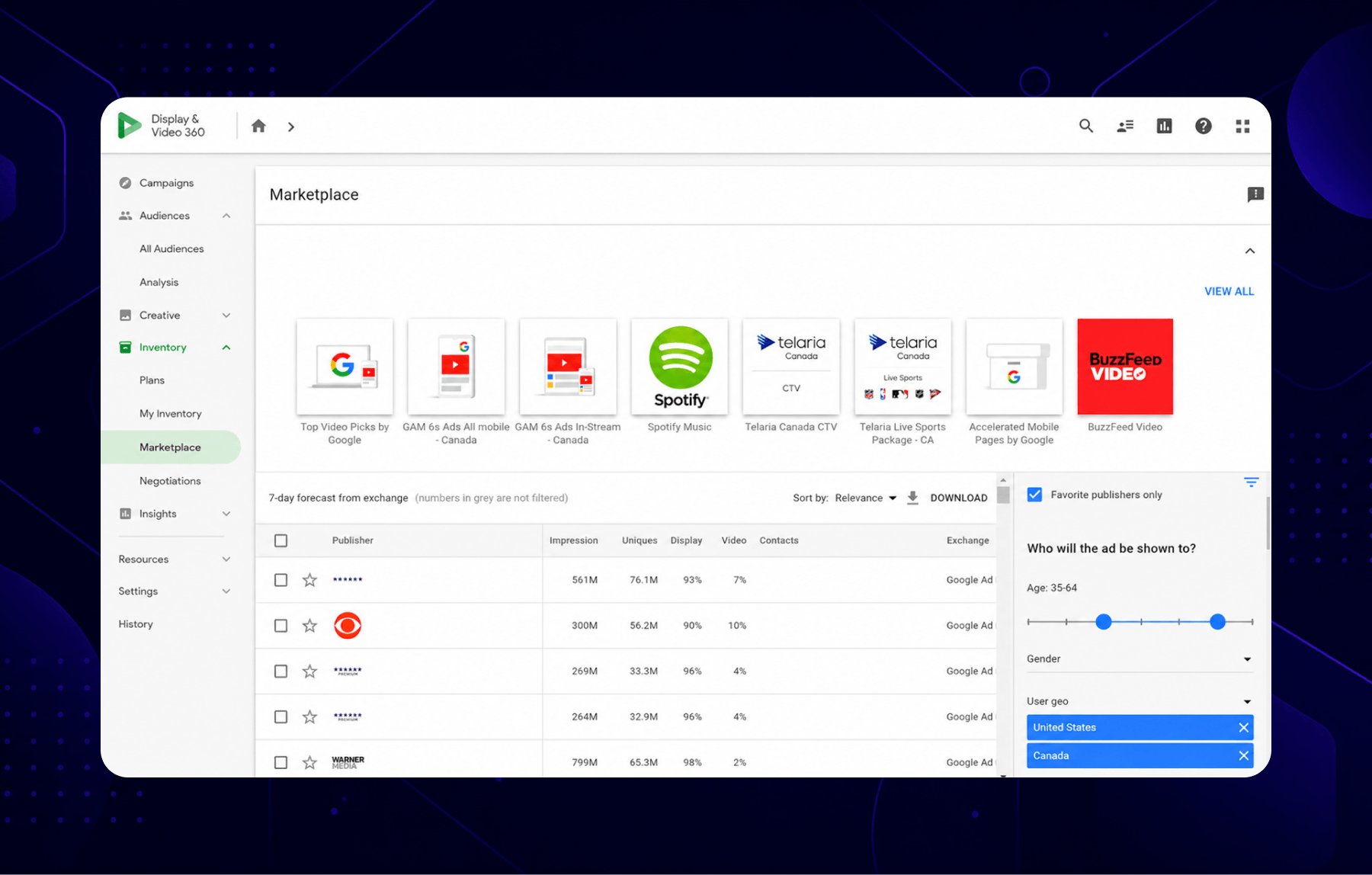
The financial barrier to entry is zero, making it incredibly easy to spin up in their simple UI. Read the AdOps fine print, though: a dedicated Account Manager doesn′t pick up the phone until you hit 50,000+ in spend. If you get stuck scaling a campaign, you are on your own.
Like StackAdapt, Quantcast restricts reporting to the Package-level.
- ❌ Not for: Teams that require domain-level transparency or hands-on technical support at lower spend tiers.
6. PropellerAds
Best for: Affiliates and media buyers driving performance via push notifications, pop-unders, and survey exits.
| Feature | SmartyAds | PropellerAds |
|---|---|---|
| Minimum Budget | $1,000 | $100 |
| Account Manager Support | All plans | From $5,000+ spend |
| Analytics Depth | SSP-level only | SSP-level only |
| White-Label DSP | No | No |
| Channels | Audio, CTV/OTT, DOOH, In-App, Mobile, Web | Mobile, Telegram Apps, Web (Push, Pop, Survey) |
PropellerAds frequently shares the SERP with SmartyAds because both historically cater to buyers seeking low barriers to entry. Both allow you to launch campaigns with just a $100 initial deposit.
Yet, their traffic profiles are worlds apart. SmartyAds focuses on mainstream display and video. PropellerAds is big on the affiliate-friendly, alternative formats (Push, Pop, Telegram Apps).
If you are an affiliate marketer driving CPA offers, PropellerAds is the powerhouse for you.
- ❌ Not for: Premium brand advertisers, B2B agencies, or CTV buyers.
7. Basis (formerly Centro)
Best for: Independent agencies managing hybrid media plans that need to reconcile programmatic buying with direct vendor IOs.
| Feature | SmartyAds | Basis |
|---|---|---|
| Minimum Budget | $1,000 | ~$5,000 |
| Account Manager Support | All plans | All plans |
| Analytics Depth | SSP-level only | Site/domain-level |
| White-Label DSP | No | No |
| Channels | Audio, CTV/OTT, DOOH, In-App, Mobile, Web | Audio, CTV/OTT, DOOH, Direct, Mobile, Search, Social, Web |
Basis rounds out the list as a direct workflow competitor. It is as much an agency automation tool as it is a DSP. It integrates programmatic buying, direct IO management, pacing alerts, and financial reconciliation into a unified platform.
If you are an agency migrating away from SmartyAds and your team is manually tracking guaranteed direct buys in spreadsheets alongside your programmatic spend, Basis eliminates massive operational friction.
- Pricing: Not published explicitly; based on leaked info, mid-market accessible.
- White-label: No.
- ❌ Not for: Pure-play programmatic teams that already have dedicated billing and ad-serving infrastructure.
📖 Read more: A full comparison of top self-serve DSP platforms in 2026
How to migrate from a bundled DSP to a white-label
Migrating to an API-first bidder is an architectural shift. You are taking ownership of your supply paths and bidding logic.
Follow this checklist to execute the transition without tanking live campaigns.
1. Extract your data
Do not orphan your algorithm's learning phase. Export your:
- Allowlists and blocklists.
- Device-level win rates.
- CRM cohorts.
Upload those lists to the bidder and layer them with Lotame integrations to jumpstart targeting.
2. Stand up the infrastructure
Setting up Bidder-as-a-Service requires DNS configuration.
- Point your CNAME records to host the DSP under your agency’s domain.
- Configure seat structures, define role-based access for media buyers.
- Bake in margin rules.
You are building a proprietary ad product, so the UI and the math must reflect that.
3. Map your supply paths
- Reclaim the DSP take rate.
- Connect directly to Epom's 80 integrated SSP endpoints.
- Turn on site and domain-level tracking.
- Optimize bid shading based on URL performance.
- Toggle on the Pixalate layer to filter invalid traffic (IVT) pre-bid.
4. Ping your postbacks
Generate conversion pixels and server-to-server (S2S) postback URLs from the dashboard. Implement them via your tag manager and run test conversions. Check server logs to ensure CPA, ROAS, and attribution logic fire accurately before pushing media spend through the pipes.
5. Shift spend gradually
Run your legacy DSP and the white-label instance concurrently for a 14-to-30-day overlap. Pacing and bid-shading algorithms need time to learn the supply landscape. Benchmark eCPMs and win rates across both platforms. Once volume and clear prices hit your thresholds, deactivate the legacy DSP.
How to choose the right SmartyAds alternative
If you are suffering from choice paralysis, ask yourself three questions to narrow the field instantly.
1. Do you need white-label or BaaS infrastructure?
This is the immediate fork in the road.
If you are an agency dealing with the Teqblaze spin-off, or an ad network looking to transition into proprietary tech, you need architectural control. Of the platforms listed above, Epom DSP offers this within a single system. The others are mostly buyer-facing managed seats that don’t allow you to rebrand the UI, control the raw QPS, or keep the DSP margin.
👉 The case study in question: read how Kenyan BreakRoom went with the white-label DSP solution. Transparent supply and open reporting helped the team understand what's happening, explain it to clients, and prepare for the high business season on time.
2. What is your monthly programmatic budget?
Your actual spend dictates your access and your support level.
| Monthly Programmatic Budget | Realistic Platform Options | Support Reality |
|---|---|---|
| Under $5K/month | Epom DSP, PropellerAds, Quantcast | Self-serve only. Epom unlocks AMs at $2K. |
| 5K–50K/month | Epom DSP, StackAdapt, Eskimi | StackAdapt & Eskimi minimums clear here. |
| $50K+ /month | All above + DV360, Basis | Quantcast finally unlocks AM support. |
3. What is your primary channel or campaign workflow?
Match your business model to the platform's core competency.
| IF your strategy relies on... | THEN your best option is... |
|---|---|
| 1st-party data, Domain-level SPO & BaaS control | Epom DSP |
| Cookieless AI targeting with a $0 spend floor | Quantcast |
| Emerging markets, Telco data, or In-Game ads | Eskimi (Managed only) |
| Affiliate formats (Push, Pop, Survey Exits) | PropellerAds |
| Contextual, cookie-free open web targeting | StackAdapt |
| YouTube + the Google | DV360 |
| Agency workflow + direct guaranteed IOs | Basis |
Frequently asked questions
Bottom line
SmartyAds built its base by making programmatic accessible. Today, corporate restructurings like the Teqblaze spin-off force agencies to re-evaluate their vendors.
Advertisers spending under $100K a month who want contextual AI targeting can migrate to simple solutions like StackAdapt or Eskimi.
But independent agencies with media teams tired of paying 20% take rates for opaque algorithms need a change in architecture.
API-first stacks provide that modularity. You buy specific capabilities. Epom DSP lets you launch a self-serve instance today and scale into a branded, margin-controlled Bidder-as-a-Service model when you are ready to own the tech. You can sign up to Epom DSP to try it out for free, or contact us to map out your migration.