
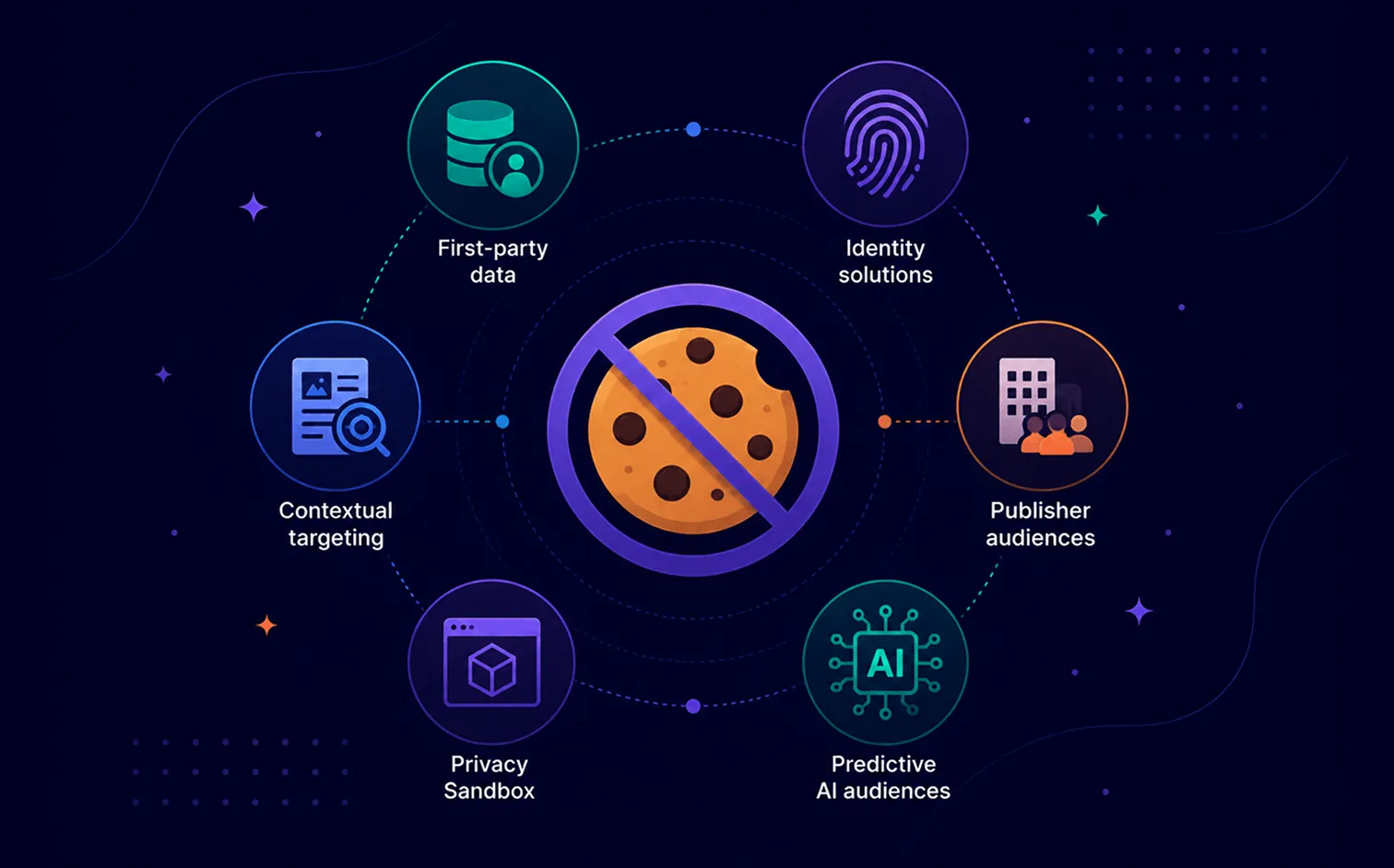
Third-party cookies are declining in use, and there is no universal replacement for them. Today, advertisers increasingly combine several approaches, including first-party data strategy, contextual targeting, publisher audiences, and identity solutions, to compensate for the loss of third-party signals. The best alternatives to third-party cookies not only help advertisers reach relevant audiences but also support campaign measurement.
At Epom, we work with performance marketers running cookieless campaigns across programmatic channels. Here's what's actually working — and what's not — based on what we see in live campaign data.
For many years, third-party cookies have been a key tool in digital advertising — but today, this model is gradually fading. However, for most advertisers, the problem isn't the decline of third-party cookies itself. The real challenge is that familiar targeting, retargeting, and campaign measurement tools are becoming less accurate.
Just a few years ago, marketers could track users across websites, build detailed audience segments, and run personalized campaigns with relative ease. Today, the rules of the game are changing. Browsers are limiting cross-site tracking, regulators are tightening privacy requirements, and users are becoming more mindful of how their data is used.
For brands that rely on automated media buying, these changes are reshaping how programmatic campaigns are planned, targeted, and measured. If you're new to the topic, learn more about what is programmatic advertising and how it works.
In response to these changes, the advertising industry is actively looking for alternatives to third-party cookies.
Why Third-Party Cookie Deprecation Matters for Advertisers
The decline of third-party cookies may seem like just another technical change. But in fact, its impact on audience targeting, retargeting, attribution, and campaign performance measuring is much deeper.
First, the complexity of retargeting increases. Before, an advertiser could relatively easily show ads to users who had viewed a specific product or abandoned a cart without making a purchase. Third-party cookies made it possible to track such users and return them back into the sales funnel.
The cookieless audience targeting is a less reliable process. If a user has not logged in to the website or provided their contact information, there are very few opportunities for re-engagement. That's why many brands are now investing heavily in first-party data strategies to maintain their ability to engage with their audience after the first contact.
Second, it's harder to segment the audience without third-party cookies. They used to be an important source of behavioral data, allowing advertisers to create segments based on users' interests, online activity, or purchase intent. For example, a sports equipment manufacturer could target users who had recently read bike reviews, searched for hiking gear, or visited thematic sites. Today, access to such signals is gradually declining, so advertisers increasingly rely on their own data, page context, and predictive models.
The third problem is frequency capping — limiting how many times a single user sees an ad. When an advertising platform cannot reliably identify a person across websites or devices, the risk of over-delivering ads increases, and a user may see the same banner dozens of times, which negatively affects both the user experience and the effectiveness of ad spend.
Finally, a major challenge is measuring advertising efficiency. In the past, third-party cookies helped link ad impressions, clicks, visits, and conversions within a single chain of interactions. Imagine a user who saw an ad on a news website, later visited the brand's website on a mobile device, and completed a purchase a few days later on a laptop. Without cross-site tracking, much of this journey could remain invisible to the advertiser.
In short, all these changes affect the entire logic of planning advertising campaigns. As a result, brands can't no longer rely on behavioral targeting and retargeting — and have to create more complex post-cookie targeting strategies.
What Makes a Good Third-Party Cookie Replacement?
Since third-party cookies have served several purposes, finding a replacement is challenging. That's why advertisers have to choose among different approaches based on their goals, available data, and resources — and start by understanding which criteria to use. Most often, advertisers focus on scale, targeting accuracy, compliance with privacy requirements, measurement capabilities, and implementation complexity.
Scale
First, it is important to understand which part of the target audience you can reach with a particular approach. For example, first-party data often provides high-quality signals, but its scale is limited by the number of users who have already interacted with the brand (since first party data collection depends on direct interactions). If a company has a large customer base, a mobile app, or loyalty programs, this may be enough to build effective segments. For small brands, collecting data directly from existing customers through user engagement may still not provide enough scale.
Contextual targeting works differently. It does not depend on user identification, so it can potentially reach a much wider audience. At the same time, it does not always provide the level of personalization that was previously available through behavioral targeting.
Targeting Accuracy
It is not enough to reach the audience — you should reach the right audience. One of the reasons for the popularity of third-party cookies was the ability to use behavioral signals from many websites to build detailed user profiles. Now, advertisers have to look for other ways to determine the audience's intentions and interests.
A first-party data strategy usually provides the highest accuracy. Data on purchases, website behavior, interactions with email newsletters, or mobile applications allows you to create segments based on real user actions.
At the same time, modern contextual targeting has also become much more accurate. Thanks to semantic page analysis, advertisers can place ads in a context directly related to the product or user need. That is why the comparison of contextual targeting vs third-party cookies is one of the most common in programmatic advertising today.
Privacy Resilience
Any modern third-party cookie replacement must meet new privacy requirements. Previously, a significant part of digital advertising relied on collecting data across different sites that was invisible to users. Today, this approach is becoming increasingly complex from both technical and legal perspectives.
The most promising privacy-first targeting alternatives use data obtained with user consent, page context, or aggregated signals, without requiring direct tracking of a person's online behavior.
Measurement Impact
Even the most precise targeting is of little value if the advertiser cannot measure the campaign's results. One of the biggest challenges after abandoning third-party cookies is related to measurement. Today, many cookie-deprecation alternatives must be supplemented with other tools — server-side tracking, clean rooms, attribution models, or incremental tests.
In fact, any modern post-cookie targeting strategy should take into account not only targeting but also how well a specific solution supports the measurement of advertising effectiveness.
Implementation Effort
The last but not least criterion is the resources required to implement the solution. Some cookieless audience targeting approaches can be tested almost immediately. For example, contextual targeting does not require a large database or complex integrations.
In contrast, a full-fledged first-party data strategy involves collecting data, setting up user consent management systems, integrating with CRM systems, segmenting audiences, and subsequently activating this data on advertising platforms. Data clean rooms or identity solutions are even more complex and often require additional technical integrations and internal data management processes.
To sum up, the best alternative to third-party cookies is not necessarily the most technologically advanced solution. But it should align with your business goals, available resources, and the company's level of data maturity.
Top 8 Alternatives to Third-Party Cookies
Now that we understand what third-party cookies used to do and how to evaluate their replacements, we can move on to specific solutions.
Below are eight approaches we at Epom see advertisers actually deploying — with notes on where each one holds up under real campaign conditions.
First-Party Data Strategy
Unlike third-party data that you collect across different websites, first-party data comes directly from users during their interaction with the brand. Hence, it is usually more accurate, more relevant, and better meets modern privacy requirements.
For advertisers, the value of first-party data lies not only in the ability to segment audiences. It allows you to build long-term relationships with customers and reduce your dependence on external platforms and data providers.
Despite all the advantages, first-party data also has its limitations. The most important of them is scale. A brand can only work with those users who have already interacted with it. If the database is small, the opportunities for audience expansion will also be limited.
This is why modern post-cookie targeting strategies often use first-party data as a foundation, and then supplement it with other approaches.
If you're building a first-party data strategy and want to activate it programmatically, see how Epom connects first-party audiences to your media buying →
Contextual Targeting
Contextual targeting, also known as contextual advertising, is one of the oldest tools in digital advertising and digital marketing, but it is entering a new stage of development in the era of cookie deprecation. Based on Epom campaign data, contextual targeting consistently outperforms behavioral retargeting. Unlike behavioral targeting, which uses user data, contextual targeting analyzes the content of the page on which the ad is displayed.
The comparison of contextual targeting vs third-party cookies often boils down to this. Third-party cookies focus on who the user is based on their past behavior, while contextual targeting focuses on what the user is interested in at a specific moment. Contextual methods can support targeted advertising without relying on cross-site identifiers and do not depend on users browsing history across multiple websites.
This approach offers many advantages, such as large scale, high compliance with privacy requirements, and fast implementation. Epom's contextual targeting engine uses semantic page analysis to match placements at the content block level — not just domain or category. For advertisers moving off behavioral segments, this is the fastest path to maintaining relevance without cookies.
Publisher First-Party Audiences
Publisher first-party audiences are based on data that media, content platforms, or online services collect directly from their users. Publishers can use sign-ups, subscriptions, content viewing history, website interaction data, user visits, and other signals to create audience segments based on interactions within the publisher environment rather than across multiple sites. Then, advertisers can access these segments through DSPs, SSPs, or private marketplaces. For the advertiser, this is an opportunity to work with audiences that are already highly engaged.
Still, this approach has some limitations. For instance, data is often only available within a specific publisher, campaigns are more difficult to scale, and segmentation quality can vary between different publishers.
Universal IDs and Identity Solutions
Identity solutions aim to address one of the main problems with cookieless advertising alternatives — user identification without third-party cookies. The most well-established solutions include Unified ID 2.0 (UID2), ID5, RampID, and other universal identifiers. Instead of cookies, they use data obtained with the user's consent, such as an email address or login, which is converted into an encrypted identifier. Thanks to this, advertisers can work with audiences across different platforms and devices without traditional cross-site tracking.
Some advantages of this approach include support of personalized advertising and better transparency compared to traditional cookies. But there are also downsides, such as high dependence on market implementation levels and limited reach compared to the third-party cookie model.
Retail Media Networks
Retail media has become one of the most dynamic areas of digital advertising in recent years. Large retailers use their own data on purchases and customer behavior to create advertising products for brands.
Unlike many other third-party cookie alternatives, retail media relies on data on real transactions. This allows advertisers to work not only with intent, but also with actual purchases. For example, a pet food manufacturer can show ads to users who have already purchased pet products.
As a result, this approach ensures high segmentation accuracy and has strong sales measurement capabilities. On the other hand, it's primarily suitable for e-commerce brands, and the data is limited to a particular retailer's ecosystem.
Data Clean Rooms
Data clean rooms are secure environments where advertisers, publishers, and technology platforms can analyze data without sharing raw user information by providing access to anonymized or aggregated data. Hence, you can compare audiences, evaluate campaign performance, and perform segmentation without compromising privacy. For example, a large retailer and a brand can analyze the proportion of users who saw an ad and subsequently purchased, without sharing customer profiles.
This approach has several advantages, including a high level of privacy compliance and the ability to compare large datasets. At the same time, it requires quite a complex implementation.
AI-Powered Predictive Audiences
Instead of relying solely on historical behavioral signals, predictive audiences use machine learning algorithms to predict future user behavior. The system analyzes available data — first-party data, contextual signals, and interaction or transaction history — and identifies users most likely to perform a desired action. For example, the algorithm can identify a group of users whose characteristics resemble those of a brand's current customers, even if they have not previously interacted with the brand.
For many advertisers, this is one of the most promising areas of development for cookieless audience targeting. This approach allows you to scale audiences and demonstrates high efficiency when quality data is available. However, you may encounter difficulties explaining results and training the model, since it requires a significant amount of data to learn.
Privacy Sandbox APIs
Google's Privacy Sandbox is a set of technologies offered by Google as part of its effort to replace third-party cookies in Google Chrome, while other browsers already impose stronger limits on third party cookie blocking. Among the most well-known components are the Topics API, the Protected Audience API, and the Attribution Reporting API. Their goal is to enable advertisers to work with audiences and measure results without transferring large amounts of individual user data. For example, the Topics API can provide aggregated information about user interests by categorizing users into broad interest areas rather than exposing detailed individual profiles, and the Attribution Reporting API can help evaluate campaign performance without traditional cross-site tracking.
Although Privacy Sandbox is still in development, many advertisers are already testing it as a possible component of future post-cookie targeting strategies.
How to Choose Your Alternatives to Third-Party Cookies
It's not easy to choose among those many alternatives, so we've summarised the key information in the table below.
| Solution | Scale | Targeting Accuracy | Privacy Compliance | Measurement Capabilities | Implementation Effort |
|---|---|---|---|---|---|
| First-Party Data Strategy | Medium | High | High | High | High |
| Contextual Targeting | High | Medium | High | Medium | Low |
| Publisher First-Party Audiences | Medium | High | High | Medium | Medium |
| Universal IDs & Identity Solutions | Medium | High | Medium-High | High | Medium-High |
| Retail Media Networks | Medium | High | High | High | Medium |
| Data Clean Rooms | Medium | Medium | Very High | High | High |
| AI-Powered Predictive Audiences | High | Medium-High | High | Medium | High |
| Privacy Sandbox APIs | High | Medium | High | Medium-High | Medium |
As you can see, there is no universal third-party cookie replacement. Each solution has its strengths and limitations. Some approaches provide high targeting accuracy, while others help scale reach or improve measurement of campaign results. That is why most advertisers today are not looking for a single perfect cookie replacement but are combining different alternatives to third-party cookies based on their goals, available data, and resources.
Not sure which combination fits your current setup? Talk to Epom specialist → a 20-minute call is usually enough to map the right approach to your stack and campaign goals.
For example, an online store with a large customer base can build its strategy around a first-party data strategy and retail media networks, using clean rooms to analyze results. A B2B company can combine contextual targeting and publisher first-party audiences to reach relevant professional audiences.
The gradual decline of third-party cookies does not mean the end of effective digital advertising. But it forces advertisers to try new approaches to targeting, measurement, and audience engagement. The most successful post-cookie targeting strategies rely on a combination of different data sources and technologies, allowing campaigns to remain effective even in a cookieless environment.
If you're not sure which approach fits your stack best, book a demo to see how Epom handles cookieless targeting in practice.