
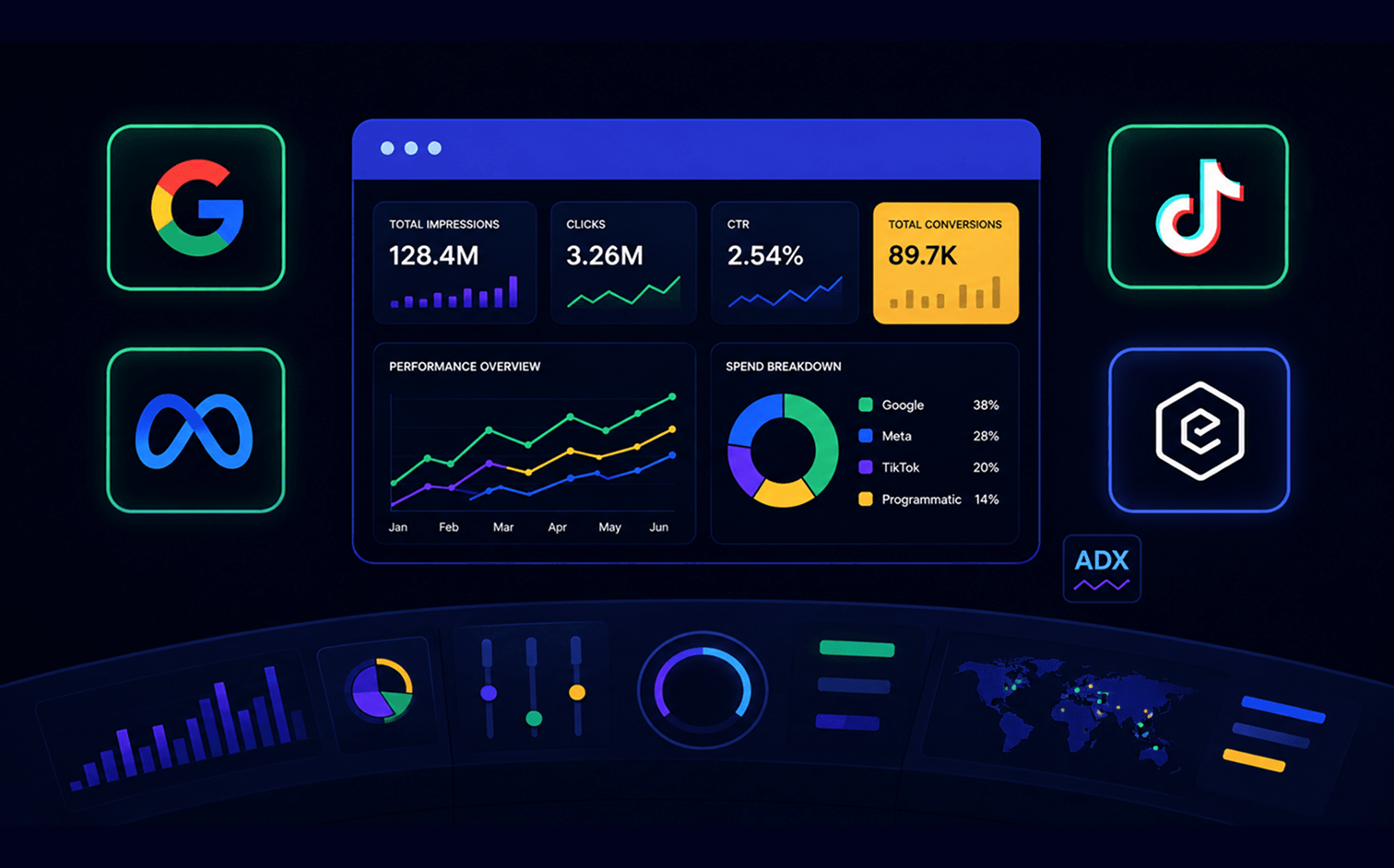
TL;DR:
The best advertising platforms in 2026 aren't chosen; they're matched. Walled gardens like Google and Meta still dominate budgets and are the right call for high-intent search and social discovery. But they're closed systems: you see what they want you to see, and you optimize toward what they define as a win. Programmatic platforms, demand-side platforms, ad exchanges, and private marketplaces offer an open-web alternative: full control, transparent supply, and first-party data ownership. Most serious advertisers and agencies now run both. The question is not which is better. The question is which one does which job. And what you're missing when you rely on just one.
At some point, every serious advertiser asks the same question: If the campaign is working, why is revenue flat? The answer is almost never the audience. It's almost always who's doing the measuring.
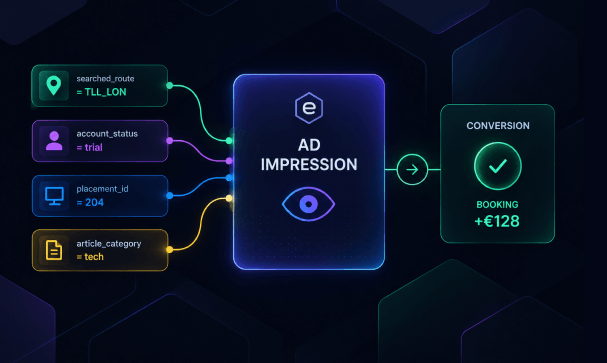
Picture this. A performance agency runs a Black Friday campaign across two major walled garden platforms. Both report record click-through rates. The client is happy. Then the CFO pulls the CRM data. Actual attributed revenue is 40% lower than what the platforms claimed. Three weeks of "successful" reporting, and the budget is already gone. Nobody lied. The platforms just measured themselves.
That's not an edge case. It's a structural feature of how programmatic advertising operates within a stack that isn't entirely yours. Attribution windows, view-through logic, conversion definitions: all set by the platform spending your budget. Before you read any comparison of the best advertising platforms, that's the conflict of interest worth naming.
Global advertising spend crossed 01.14 trillion in 2025, according to eMarketer. A significant portion of that went to platforms reporting strong results while CPAs quietly climbed and attribution gaps widened. Most marketing teams didn't notice until Q3, when the numbers stopped adding up.
Picking the right advertising platform in 2026 is less about reach and more about control.
- Who owns the data?
- Who sets the measurement rules?
- Who keeps the margin?
This guide answers those questions for every major platform category, including when walled gardens are the right call, and when they stop being enough.
What Is an Advertising Platform?
Before we rank anything, let's get one definition straight. People use "advertising platform" to mean wildly different things. Sometimes they mean Google Ads. Sometimes they mean a DSP. Sometimes they mean the entire ad tech stack. All three answers are technically correct and also confusing.
Here's the cleanest breakdown:
A digital advertising platform is any technology that enables the creation, management, buying, or optimization of paid ad campaigns across digital channels.
That covers a lot of ground. Three categories dominate:
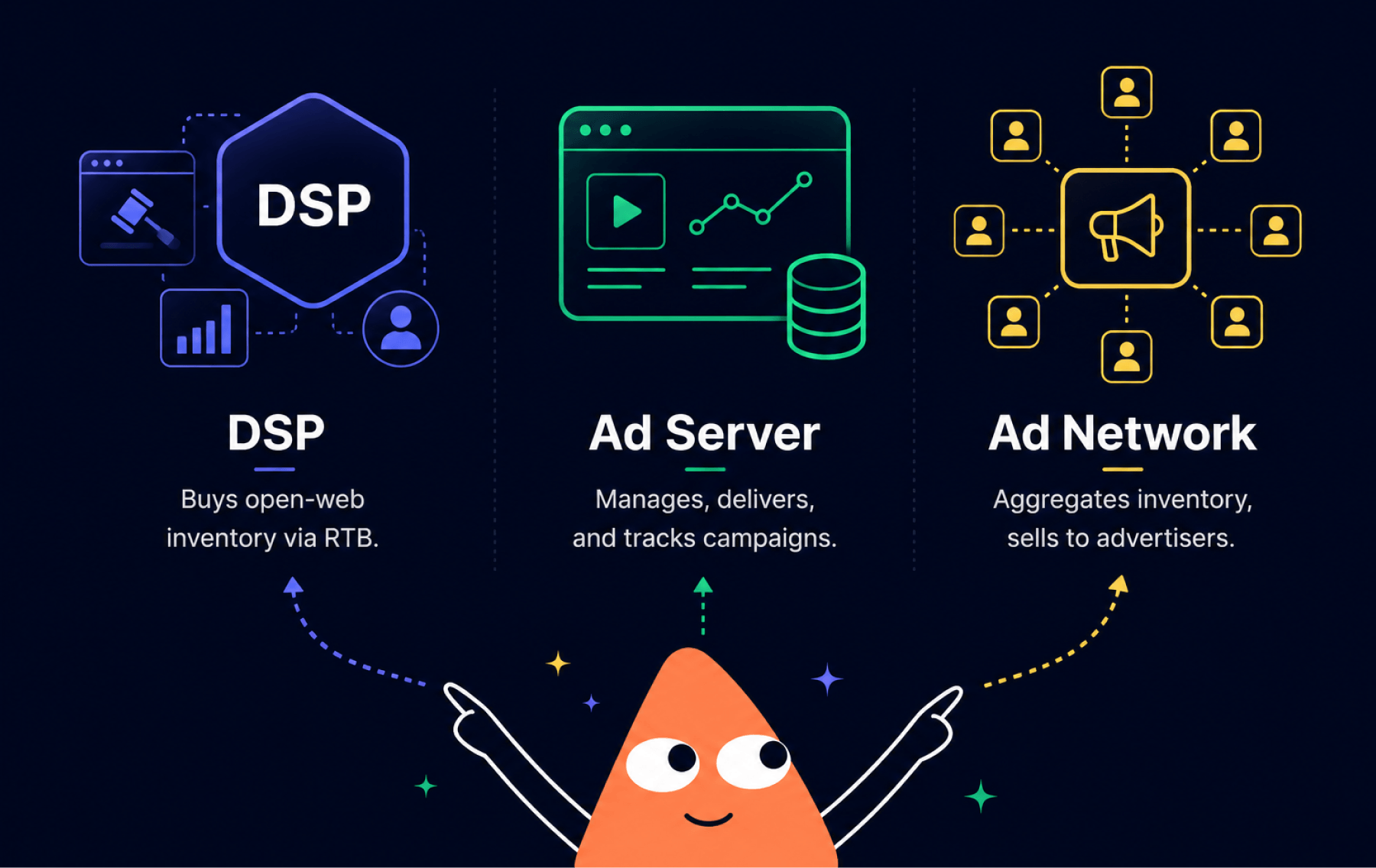
Demand-Side Platforms (DSPs) are the buy-side infrastructure of programmatic advertising. A DSP connects advertisers to ad inventory across thousands of publishers through automated real-time bidding. You set targeting parameters, budget, and bid logic. The platform buys impressions matching your criteria in milliseconds. Your ad appears. The whole thing happens while a page loads.
Ad servers are the management and delivery infrastructure. They store ad creatives, track delivery, manage campaign priorities, and report on performance. Publishers and ad networks use them to run direct deals alongside programmatic demand within a single controlled environment.
Ad networks and traffic platforms are aggregators. They bundle inventory from multiple publishers and sell it to advertisers at a markup, with varying levels of targeting and transparency. PPC models are part of why walled gardens feel so approachable at first, you set a budget, you pay only when someone clicks, and the feedback loop is immediate. The risk comes later, when you realize the click is the easy part. Google Ads and Meta Ads technically behave as ad networks inside their own walled gardens, though they're far more sophisticated than legacy networks.
One detail worth keeping in mind as you read the comparisons above: Only one of these three categories gives you an independent measurement. Ad servers and DSPs report what actually happened. Walled garden networks report what they want you to see. That distinction shapes every evaluation in this guide.
Understanding which category does what is the first decision you need to make before any platform comparison makes sense.
Types of Advertising Platforms: A Quick Breakdown
Let’s dive into the nuts and bolts of different advertising platforms. Here’s a quick look at what we are working with here.
Demand-Side Platforms (DSPs)
A DSP is a platform for buying ad space programmatically. Instead of negotiating placements with individual publishers, you connect to supply-side platforms and ad exchanges, set your audience targeting and bidding rules, and let automation handle the rest. The scale is immediate: a single DSP can access billions of impressions per day across display, video, connected TV, audio, and mobile.
When do you need one? When you're done letting platforms grade their own homework. A DSP gives you independent reporting, editable bidding logic, and supply-path visibility that no walled garden will voluntarily offer. The scale is immediate. The accountability is yours.
According to eMarketer, programmatic will account for 90% of all global digital display ad spending by 2026. At that point, not having a DSP in your stack isn't a bold contrarian position. It's just being behind.
For a detailed breakdown of which DSPs lead the market and how to evaluate them, our top DSP platforms comparison covers the full field with feature-by-feature analysis.
Ad Servers
Ad servers are the operational backbone for publishers, ad networks, and any advertiser running direct deals alongside programmatic. A publisher uses an ad server to fill placements with the highest-value combination of direct-sold campaigns and programmatic demand. Priority rules, floor pricing, and pacing are all managed here.
For advertisers running at scale, a third-party ad server provides independent tracking and verification separate from the platforms they're buying through. You're not relying on Google's reporting to evaluate Google's performance, a conflict of interest that should concern any performance-focused buyer.
Ad Networks and Traffic Platforms
Ad networks are entry-level inventory aggregators. They're fast to set up, require minimal technical knowledge, and can drive traffic quickly. The trade-off is transparency: you generally see what you bought in aggregate, not impression-by-impression, and the network captures a margin on top of what you'd pay direct.
Google Ads, Meta Ads, LinkedIn Ads, TikTok Ads, and Amazon Ads all fall under this category in spirit, even if they're far more sophisticated in practice. They're closed systems, valuable, high-quality, premium inventory, but closed nonetheless.
How to Choose the Right Advertising Platform
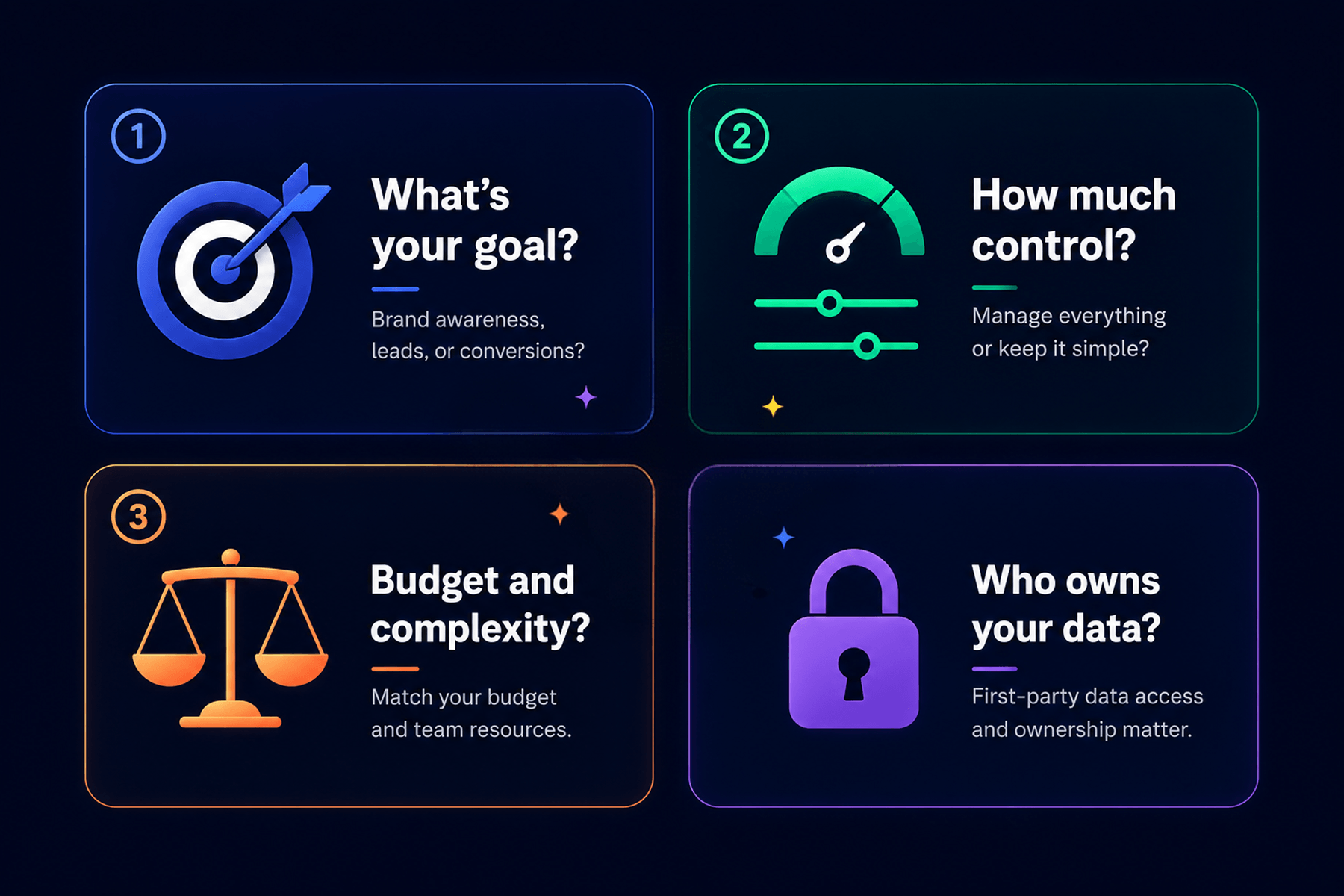
Four questions will narrow your options faster than any comparison chart:
1. What are you actually trying to do?
Buy media at scale across the open web? You need a DSP. Manage direct campaigns and programmatic demand together? You need an ad server. Run quick paid social experiments with fast feedback loops? Walled garden platforms are your starting point.
2. How much control do you actually need?
If "the algorithm decides" is fine for your team and clients, then self-serve walled-garden tools work well. If your team asks questions like "which specific publishers drove our CPA down last week?", you need transparency that walled gardens structurally can't provide.
There's a simpler version of this question. Ask your current platform: Show me every site where my ad ran last month. If the answer is a campaign total instead of a site list, you don't have transparency. You have a summary.
Here's the line most platform comparisons skip entirely: the gap between ad clicks and conversions is where most advertising budgets actually leak. Platform choice affects the click. What happens after the click is your funnel's problem. And no platform solves that for you automatically.
3. What's your budget and complexity tolerance?
A small brand testing digital ads for the first time belongs on Google or Meta. A mid-market agency managing 15 client campaigns needs a consolidated programmatic platform. An enterprise advertiser running CTV, display, and audio simultaneously needs infrastructure, not a dashboard.
Continuous updates to creative, targeting, and audiences are what keep CPCs from drifting upward over time. The platforms that make those updates fast and visible are the ones worth staying on.
4. Do you own your data?
This question matters more than most buyers realize. In a walled garden, the audience data stays on the platform. You can target, but you can't export. In an open programmatic environment with a proper DSP, your first-party data is yours, your audience models are yours, and your performance history is yours.
Based on Epom observations, advertisers who migrate to a DSP after running exclusively on Meta and Google almost universally report two things: lower effective CPMs on comparable inventory and significantly more granular attribution data than before.
Best Advertising Platforms by Use Case
Here's where most "best platforms" articles get it wrong: they rank platforms as if everyone has the same goal. That's not useful. What's useful is matching platform categories to the job you're actually trying to do.
Best Platforms for Running Ads: Performance and Growth
If your primary goal is buying media and driving conversions, these are your options in rough order of where most teams start:
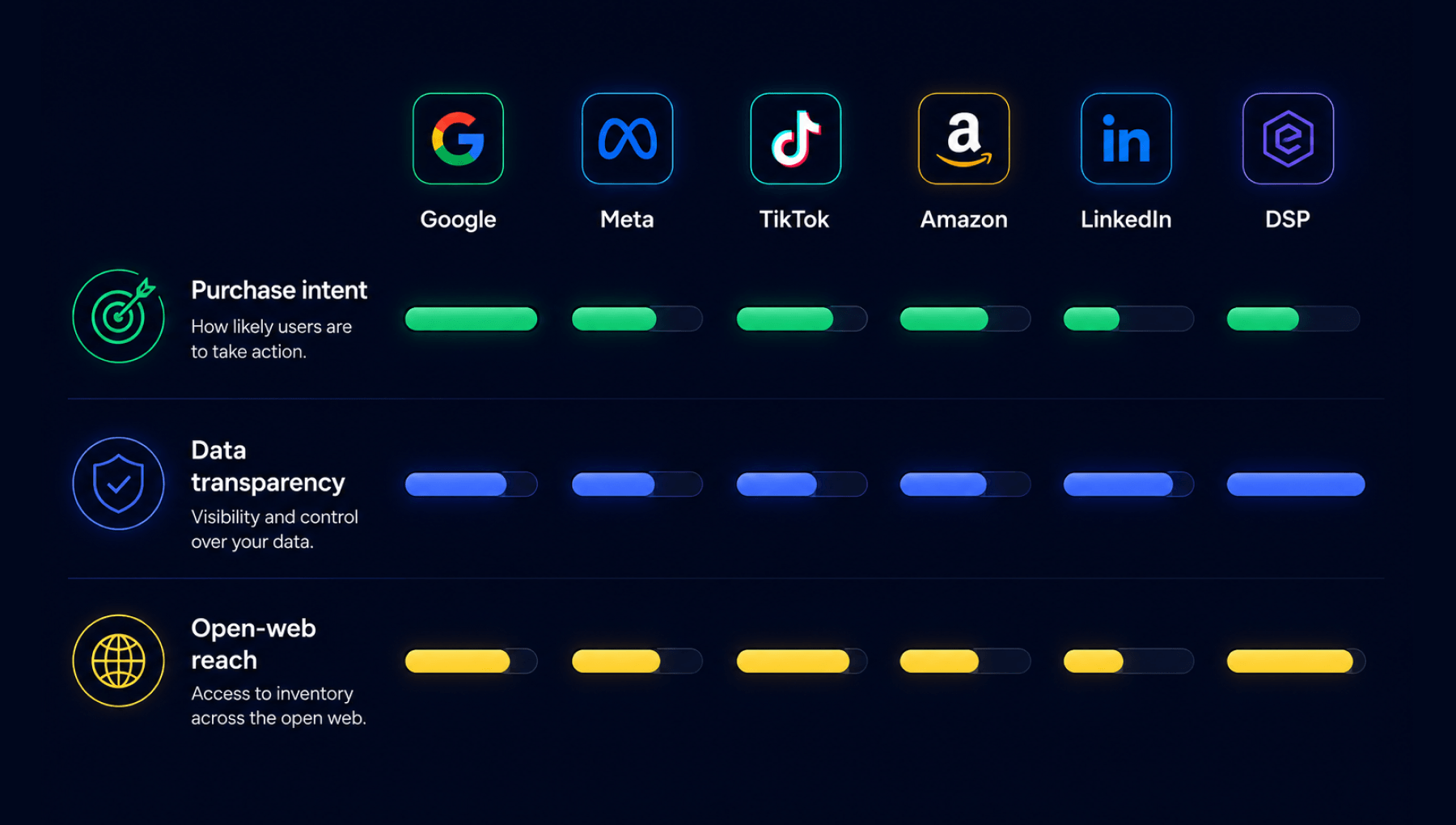
Search ads still convert better than almost any other format when the keyword intent is right. The problem is that they only work if someone is already looking.
Google Ads captures high-intent users at the exact moment they're searching for what you sell. Search campaigns are still the highest-converting format in performance marketing when the keyword strategy is right. Shopping ads work well for e-commerce brands. The downside: rising CPCs, limited transparency outside Google's ecosystem, and zero open-web reach.
Meta Ads (Facebook and Instagram) are the dominant platform for social discovery and demographic targeting. Over 3.1 billion monthly users on Facebook alone, with sophisticated behavioral targeting across the family of apps. Where Google captures intent, Meta creates it. Ideal for brand discovery, retargeting existing audiences, and video advertising. Carousel ads and collection ads work particularly well for e-commerce.
One thing every platform has in common: a message mismatch between your ad and your landing page will tank performance, regardless of how good the targeting is. The platform gets you the click. What's on the other side determines whether you make money.
And while you're at it, a one-second delay in mobile page load time can cut conversions by up to 20%. Your CPC can be perfect and your landing page can still be where the budget dies.
TikTok Ads is where you go when your target audience skews Gen Z and Millennial, or when you want viral reach without paying for it upfront. TikTok's algorithm-driven feed can generate massive organic amplification on paid content. Engagement rates are genuinely higher than most other platforms right now, though that gap is narrowing as competition for ad space increases.
Amazon Ads reaches shoppers with direct purchase intent at the bottom of the funnel, particularly for consumer products where the transaction will happen on Amazon regardless. Over 310 million active customers. Retail media as a category is growing fast: by 2026, Amazon, Walmart, and the major retail networks will collectively attract over 15% of total digital ad budgets.
Note: Quick practical note that applies across every platform on this list: A/B testing your landing pages against live traffic will often move ROAS more than any targeting adjustment. Most teams skip it. Most teams also wonder why their CPAs are stuck.
LinkedIn Ads is the dominant online advertising platform for B2B. If your target audience filters by job title, industry, and company size, LinkedIn's targeting precision is unmatched. CPCs are high, often $8 to $15, but conversion quality is consistently better for B2B offers than any other platform.
Every platform above is useful. None of them will tell you it underperformed. That's the job the next layer exists to do.
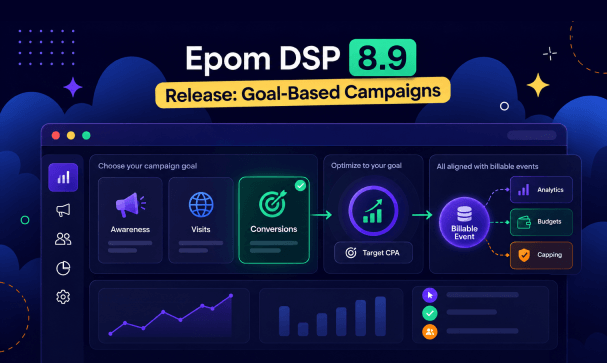
Programmatic DSPs sit above all of these as the open-web layer. They access inventory across publisher sites, apps, CTV, and audio that no walled garden can touch. Epom DSP, for example, connects to 50+ supply-side platforms and supports display, video, native, and CTV campaigns with transparent bidding rules and real-time reporting.
For teams scaling beyond Meta and Google, a programmatic advertising platform is the missing piece, not a replacement, but an extension that your current stack can't provide.
Best Platforms for Managing and Serving Ads
If your goal is management and delivery, not buying, the tool category changes entirely.
Ad servers are the right tool for publishers managing direct deals alongside programmatic demand, agencies running multiple advertiser campaigns on owned inventory, and ad networks building a controlled supply stack. Epom Ad Server, Google Ad Manager, and similar solutions handle campaign prioritization, creative trafficking, and consolidated reporting across all demand sources.
The key differentiator in this category is how much control you have over delivery logic. A good ad server lets you define which campaigns serve first, at what floor price, and with what targeting parameters, with full visibility into every decision. A bad one hides that logic and calls it "automated optimization."
Best Platforms for Quick Traffic Access
Sometimes you don't need infrastructure. You need volume, fast, with minimal setup.
Microsoft Advertising (Bing, Yahoo, AOL, partner sites) delivers lower CPCs than Google with less competition on most verticals. It reaches a desktop-heavy, slightly older demographic that converts well for financial services, B2B software, and local businesses. Often overlooked; consistently useful.
Pinterest Ads captures users in the discovery and planning phase, particularly powerful for home goods, fashion, food, and lifestyle brands, where users are actively building wishlists and inspiration boards. The intent isn't always purchase-ready, but the purchase follow-through is strong.
YouTube Ads gives you the world's largest video advertising inventory with over 2.7 billion monthly users. Pre-roll, mid-roll, and bumper formats work for both awareness and performance objectives. Skippable video ads in particular allow you to pay only when viewers choose to engage, a rare combination of scale and efficiency.
Start programmatic campaigns
without the complexity of enterprise DSPs
When You Actually Need a DSP
You've been running Google and Meta. Performance has plateaued. You've optimized everything optimizable. What now?
This is the question most mid-market advertisers face at some point, and the answer is almost always the same: expand the programmatic advertising ecosystem beyond walled gardens.
Here's when the shift is right:
- Your ad spend has crossed $10,000 to $15,000 per month, and you're hitting frequency caps or audience saturation on Meta. More budget into a saturated audience doesn't help. Using first-party data improves both targeting precision and measurement accuracy. And unlike walled garden audience signals, it doesn't disappear when you stop spending.
- You need cross-channel attribution that isn't mediated by the platform spending your money. When Google reports 200 conversions and your CRM shows 140, that gap is a data problem, and a DSP with independent conversion tracking solves it.
- You're running multi-format campaigns across display, video, audio, and CTV simultaneously. Managing those in separate walled garden tools means four dashboards, four attribution windows, and four different definitions of "conversion."
- You're building an agency or ad network and need margin control, white-label capability, and client-level reporting. None of the platforms above offer that. A white-label DSP does.
- First-party data is becoming your primary targeting asset. Third-party cookies are diminishing. Your CRM lists, website visitors, and customer data deserve a platform built to activate them, not a walled garden that keeps the data on their servers.
The programmatic world also offers inventory categories that Google and Meta simply don't touch. Connected TV, digital out-of-home, programmatic audio, these are channels where new attention is going, and where CPMs are still below what they'll be in two years.
Why More Teams Are Moving to Programmatic Platforms
The conversation around walled gardens has shifted. It used to be about performance versus open web. Now it's about ownership versus dependency.
According to Statista, walled gardens controlled approximately 78% of global digital ad revenue in 2025. That number is projected to decline as open-web programmatic buying and retail media attract a growing share of budgets. The shift isn't because walled gardens got worse. It's because advertisers got more sophisticated about what they're giving up to use them.
By 2026, over 70% of ad workflows are expected to be AI-managed. That sounds like good news, and it is, if you can actually see what the AI is optimizing toward. If you can't, you're just paying for confidence you haven't earned.
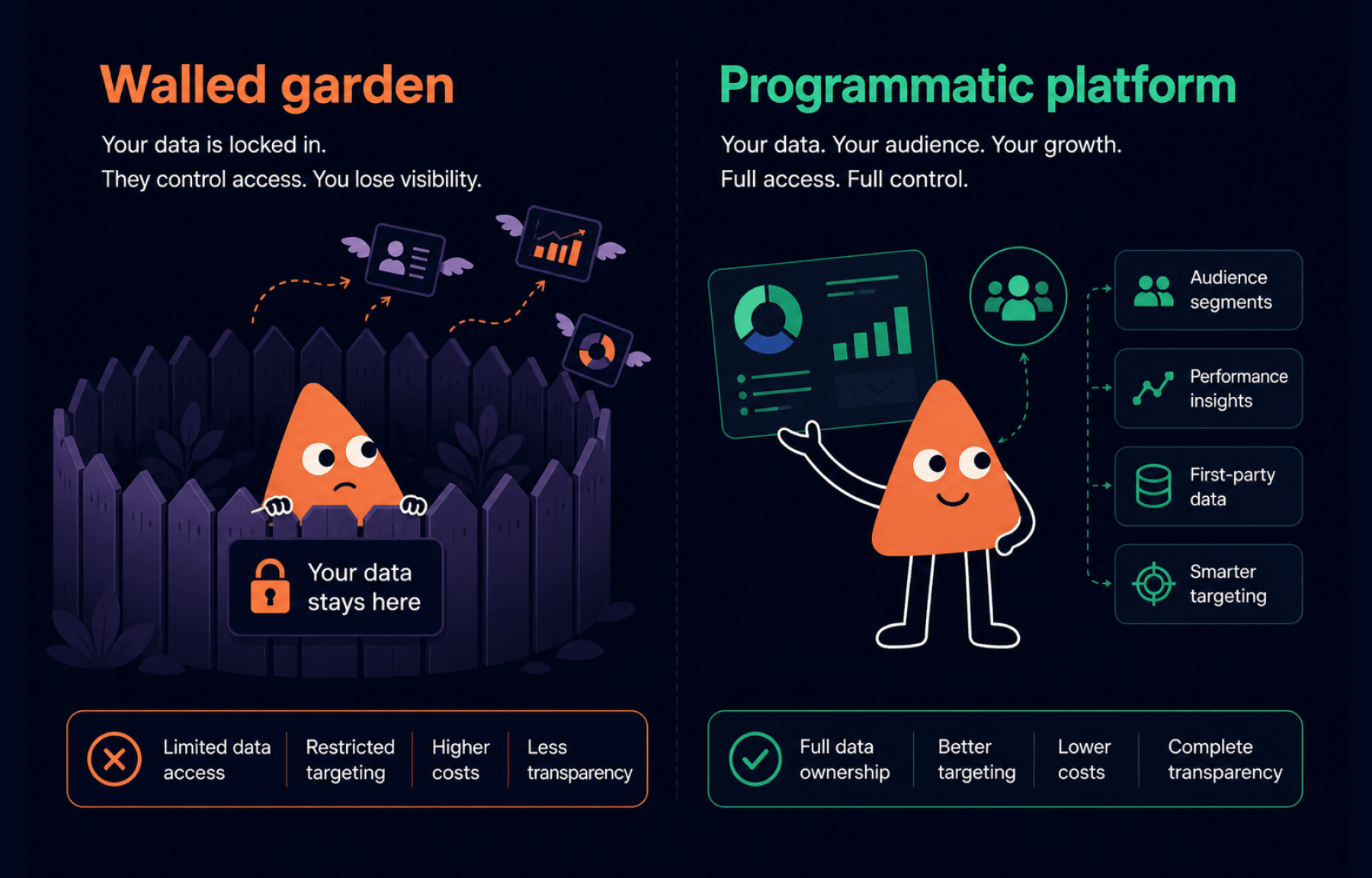
Three structural problems are pushing teams toward programmatic platforms:
- Walled garden data doesn't leave the garden. Google and Meta optimize your campaigns using audience signals that stay locked in their platforms. You benefit while you're spending. The moment you pause campaigns, you lose access to those learnings. A DSP with first-party data integration keeps that intelligence inside your stack.
- Reporting is biased by design. Every walled garden measures its own success. Attribution windows, view-through conversion logic, and reporting definitions are all set by the platform selling you the inventory. That's not fraud, it's just a conflict of interest you should account for. Independent programmatic platforms with transparent supply paths remove that conflict.
- Agency margin pressure is real. Platforms charge a percentage of ad spend, cap customization, and limit resale. A programmatic display advertising platform with white-label capability lets agencies own the client relationship, control margins, and deliver proprietary reporting under their own brand. The economic difference is significant at scale.
Based on Epom observations, agencies that move even a portion of their programmatic buying onto a white-label or self-serve DSP typically recover enough margin within the first quarter to offset the platform cost entirely.
Where Epom Fits in the Advertising Platform Landscape
There are a lot of platforms promising to solve the programmatic complexity problem. Most of them replace one form of black box with another.
AI-driven automation handles ad placement and creative rotation far faster than any human media buyer can. The question isn't whether to use it. It's whether your platform shows you what it decided and why.
Epom is built around a different premise: you should be able to understand what your platform is doing, and you should own the infrastructure when you're ready to.
Here's where it fits in practical terms.
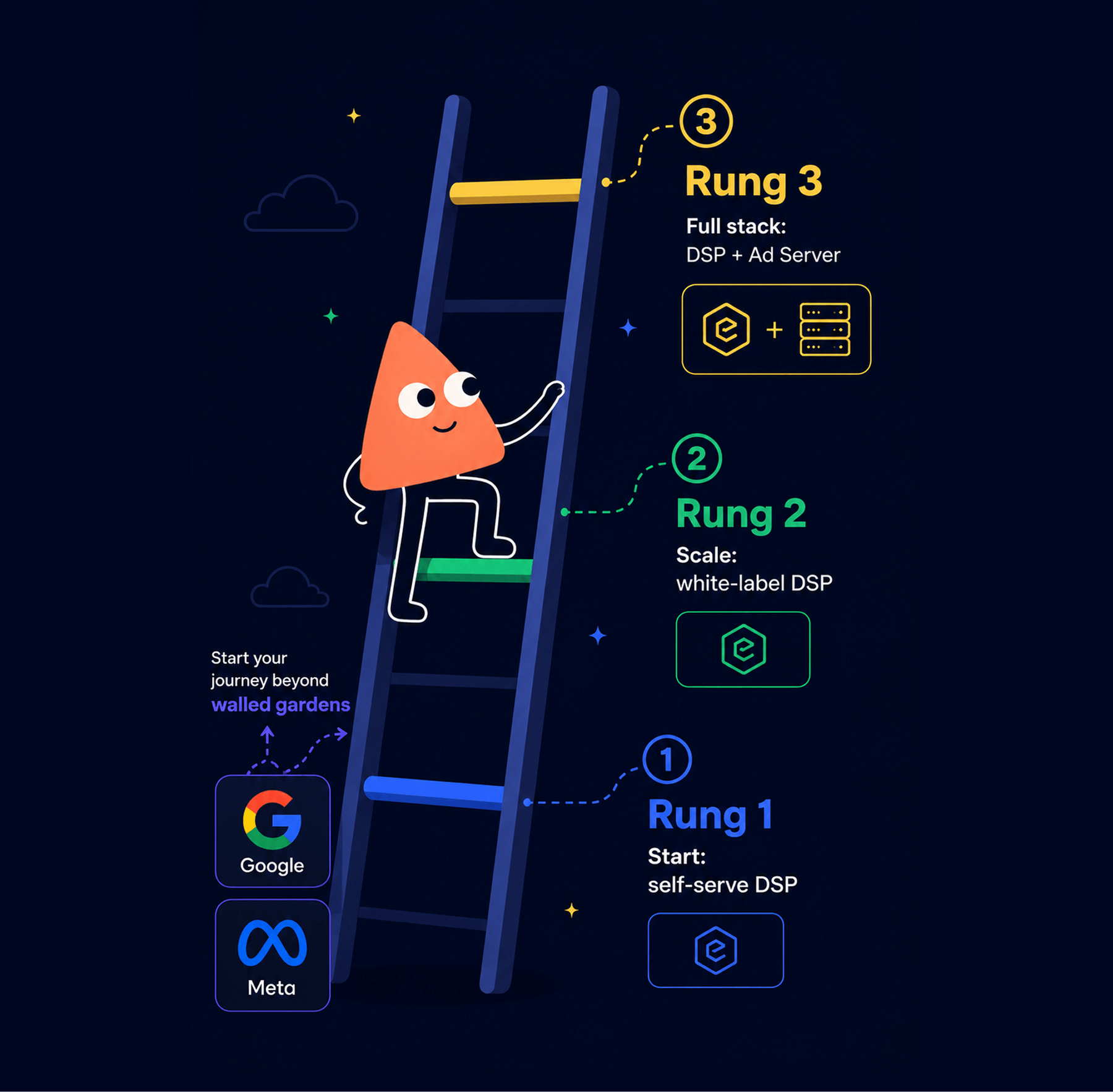
- As a starting point: Epom's self-serve DSP gets agencies and performance marketers into programmatic without the six-figure setup cost per month and six-month implementation that enterprise platforms require. You connect to 80+ pre-integrated SSPs on day one. You set bidding rules you can see and edit. You launch campaigns that run across display, video, native, and CTV in a single dashboard.
- As a scaling tool: As campaign volume grows, the white-label DSP option lets you rebrand the platform as your own, connect custom SSP endpoints, manage multiple client accounts with separate permissions, and control the margin between what you pay for inventory and what you charge clients. No revenue share with the platform. No algorithm deciding things you can't audit.
- As a complete stack: Epom also runs an ad server for publishers and networks who want direct and programmatic revenue managed in one place. That means the same company that powers your DSP buying can power your publisher-side ad management — which is a significantly simpler operational environment than running separate vendor relationships for each.
The short version is this: Epom is the online advertising platform you grow into from Meta and Google, not the enterprise platform you need a procurement process to access.
Compare it against alternatives in our DSP comparison guide if you want the full feature breakdown before committing to anything.
"The goal isn't to get advertisers off Google or Meta, those platforms do real jobs. The goal is to give teams the infrastructure they need when those platforms stop being enough. That's where transparent programmatic buying starts."

See the inner workings of Epom Ad Platforms
Epom DSPThe Best Advertising Platform Decision in One Table
You don't always need a lengthy framework. Sometimes you need a one-page answer. Here's the condensed version:
| If you want to... | Best platform category | Example |
|---|---|---|
| Capture high-intent search traffic | Walled garden search | Google Ads |
| Build brand awareness via social | Walled garden social | Meta Ads, TikTok Ads |
| Reach professional B2B audiences | Walled garden B2B | LinkedIn Ads |
| Target bottom-funnel shoppers | Walled garden retail | Amazon Ads |
| Run open-web display and video | Programmatic DSP | Epom DSP |
| Manage direct and programmatic together | Ad server | Epom Ad Server |
| Buy CTV and audio at scale | Programmatic DSP | Epom DSP |
| Own your data and audience models | Programmatic DSP | White-label DSP |
| Resell campaigns to clients | White-label DSP | Epom WL DSP |
No single platform wins every row. The strongest stacks pick two or three complementary tools and run them in parallel.
Final Thoughts
Every platform in this guide works. Google Ads converts. Meta discovers. TikTok reaches. LinkedIn qualifies. Amazon closes. The problem isn't that any of them are broken. The problem is that each one measures its own success, and each one has a financial incentive to look good in the report.
The teams that grow beyond plateau aren't using better platforms. They're using platforms that let them verify the results independently. They own the attribution layer. They own the audience data. When they pause a campaign, the knowledge doesn't disappear with it.
That's what programmatic infrastructure, a DSP with transparent supply paths, an ad server with editable delivery logic, actually provides. Not a replacement for Google or Meta. A layer that tells you whether Google and Meta are doing what they claim.
Start with what works. Then build the layer that tells you the truth about it.
Ready to launch programmatic campaigns or scale your agency's buying infrastructure?