

TL;DR:
AI programmatic advertising mainly helps platforms analyze large amounts of campaign data and make bidding decisions in milliseconds. Most practical use cases include bid optimization, audience modeling, fraud detection, and budget pacing, not fully autonomous campaign management. The real challenge is openness, because company-controlled software can hide profits and make it hard to see auction information. Before picking an “AI DSP,” focus on having control, getting all the data, and being able to connect with other systems easily. The real benefit comes from the setup and owning your data, not just from calling it AI.
Every DSP vendor on the market is AI-powered now. Apparently.
Scroll through any ad tech product page, and you will find machine learning bidding, AI-driven ad optimization, and smart audience targeting. The terminology is everywhere. The actual explanations are not.
- So what does artificial intelligence and advertising actually accomplish together inside a programmatic platform?
- Where does it genuinely improve campaign performance?
- And where is it just a marketing layer on top of rules-based automation that existed a decade ago?
In the advertising industry, this matters because the market is huge. WPP Media reported that the global ad revenue reached about $1.08 trillion in the previous year, 2025. And digital advertising represented about 73.2% of that. When the market moves that much money, a small percentage leaks turn into big dollars.
This article is the honest version. No hype, just a practical breakdown of how AI programmatic advertising works today, what the technology actually looks like behind the scenes, and what to watch out for when a vendor starts throwing AI claims at you.
Stay tuned.
What Is AI Programmatic Advertising?
Before anything else, AI and programmatic advertising have a definition problem that needs addressing. Most teams hear “AI” and think the platform will do the job end-to-end. That rarely happens in real campaigns.
In reality, the advertising industry uses "AI" to describe three very different things. Conflating them is how vendors get away with a lot.
Here is the actual breakdown:
| Layer | What it is | Example in programmatic |
|---|---|---|
| Automation | Rules-based logic. If X happens, do Y. No learning involved. | Auto-pause a campaign when CTR drops below 0.05% |
| Machine Learning | Algorithms that learn patterns from historical data and improve predictions over time. | Bid multipliers based on past win rate by placement |
| Generative AI | Models that create new content (text, images, code) based on training data. | Dynamic ad creative variations per audience segment |
Most of what ad tech calls "AI" is actually automation. Some of it is genuine machine learning (ML). Very little of it is generative AI applied meaningfully to ad buying.
AI programmatic advertising and real-time bidding (RTB)
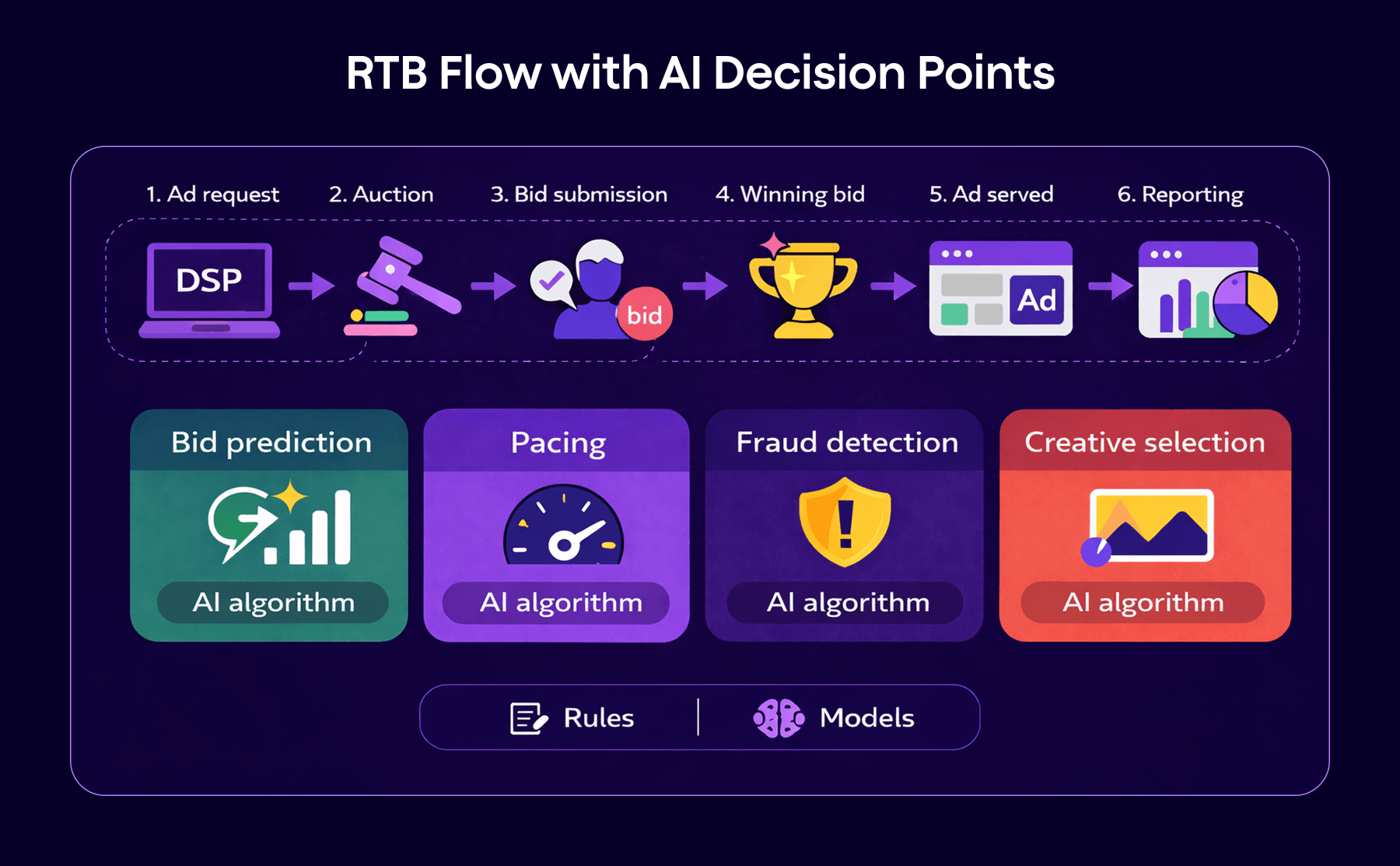
Here is the core loop in the programmatic advertising ecosystem.
- A user loads a page or app.
- The supply side platform sends a bid request through ad exchanges.
- A demand-side platform evaluates the request.
- The platform bids.
- The winner gets the ad space, and the ad server completes ad delivery.
EMARKETER describes programmatic as:
“technology platforms that match supply and demand in milliseconds, allowing campaigns to scale across millions of placements.”
Why does this matter in real-time bidding?
Because programmatic ad buying via RTB operates at speeds and volumes that typically require human intelligence to manage manually. Millions of ad auctions happen every second. No team can manually set bids across that many data points. That is the actual value of AI for programmatic advertising: not intelligence in the human sense, but speed and scale applied to pattern recognition.
Ad Tech Use Cases for AI Programmatic Advertising Today
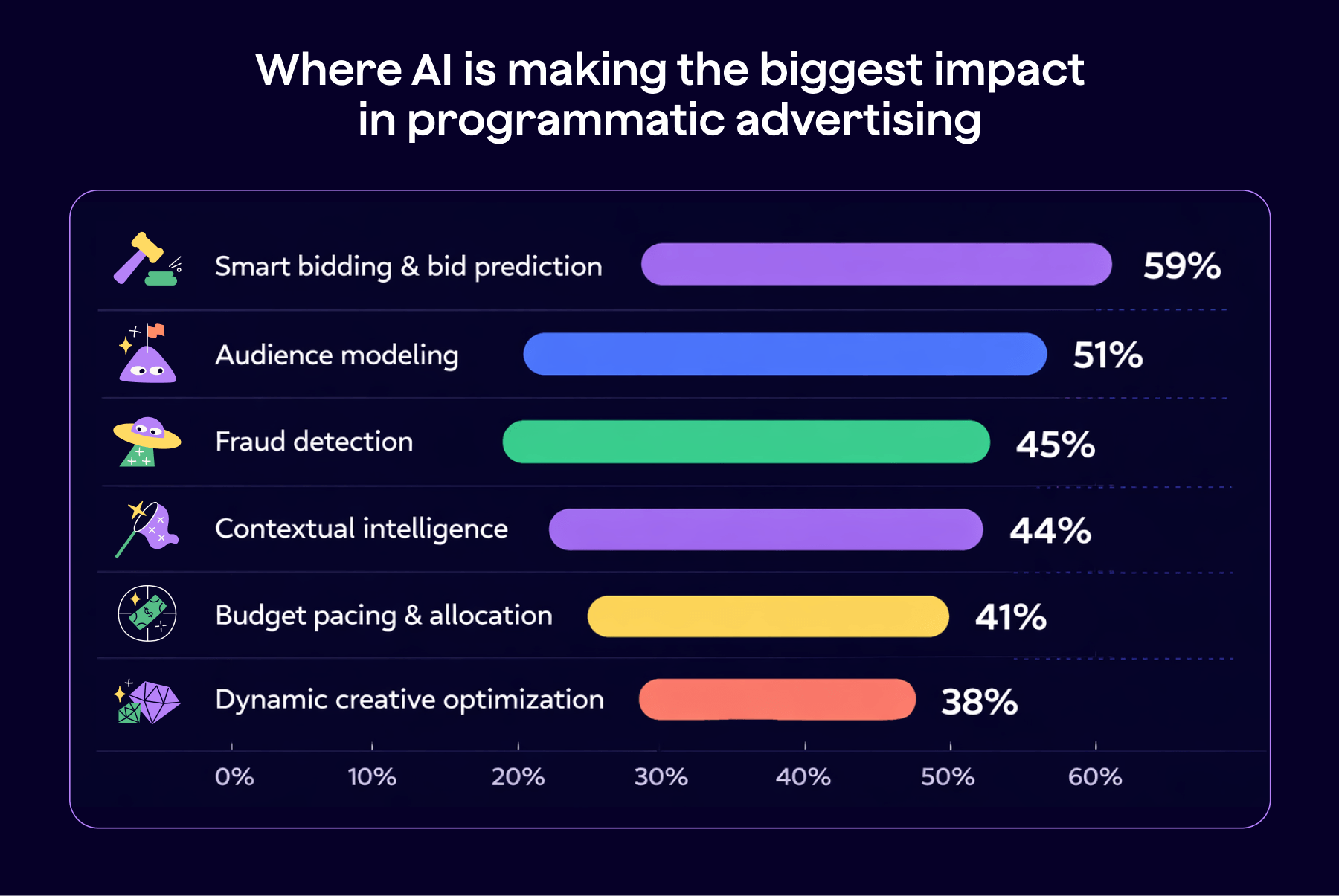
Based on Epom observations across agency and ad network clients, the most impactful applications of AI in programmatic advertising today fall into six areas.
1. Smart bidding decisions and bid prediction
Smart bidding usually means bid prediction.
- The model estimates win probability.
- The model estimates the expected value for the campaign goals.
- The platform applies bid multipliers.
Example: You run programmatic campaigns for a mobile game. You want installs, not clicks. The model learns which contextual signals correlate with installs. The platform then pushes more ad spend into those paths.
The model needs to know what outcome to optimize for. That depends on how your campaign is structured around CPM, CPC, and CPA pricing models and what "performance" actually means for that specific buy.
Smarter bidding decisions with less budget wasted, optimizing ad placements toward the inventory that actually converts. According to McKinsey's 2025 State of AI in Marketing report, companies using ML-driven bid optimization report up to 15% improvement in ad spend efficiency versus manual approaches.
2. Audience modeling and high-value audiences
Rather than relying on static audience segments, AI systems build dynamic models that identify high-value audiences based on audience behavior, purchase intent, and user interactions across the programmatic advertising ecosystem. First-party data feeds these models well. These models perform best when using first-party data.
Example: A travel site connects people who have searched for flights, includes groups interested in luxury travel, and seeks new users similar to past customers. Machine learning then scores users based on how likely they are to book and shows ads to those most likely to make a purchase.
3. Contextual intelligence
With third-party cookies on life support, contextual targeting powered by natural language processing has become critical. AI analyzes the content surrounding an ad placement in real time to determine relevance without relying on user IDs or user behavior data. This is one of the more legitimate AI applications in modern programmatic campaigns.
Example: A travel advertiser targets “summer flights” content. The platform reads contextual signals, then targets ads near that content.
Want to understand how Epom's infrastructure supports your AI and optimization strategy?
Get In Touch4. Fraud detection
Ad fraud costs the industry an estimated $84 billion annually, according to the World Federation of Advertisers. Fraud detection tries to reduce ad fraud and invalid traffic. This includes:
- bot patterns,
- device spoofing,
- click farms,
- made-for-advertising sites.
Example: An ad platform detects suspicious traffic where thousands of clicks come from the same device pattern and identical timing intervals. The AI model flags the activity as bot traffic and blocks those impressions before advertisers pay for them, since no real user engagement ever occurred.
5. Budget pacing and allocation
ML models manage how budgets are distributed across dayparts, geographies, and placements to optimize ad delivery based on real-time data and predicted performance. Even pacing, front-loaded pacing, goal-based pacing: these are driven by optimization logic that automation alone cannot handle at scale.
Keep in mind, pacing optimization does not exist in a vacuum. It is one piece of a broader media buying strategy that determines whether your budget actually does what you intended.
Gartner found that many CMOs still feel campaign performance issues often. In its survey write-up, Gartner notes that 87% of CMOs reported campaign performance issues in the last 12 months. Pacing and guardrails reduce the damage when performance shifts fast.
6. Dynamic creative optimization (DCO)
GAI is starting to make a real difference here. DCO tools try out and switch ad designs based on how people react, automatically showing the ones that work better more often. It is not magic. It is careful testing with quicker results.
Example: An e-commerce brand runs three ad variations with different headlines, product images, and CTAs. The system automatically promotes the version with the highest click-through rate for each target audience while pausing weaker variants.
ML in Programmatic Advertising: What Happens Behind the Scenes
Here is the part most vendors skip. Understanding how ML actually works inside a demand-side platform helps you evaluate whether a platform's optimization logic is genuinely useful or just a dashboard label.
The process looks roughly like this:
- A bid request arrives from a supply-side platform. It contains data points including site URL, ad placement dimensions, device type, user signals, and floor price.
- The ML model runs the request against historical data and produces a win rate prediction for that specific combination of signals.
- A bid is calculated based on that prediction, adjusted by campaign goals and any manual bid multipliers the buyer has set.
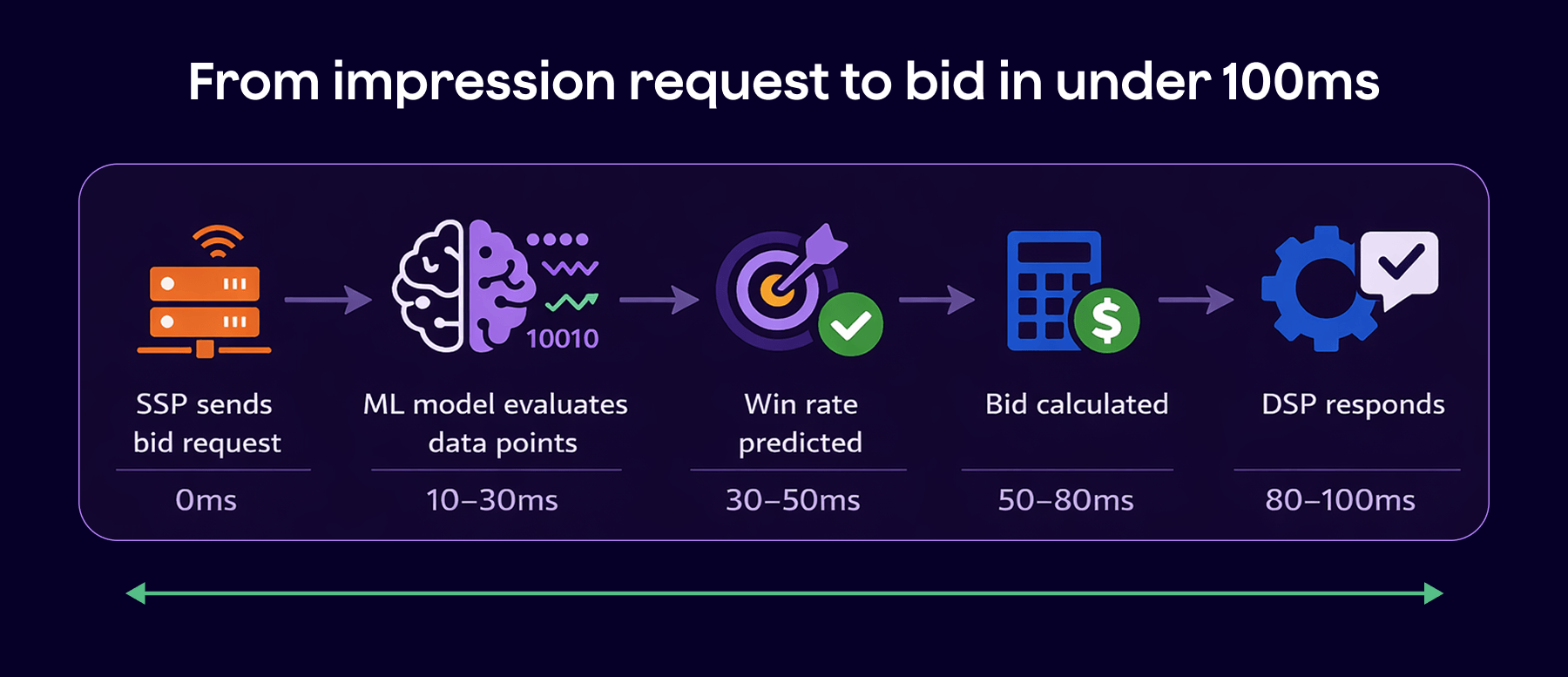
This happens in under 100 milliseconds. Every time.
The quality of the output depends entirely on the quality and volume of training data. An ML model fed limited campaign data will make poor predictions. One fed millions of historical data points across similar placements, audiences, and campaign goals will make much better ones.
Key mechanisms to understand:
- Pattern recognition finds correlations between impression characteristics and conversion outcomes. Time of day, device, and publisher category: all of these become predictive variables.
- Historical performance modeling weights recent campaign data more heavily than older data. A placement that worked well last week is more predictive than one that worked last year.
- Win rate prediction estimates the probability that a given bid will win the auction, helping avoid overbidding on low-competition inventory or underbidding on high-value placements.
- Bid multipliers let buyers layer human judgment on top of algorithmic logic. Increase bids by 20% for mobile users in a specific geo, for example. This is where transparency and control intersect with optimization.
Here is a grounded example.
You buy video inventory through several ad exchanges. One source gives you cheap CPM but weak campaign performance. Another source costs more but drives better ad revenue for the network long term. A model can spot that difference faster than a person. Your team still chooses whether the campaign goals justify the cost.
Based on Epom observations, the best results come when buyers combine AI-driven tools with hard guardrails. Rules keep the system honest.
AI and Transparency: The Black-Box Problem in Programmatic Advertising
Here is where things get uncomfortable.
The most capable AI in programmatic advertising often comes in a black box. You get the output. You do not get the reasoning. And that creates three real problems for agencies and ad networks.
Common problems:
- You cannot see auction logs.
- You cannot explain why the model chose certain ad placements.
- You cannot separate platform fees from media costs.
- You cannot export raw data for your own data analysis.
This is where many mid-size agencies and ad networks get stuck. They want modernization, but they also want control.
- Vendor-controlled bidding logic. When a DSP's AI decides how to bid, it is optimizing for outcomes the vendor defines. That might align perfectly with your campaign goals. It also might not. If you cannot see how the AI algorithms make decisions, you cannot check if the optimization benefits you or just helps the platform increase its profits.
- Hidden margin optimizations. Some online ad platforms use AI to hide price changes that boost their profits. The software sets the price, adds extra costs, and includes the markup in your bid. The markup is baked in. You see a performance report. You do not see what actually happened at the auction level. According to a 2025 PwC Digital Advertising Transparency report, 61% of mid-market agencies say limited data access from DSP vendors is a top operational challenge.
- Dependency risk. The more your campaign performance depends on a vendor's proprietary AI, the harder it becomes to migrate. Your audience models, optimization logic, and campaign data live in their system. That is not a technology problem. It is a business risk.
Epom’s view on this is direct. In an Epom programmatic trends piece, Inga Sydorenko said the goal is “neutral ground,” where transparency and flexibility are standard, so partnerships can work.
A CEO-level principle fits here, too. As our CEO Anton Ruin put it simply:
“The Client is the King.”
That quote maps to a practical buying rule. If your client cannot understand the spend, the client will not trust the spend.
See how our DSP applies transparent optimization along with flexible bidding rules
Explore Epom DSPProgrammatic advertising AI integration: Build vs. Buy
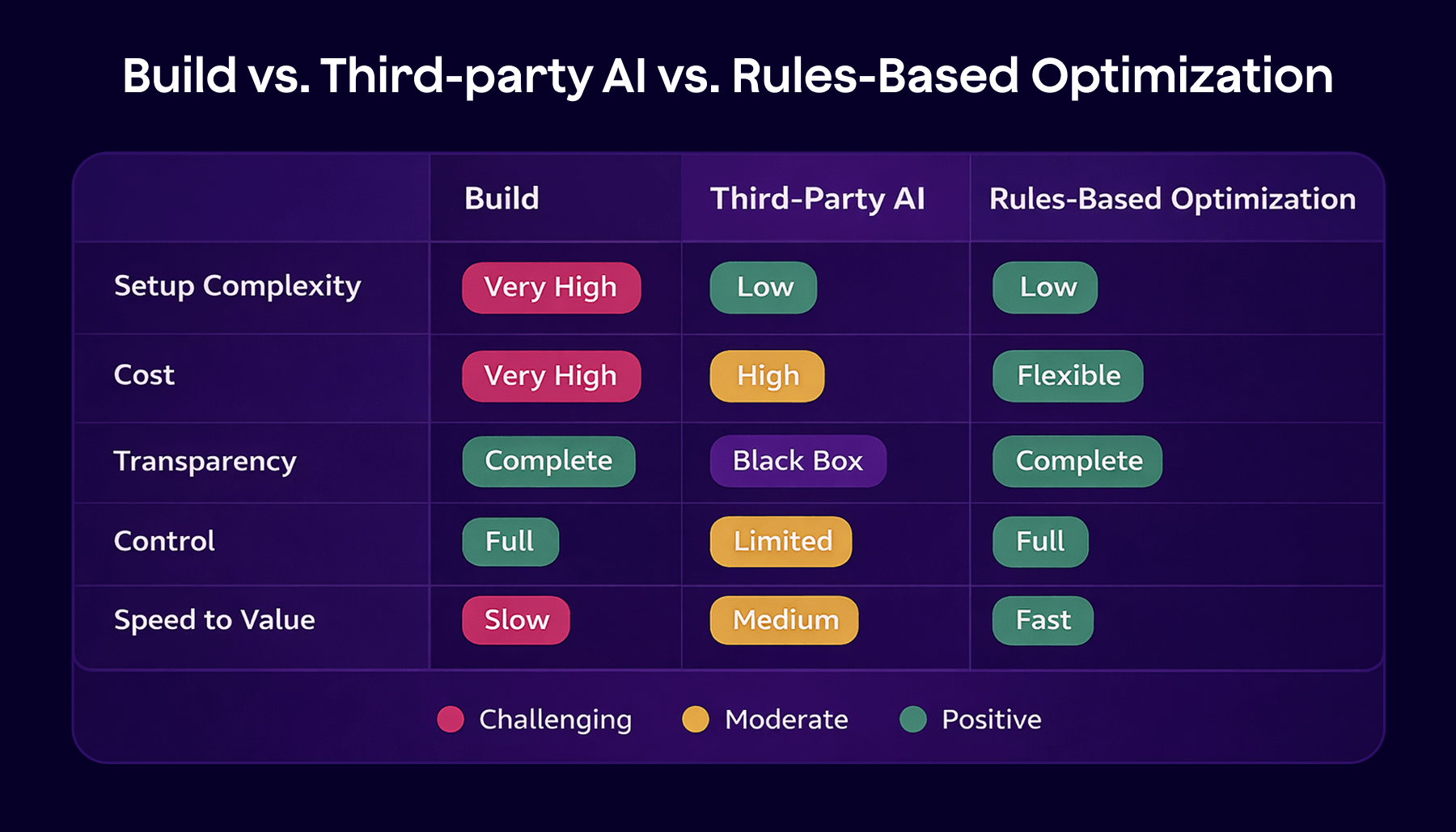
Most teams choose one of three paths. Each path fits a different maturity level.
Part #1. Proprietary AI development
This means building your own ML models on top of your own data infrastructure. This gives you maximum control and competitive differentiation. It also requires data scientists, engineers, and a dataset large enough to train meaningful models.
This is not a realistic path for most mid-market operations.
Part #2. Integrating third-party AI via API
Perhaps, it is the approach most programmatic platforms take. They connect to external AI tools for fraud detection, audience data, or creative optimization and surface the results through their own interface.
Lotame for audience targeting, Pixalate for invalid traffic detection: these are real integrations that add genuine value. The key question is whether you retain access to the underlying data to drive your own ad monetization decisions, or just see a summary score.
If you are weighing how much platform control actually matters at your scale, the white-label DSP vs self-serve breakdown covers that trade-off in practical terms.
Part #3. Rules-based automation with optimization layers
Most agencies want AI for programmatic advertising to be very clear. They don’t want something confusing, something no one understands. You set your bidding rules, change prices, and set speed limits, and the platform should get better results while following those rules. Review campaign data weekly. Adjust. This is effective programmatic advertising without the black box.
According to Gartner's 2025 Marketing Technology Survey, 67% of marketers say controllable automation outperforms fully autonomous AI tools in terms of campaign ROI and team confidence.
A simple “build vs buy” snapshot helps.
The Future of AI for Programmatic Advertising
A few trends will shape how AI and programmatic advertising evolve through 2026 and beyond
The media buying workflow is about to get a co-pilot
AI agents in media buying are starting to move from experiment to production. These are systems that can execute multi-step tasks, not just single-variable optimization. Research an audience, draft targeting parameters, allocate a budget, and report back. Not here yet at scale, but directionally clear.
The cookie is dying. Predictive modeling is filling the gap.
Cookieless modeling is where ML has a genuine, near-term role to play. With third-party cookies declining, predictive models built on first-party data and contextual signals are becoming the primary targeting infrastructure. The programmatic advertising platforms investing here now will have a meaningful advantage in 18 months.
CTV is where AI optimization has real room to run
AI plus CTV expansion is accelerating. According to EMARKETER, connected TV ad spend will exceed $38 billion in the U.S. by 2026. Advanced predictive analytics for CTV audience modeling and frequency management is one of the more legitimate AI applications entering the ad tech market right now.
Generative AI for creatives: Still early, already useful
It is too early to speak about the proper use of GAI in predictive creative testing. However, the promise is huge. The idea is straightforward: instead of testing three creative variants manually, use AI models to generate and pre-score dozens of variants before any ad dollars are spent.
Based on Epom observations, this kind of creative optimization workflow is becoming a meaningful differentiator for performance-focused agencies. Also, the platforms that win here will support evolving optimization strategies, not lock buyers into one “AI engine.”
Should You Choose an “AI DSP”?
Every DSP is an AI DSP now, according to their marketing. So the question is not whether a platform uses AI. It is whether the AI serves your goals or theirs.
Use this checklist before committing to any programmatic advertising platform that leads with AI claims:
- Do you get access to raw campaign data and auction logs, or only summary reports?
- Can you set your own bidding rules and override algorithmic recommendations?
- Does the platform let you connect to your own ad sources and use your own data?
- Is there a white-label option that lets you own the platform rather than rent it?
- Can you add your own fraud checks, audience tools, or data systems using your own software connections?
And the real punchline: if advertising were cooking, many platforms would sell you the finished meal. An ad server gives you the kitchen. Sure, you still need ingredients and a bit of skill, but the results are yours.
Want to understand how Epom's infrastructure supports your AI and optimization strategy?
Get In Touch