
TL;DR:
- Hybrid Execution: Top agencies leverage platforms like Epom DSP to combine programmatic scale with direct buying control, eliminating manual inefficiencies.
- Budget Agility: The traditional 70/20/10 budget framework now requires weekly AI-driven incrementality testing rather than quarterly reviews.
- Global Planning: Centralized global strategy paired with localized creative execution drives the highest engagement and ROI.
- Emerging Formats: Connected TV (CTV) and retail media are the fastest-growing channels for capturing high-intent audiences with precise attribution.
It’s a tough time for ad agencies. The overwhelming amount of ad tech software, AI tools, and information has made the field twice as accessible and, at the same time, a thousand times more competitive.
But the ad dollars keep rolling, and the profits keep going, so simply quitting the digital media buying field is hardly an option either. As Chris O'Hara noted in AdExchanger's breakdown of the dying transactional RFP business, publishers can spend an average of 1,600 man-hours a month churning through RFPs that have merely a 25% average "stick rate"—making manual Insertion Orders (IOs) a massive waste of agency hours compared to API-driven direct integrations. In 2026, media buying is all about strategic planning and smart execution, and that’s what we’re gonna teach you to do here.
We will cover global industry data—including how total global digital ad spend is shifting by reaching $1.06 trillion in total with digital capturing a 69% share according to Dentsu's mid-year 2026 forecast—alongside programmatic vs direct ads, budget allocation, and hidden tactics in advertising campaigns. All in one guide, so enjoy!
Programmatic vs. Direct vs. Programmatic Guaranteed
| Buying Environment | Execution Speed | Pricing Model | Brand Safety | Best Use Case |
|---|---|---|---|---|
| Open Programmatic | Real-time (Milliseconds) | Dynamic CPM (RTB) | Variable (Requires SPO) | Scalable reach & prospecting |
| Traditional Direct | Slow (Manual RFPs/IOs) | Fixed CPM | 100% Guaranteed | Premium homepage takeovers |
| Programmatic Guaranteed (via Epom DSP) | Automated (API-driven) | Fixed CPM | 100% Guaranteed | Premium placements with automated execution |
What Are the Top Media Buying Trends in 2026?
To better understand media buying in 2026, we’ll first have to set the stage with global data.
By annual tradition, the global advertising spend is reaching another record high this year, according to recent data from eMarketer's summary of Dentsu's 2026 global ad spend report. The estimates differ, but most point to $1.1 trillion at the beginning of 2026, a 5.1% increase since last year. More budget is at play than ever, so the competition for the audience's attention is fierce.
In this day and age, everyone’s buying across multiple channels, so the best way to think is in buying environments such as programmatic and direct.
Programmatic Advertising
The simplicity, speed, and scalability of programmatic advertising have made it the default mode of buying digital media. By 2022, programmatic media buying (via automated real-time bidding platforms) already accounted for 84% of total digital ad spending, and forecasts show it rising to 87% by 2026.
But what makes a programmatic media buying strategy?
“The key to a successful online media buying strategy lies in combining data-driven decisions with advanced technology to optimize ad spend and maximize campaign impact. That’s where programmatic advertising shines. Modern demand-side platforms make execution easier than ever, letting the ad agencies focus on creating working strategies and compelling creatives.”

Direct Advertising
Contrary to what some media buyers think, traditional direct media buying is far from being dead either. Direct is much smaller in size, but that only makes it more valuable for its main purpose: premium placements and guaranteed deals.
Direct lets you know exactly where your ad appears. It gives the advertisers a sense of certainty and security, which is highly valued in the age of ad fraud and fragmentation.
Truth be told, modern media buying isn’t an “either/or”; the smartest approach is to use both programmatic and direct. In 2026, it’s common to run: open auction programmatic for scalable reach, private marketplaces for clean premium inventory, and direct deals for guaranteed placements.
As a result, media buying platforms evolved into hybrids as well. DSPs can run deals that feel “almost direct” (e.g., programmatic guaranteed). Ad servers can connect to programmatic pipes or, in some cases, even implement RTB.
Why Strategy Matters More Than Ever
“Media buying strategy” is a nice buzzword, but once you dig deeper into the problem of wasted ad spend, you realise why all of this talk of direct and programmatic matters.
According to Epom’s research, marketers report that a significant chunk of spend doesn’t drive results: on average, approximately 20% of annual digital marketing spend is wasted on things like non-viewable impressions, incorrect targeting, or bot traffic.
Moreover, most marketers believe that up to 30% of their marketing budget could be wasted in vain without careful optimization. That’s why in 2026, efficiency is the new mantra of ad tech.
The global data shows us that ad tech has more money and automation than ever, but also highlights the need for a thought-out strategy.
Media Planning vs Execution for Agencies
To start off, a successful media buying strategy consists of media planning and buying (execution). The distinction is crucial.
Media planning is more of a strategic process. It’s all about defining target audiences, setting campaign objectives, selecting channels, and mapping out a media outlet mix and schedules.
Traditional media buying is the tactical execution. It implies negotiating with publishers or activating programmatic campaigns, placing bids, and optimizing in real time.
Why does it matter?
In short, the variety of ad tech solutions has made the execution aspect much easier than it used to be. To stand out among the crowd, many agencies differentiate themselves as strategic advisors.
“The excessive problem of media fragmentation has made planning a cohesive marketing strategy much harder and more critical than ever. Rather than just pumping up volume, the new competitive edge for most marketing agencies lies in providing high-impact, research-backed content and strategy. Simply put, the agencies are redefining their value, helping clients with broader media strategy, data analysis, and creative insights, instead of acting as mere middlemen buying ad placements.”

In practice, an ad agency (media planners) is now expected to advise on:
- Which markets to enter;
- Which channels to prioritize for a given campaign;
- How to integrate campaigns across channels;
- How to adjust messaging per audience segment.
Of course, the execution is still important. But once again, AI can set up ads and manage bids; build a cohesive media planning process – not so much.
Global Marketing Strategy vs Local Media Buying
Now that we’ve established what a modern, successful media buying agency does, let’s dive into specifics.
The most important strategic consideration for any sizable brand or agency is how to manage global versus local media buying. Companies that operate in multiple regions often face the same dilemma:
“Should we run a single global ad campaign for efficiency and consistency, or tailor campaigns to each local market for relevance?”
On one hand, global strategies excel in efficiency. They’re easier to implement and require less tailoring.
On the other hand, local media buying is the king of engagement; it beats global in traffic, conversions, and sometimes even efficiency.
Global is far more sensitive to ad regulation and audience behaviors, with regional compliance costs and conversion rates varying by margins that are highly fragmented across platforms (as universal industry-wide conversion benchmarks remain unverifiable without relying on vendor-specific data). Some markets respond much better to specific advertising channels.
The best answer is usually a balance – a “glocal” approach that combines a unified strategy with local adaptation.
That much should be clear. But how does this hybrid approach work?
- Central planning, local execution
The winning formula for many agencies is to set overall objectives and messaging at a global level and then let local teams take the lead in execution.
It’s quite simple: the global plan dictates the core message, theme, and channels; local media buyers adjust the plan to fit in their specific market.
- Localized creatives
Even if media buying is done centrally through a single DSP or agency trading desk, smart advertisers feed in multiple creative variants for different regions. The image that works in the US might fall flat in APAC.
Local language, cultural references, and even memes/sense of humor – all of these are far more likely to be relevant.
- Global buying power, local market rates
The benefit of a global approach is being able to find and negotiate bulk deals and package buys. The global spend lets advertisers access discounts that are simply not available in the local market.
The latter, however, is much more flexible. If one region underperforms, it’s much easier to detect the gaps and reallocate budget to a higher-ROI market, rather than stick to a global split.
Buying Process: Budgets, Measurement, Diversity
Now to the meaty part – money. The sheer size of the budget doesn’t guarantee success, especially with the modern economic pressures and rising media costs. So, how do you manage budgets smartly?
70/20/10 Framework
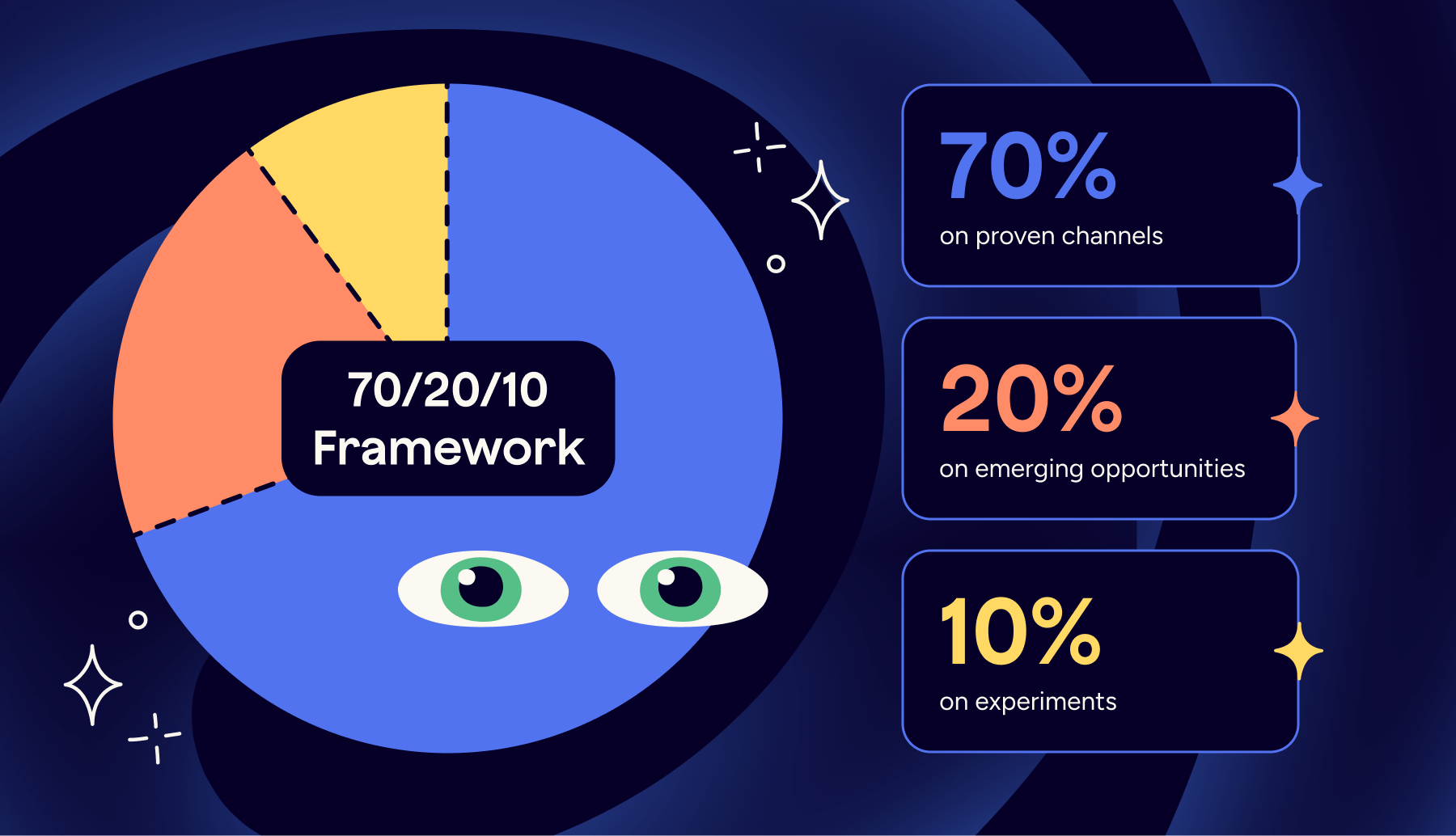
These days, the most popular and effective framework is the 70/20/10 rule. Here is how modern agencies structure it:
| Allocation % | Channel Types | Risk Level | Reallocation Frequency | Goal |
|---|---|---|---|---|
| 70% (Core) | Search, Retargeting, Proven Traffic Sources | Low | Quarterly | Predictable attribution; CPA below revenue per customer. |
| 20% (Emerging) | New Platforms, Untested Audience Segments | Medium | Monthly to Quarterly | Test and grow; potential pipeline for future core channels. |
| 10% (Experimental) | Viral Trends, Startup Tools, Bold Ideas | High | Weekly to Monthly | High risk/high reward; keeps media buying fresh. |
The 70/20/10 rule is a new meta for marketing playbooks, but it has its nuances. Epom specialist advice reviewing performance by channel monthly and tweaking the budgets quarterly (as a minimum).
Don’t wait too long to reallocate and be flexible. If you see the 70% core underperforming, don’t hesitate to reallocate into a better channel.
Aligning budgets with the funnel objectives is a non-negotiable key. Lower-funnel conversion goals and upper-funnel awareness should work together.
And of course, all your traffic options should be reliable. Where do you buy traffic without bots and hidden fees? We’ve made a list of the 80 best options, and you can access it for free.
Discover Top 80 SSPs on the Market
Read hereIndependent Measurement
One more thing, the attribution in modern ad tech is having its share of problems. That’s why the most prominent 2026 trend is increased use of independent measurement.
That means moving beyond platform metrics and utilizing unbiased third-party data to judge campaign performance. Walled gardens like Google and Facebook often attribute conversions to themselves or limit the amount of data you can see in the platform.
Industry reports, such as those from the IAB's 2026 State of Data report, state that reallocating the budget according to incrementality helps massively improve ROAS in a short period of time. If enabling more third-party software in an increasingly complicated ad tech stack isn’t your thing, then you can utilize more subtle tricks.
For instance, techniques like geo-testing (turning off ads in a random geography to see what lift disappears) or holdout experiments can reveal where spend is actually incremental.
Media Diversity
It should come as no surprise that diversity in your media mix is beneficial, to say the least.
Don’t put all your eggs in one basket. Advertisers using a balanced mix of traditional and digital channels see more consistent success.
For instance, many advertisers keep forgetting about traditional media channels like TV, radio, print, and outdoor. They still hold a significant sway, especially for broad reach. DOOH advertising could provide an offline + online boost that significantly amplifies brand building.
You might be tired of terminology like “omnichannel strategies,” but the rule stays the same: it’s better to reach target audiences multiple times. Let your message follow the user across multiple screens.
To sum up, effective budget allocation in media buying (as everything these days) is dynamic and data-driven. Start with a 70/20/10 framework, align it to your funnel goals, and keep a hand on the pulse of analytics data.
5 Best Tactics and Practices of Media Buying
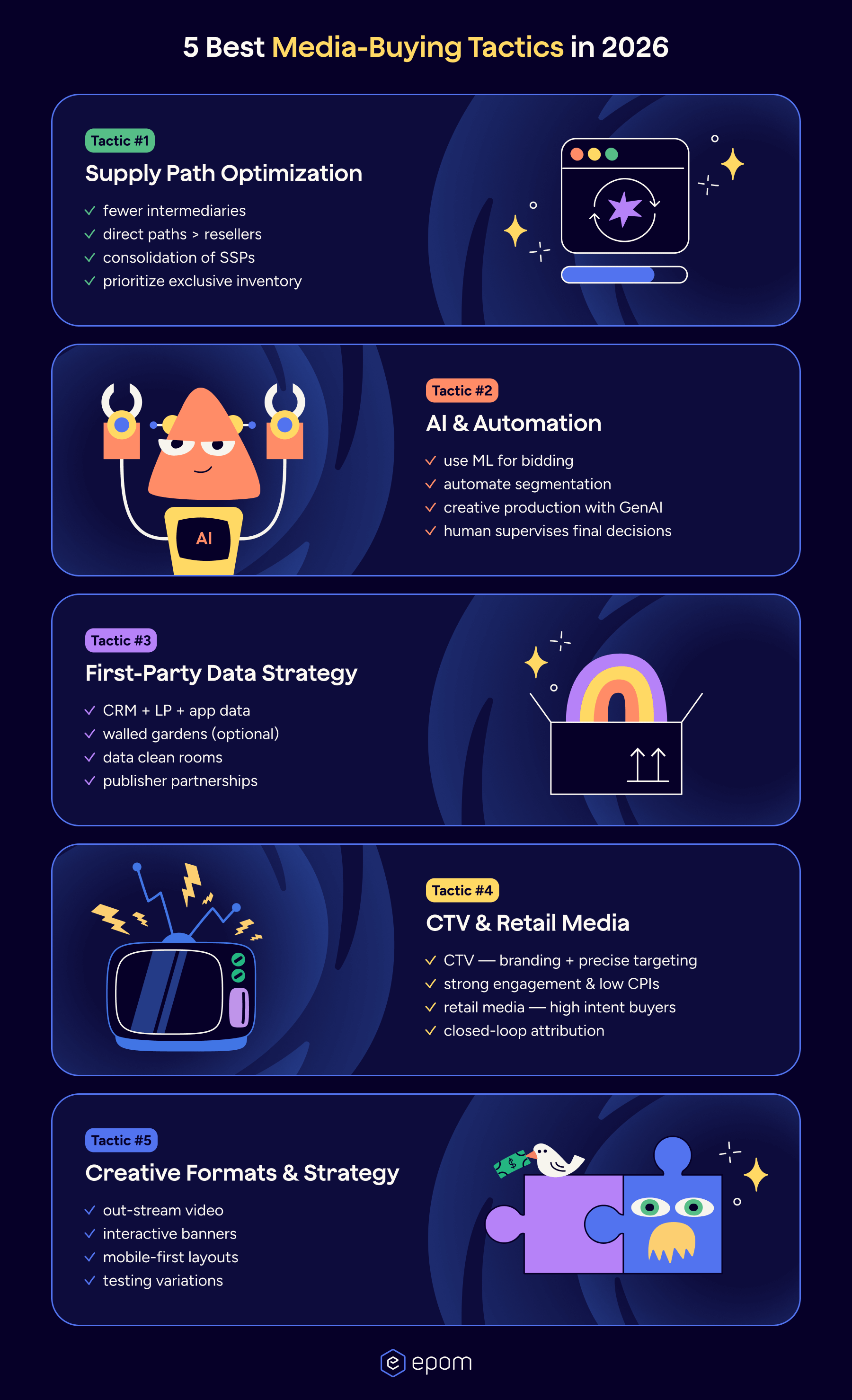
The fundamentals are covered; let’s move on to more advanced strategies and fresher media-buying tactics in 2026. These are areas and practices that agencies should pay attention to, according to Epom’s research and latest industry trends:
Tactic #1. Supply Path Optimization
As mentioned in our SPO guide, supply-path optimization is a strategy advertisers use to find the most efficient and cost-effective ways to buy digital ad space.
Over the past few years, programmatic advertising has continuously been crowded with SSPs, exchanges, and resellers. SPO is a mix of methods to solve that.
For instance, in one case study, a media buyer audited 40,000 programmatic supply paths and then optimized bids to favor the leanest paths. The result? A 40% reduction in CPM cost, all while maintaining the same viewability and completion rates.
It’s important to understand that SPO isn’t a magic automated algorithm to fix all the issues in under 10 minutes. When using advanced platforms like Epom DSP, it involves a scrupulous audit of your traffic sources and connections:
| Traditional Supply Path | Optimized Supply Path (SPO) |
|---|---|
| Fragmented SSP and ad exchange stack | Consolidated SSP and ad exchange stack |
| Bidding on all available inventory | Sticking to bids with the highest winning chances |
| Buying through multiple resellers | Making filtered lists for SSPs that sell directly |
| Open auction dependency | Prioritizing sellers who offer exclusive inventory |
Tactic # 2. Cautious Implementation of AI and Automation
It’s no secret that in 2026, AI is the only thing on the advertisers’ minds. According to a 2026 digital advertising trends survey, 46% of marketers now use AI to scale creative production, and 33% are using AI across creative, media buying, and measurement workflows.
And while everything with the badge “AI-enhanced” sells better, you have to understand the purpose behind using machines in the first place. A lot of marketers classify it just like that – “initial testing of the technology.”
In simpler terms, use AI to add value. Machine learning within platforms like Epom DSP works exceptionally well for bid optimization and audience segmentation, often achieving an average 5x ROAS ($5.40 per dollar spent) as seen in recent platform data from The Trade Desk's Kokai AI, but human oversight is still required.
Tactic # 3. Invest in First-Party Data
Due to Google’s hesitations, third-party cookies are still here, but the writing is on the wall: first-party data strategy is the new norm.
First-party data is accurate, up-to-date, compliant, and invokes actual trust. That much is understandable, but how do you collect first-party data as an ad agency? We suggest:
- Using walled gardens (if you prioritize accessibility over freedom);
- Collecting first-party data directly from landing pages, app engagements and CRMs;
- Partnering with reliable open web publishers;
- Trying your hand at data clean rooms;
- Getting access to data co-ops and media networks;
Tactic # 4. Focus on CTV and Retail Media
Yes, CTV advertising is not ideal, and we’ve already touched on its problems. Neither is retail media. But the challenges that both these channels provide can be solved, while their benefits are worth it in 9 out of 10 cases.
CTV combines the emotional power of TV with digital targeting, making it central to branding campaigns. In the U.S., CTV spend hit $40B in 2024, and 70% of CTV advertisers plan to increase budgets further. CTV is the king of viewability and engagement, boasting a Video Completion Rate (VCR) of 95.80% compared to just 81.70% for desktop and 80.70% for mobile compared to traditional display advertising.
Retail media doesn’t fall behind. Ads run directly on e-commerce sites or apps like Amazon, Walmart, and Target and continue to grow at double-digit rates globally, a trend heavily tracked by eMarketer's retail media ad spending forecast, which projects US omnichannel retail media reaching ~$71B. These channels offer high-intent audiences and closed-loop attribution, making them a goldmine for performance marketers.
Tactic # 5. Creative Strategy and Formats
And lastly, don’t be afraid to experiment with digital ad formats. There is a use for every ad placement, but in 2026, ad agencies mostly focus on engagement-first formats like out-stream video, interactive banners, and mobile-first designs.
For instance, out-stream video, which plays within non-video environments, tends to deliver higher click-through rates due to better integration with content feeds.
Conclusion: What Smart Agencies Do Differently
Here is the definitive recap of 2026 media buying strategies:
- Media buying is more strategic than ever. In a $1.1T+ ad market, success depends on thoughtful execution, strong planning, and smart use of programmatic and direct buying channels.
- Programmatic media buying strategy dominates due to its speed and scale, but it’s most effective when paired with direct buys for premium, guaranteed placements.
- Media planning & buying should be split clearly: Media planning strategy = audience targeting, channel mix, campaign goals, budget allocation. Execution = bidding, optimization, reporting.
- Global vs. local media buying strategy: Global planning gives consistency and volume deals. Local execution boosts engagement and adapts to cultural and legal nuances. The winning play is a “glocal” approach: central planning + local creative + geo-level optimization.
- Effective budget allocation in media buying = flexibility + structure: 70% on proven channels (search, retargeting), 20% on growth opportunities (new audience segments or online platforms),10% on bold experiments (viral trends, emerging tech, small social media channels).
- Reassess performance monthly; adjust budgets quarterly. Use independent measurement tools to validate platform metrics and uncover true ROI.
- Media buying activities should be diversified: A mix of digital and traditional media delivers stronger results across the funnel.
- Supply Path Optimization (SPO) cuts waste by streamlining programmatic supply chains.
- AI helps automate media buying, but human oversight remains critical. Use AI for bid management and segmentation, but ensure it aligns with brand and campaign goals.
- First-party data and contextual targeting are replacing cookies: Build your own audiences through CRM, landing pages, and apps.
- Emerging formats matter: CTV and retail media are fast-growing channels with high-intent audiences and precise attribution.
- Creative still drives results: Out-stream video and interactive formats outperform static banners.
Agencies that leverage AI-driven incrementality and strict supply path optimization will dominate the 2026 landscape. By executing these strategies through a robust platform like Epom DSP, media buyers can automate the heavy lifting of real-time bidding and programmatic guaranteed deals, freeing up critical hours for high-level strategic planning.
Make the first step toward successful media buying with Epom DSP
Apply for a free trial