


Ad revenue is the income publishers earn from displaying ads on their websites, apps, or OTT properties. It depends on three variables: how many impressions you serve, what advertisers pay per thousand (eCPM), and how much of your inventory actually fills. Most publishers lose a lot of money not because they have few visitors, but because of bad minimum pricing, weak competition for ads, and scattered reporting. An ad server gives you a single view and control over delivery to fix these problems and increase earnings.
Here's a number worth sitting with: global digital advertising spending surpassed $750 billion in 2025, according to eMarketer, which is more than three-quarters of all media spend worldwide flowing through digital channels for the first time in history.
And yet, ask most mid-market publishers how much of that flows their way. You'll hear the same familiar lines. "My RPM keeps fluctuating." "Impressions are up but revenue is flat." "We switched ad networks twice and nothing changed."
That gap between the industry's total ad revenue and what lands in your bank account? That's what this guide solves.
We'll cover what ad revenue actually is, how to calculate it with a free interactive calculator, the most common reasons publishers underperform, and what fixes actually stick, from fill rate fundamentals to ad server infrastructure. Whether you're monetizing a news site, an app, or a video property, the same logic applies.
What Is Ad Revenue? A Publisher's Definition
Ask ten people in ad tech to define ad revenue and you'll get ten slightly different answers. Here's the one that matters if you're on the sell side.
Ad revenue is the monetary income you generate by displaying ads to users on your website, app, or video content. Advertisers pay to reach your audience. You collect that payment, directly or through an automated exchange. Simple premise. Less simple execution.
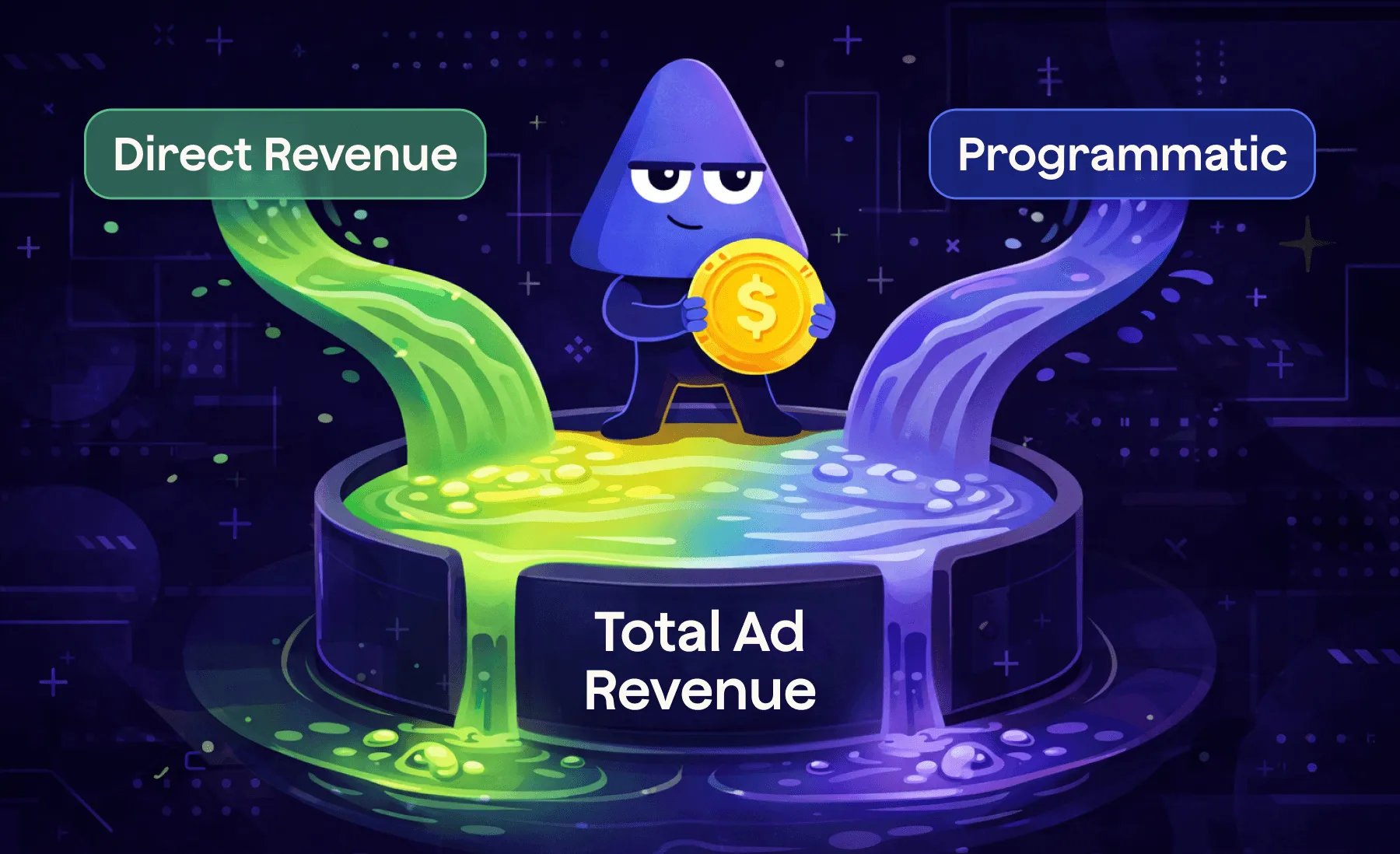
To understand how ad revenue works for publishers, it helps to split it into two streams:
- Direct advertising revenue comes from deals you negotiate personally with brands or agencies. You set the price, the placement, the duration. Direct ads typically earn 2–3x more per impression than programmatic placements. The trade-off: active sales effort and unsold inventory risk if campaigns don't renew.
- Programmatic advertising revenue is automated. Your inventory connects to supply side platforms and ad exchanges, which run real-time bidding auctions each time a user loads a page. Lower average CPMs than direct, but far better fill rate across a wider inventory pool.
Most publishers run both. Your total ad revenue is a sum of direct sold revenue and programmatic sold revenue. The ratio between the two shapes your revenue ceiling more than traffic volume does.
Ad revenue is a crucial source of income for website owners, app developers, and news organizations alike. It funds content, infrastructure, and teams. And it's one of the most systematically undermined revenue streams in digital media, usually not because of bad content, but because of bad configuration.
The Three Metrics That Drive Ad Revenue
Before you can increase ad revenue, you need to know what moves it. These three numbers are your core dashboard.
- eCPM (effective cost per mille/thousand) is what advertisers really pay for every 1,000 views after fees. It shows how valuable the audience is. Advertisers pay more for viewers in certain areas and groups, with top markets like the US, UK, and Germany having much higher eCPMs Niche verticals like finance and B2B also see higher CPMs due to advertiser competition for those specific segments.
- RPM (revenue per mille) is your actual revenue per 1,000 page views, after fill rate, after platform fees, after everything. This is the real performance metric. It tells you how efficiently your ad inventory is monetizing your existing traffic.
- Fill rate is the percentage of ad requests that actually served an ad. A 100% fill rate at $1.00 eCPM outperforms an 80% fill rate at $1.50 eCPM. Many publishers chase eCPM alone and bleed revenue through the fill gap.
The confusion between RPM and eCPM trips up a lot of publishers. RPM accounts for your fill rate. eCPM doesn't. That's the whole difference, and it's a meaningful one at any real scale.
How to Calculate Ad Revenue
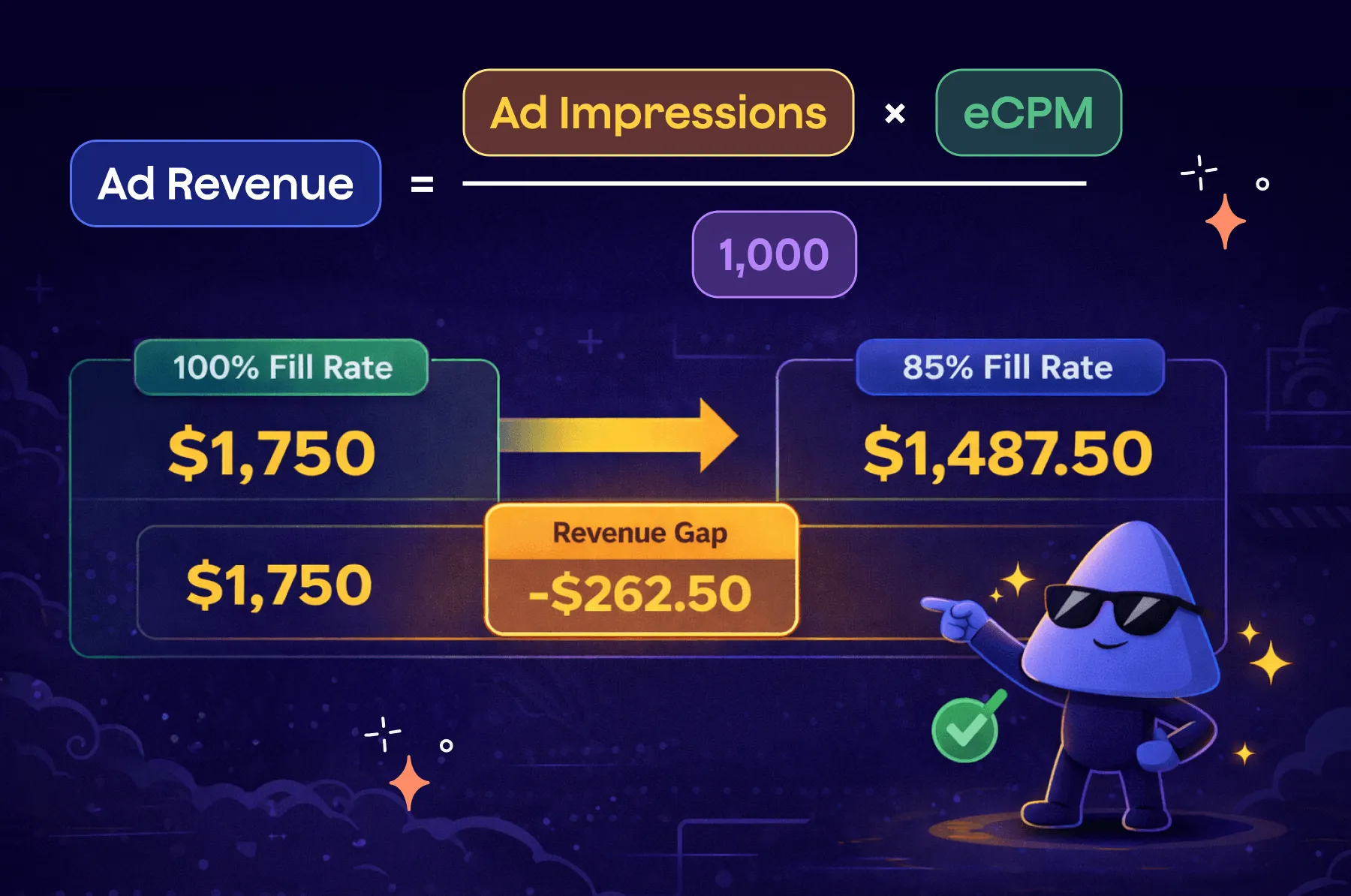
The core formula every publisher should have memorized:

A quick worked example. You serve 500,000 impressions per month at a $3.50 eCPM:

Now factor in fill rate. At 85%:

The $262.50 difference each month shows how much money is lost because inventory isn't filled, even before making any other improvements. Over a year, that adds up to more than $3,100 lost with average traffic. With 5 million monthly views, the loss is $26,000.
To calculate total ad revenue across multiple ad units, sum each unit's output. A news site running five placements, header, mid-article, two mobile slots, and a sidebar, has five separate calculations feeding into one total. How to calculate ad revenue manually across that setup, at any meaningful volume, is exactly the kind of work that lands publishers in spreadsheet hell.
The formula is simple. The variables are not, especially at scale. That's where a calculator earns its keep.
Ad Revenue Calculator
Use this interactive website ad revenue calculator to estimate your monthly and annual ad revenue based on your current traffic, eCPM, and fill rate. Adjust the eCPM input to model what a $0.50 or $1.00 improvement does to your annual income.
Inputs:
- Monthly page views or impressions
- Average eCPM ($)
- Fill rate (%)
Outputs:
- Estimated monthly ad revenue
- Estimated annual advertising revenue
- Revenue increase with an extra $0.50 cost per thousand impressions
- Revenue increase with a 5% higher fill rate
According to Epom observations, publishers who increase their eCPM by $1.00 while keeping the fill rate the same often see 25–40% yearly revenue growth, not from more traffic. But from getting more value from their current inventory. The calculator shows this clearly: small improvements add up quickly when scaled.
Monthly revenue
$0
Annual revenue
$0
Revenue uplift scenarios vs. your current baseline
A website ad revenue calculator like this is most useful as a planning tool, not just for estimating. Try three scenarios: the current situation, a realistic increase in eCPM, and an improvement in fill rate. The difference between the first and third scenarios usually shows the plan forward.
How to Get Advertising Revenue From Your Website
There are four main routes to advertising revenue. Each has different economics, trade-offs, and operational demands.

- Direct deals. You sell ad space directly to brands or agencies at a negotiated CPM. Best for premium inventory and niche audiences. Direct ads earn 2–3x more per impression than programmatic placements. No exchange, no platform cut, no mystery about who's advertising on your property.
- Ad networks. A network aggregates advertisers and matches them to your inventory. Google AdSense is the entry point for most website owners. The trade-off: lower transparency, a platform take rate that reduces your effective CPM, and limited control over which ads appear next to your content.
- Programmatic / RTB. Connect your ad units to supply side platforms for real-time bidding auctions. Header bidding pushes this further; instead of sequential waterfall logic, it lets multiple DSPs bid simultaneously, which consistently produces higher eCPMs. Google Ad Manager is the most common management layer publishers use for this.
- Hybrid model. Most serious publishers combine all three. Direct deals fill premium positions. Programmatic handles the rest. For mobile app developers and OTT properties, rewarded video ads add a fourth layer, converting user engagement directly into revenue generated per session.
According to Statista, global digital advertising spending is forecast to reach $835.82 billion by the end of 2026. Publishers capturing a meaningful share of that aren't relying on one monetization channel. They're mixing direct, programmatic, and format diversification with active yield management, and measuring all of it in one place.
Why Your Ad Revenue Is Lower Than It Should Be
Here's the uncomfortable truth: most publishers aren't underperforming because of low traffic. They're underperforming because of how their inventory is configured. App ad revenue and website ad revenue suffer from the same structural issues.
Epom specialists consistently identify these five revenue killers when publishers migrate to a managed ad server environment:

- Low fill rate. Sit below 85% and you're leaving money on the table every single session. Unsold inventory is dead inventory, it generates zero income while consuming the same page load weight as filled placements. This is a demand problem, not a traffic problem.
- Weak demand competition. When one or two advertisers dominate your inventory, eCPM stays flat regardless of content quality. Having more buyers means more competition. More competition leads to higher prices per thousand views. This is basic auction logic, but many publishers overlook it when selling ads.
- Poor floor pricing. Set floors too low and advertisers bid the minimum. Set them too high and fill rate collapses. The optimal floor price by ad unit, geography, and format is where yield management earns its keep.
- Bad priority logic. Direct campaigns, programmatic, and ad networks running without clear priority rules means lower-value ads sometimes win slots meant for higher-value placements. This is a configuration issue, not a traffic issue.
- Limited reporting visibility. If you can't see which ad placements earn the most, which advertisers are underbidding, and which ad formats underperform, you're flying blind. News organizations that migrate to unified reporting consistently find 10–20% in recoverable revenue within the first analytics audit.
None of these problems require more traffic to fix. They require better tooling and more control.
Case Study: Gazeta Express, From Open-Source Chaos to Higher CTR
Now, let’s look at what fixing a bad tooling looks like with Epom. Gazeta Express is the most-visited news portal in Kosovo and one of the most prominent online media outlets in the Balkans. When they came to Epom, they were running on Revive, an open-source ad server that required constant manual maintenance, had no support, and was slowing down their website, killing both user experience and ad performance at the same time.
They needed a hosted solution with real targeting capabilities, proper support, and the infrastructure to serve more ad units without breaking page load speed. Epom Ad Server delivered all three.

Read the full Gazeta Express story
How to Increase and Maximize Ad Revenue
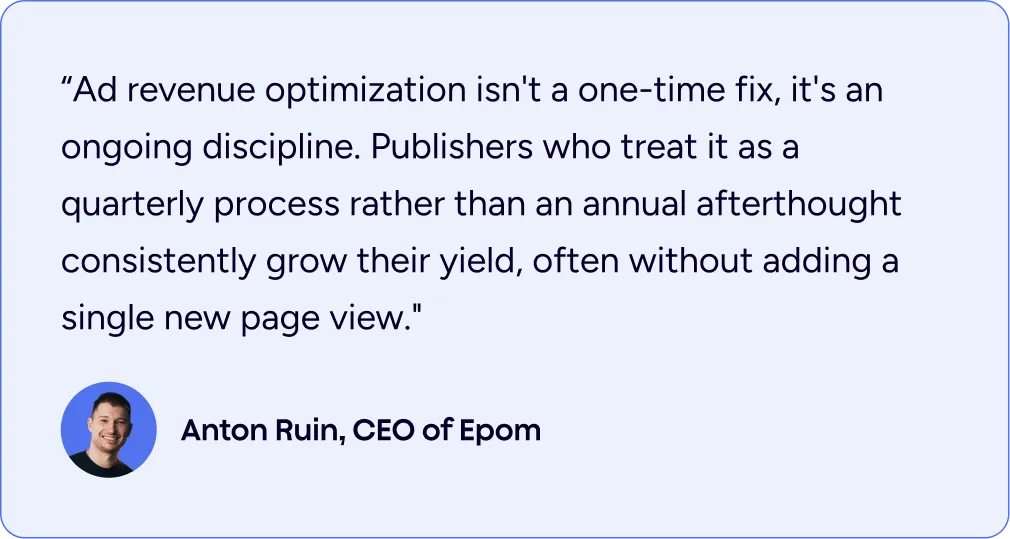
There isn’t one simple way to boost ad revenue. Instead, it takes a series of improvements that build on each other, and the order matters. Ad revenue optimization done right is a discipline, not a one-time project.
1. Fix Fill Rate Before Chasing eCPM
Start by making sure that over 90% of your ad spaces are filled. Make sure you bring in more buyers, enable backup rules, and connect to additional ad platforms. BTW, Empty ad spots mean lost revenue that higher prices can't make up for, so focus on this first.
2. Implement Header Bidding
Moving from waterfall to header bidding is one of the best steps a publisher can take. Our Header Bidding vs Waterfall guide covers the details. Simply put, letting several buyers bid at once often raises ad prices by 20 to 30 percent, even without more visitors.
3. Optimize Ad Placements and Formats
Ads placed at the top of the page, inside the article, and near popular parts get better CPMs. Viewability is important; it means at least half of an ad is seen for at least one second (two seconds for video ads). Ads that are seen more get more interest, which leads to higher CPMs.
Consumers are choosing more engaging ad types. Video ads and native ads regularly do better than static banners in both click rates and earnings per thousand views. Adding a video ad to a busy page is often the quickest way to boost ad revenue per visit without redoing your whole system. Using A/B testing to check ad placements helps find out which setups really work on your site, so don't skip this step.
4. Activate First-Party Data
First-party data is the key to maintaining strong ad prices as third-party cookies go away. Publishers who collect audience information through email newsletters, logged-in users, and content preferences will attract top advertisers willing to pay more for verified, well-defined groups. Your user demographics are likely more valuable than what you are currently charging.
5. Manage Direct vs. Programmatic Deliberately
There isn’t a single perfect ratio, but you can usually find a better one than what you have now. Based on Epom observations, publishers who check their direct and programmatic split every quarter and adjust floor prices as needed tend to do better than those who set it once and leave it. Cohesive ad revenue optimization strategies that align direct and programmatic incentives are what separate growing publishers from stagnant ones.
How an Ad Server Helps Optimize Ad Revenue
Most publishers using only Google AdSense or handling programmatic ads through one network miss key controls that directly impact earnings. An ad server is the system that makes ad revenue optimization a planned process, not a matter of chance.
Here's what a properly configured ad server actually does:

Unified reporting across all channels
Instead of logging into three platforms to understand where revenue is coming from, you see every direct deal, programmatic campaign, and ad network in one dashboard. That visibility alone tends to surface 10–15% in recoverable revenue during the first 30 days for publishers who migrate. The number of ad units, campaigns, and revenue generated, all in one place, in real time.
Transparent delivery logic
You control the priority rules. Direct campaigns serve first. Programmatic fills what remains. Remnant inventory goes to networks. No black box. No unexplained underperformance. You set the rules, you see the outcomes.
Dynamic floor price management
Set floor prices by geography, ad format, advertiser category, and time of day. Your news site at 8am EST during a breaking news cycle should have different floors than the same page at 2am CET. Ad servers automate that logic without manual intervention.
Automation without opacity
AI optimization in an enterprise platform is a black box, you see outputs, not decisions. With a properly configured ad server, every optimization rule is visible, editable, and auditable. That transparency matters for team accountability.
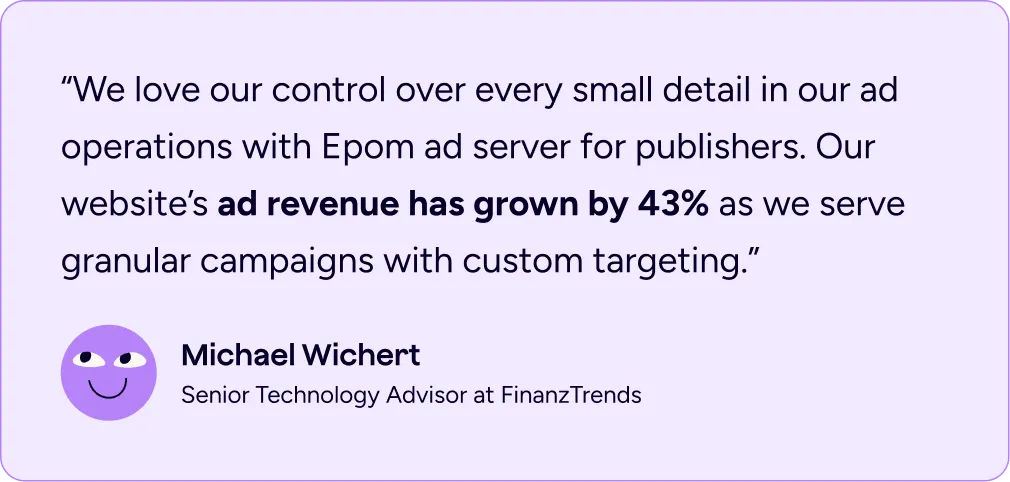
The results are concrete. Michael Wichert, Senior Technology Advisor at FinanzTrends, reported that after moving to Epom's ad server with granular targeting and advanced yield controls, his website's ad revenue grew by 43%. Same traffic. Better tooling.
According to eMarketer, digital ad revenues are expected to increase by double digits for the 16th consecutive year in 2025. Publishers with the infrastructure to capture a growing share of that total ad revenue will compound gains year over year. Those relying on basic monetization stacks will watch their share erode.
The table below shows what reporting looks like with and without an Ad Server, because seeing the difference is faster than explaining it.
| Metric | Without Ad Server | With Epom Ad Server |
|---|---|---|
| Revenue by ad placement | Manual, fragmented | Unified, real-time |
| Fill rate by channel | Estimated | Exact per source |
| eCPM by advertiser | Partial visibility | Full transparency |
| Direct vs. programmatic split | Spreadsheet-dependent | Automated |
| Revenue trend alerts | Manual monitoring | Configurable rules |
| Floor price optimization | Guesswork | Data-driven automation |
Unified reporting isn't a feature, it's how you stop guessing and start managing.
The Bottom Line on Ad Revenue: Fix the Leaks Before You Chase the Traffic
Ad revenue isn't a passive income stream. It never really was, but the gap between publishers who treat it that way and those who actively manage it has never been wider. Traffic gets you in the room. Yield optimization is what determines how much you leave with.
The publishers consistently growing their ad revenue in 2026 aren't necessarily the ones with the most page views. They're the ones who fixed their fill rate before chasing eCPM, who know their RPM by placement, and who stopped guessing when they could be measuring. Same inventory. Better infrastructure. Meaningfully different outcomes.
If the calculator above showed you a number that stings a little, good. That's recoverable revenue, not lost revenue. And most of it doesn't require more content, more traffic, or more ad units. It requires better visibility into what's already happening and the controls to act on it.
That's exactly what Epom Ad Server is built for.



![Video Ads for Website Publishers: Make More - Spend Less [+7 Best Ad Formats Inside]](https://cms.epom.com/api/media/file/video-ads-for-publishers-preview.webp)