

TL;DR:
- Definition: A supply-side platform (SSP) is programmatic advertising software that enables digital publishers to sell, manage, and optimize web, mobile in-app, native, and CTV ad inventory through automated real-time auctions.
- Core Function: Connects publishers simultaneously to multiple demand-side platforms (DSPs), ad exchanges, and ad networks to maximize bid competition, fill rates, and net eCPMs.
- Leading Platform Examples: Industry benchmarks include enterprise options like Google Ad Manager, OpenX, PubMatic, Xandr, Sovrn, and white-label hybrid infrastructure like Epom AdServer.
- Key Differentiators: Platforms differ substantially by fee structure (revenue-share take rates vs. flat monthly fees), auction latency, CTV capabilities, and first-party data control.
With US programmatic ad spend topping $200 billion in 2026 according to eMarketer, programmatic monetization is essential for publishers. However, maximizing revenue requires balancing demand fill rates against middleman fee margins and page latency.
A supply-side platform (SSP) serves as the core monetizing gateway for web and mobile publishers. Relying exclusively on multi-layered third-party SSPs incurs standard take rates of 10% to 20% per bid according to Digiday Research, whereas white-label ad server integrations like Epom AdServer operate on flat-fee pricing to protect publisher margins.
In this guide, we evaluate top supply side platform examples, analyze their architectural differences, and detail actionable criteria to maximize yield while retaining full control over first-party audience data.
| Platform | Architectural Type | Primary Focus | Fee Model / Take-Rate | Target Publisher Tier |
|---|---|---|---|---|
| Google Ad Manager | Hybrid SSP / Ad Exchange | Enterprise Web & Video Monetization | Variable Revenue Share | Enterprise Tier-1 |
| OpenX | Independent SSP | PMP & Transparent Header Bidding | Take-Rate % | Mid-to-Large Digital Media |
| PubMatic | Cloud SSP | Omnichannel & CTV Programmatic | Take-Rate % | Enterprise & CTV Broadcasters |
| Xandr | Enterprise SSP / Exchange | Data-Driven & Cross-Screen Buying | Platform Fee / Rev Share | Enterprise Publishers |
| Sovrn | Publisher Tech SSP | Commerce & Independent Web Monetization | Rev Share / Dynamic Pricing | Mid-Market & Independent Publishers |
| Epom AdServer | White-Label Ad Server + SSP | Complete Custom Control & Monetization | Flat Monthly / Volume Fee | Ad Networks & High-Volume Media |
What Is a Supply-Side Platform?
Programmatic advertising became a pivotal technology for digital marketing because it allowed publishers and advertisers to sell and buy digital ad space automatically. Real-time bidding (RTB) played a crucial role in this process. SSPs and DSPs serve opposite sides of the programmatic advertising market: the SSP represents the publisher (sell side), while the DSP represents the advertiser (buy side).
Before RTB, direct ad deals required manual price negotiations. RTB automated this ecosystem, allowing publishers to clear inventory through automated auctions in under 100–150 milliseconds.
In these real-time auctions, advertisers bid concurrently, and the highest bidder wins the ad placement. These transactions occur almost instantaneously on digital marketplaces called ad exchanges.
Every deal has two main parts: a publisher and an advertiser. Each of them accesses the auction via a specific platform. For advertisers, it is a demand-side platform (DSP). For publishers, it is a supply-side platform (SSP). To understand how the programmatic ecosystem functions in practice, it helps to look at DSP and SSP examples side by side.
So, an SSP is software that allows digital publishers to sell ad inventory, manage their digital ad space, and maximize ad revenue while getting more money for every ad impression.
According to Statista, global programmatic ad spend reached $595 billion in 2025 and is forecast to approach $800 billion by 2028. For publishers, this growth means the ad buying process is increasingly automated, and choosing the right supply-side tools has never been more consequential.
How Does SSP Work?
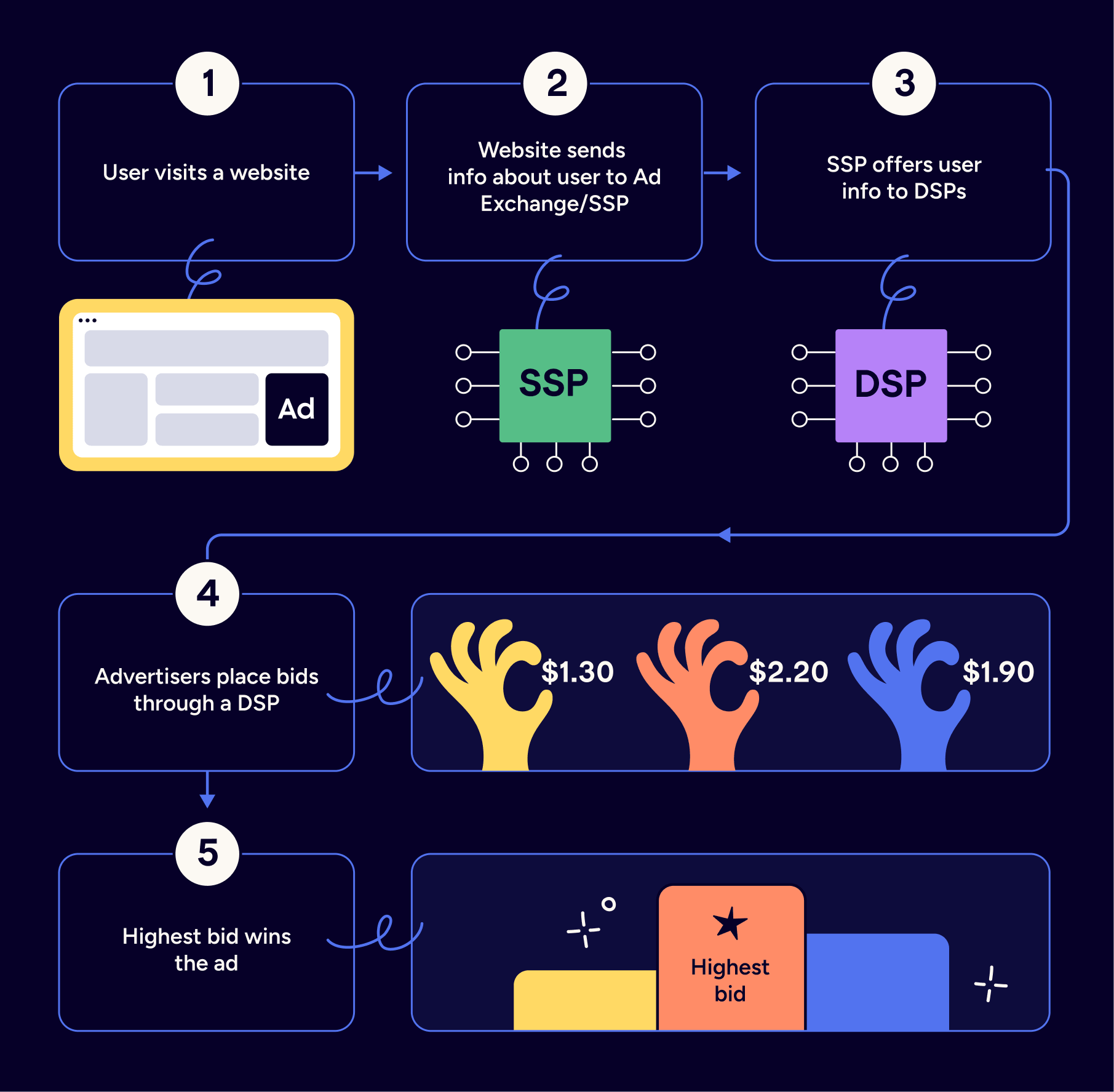
The process of selling and buying ads in each of the supply side platform examples looks like this:
- The customer visits the publisher's site or mobile app.
- The real-time bidding auction begins.
- The website accesses the SSP and sends an ad request.
- The SSP analyzes the data and makes a decision about ad space availability. Let us say it is a positive decision.
- The data goes to different DSPs via an ad exchange, and they make their bids.
- The highest bid wins, and the winning ad is shown to the customer.
As you can see, DSP and SSP are equally important pieces of the programmatic advertising technology puzzle. Header bidding allows publishers to offer inventory to multiple ad exchanges simultaneously, increasing fill rates and improving prices for every ad unit. Since SSP is our main topic today, let's proceed to its numerous advantages.
What Are the Benefits of SSPs?
An SSP is a critical element of the programmatic ecosystem for several reasons. One is that it helps publishers increase ad revenue without investing additional time and effort. The SSP's algorithms ensure the best price for ad space provided by every publisher.
According to eMarketer, programmatic will account for 96.8% of new digital display ad dollars in 2025. That makes the case for SSP adoption in the advertising industry stronger than ever.
Here are some other advantages of supply-side platforms:
- Automation of ad placement. An SSP can automatically access multiple demand sources and sell advertising inventory 24/7. Publishers can serve ads across multiple ad formats, including display, video, native ads, and rich media formats, without manual intervention.
- Lots of opportunities to sell. SSPs can connect to various ad exchanges, DSPs, and premium ad networks. As a result, they can reach many advertisers. Leading SSPs open access to multiple demand partners and premium demand partners that are otherwise difficult to reach directly.
- Better targeting. SSPs grant access to valuable data about potential audiences. Digital publishers can adjust their ad inventory and make it more suitable for visitors. Eventually, it helps increase eCPM and maximize ad revenue.
- Control over the ad inventory. Publishers can set a minimum price (the floor price) for each of their ad slots and change it when necessary, such as during high-demand seasons. SSPs can also help publishers block untrusted advertisers and focus on high-performing channels. Moreover, publishers can control the types of ads on their websites to ensure ads are consistent with their brand.
- Data access and reporting. SSPs allow publishers to better understand their audience and monitor ongoing campaigns. They can adjust their advertising inventory to optimize ad revenue. With an SSP's help, publishers also get insights about current advertisers: who is bidding on their digital ad space, how much ad inventory they buy, and how ad campaigns are performing.
To select the best supply-side architecture, publishers must understand the structural differences between third-party standalone SSPs and integrated white-label solutions:
Standalone SSP vs. White-Label Ad Server + SSP Architecture
| Feature / Metric | Standalone Third-Party SSP | White-Label Ad Server + SSP (e.g., Epom AdServer) |
|---|---|---|
| Fee Structure | 10%–20% Take Rate per transaction | Flat monthly fee / Low volume tier |
| First-Party Data Ownership | Shared with SSP and demand partners | 100% Private & Publisher-controlled |
| Latency & Control | Multi-wrapper client-side load delays | Direct server-side auction & tag management |
| Pricing Floor Flexibility | Basic dynamic floors set by SSP algorithms | Granular rule-based dynamic pricing controls |
| Custom Demand Integration | Restricted to supported demand sources | Open direct API & DSP/Exchange integration |
Now, let's explore the best supply-side platform examples in detail.
What Are the Top SSP Examples for Publishers
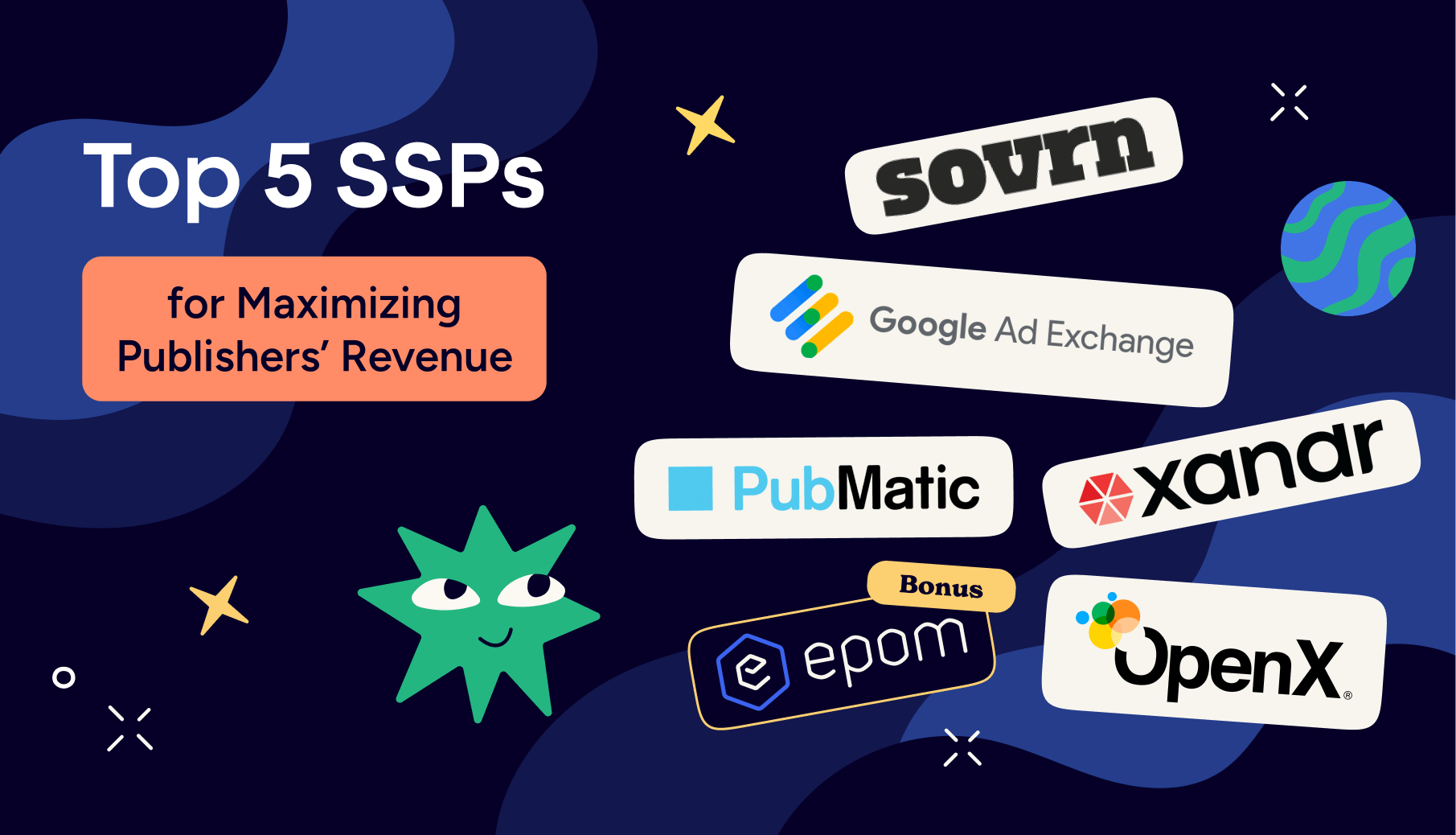
Since an SSP provides so many benefits for publishers, it makes sense to find out more about these platforms. In this section, we cover real-world SSP advertising examples and explain how each platform approaches inventory monetization differently. Here is an overview of the most popular options.
| SSP | Best For | Key Features | Notable Clients |
|---|---|---|---|
| Google Ad Manager | Large publishers | Multi-format, fraud protection, Google network | Conde Nast, Tinder |
| OpenX | Transparency-focused | Header bidding, private marketplace, brand safety | Ernst and Young, Samsung |
| PubMatic | Omnichannel, CTV | Premium header bidding, ad quality, fraud prevention | Toyota, FOX, Coursera |
| Xandr | Data-driven publishers | Cross-screen, precise targeting, multiple auction protocols | Seattle Times, Schibsted |
| Sovrn | Independent publishers | Ad blocking management, analytics, dynamic pricing | Mumsnet |
| Epom Ad Server | White-label SSP builders | Ad server plus SSP, white-label, 14-day free access | Custom |
1. Google Ad Manager

Google Ad Manager commands 76.4% supply coverage across DSP spend according to Jounce Media. Among its clients are global media companies like Conde Nast and high-traffic mobile apps like Tinder. See Google's Official Ad Manager Guidelines for enterprise setup.
It allows publishers to manage their ad inventory across websites, mobile apps, and multiple ad formats. Its advantages include:
- Advanced reporting features and a convenient dashboard.
- Many different ad formats, including display, video, and native.
- Safeguarding against fraud and malware.
- Access to Google's broad network of advertisers. Google Ad Manager also supports multiple third-party ad exchanges and networks.
Google Ad Manager is one of the top SSP platforms for large publishers. Among its clients are the publishing company Conde Nast and the dating app Tinder.
2. OpenX
OpenX is an omnichannel SSP known for its transparency. It provides a real-time bidding platform (OpenX Bidder), tools like OpenX Mobile and OpenX Video to access mobile and video ad inventory, and an audience segmentation tool (OpenAudience).
OpenX's advantages include:
- Header bidding that gives publishers an opportunity to offer ad inventory to multiple ad exchanges simultaneously before the main auction closes, resulting in higher bids and higher ad revenue.
- Access to premium advertisers via OpenX Private Marketplaces.
- Quality and safety control.
OpenX has many large clients, in particular consulting and financial businesses. Some examples are Ernst and Young, JP Morgan Chase, and Samsung Electronics.
3. PubMatic

PubMatic is a cloud infrastructure platform that offers publishers omnichannel monetization. Beyond display, video, and mobile ads, PubMatic is also pursuing the CTV format, which has been growing significantly in popularity. According to eMarketer, over 90% of all digital display ad buying is now transacted programmatically, and CTV is one of the fastest-growing segments within that shift.
Advantages of PubMatic include:
- Premium header bidding solution, along with real-time bidding.
- Ensuring ad quality through partnerships with ad quality enterprises.
- Tools for fraud prevention.
- Header bidding options available even for mobile and video ad inventory.
Many companies from retail, digital media, online education, and other industries choose PubMatic, including Toyota Motors, FOX, Kohl's Corporation, and Coursera.
4. Xandr
The former name of this SSP is AppNexus, and it is now part of the Microsoft Advertising ecosystem. It offers solutions for both publishers and advertisers, as well as the Xandr ad exchange. Xandr is known for its strong analytical capabilities and additional benefits:
- Cross-screen solutions covering display, video, and CTV.
- Precise targeting that guarantees ad relevance and quality.
- Support for multiple auction protocols to maximize flexibility in how inventory is sold.
There are well-known publishers among Xandr's clients, such as the Seattle Times, Ouest France, and Schibsted.
5. Sovrn

This example of a supply-side platform is attractive thanks to its advanced analytics and simplified installation and management, in addition to the header bidding feature. Sovrn allows publishers to:
- Manage ad blocking with the Ad Block Unblock tool.
- Monetize in-app data and other data types, such as information about visitors' locations.
- Analyze ad inventory performance, bids, advertisers' data, and ongoing campaigns.
Sovrn continues to introduce new features. In spring 2024, it announced a dynamic pricing tool that helps increase publishers' revenue by 10%. The online parents community Mumsnet achieved a 21% yield uplift as a result.
Bonus: Epom Ad Server

All the abovementioned example of SSP are strong alternatives for companies looking to monetize their ad inventory. But before moving on, it is important to note that an SSP can take many forms. It can be separate software or part of a bigger solution, such as an Ad Server.
There is also a type of software called a white-label SSP: an SSP built by one company that others can purchase and rebrand as their own. A white-label SSP eliminates the need to manage several SSPs, ad exchanges, and premium ad networks separately. One product allows publishers to reach enough demand partners and increase fill rates on their advertising inventory.
Epom's white-label solution is a strong example of an SSP combined with full ad server functionality. It adds the publisher's ad inventory to the supply of ad placements it offers, making it suitable for publishers who want centralized control over both serving and monetization.
Based on Epom performance benchmarks: publishers who pair a white-label SSP with a dedicated ad server achieve up to 10% to 20% net margin preservation by eliminating intermediary take rates compared to those relying solely on standalone SSPs, especially when managing cross-format ad campaigns across multiple demand sources.
How to Choose the Right SSP?
Every publisher is unique, even though one aspiration unites them all: the desire to maximize earnings. It is crucial to understand what factors matter most in your case. You can start with these questions:
- What are our needs? What inventory type can we work with (display, native, video, CTV, etc.)?
- What traffic volume can our websites, mobile apps, etc. generate?
- What is the geographical distribution of our visitors?
- What are the biggest problems of monetizing our ad inventory today?
When researching top SSP platforms, publishers should evaluate not just features but also support quality, pricing transparency, and integration flexibility. Transparency in pricing and reporting is crucial when selecting an SSP, as it directly impacts your ability to optimize ad revenue over time.
Then, consider the key components of an SSP you may or may not need:
- Support of header bidding
- Variety of ad formats
- Reporting tools
- Analytical tools
- Opportunity to optimize ad campaigns and maximize bids in real time
- Brand safety features
- Customization features
Publishers should also ensure platforms support multiple auction protocols (OpenRTB, Header Bidding, PMPs) to maximize sales flexibility.
To simplify selection, use the decision framework below to align platform capabilities with your operational tier:
SSP Selection Matrix by Publisher Tier & Business Goal
| Publisher Tier / Goal | Primary Architectural Priority | Recommended Platform Focus | Key Operational Benefit |
|---|---|---|---|
| Enterprise Media (100M+ impressions) | Unifying direct & programmatic sales | Google Ad Manager / Xandr | Maximum demand density & multi-channel scale |
| Mid-Market / Niche Web | High viewability & dynamic price floors | Sovrn / OpenX | Dynamic pricing rules & ad-block recovery |
| CTV & Mobile App Developers | High-bitrate video & in-app SDKs | PubMatic / OpenX | Low-buffering video programmatic yields |
| Ad Networks & Media Agencies | White-label branding & zero rev-share | Epom AdServer | Flat-fee pricing, full tech control, 100% data privacy |
Also, try some SSPs and assess how easy they are to use. Do you like the interface? Is the dashboard convenient enough?
Finally, pay attention to integration capabilities. Which SSPs can integrate with various ad exchanges and data management platforms? Publishers should also assess the responsiveness of an SSP to industry changes when making their choice, since the digital advertising landscape shifts quickly and ad tech solutions that lag behind can cost publishers real revenue.
After answering these questions, you will be on the right track to choose the best SSP for your needs.
How to Optimize Your SSP for Maximum Yield
To turn your SSP into a real money-making tool, you must study its features and use it wisely. Here are some tips that may help you achieve the best possible outcomes.
Tip #1. Set a Clear Goal
How much do you want to earn with your ad inventory? Make your goal ambitious yet realistic. Remember to consider your industry potential and benchmark against similar digital publishers in your niche.
Tip #2. Optimize Your Inventory
Create ad packages that attract premium advertisers. Organize your digital ad space and experiment with responsive ads across different ad formats. App developers and mobile app developers should also optimize in-app ad units separately from web inventory, since in-app ad slots often command different CPMs and require tailored floor pricing.
Tip #3. Pay Attention to Price Floors
Before setting minimum price floors, analyze historical bid density. Dynamic pricing floors based on real-time demand protect eCPMs by driving yield increases through automated bid-density optimization. Floors should vary by ad placement, viewability score, and geography.
Tip #4. Keep Improving User Experience
Every publisher benefits from optimizing page loading speed and meeting Google Core Web Vitals guidelines. SSPs allow publishers to cap ad frequency and mitigate ad fatigue, which directly protects CTRs and eCPMs over time.
As an Epom ad tech specialist puts it: "Publishers often underestimate how much revenue they lose to frequency fatigue. Controlling how many times a user sees the same creative is one of the easiest wins available in any SSP."
Multiple programmatic advertising examples prove that with all these tips in mind, you are fully equipped for the journey to higher ad revenue.
Conclusion
Selecting the right supply-side platform depends directly on your traffic volume, inventory format (web, mobile, or CTV), and preference between legacy revenue-share models or full architectural ownership. While standalone SSPs like Google Ad Manager, OpenX, and PubMatic provide turnkey demand access, high-growth publishers and ad networks increasingly adopt white-label solutions like Epom AdServer to eliminate middleman take rates and control first-party auction logic.
Summary Checklist
- Inventory Alignment: Match platform strengths with your core ad formats (e.g., PubMatic for CTV, OpenX for PMPs, Epom AdServer for custom ad network building).
- Cost Efficiency: Evaluate net eCPM yields after deducting standard SSP take rates (10% to 20% according to Digiday Research).
- Latency Control: Balance client-side vs. server-side header bidding implementations to safeguard Google Core Web Vitals and user retention.
Reviewing both DSP and SSP examples clarifies how the buy side and sell side of programmatic advertising coordinate in real time, and helps you make a more confident platform decision.
Luckily, many SSPs offer free trial access. For example, you can try all the features of Epom Ad Server for free before deciding if it is the right platform for your needs.