


Every time an advertiser pays to appear on your site, your ad network or SSP takes a cut before the money reaches you. You have probably done the math and felt the obvious pull: sell space directly, keep the margin, and stop paying the middlemen fee. But how?
Maybe you already found a few brands who want to buy placements from you tomorrow. Then comes the question that stops most publishers — what exactly you need to manage your own inventory independently instead of delegating its monetization?
This guide answers that question. You will learn what your ad inventory actually is, how to sort it into what is premium and what is not, how to price each placement so you are not leaving money on the table. By the end you will know what to set up, and in what order, before you commit to any ad server.
Publishers on Epom Ad Server report an average +40% revenue lift without increasing traffic. Open a free demo account and see what your placements are worth.
- Ad inventory management is how a publisher organizes, classifies, prices, and measures their ad placements to control what each one earns — distinct from monetization, which is simply selling that space to demand partners.
- It matters because monetization without management leaves money on the table. A 90% fill rate does not always mean optimized selling of each slot. You can be fully monetized and still underprice your best placements.
- Inventory splits into three tiers — premium, remnant, and unsold — where the tier is a decision you make. A high-value placement with no floor price is functionally remnant, regardless of what it could earn.
- Structure comes before optimization. The Site → Zone → Placement hierarchy is what makes placement-level floors, inventory packaging, and independent reporting possible. Without it, you optimize at the wrong level.
- The floor price gap is the most common source of silent revenue loss. When a placement clears consistently above its floor, every impression served since has earned less than it could.
- Aggregated reports hide the truth. Ad networks show blended numbers. You need placement-level, independent measurement to turn guesswork into real optimization.
What Is Ad Inventory Management?
Ad inventory management is how a publisher organizes, prices, and measures their ad placements to control what each one earns.
Your ad inventory is every ad placement you can sell across your sites, apps, or other placements. Each one has its own audience, format, and price ceiling. Managing it means knowing what each is worth, not just whether it is filled.
Why take this on yourself instead of just opting for monetization? There are three reasons publishers cite:
- Keep the margin a network takes.
- Control how much every placement earns.
- Own the advertiser relationship under your brand.
📖 Gazeta Express, the largest news publisher in Kosovo, faced the same choice. Google AdSense couldn't target their market. Ad networks weren't viable — the revenue share was too high. They moved to Epom, cut out the middlemen, and now run 200+ direct advertisers on their own terms, serving 2.1 billion impressions a year.
If your situation looks similar — decent traffic, but pricing and data controlled by someone else — see how they set it up →
The tool that makes ad inventory management possible is an ad server: the platform to host your inventory, price each placement, decide which advertiser wins each impression, and measure the result.
Your inventory may be bigger than you think. Beyond web banners, it now spans web and mobile app inventory, connected TV, digital out-of-home screens, AI chatbot placements, even Wi-Fi portals. Every one is a placement you could sell directly, worth only as much as your ability to see it, price it, and control what fills it.
Ad Inventory Management vs. Monetization
Monetization is when a demand partner buys your inventory and you get paid for the user seeing an ad on your web or app page. Management is the process of defining who bought that placement, how much they pay for it, and how you can improve your yield from that impression.
| Monetization with ad network | Ad management with ad server | |
|---|---|---|
| What it does | Sells your inventory for you | Lets you manage and serve it yourself |
| Who sets the price | The network | You, per placement |
| Reporting you see | A blended payout | Your own count, per placement |
| Your data | Theirs | Yours |
| Control | Minimal | Full |
| Your cut after fees | ~68–80% | 100% (minus platform fee) |
| See Epom’s pricing |
The pattern is clear: when a platform or network monetizes for you, you lose control and transparency. That is the trade most publishers never consciously made — they reached for the easiest way to earn, and handed over the pricing, the data, and the proof in the process.
The numbers make the trade visible. Google AdSense keeps 20% of ad revenue and passes 80% to the publisher. Google Certified Publishing Partners typically take a further 15–25% share on top of that. For example, if advertisers use Google Ads to purchase that inventory, publishers get just 68%.
Most ad networks sit in a similar range — some share as much as 75% with publishers, meaning they keep 25%. That cut comes out of every impression, whether the network priced that impression correctly or not, and whether you can see how they arrived at the number or not.
An independent ad server flips the model: you pay a flat platform fee, typically based on the number of your impressions, the revenue share drops to zero, and every pricing decision stays yours.
The Three Tiers of Ad Inventory: Premium, Remnant, and Unsold
The tier a placement belongs to isn't fixed by the placement itself. It is a management decision — and most publishers are making it by accident rather than by design.
A video pre-roll with no floor price is functionally remnant inventory, regardless of what the market would pay for it. A homepage banner sold through a direct-sold deal, with a floor that reflects seasonal demand, is premium inventory — even if it looks identical to every other banner in your ad server.
| Tier | What it is | How it's sold | Common mistake |
|---|---|---|---|
| Premium | High-value placements with audience guarantees or strong editorial context | Direct-sold deals, programmatic direct, private marketplace with floor protection | No floor set — clears at open exchange rates despite being worth more |
| Remnant | Remaining inventory after direct commitments, or lower-priority placements | Open programmatic, ad networks, exchange backfill | Used as primary demand source instead of fallback — kills the incentive to sell direct |
| Unsold | Unsold impressions that didn't fill within the campaign window | House ads, default creatives, or nothing | Assumed zero-cost — still consumes server resources and trains demand partners to expect low floors |
Most publishers have more inventory belonging to premium than they treat as such. The classification only becomes real when floors are set at placement level, priority rules are configured, and the ad server enforces them.
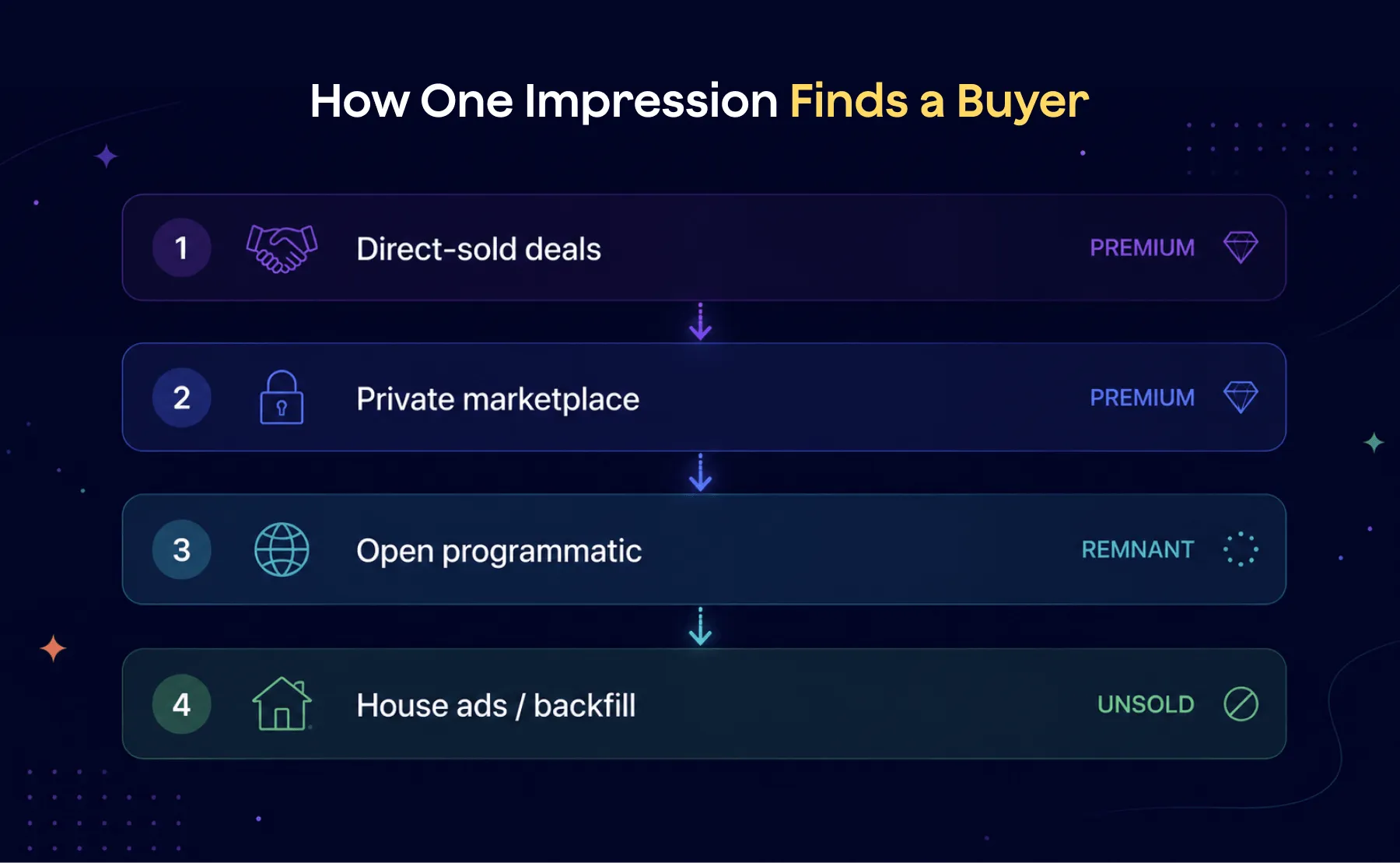
Without that structure, everything drifts toward remnant pricing — which is exactly what demand partners would prefer but you as a publisher would like to avoid. Reducing your share of unsold ad inventory starts here, with deliberate classification rather than default treatment.
How Ad Inventory Management Works in Practice: Structure in Ad Server
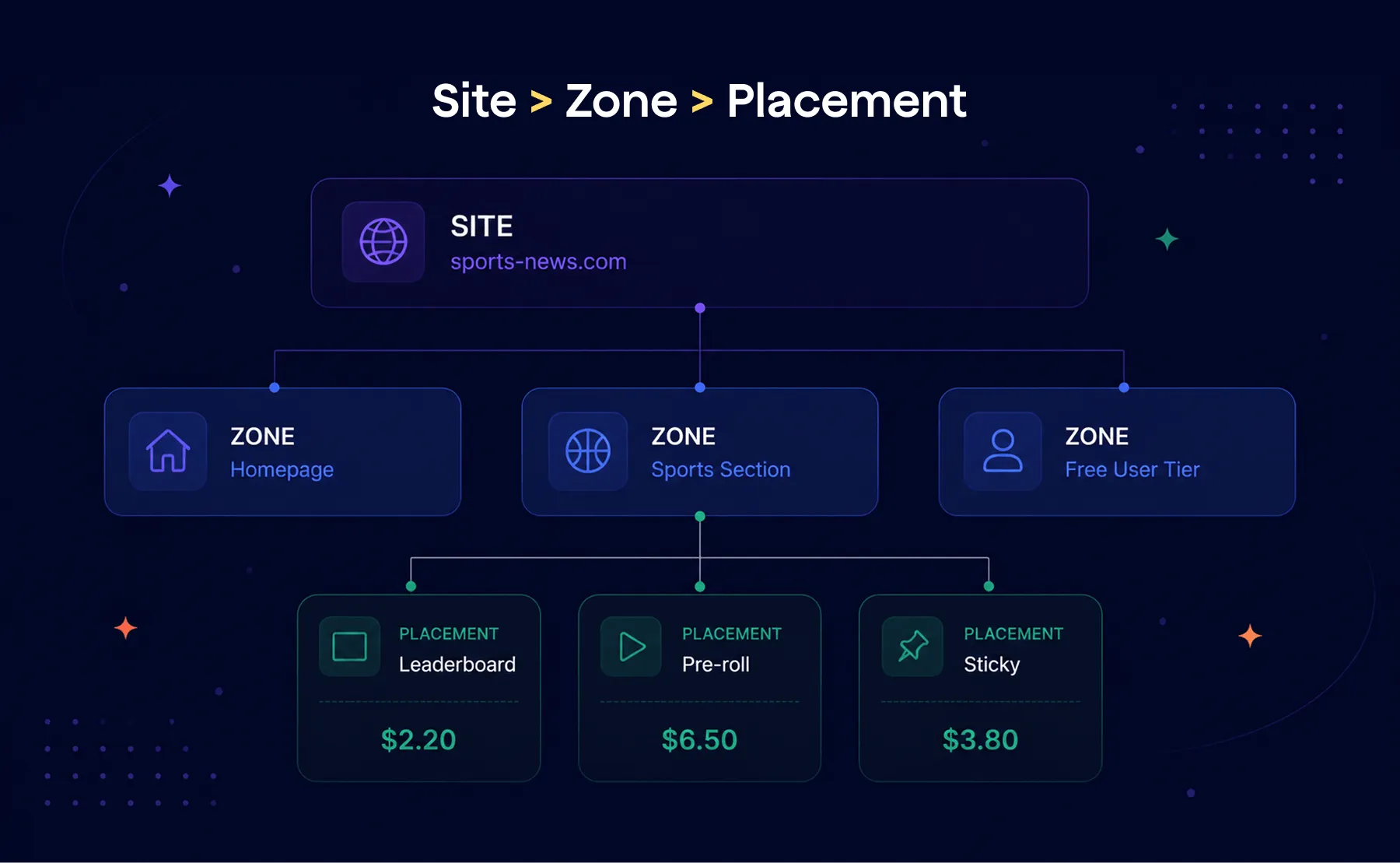
Let's take the Epom ad server for publishers as a live example of how ad management hierarchy is organized in major platforms. Our ad server uses a tree-like structure with three levels. Each level unlocks a different type of control, and all three are necessary for placement-level optimization to be possible.
Level 1: Site
The property level. One site per publisher domain or app. It sets the top-level container for reporting, so performance across owned properties is visible without manual filtering.
Level 2: Zone
The category level. Zones group placements by shared trait: "Sports Section," "Homepage," "Free User Tier," "Pre-roll Video." This is where editorial logic meets ad logic, and where inventory packaging happens — a direct advertiser buying sports content gets a zone, not a list of individual ad tags.
Zones also make audience segmentation practical, because you can attach targeting and pricing rules to a meaningful group rather than to scattered placements.
For a publisher network running across nine sites, or a media group with dozens of regional outlets, zones allow mass creative updates: swap a creative across an entire section without touching individual placements one by one.
Level 3: Placement
The ad tag level — the individual ad unit. This is where impressions fire and where every variable that determines what an impression earns is set: floor price, frequency cap, priority rules, ad format spec, targeting parameters.
A floor set at zone level applies across all placements in that zone by default. Individual placements can override it, which is how a publisher differentiates between a standard article banner and a high-viewability sticky unit in the same content section, without duplicating the entire setup.
The Site → Zone → Placement hierarchy separates the property (what you own), the category (how you package it), and the placement (where the impression fires and the price is set). Without this structure, floor prices and reporting operate at the wrong level of granularity — and optimization decisions get made against averages that obscure what is actually happening.

Ad inventory management runs through three stages in practice.
- Forecasting and planning — understanding what inventory you have, what it can deliver, and what money you can potentially earn from it.
- Yield management — defining how much your inventory will cost, setting up floors and distribution places among advertisers.
- Optimization — adjusting floors, priorities, and demand sources based on what the data shows. The sections below follow that sequence.
Stage 1: Ad Inventory Forecasting
Every direct deal starts with a commitment: you tell an advertiser their campaign will deliver X impressions over Y days. Forecasting is how you make that commitment without guessing.
Without forecasting, two things can go wrong:
- You oversell — you promise impressions you can't deliver, the campaign under-performs, and you owe make-goods.
- Or you undersell — you leave guaranteed revenue on the table while those same impressions clear at open-exchange rates instead.
The less obvious problem is contention. When two campaigns target the same placement at the same time, neither was booked knowing the other existed. One of them won't deliver in full. Forecasting shows you that conflict before you've made promises
💡 A capability worth knowing about: Epom Ad Server logs every impression, click, and conversion at the individual event level — placement, country, device, IP, transaction ID — and makes that raw data available via API or direct export to S3 or your own BI tool.
Enterprise platforms use the log-level data as the foundation for forecasting and yield analysis. You may not need it on day one, but it means the infrastructure for serious inventory intelligence is already there when you do.
Stage 2: Ad Yield Management
Yield management is the set of decisions that determine what each placement earns before a single impression fires. Three of them matter most.
1. Floor price — the minimum CPM you will accept for a placement. Without defining one, your inventory clears at whatever a demand partner offers. (That number is always lower than what the market would pay if you asked.)
2. Priority order — which demand source gets to fill the impression first. Direct-sold deals should be sold before private marketplace bids, which should clear before open exchange. When that order is wrong or unset, programmatic backfill cannibalizes inventory you could have sold at a premium.
3. Inventory protection — deciding which placements are premium and holding their floor, rather than letting every slot compete in the open auction to maximise fill rate at the expense of yield.
Once those decisions are in place, the metrics tell you whether they were right.
| Metric | What it measures | What it misses |
|---|---|---|
| Fill rate | Share of ad requests that served an impression | Whether those impressions cleared at the right price |
| CPM | The price an advertiser pays per 1,000 impressions | What you actually keep after fees — that's eCPM, not CPM |
| eCPM | Effective earnings per 1,000 impressions across all demand sources | Placement-level variance — a blended average hides which slots perform and which underdeliver |
| Sell-through rate | Share of available inventory sold in a given period | Inventory held above floor by design — a revenue decision, not a failure |
| Unsold inventory share | Portion of impressions that never filled | Whether the cause is a floor set too high or missing demand connections |
| CPM-to-floor gap | Distance between your floor price and your average clearing CPM | Revenue left on the table per impression — the most recoverable loss in most setups |
The CPM-to-floor gap is worth dwelling on. When a placement clears consistently above its floor, the floor is set too low, and every impression served since has earned less than it could.
For a publisher with 8 million monthly pageviews and a 15% video ad load, a $3.70 CPM gap on a single unconfigured pre-roll placement costs over $50,000 per year. The placement exists, the traffic is real, the demand is there. The only missing variable is a floor price that reflects market rate.
Run the same calculation for your placements — your account shows this by placement in Epom's dashboard. See a live example → Start free trial
Stage 3: Ad Inventory Optimization
Most publishers cannot run a real audit because they cannot see their own data. The reporting they receive depends on what their tooling chooses to show them, and for most setups that is far less than they assume.
If you monetize through an ad network like AdSense, Adsterra, PropellerAds, or any of the dozens of CPM networks what you receive is a blended report: total impressions, total revenue, an average eCPM. The eCPM of each individual placement and the actual price each demand partner bid are usually not shown.
The industry calls this the "black box tax": because the network controls the reporting, you can't easily verify what the buyer paid versus what you received.
An ad server gives you a count of your own. Epom Ad Server reports at the placement level across eCPM, fill rate, CTR and other crucial publisher metrics. Those numbers come from the system controlled directly by you.
Once you can see your inventory at the placement level, three checks tell you where the money is going and where it isn't.
Find What is Underearning
Pull eCPM by placement and sort it. The gap between your best and worst placements is rarely explained by traffic quality alone. Low eCPM on a high-traffic placement usually means one of two things: the price you set does not reflect what the audience is worth, or the placement is going to the wrong advertiser category. Both are fixable once you know the problem.
Check What Is Filling and What Isn't
Which placements have an active direct campaign running, and which are sitting empty or backfilling to programmatic by default? An empty premium placement is a sales problem. A premium placement defaulting to programmatic backfill at remnant rates is a prioritization problem. Direct-sold campaigns should always sit above programmatic in the priority order settings.
Verify Your Delivery Numbers Against the Advertiser's
Your ad server counted X impressions for the campaign. The advertiser's tracker counted Y. An ad discrepancy above 10% is common when you have no independent count — and it creates problems at renewal time because neither side trusts the other's numbers. Running your own ad server gives you the independent count that makes that conversation straightforward.
Independent Transformation: What Changes When You Manage First
Publishers who move from ad networks to their own ad server agree: revenue improves not because traffic increases but because the same inventory is finally priced and measured correctly.
A network sets the price, takes its cut, and hands back a blended number. An ad server puts that pricing decision back in your hands.
A UK-based healthcare review platform with 9,000 doctors logging in daily had brands already asking to reach that audience. They briefly considered programmatic but trade-off was too high: algorithmic placements, irrelevant brands, no direct relationship with the advertiser.
We didn’t want programmatic noise, we wanted it to be all direct-only, so we’ve got the control. With programmatic, you can make it somewhat relevant, but there will still be times it won’t be.

They set up direct deals on Epom Ad Server with our advertisers. The result: an effective CPM of £142 against a programmatic industry benchmark of £20 — 7× the yield, on the same audience, without running a single auction.
The £122 gap didn't come from more traffic. It came from one decision: sell direct, set the floor, own the relationship.
Publishers switching to Epom Ad Server report an average of +40% revenue growth — not from more traffic, but from managing what they already had.
Other quick benefits you get with Epom Ad Server: no revenue share, placement-level reporting, floor price control, and banner moderation.



![Video Ads for Website Publishers: Make More - Spend Less [+7 Best Ad Formats Inside]](https://cms.epom.com/api/media/file/video-ads-for-publishers-preview.webp)