
Most answers to the question of “how to build an ad network” starts with the technology stack — RTB, ad servers, auction logic. That might sound controversial, but the software is actually the easier part.
What determines whether your ad network survives its first year is whether the founder lined up real publisher and advertiser relationships before licensing a platform. The technology decision can be made in a few days right after.
Things that matter are: picking a niche narrow enough to attract clients quickly, earning publisher trust, and proving to advertisers you can deliver (the only part that takes months.)
This guide will walk you through A to Z of establishing your ad business, including building relationships with clients, picking the right technology set, and making the ad network profitable.
Want a platform that's ready before your first publisher signs on? Start a free 14-day trial of Epom ad server — live in weeks.
- An ad network is a company that aggregates publisher inventory and resells it to advertisers, taking a margin for being a middleman and building revenue on it.
- Building one is a relationship problem before it's a technology problem. You need publishers and advertisers lined up, since software alone doesn't create demand or supply instantly.
- An ad network's margin comes from the spread between what advertisers pay and what publishers receive — typically 15-30% of ad spend.
- An ad server is a foundation of ad network ops. A white-label ad server can be live in 1-2 weeks, versus 12-24 months and $600K+/year in engineering salaries to build one in-house.
- Niche networks often fill more efficiently and convert better than broad “everything for everyone” networks — vertical, geography, or format focus gives advertisers a clearer reason to buy from you specifically.
- A well-built white-label platform gives you real structure — sub-accounts, permissions, reporting, but not every of them supplies the publishers or advertisers themselves. Confusing those two is the most common first mistake founders make.
What Is an Ad Network? Definition and How It Works
An ad network is a company that aggregates ad inventory from multiple publishers and resells it to advertisers, taking a margin on the transaction, typically 15-30% of advertiser’s spend.
That's the core distinction from an ad exchange, which runs real-time auctions rather than reselling pre-aggregated inventory.
Three roles make up the rest of the ecosystem:
- Advertiser — buys ad placements to promote a product or service.
- Publisher — owns the website or app and sells its ad space.
- Ad agency — manages advertising on behalf of clients, demand-side only, no publisher relationships.
Today these roles merge more than they used to. Large publishers often run their own ad networks on the base of enterprise ad servers. Retailers with enough first-party data — Amazon Advertising, Walmart Connect — became demand-side platforms on top of being sellers.
It's not just the giants, either: a regional streaming service, a news site with a loyal readership, or a mobile app with a few million installs can run the exact same model at a smaller scale. If you plan to sit on both sides of the transaction and take a markup for the match, you're building an ad network.
Common Misconceptions About Building an Ad Network
Most of the hesitation around starting an ad network comes from assumptions that were true a decade ago and aren't anymore. Three are worth clearing up before you plan anything else.
Myth: you need to build the technology yourself.
Reality: most new ad networks license a white-label ad server instead. The technology is the fastest part of this process, not the hardest.
Myth: you need a massive scale before you start.
Reality: platforms are available for networks starting under 10 million monthly impressions. Scale comes after you prove the match works.
Myth: an ad server and a DSP are separate purchases you need on day one.
Reality: many founders start with just a simple ad server setup for direct publisher deals, then add programmatic demand later by connecting a DSP. You don't need both from day one.
Myth: an ad network and an ad exchange are basically the same thing.
Reality: an ad network aggregates and resells inventory through negotiated deals; an ad exchange runs open real-time auctions.
Myth: there's a standard revenue share rate you're expected to offer publishers.
Reality: it typically runs 55-85%, with 65-75% most common — but it's negotiable based on demand competition and how replaceable the publisher's traffic is to you.
Choosing Your Ad Network's Niche and Operational Model
When you show “everything to everyone”, your conversion rates benchmarks typically sit at <2%. Niche down, and you have chances to increase these numbers tenfold. And advertisers care about conversion rates more than raw traffic.
A tightly-targeted network with a clear niche routinely out-converts a broad one with more impressions, because advertisers know exactly what they're buying.
| Model | Best for | Difficulty to launch |
|---|---|---|
| Vertical (single niche — finance, gambling, dating, health) | Founders with existing niche relationships or content | Low |
| Horizontal / display | General-audience publishers, broad advertiser demand | High |
| Native | Content-driven publishers wanting in-feed formats | High |
| Video | Publishers with existing video inventory | High |
| Mobile app network | App developers monetizing in-app inventory | Medium |
A second layer of definition matters just as much: are you a rep firm (outsourced sales for well-branded sites), an ad arbitrage (the classic buy-low-sell-high network model — most networks fall here), or an aggregator (a network of networks)? Let’s elaborate a bit more on each.
Rep firm — you don't buy or hold inventory at all. You're paid a commission (typically 15-20%) for selling ad space on behalf of publishers who already have direct-sale relationships or brand reputation, but no in-house sales team. Low risk, but you need an existing relationship with a quality publisher to start.
Ad arbitrage — you buy inventory at one price and resell it at a markup. Buy at a $2 CPM from a publisher, sell to an advertiser at $5 CPM, keep the $3 spread. This is the default model for a reason: it doesn't require an existing sales relationship or scale, just a niche where you can find both sides.
Aggregator — you're running a network of networks. Smaller arbitrage networks route their unsold inventory through you because you have deeper demand pools or better fill rates than they can access alone. This only works once you already have scale — it's where an arbitrage network graduates to.
Most founders starting out are building an arbitrage model: no existing publisher relationships needed, just a niche where supply and demand both exist. That's the exact starting point for the tool below: tell it your niche and volume, and it'll suggest the operational model and pricing to match.
Which pricing model fits your ad network?
Pick your niche and volume to get a starting recommendation.
Ad Network Architecture: Ad Server as a Decision Engine
At minimum, your stack needs five things working together:
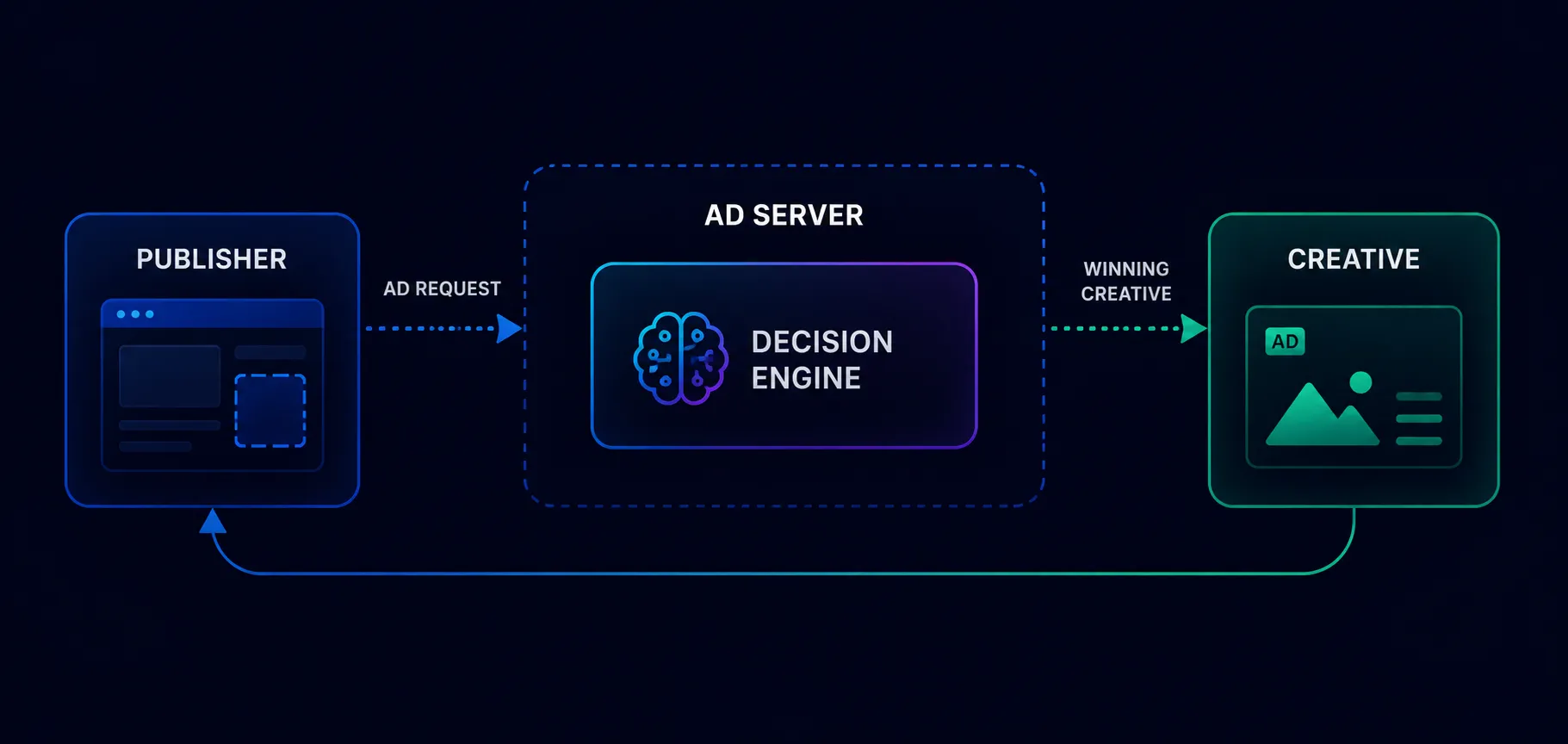
- Ad server — the decision engine. Filters eligible campaigns, runs the ad serving logic, returns the winning creative, logs the impression. In practice this runs as a priority waterfall: direct campaigns with their own frequency caps fill first, and a connected DSP fills what's left over.
- Publisher integration — JS tags for web, SDKs for mobile apps.
- Advertiser interface — campaign creation, budget and targeting controls, creative controls.
- Reporting layer — fill rate, eCPM, CTR, CPA, ROAS, viewability, tracked per publisher and per advertiser. For any vertical with a delayed conversion, server-to-server postbacks are worth setting up from the start rather than relying on JS pixels.
- Fraud detection — bot filtering, invalid traffic detection, device fingerprinting, plus IP and behavioral analysis and geo/timezone mismatch checks. Non-negotiable; demand partners won't trust a network without it.
Discrepancy control is worth building into your reporting habits early too: minimizing unnecessary redirects and keeping a close eye on the timezone settings of your traffic sources are two of the more mundane but effective ways networks keep their own counts close to what advertisers and publishers independently measure.
Response times matter more than most founders expect going in: modern setups typically respond within roughly 100 milliseconds, since ad requests are latency-sensitive by nature — a slow ad server loses auctions before it can even bid.
Scale changes what you need underneath this:
- Micro: even a single publisher counts — the moment you're aggregating your own inventory and reselling it to more than one advertiser, you're technically running an ad network, just at the smallest possible scale.
- Small network: ~10 publishers, ~100M impressions/month — a simple ad server instance handles this comfortably.
- Medium: ~500 publishers, ~5B impressions/month — needs load balancing and a proper caching layer.
- Large: tens of thousands of publishers, tens of billions of impressions/day — needs distributed auction servers and stream processing for reporting.
You don't need to build any of this yourself to launch. Hosted ad servers like Epom run this architecture already — full API access, so your team can handle campaign creation, creative uploads, and reporting without touching the admin UI if you'd rather build your own tooling on top.
Build vs. License: Choosing Your Ad Network's Ad Server
There are three real paths, and they trade off the same way every time: money and control against speed.
| Option | Time to launch | Ownership | Cost | Dev requirement |
|---|---|---|---|---|
| In-house | 12-24 months | Full | $600K+/year in salaries alone | Very high |
| API-based | 3-6 months | Front-end only | Mid | Medium |
| White-label | 1-2 weeks | Brand only | Low | Low |
We cover this decision in more depth, including who each option actually fits, in “How to Build an Ad Server: 3 Ways From Hardest to Easiest”
The table above uses industry averages. Plug in your own team size, salary assumptions, and expected volume below to see what build vs. license actually costs for your specific network.
Build in-house
total, one-time build cost
White-label
$600K+/year in salaries buys the team. It doesn't guarantee the team knows what they're doing.
“The expense isn't the real barrier — it's finding developers who actually understand ad tech specifics: auction logic, latency budgets, fraud patterns, the dozen small protocol details that don't show up in a generic backend job description. That's a narrow pool of people, and it's why most teams that want something custom start with an API rather than a from-scratch build.”

That's the practical reason the API-based middle option in the table above exists at all: it's not a compromise between cost and control so much as a way to build custom-looking functionality without first needing a team that already has years of ad-tech-specific experience baked in.
For most first-time ad network founders, white-label is the right starting point — not because building in-house is a bad idea, but because you don't yet know which features your specific publishers and advertisers will actually need. Find that out first. Build custom later, once you're sure what to build and you have the specialized team to build it well.
If you're comparing specific vendors rather than deciding build-vs-license in the abstract, the criteria that actually separate a good fit from a bad one are consistent regardless of niche: can it handle your real volume and ad formats, how it handles discrepancy and fraud, whether custom dev support is available when you hit an edge case, and whether it supports OpenRTB cleanly for programmatic connections.
Onboarding Publishers and Advertisers to Your Ad Network
Sequence matters. An ad network with no publisher inventory has nothing to sell an advertiser — so publishers come first.
Recruiting publishers:
- Start by finding who's already running ads in your niche. Publishers currently working with a competing network or running generic display ads in your vertical are your best first targets.
- Research the going rate before you pitch. Publisher revenue share in ad networks typically runs 55-85%, with 65-75% being the most common range for established niches.
- Guarantee fill rates above 90% once live — this is the number publishers actually watch, often more closely than the revenue share percentage itself.
- Offer transparent reporting from day one; it's the fastest way to earn repeat inventory.
The tricky part is turning "we offer 70% revenue share" into a real number a publisher can compare against what they're already earning. That's what the tool below does.
What would this rate actually pay out?
See the split before you put a number in front of a publisher.
Once you've got a number in mind, the outreach itself doesn't need to be complicated — lead with the rate, back it with the fill-rate guarantee, and ask for fifteen minutes.
Copy-paste: publisher outreach email
Subject: Partnership opportunity for [Publisher Site Name]Hi [Name],I run [Your Network Name], a [your niche] ad network offering a [X]%revenue share while we build our first publisher relationships. Inexchange, you get transparent per-placement reporting and a fill-rateguarantee above 90%.Would you be open to a 15-minute call this week to see if it's a fitfor [Publisher Site Name]?[Your name]Publishers get you the inventory. The other half of the equation is filling it — that's the advertiser side.
Recruiting advertisers, once you have supply:
- Offer tiered pricing and bonus impressions for longer commitments.
- Match the pricing model to the advertiser's actual goal: CPM for brand-awareness campaigns, CPC or CPA for performance-driven advertisers. A meaningful part of running a network is translating between advertiser and publisher pricing language.
- Run small pilot campaigns before asking for large budgets.
The pitch here follows the same shape as the publisher one: small ask, real numbers, no pressure to commit big on the first conversation.
Copy-paste: advertiser pilot proposal
Subject: Test campaign proposal — [Your Network Name]Hi [Name],I'd like to propose a small pilot: a [X]-day test campaign at [$Y]budget across [niche] inventory on [Your Network Name]. You'll getfull placement-level reporting so you can judge fit before committingto anything larger.If the numbers work for you, we can scale from there. Interested?[Your name]One real example shows how that plays out if you get technology BEFORE signing up with publishers and advertisers first.
A founder building a network across Nigeria and wider West Africa came to us with the platform question already answered in his head — he just needed the software. What he didn't have yet was a single publisher or advertiser signed. When our team asked him directly — do you have advertisers and publishers already, or are you looking to get them elsewhere — he paused, then admitted no, he'd planned to source both sides himself, starting from nothing.
That pause is the moment worth naming upfront: the platform is the infrastructure, not the inventory or the demand. No amount of software solves the cold-start problem of an empty marketplace.
What actually happened next is the more useful part. He didn't wait until he had those relationships lined up — he started a 14-day trial, worked through the basic setup, and had the platform configured and ready before his first publisher call.
By the time he was pitching publishers, he could show them a live, working account instead of a plan on a slide. The sequencing wasn't platform-first-then-relationships — it was platform in parallel with relationships, so neither side was left waiting on the other.
Ad Network Compliance: GDPR, CCPA, and IAB TCF
Privacy compliance in an ad network splits across two different jobs, and conflating them is the most common mistake founders make here.
Collecting user consent is the publisher's job, not yours.
The publisher owns the direct relationship with the end user, so they're the one who shows the cookie/consent banner and captures the actual opt-in or opt-out. Your ad network doesn't sit in front of the user at all — it never collects consent directly.
Receiving, honoring, and passing through that consent signal is your job.
When a publisher's site captures consent, that signal needs to travel with the ad request through your platform and into every downstream demand partner's bid request. If your ad server drops that signal or ignores it, you're liable regardless of whose banner collected the original consent.
- GDPR and CCPA govern how targeting data is collected and used across the EU and applicable US states. As the network, you need contractual clauses confirming the publisher actually captures valid consent.
- IAB's Transparency and Consent Framework (TCF) is the industry-standard mechanism for encoding and passing consent signals through the bidstream. Treat it as a strong technical default.
- ads.txt and sellers.json are now baseline expectations for programmatic trust, and both are your responsibility to implement correctly.
Build the division of responsibility into your publisher and advertiser agreements explicitly: the publisher warrants that consent is captured correctly at their end; you warrant that consent signals are honored correctly at yours.
One more thing here: if you tell publishers and advertisers “your data is yours,” that's a contractual promise rather than a technical feature your platform automatically enforces.
Copy-paste: contract compliance clauses
Paste these directly into your publisher/advertiser contract template, filling in the bracketed terms:
DATA OWNERSHIP[Publisher/Advertiser] retains ownership of all user and targetingdata generated through this partnership.CONSENT WARRANTY (Publisher agreements)Publisher warrants that valid user consent is captured via acompliant Consent Management Platform, per IAB TCF or equivalent.REGIONAL COVERAGEThis agreement covers [EU/GDPR, US states under CCPA/CPRA, other].ADS.TXT / SELLERS.JSONPublisher agrees to maintain an accurate ads.txt entry. [NetworkName] agrees to maintain an accurate sellers.json entry.BREACH AND REMEDYMaterial breach may be suspended with [X] days' written notice.DATA RETENTIONData will be retained for no longer than [X] days/months.Disclaimer: This is a starting point — have actual counsel review it against your specific jurisdictions and demand partners before it goes into a signed contract.
Challenges Real Ad Network Founders Run Into
"I've never run something like this before."
The technology rarely trips people up. What it does not know is whether the platform will actually be there when something breaks at 11pm on a launch day. First-timers do best with a vendor whose account manager answers fast and knows the account by name. That responsiveness matters more here than any advanced feature set.
Your first team is smaller and less structured than you'd expect.
Most networks launch as a founder plus one to three trusted people, sharing simplified, unified access rather than carefully separated roles and permissions. That's fine — the granular sub-account structure matters once you're onboarding your own clients' teams.
Needing an ad server and a DSP at the same time.
Some founders come in wanting to manage direct publisher deals and buy programmatic demand from day one. Sequencing the two — getting the ad server running first, then connecting demand — makes it possible to debug one side of the system before adding the other.
Payment terms friction at low volume.
New networks starting with modest volume sometimes hit cash-flow friction with vendor prepay requirements. Ad networks generally don't build their own payment infrastructure — they rely on third-party processors, so a vendor's flexibility on terms is partly a function of their processor's flexibility with them.
Niche and geography specificity.
A founder building for an underserved audience — a regional market, a religious or cultural community, an emerging geography — runs into the same wall repeatedly: platforms that quietly restrict or deprioritize exactly the vertical they're trying to serve. The founders who've come to us building for developing countries, for religious audiences, for other underserved niches all hit this same question first: will the vendor actually support what I'm building.
Real Ad Networks Running on Epom's White-Label Platform
Adera Agency runs iGaming campaigns and needs precise category targeting alongside custom ad templates. After implementing them on Epom's ad server, user retention rose 22% and click-through rates rose 34% compared to the standard banners they ran before. See full case study here.
ViewTraff needed strong VAST/VPAID support for video specifically. After switching, they reached 210 million video impressions per month and saw click-through rates rise 4x.
BidMath, a data-driven agency, credits the granularity of Epom's targeting and reporting features with a 27% increase in monthly profits and an 18% improvement in engagement.
A U.S./Canada network built specifically for Muslim-audience advertising needed something more particular: publisher inventory and DSP demand showing up in one unified dashboard their own advertisers could log into, instead of two disconnected reports. Connecting Epom's ad server and white-label DSP took just days — the exact sequencing question raised earlier, solved in practice, for a niche most platforms don't build for.
“We'll give you software to create your ad network — you just need to bring publishers and advertisers, and we'll do the ad serving itself.”

At the larger end of our ad network clients, they typically run over 1 billion impressions a month on Epom's platform. Adera (at network scale) runs around 229 million impressions a month. Across the full base of 120+ ad businesses on Epom, average year-over-year growth runs around 30%, and the average client stays 4.5 years.