


You built something people log into. After a while, companies started emailing to ask whether they could advertise on it. So you went to sign up for AdSense, because that is what everybody does.
Here is what that costs you. AdSense pays you a general-web rate and fills your inventory with whoever bids on your visitors. Meanwhile the companies sitting in your inbox are the most motivated buyers your ad inventory will ever have, and they arrived ready to pay premium rates.
In ad tech, premium usually describes the inventory: viewable, brand-safe, zero backfill, ideally through a shorter supply path. But a brand from your own industry advertising on your own platform is the shortest link between a product and its buyer that exists. Selling that context, rather than the impressions inside it, is what endemic advertising means.
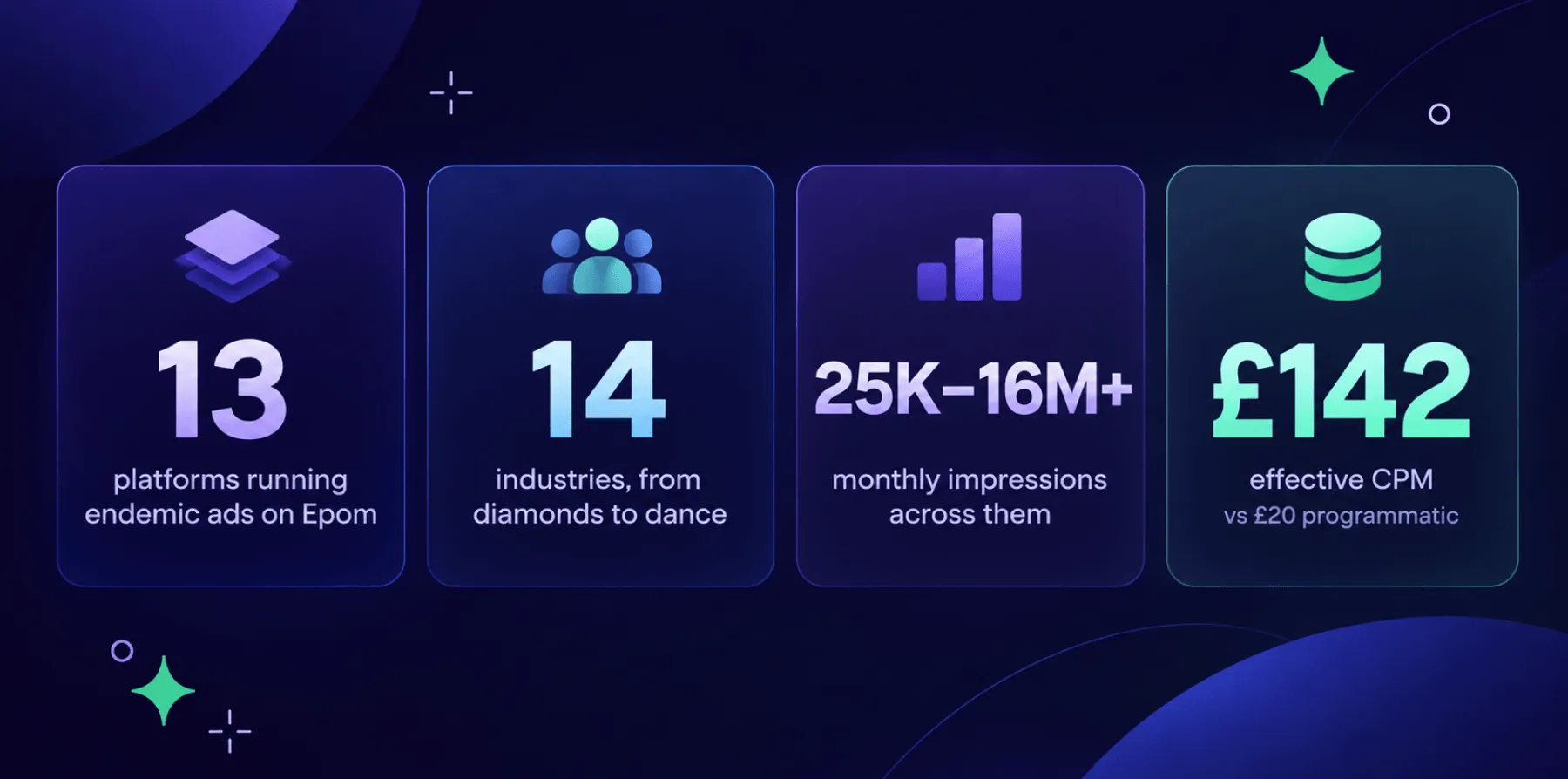
Case in point: One healthcare platform running direct deals with us shows what that is worth. They do not run many advertisers, but each pays £1,000 a month for 7,000 guaranteed impressions — an effective CPM of £142, against a programmatic benchmark of roughly £20.
Epom Ad Server handles flat monthly sponsorships, advertiser rotation with guaranteed impressions, and rules keeping competitors off the same page. Start a free trial and load your first advertiser.
- Endemic advertising is advertising for products that are natively relevant to what your platform is for — medical tech companies advertising to doctors, camera makers advertising to cinematographers, dive resorts advertising to divers.
- The premium comes from how motivated your audience already is. People on a niche platform arrive with the problem the advertiser solves, which is why endemic placements convert where general display does not.
- Flat monthly fees beat CPM for this kind of deal. Your advertiser is buying presence in front of a specific group, and CPM prices the impressions instead, which is the cheap part.
- Huge volume is optional. Platforms running endemic ads on Epom range from around 25,000 impressions a month to over 16 million, and several at the smaller end have been doing it for years.
- An ad server suits this better than an SSP, because sponsorships, flat fees and seasonal takeovers are not auctions and cannot be held above a programmatic layer.
What Is Endemic Advertising?
Endemic advertising is advertising for products and services that are natively relevant to what a platform is for.
A diagnostics company advertising on a doctors' review site is endemic. A lens manufacturer advertising in a cinematography magazine is endemic. A dive resort advertising to divers is endemic.
The word comes from ecology, where endemic means native to a particular place. The sense carries over: these advertisers belong here because the audience came for the subject they sell into.
Endemic vs non-endemic advertising is the distinction most people meet first, and both are legitimate ways to earn.
| Endemic | Non-endemic | |
|---|---|---|
| What the advertiser sells | Something the audience needs for the reason they are here | Something unrelated they might also buy |
| Example on a healthcare platform | Lab equipment, diagnostics, medical software | A credit card, a car, a holiday |
| Why they pay | Your audience is the exact group they sell to | Your audience is a demographic they want to reach |
| Typical deal | Flat fee, agreed directly | CPM, usually programmatic |
Non-endemic advertising works, and plenty of platforms run both. The perfume trolley on a long-haul flight is non-endemic done well, and airlines make real money from it. But it competes on audience size, which means competing with the entire internet and average internet prices.
If the phrase feels new, the model will not. Retail media networks are endemic advertising with a different name, where a grocery chain sells placement to the brands already on its shelves.
Do I Have an Endemic Audience for Premium Rates?
Three things have to be true. If all three are, you can charge well above market rate.
Your audience is defined by something other than demographics. Not "men 25–54 interested in finance" but "licensed insurance advisors," "metals buyers," "people currently choosing a university." If you can name your audience by their job, their credential or the decision they are in the middle of, that is the asset.
There is an industry that sells to them. Every defined audience has suppliers. Doctors rely on medical equipment, while architects and interior designers constantly look for good quality building materials. If you cannot name ten companies whose business depends on reaching your audience, endemic will be a struggle — and if you can name them, you have your prospect list.
They arrive already in the decision. Someone on a property portal is looking for a house and, quite often, for the broker who will help them get one. Another person scrolling the eSports portal is probably looking for a new gaming gear to upgrade their PC. The intent to buy is already there.
It is also why retail media became a textbook example for endemic advertising. A shopper on a grocery site is already shopping, so they can buy a sponsored product with nearly same probability as they buy a non-sponsored listing, if it’s a fit. EMARKETER forecasts US retail media ad spending will reach nearly $70 billion in 2026 on the strength of that one observation.
Notice that none of the three mentions traffic. The platforms running endemic ads on Epom mostly do not run huge volume — they are independent and extremely specific, and that combination is the point. The range runs from around 25,000 impressions a month to over 16 million, and several at the smaller end have been doing it for years.
Endemic Advertising Examples: Five Kinds of Platform
According to Epom internal research across its publisher accounts, the same model turns up in fourteen verticals and five recognisable shapes of business. Read on and see if any of them matches your company profile.
| Platform type | Audience | Impressions/mo | Who advertises |
|---|---|---|---|
| Niche trade magazine | 5,000–50,000 industry readers | 100K – 1M | 10–15 suppliers to that industry |
| Professional web platform | Thousands of verified professionals | 100K – 1M | Vendors selling to that profession |
| Two-sided marketplace | Hundreds of thousands of users | 1M – 10M+ | One side of the marketplace, selling to the other |
| Hobby or scene site | Tens to hundreds of thousands | 500K – 10M, tripling in season | Gear, travel, schools, events |
| Industry app | Thousands of daily users | 500K – 2M | Suppliers to that trade |
You Run a Trade Magazine for One Niche Industry
Metals buyers. Cinematographers. Garden centre owners. Biotech executives. A few thousand people read you because it is their job and they need fresh expertise.
Your advertisers already exist and you already know them. They are the ten or fifteen suppliers who sell into your industry, and most have advertised with you in print. Steel processing equipment, camera lenses, lab instruments.
What is true for you: these relationships outlast everything else in adtech. Four platforms in this group that use Epom ad server have run the same setup for between four and nine years. Their advertisers renew because there is nowhere else to place the budget.
You Run a Web Platform Professionals Log Into
They log in because they have to. Leaving a review, checking a benchmark rate, managing their clients. You know exactly who they are, because they verified.
Your advertisers are buying the credential. A diagnostics company cannot assemble 9,000 verified doctors any other way in one burst, and it knows that.
What is true for you: the highest price per impression anywhere in this article. One healthcare platform charges £1,000 a month for 7,000 guaranteed impressions, an effective CPM of £142 against roughly £20 programmatic. Verification is what the advertiser is paying for.
Read the full story: how a healthcare platform grew ad revenue by 614% with Epom.
You Run a Marketplace Where One Side Wants to Reach the Other
Estate agents want house-hunters. Diamond sellers want diamond buyers. Brands want your shoppers.
Your advertisers are already your customers. They have a login, a payment method and a reason to spend, so there is effectively no sales cycle.
What is true for you: you can be extremely selective. One property marketplace serving the Dutch market runs ads from estate agents and nobody else — no mortgage brokers, no insurers, no removals firms.
Their setup is ordinary in the best sense: API integrations, conversion tracking, some custom targeting. The conversion tracking matters here, because an estate agent wants to know the placement produced enquiries rather than impressions.
You Run a Site for a Hobby or a Scene
A scuba diving magazine. A dance industry publication. An esports news and tournaments platform.
Your advertisers are gear, travel, schools and events. Dive resorts, dancewear, tournament sponsors.
What is true for you: the biggest volumes in this group and real seasonality. One eSports platform runs about 4M impressions on Epom in a quiet month and triples that during tournaments.
You Run a Mobile or Web App for One Industry
An app for traders. A tool professionals open at work rather than a site they browse.
Your advertisers want the app's users, and in-app placement puts them there. Same model as everything above, delivered through app inventory instead of a page.
What is true for you: control is usually the reason people in this position pick an ad server over an ad network. One diamond-industry app came to Epom specifically for it — standard in-app banners, nothing exotic, but every advertiser decided by them rather than by a network’s algorithm.
Five businesses, five different advertiser types, and one thing in common: their audience turns up already carrying the problem the advertiser solves.
What If Your Advertisers Are in a Restricted Category?
For some platforms the most relevant advertiser is one the large ad platforms will not serve. Betting operators for esports audiences, supplements for health platforms, crypto, cannabis.
An esports media company put it plainly when they came to us:
"Google has its own limitations, in terms of what type of clients that we can run in certain countries. The limitations on running, let’s say, iGaming ads, and things that Google might flag as an issue."
Their audience is exactly who a betting operator wants, and their existing stack would not carry that demand. So the endemic advertiser with the highest willingness to pay was the one they could not sell to.
Their solution is worth copying, because it is not all-or-nothing. They keep Google Ad Manager for the countries and campaigns where it works, and run their own ad server for the inventory and demand it will not take.
What Endemic Ads Are Worth
The healthcare platform above is the clearest worked example, because they published their numbers.
| Programmatic | Endemic, direct | |
|---|---|---|
| Pricing model | CPM, roughly £20 | Flat £1,000 per advertiser per month |
| Monthly impressions | 7,000 | 7,000 |
| Revenue per advertiser | £140 | £1,000 |
| Effective CPM | £20 | £142.85 |
Why the flat fee is the right instrument. Everything in modern advertising moves toward the dynamic: real-time bidding, automated optimisation, prices that change by the impression. A fixed monthly fee looks like something left over from a rate card in a print magazine.
For this kind of inventory, that is exactly why it works. Your advertiser is not trying to buy the cheapest thousand impressions available this second. They want to be present in front of a particular group for a month, and they want to know what that costs before they commit.
It also removes an annual argument. A flat fee for guaranteed visibility is one conversation a year, instead of a number that moves every month and invites a renegotiation each time it dips.
How Much Should I Charge for a Premium Placement?
Programmatic pays per impression, which means it pays a niche publisher almost nothing. Seven thousand impressions at open-exchange rates comes to about $20 a month. That is not a business, and it is why so many small specialist sites conclude that advertising does not work for them.
A flat fee ignores volume entirely. It prices the audience, and the audience is the thing that does not get cheaper because there are fewer of them.
Put your own numbers in and see where you land.
Benchmarks: open-exchange display $2.80 and LinkedIn-level $56 (CalculateCPM, 2026); private marketplace $5–15 (IAB / DoubleVerify via OwlClaw); financial services $6.80 (eMarketer); B2B account-based $8–15 (LinkedIn B2B Benchmark). Figures are US averages for standard targeting and are indicative only.
Why This Works Best When Your Volume Is Small
Run the slider up and something counterintuitive happens. The multiple collapses.
At 7,000 impressions a month, a $1,000 sponsorship is worth about 50 times what the same inventory would earn on the open exchange. At 91,000 impressions it is roughly four times. At 357,000 the two are level, and above that programmatic starts to win on pure arithmetic.
| Monthly impressions | Programmatic at $2.80 CPM | $1,000 flat fee |
|---|---|---|
| 7,000 | $20 | 51× better |
| 25,000 | $70 | 14× better |
| 91,000 | $255 | 4× better |
| 357,000 | $1,000 | level |
| 1,000,000 | $2,800 | programmatic ahead |
Read the top row again. One advertiser paying $1,000 a month is worth the same to you as roughly 357,000 programmatic impressions. A platform serving 7,000 is getting the revenue of a site fifty times its size.
That is the whole argument for small specialist publishers, and it explains something in the account data. The platforms running endemic ads are small, and the model suits them precisely because of it. At their volume programmatic was never going to pay, and an audience advertisers cannot reach elsewhere is the only asset they have to sell.
If you serve millions of impressions a month, endemic deals are a premium tier on top of a programmatic base. If you serve thousands, they are the entire business.
How to Justify Endemic Rates to a Buyer
A flat fee well above the market CPM needs an answer to one question: why is this worth more than the same money spent programmatically?
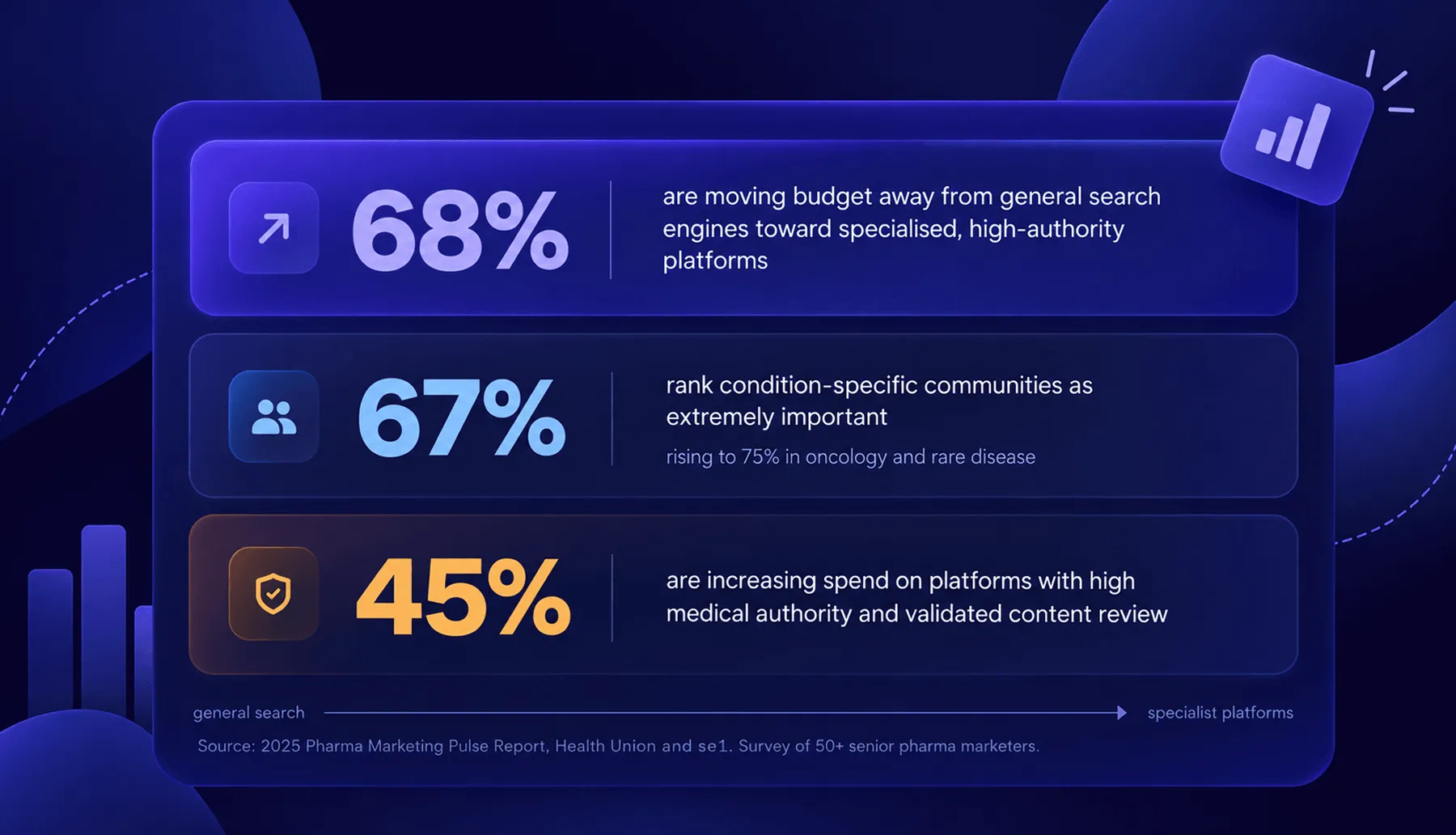
The first is that general search is leaking, and the budget is moving. In the 2026 Pharma Marketing Pulse Report from Health Union and solli, 68% of pharma marketers said they were reallocating budget away from general search engines toward specialised, high-authority content platforms, specifically to counter zero-click results and AI-powered search.
The same survey found 67% rank condition-specific communities as extremely important, rising to 75% in oncology and rare disease, where marketers reported spending nearly double on community and endemic platforms compared with other therapeutic areas.
Pharma is ahead of most industries here, but the mechanism is not specific to pharma. If AI answers are absorbing the traffic that used to arrive through search, the places that still hold a defined audience become more valuable.
The second is that trust has become a line item. In the same survey, 45% of marketers said they were increasing spend on platforms with high medical authority and validated content review systems.
What buyers now ask for. Trade coverage aimed at endemic publishers is consistent about this: brands want to know who exactly is in your audience, which segments and specialties you reach, and how your platform performs on qualified actions rather than impressions. Static media kits built on traffic numbers no longer answer that.
Three things worth having ready before you quote a price:
- Who your audience actually is. Registered professionals, verified roles, seniority, region. If people log in, you know this, and almost nobody else selling to that advertiser does.
- What a qualified action looks like on your site. A demo request, a directory click, a downloaded spec sheet. Conversion tracking on the placement turns that from a claim into a number.
- What you turn away. A short, honest statement of what you will not run is a stronger trust signal than any viewability score.
I Already Have Advertisers Asking. What Now?
Most people arriving at endemic advertising are not shopping for a premium monetization strategy in the abstract. They already have demand and nowhere to put it.
One publisher described it exactly, in his first message to us:
"We recently launched a new media publishing company. We already have many clients who want to advertise on the website and, like everyone else, we signed up with Google AdSense to get a GAM account to manage these client ads. We are not interested in showing any other Google ads, only high quality clients."
That sequence — demand first, tooling second — is the opposite of how monetization is usually described. Nobody in that position needs advice about building an audience. Turning web app revenue from ads into something real means three things: somewhere to upload a creative, a way to rotate several advertisers fairly, and a report you can send the client at month end.
Why an Ad Server Suits Endemic Advertising
Endemic deals are sponsorships, flat fees and seasonal takeovers. They are not auctions, which is why the tooling most publishers reach for first fits them badly.
A supply-side platform cannot hold a Q4 sponsorship at a fixed cost per day above the programmatic layer. An ad server can, and that difference explains most of what follows.
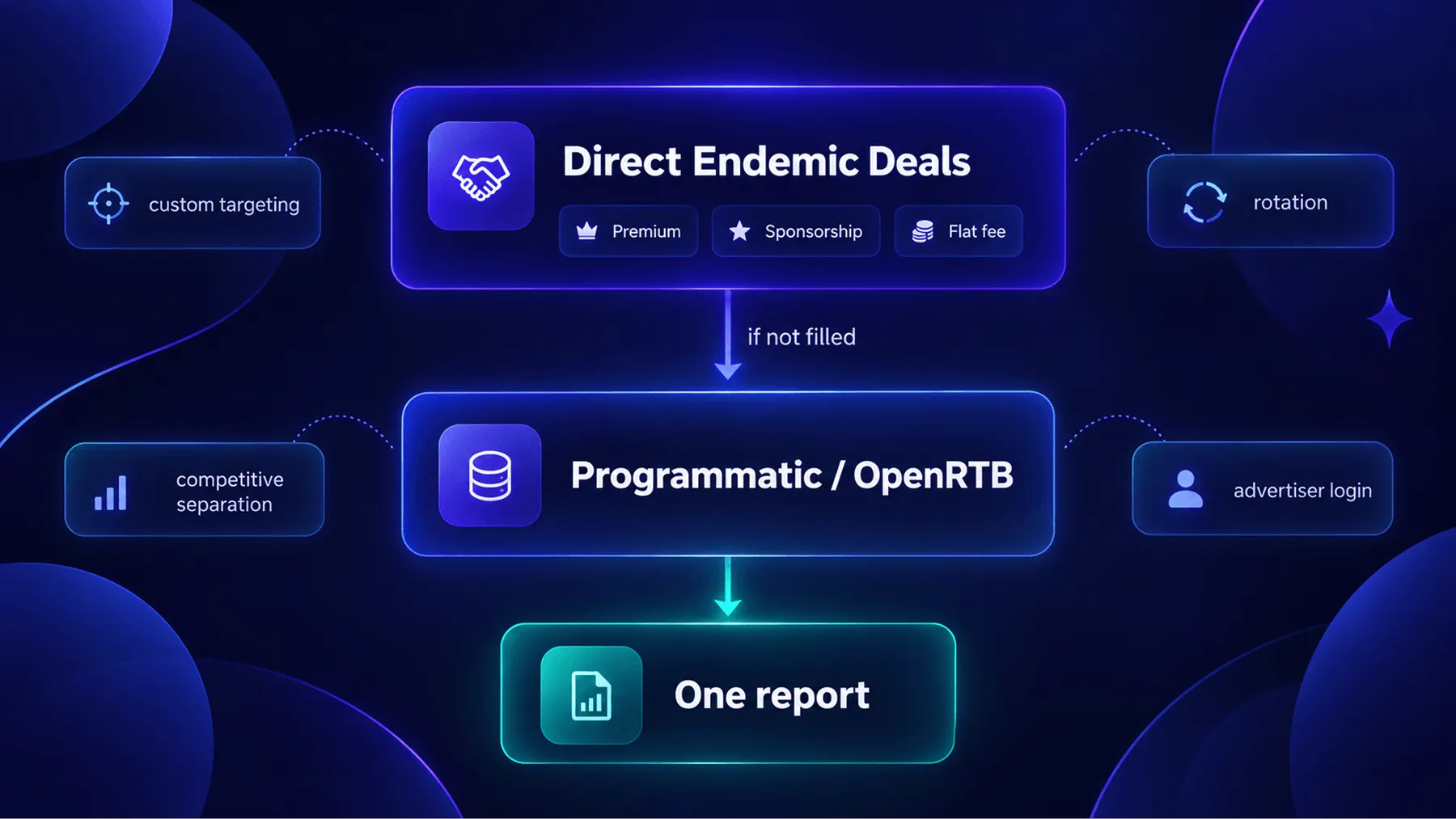
Billing that matches how you actually sell. Epom supports CPM, CPC, CPA, cost per day and cost per month, six delivery priorities from Premium down to house ads, and per-campaign weighting. A flat monthly sponsorship is a native pricing type rather than a workaround.
Contextual signals you own. Endemic targeting depends on section granularity, and you know your own sections better than any third-party category taxonomy does. You pass your own values in the ad tag — vertical, section, procedure, SKU family — and target them directly. A rule like specialty=cardiology combined with user_role=clinician works as a proper targeting condition.
There is also targeting that polls an external API and matches a JSON field, so in-stock status, match day or pollen count becomes a targeting trigger. Very few platforms expose that as a first-class option.
Your advertiser gets a real seat. You can give a brand a full account login, or a read-only reporting account for their media team. Creative moderation is built in, so the advertiser uploads and you approve before anything serves. All of it runs white-labelled on your own domain and branding.
Competitive separation. Endemic buyers care intensely about who else appears on the page. You can block an advertiser, campaign or banner at placement level, site level or across all sites, and categorise advertisers so the rules apply by group rather than one at a time.
A sales tool most people miss. On any site, zone or placement, the platform shows which advertisers and campaigns actually match that inventory’s rules. "Who can I sell this section to" gets answered before the pitch rather than after it.
And nothing goes to waste. Unsold endemic inventory falls through to OpenRTB in the same waterfall, under the same bid-floor chain. Direct deals on top, programmatic underneath, one report covering both.
"Sub-accounts, rotation, competitive separation — the setup itself is standard. What these publishers want is maximum control over who appears, and that is why they choose an ad server over a network."

The reason an ad server fits is efficiency rather than sophistication. Direct endemic sits on top, programmatic fills underneath, and both report in one place. You are not running two systems and reconciling them at month end.
"Epom wins endemic when the publisher owns strong contextual signals and the advertiser relationships, and wants the whole thing white-labelled under their own brand — without GAM’s complexity or a build-it-yourself API."

Running Endemic Ads Without a Developer
The healthcare platform rotates advertisers with guaranteed monthly impressions each, and it is managed by one business development manager who spends about a quarter of his day on it.
His requirement, in his words, was that it "had to be basically idiot-proof." He is not technical and there was no engineering team to ask.
Another publisher solved the same problem differently, by handing ad operations to a contract ad ops specialist a few hours a month. Either works.
What running it actually involves:
- Upload the creative
- Set rotation weights so each advertiser gets the share they paid for
- Keep competitors apart
- Send the monthly report
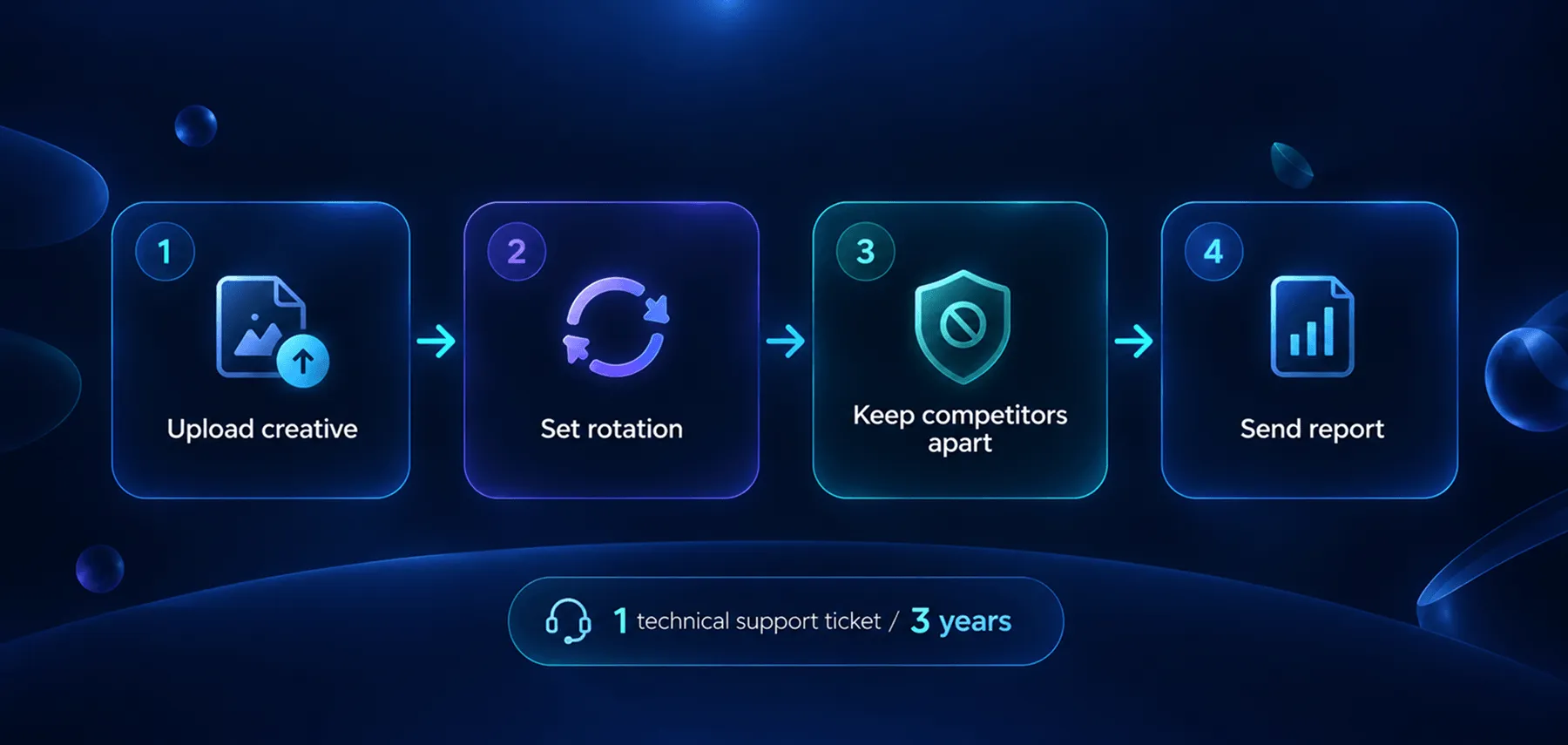
One number puts the operational load in perspective. Looking at three years of one account’s history — a publisher serving 185,000 impressions a month — there is a single technical support ticket in the entire period.
None of these publishers use anything exotic. Standard banner formats, a handful of campaigns, rotation weights, and where it is worth the effort an API integration and conversion tracking. The complexity people expect from an ad server mostly is not there when you are running dozens of advertisers rather than four hundred.
FAQ
Find Out What Your Audience Is Truly Worth
Before anything else, answer one question: can your advertisers reach these people anywhere else? If they cannot or they struggle to do so easily, you are not selling impressions, and you should not be priced as though you were.
Epom Ad Server handles flat-fee sponsorships, advertiser rotation, API integrations, custom targeting and advertiser logins from $250 a month.
Get a platform to run endemic ads on your web app for the premium rates. Start a free trial and load your first advertiser to test it out.