

TL;DR:
Ad fraud protection is a combination of pre-bid filtering and post-bid measurement that prevents invalid traffic like bots, click farms, agentic AI systems, and MFA sites from consuming advertising budget and corrupting campaign optimization data.
Non-optimized campaigns hit 10.9% IVT in H2 2024 (IAS), optimized ones held at 0.7%which presents a 15× gap. AI campaigns now run at up to 2× higher fraud rates because invalid traffic trains the algorithm to buy from fake audiences (Spider Labs, 2026). Ad fraud detection tells you what went wrong. Ad fraud prevention at the pre-bid layer stops it before a dollar is spent.
There's a running joke in ad tech: somewhere on the internet, bots are watching ads, filling lead forms, and completing purchases. Wait, is it still a joke? We live at times when the dead internet theory no longer looks surreal; it cripples into the side of the virtual world filled with real money.
It sounds fun when you are just a web user. What makes it less funny is when it's your client's budget.
Digital ad fraud has been discussed since display advertising started. But the conversation usually stops at "malicious bots are annoying" or "let's get a demand-side platform with an in-built anti-fraud tool", just as if the problem hasn't fundamentally shifted ever since.
In 2026, basic bot farms have given way to agentic AI systems that simulate mouse movements and form submissions using stolen personal data.
What's more, it's stopped being just an ad spend drain. Invalid traffic now gives false positives to bidding optimization, training your machine learning algorithm to bid harder on fraudulent ad placements with every cycle.
By the time your digital advertising campaign report shows the numbers, your optimization model might have already learned the wrong lesson. And it calls for the new level of ad fraud protection.
What Is Ad Fraud Right Now and How Big Is the Damage
Ad fraud is any activity that imitates user behavior and generates fake impressions, clicks, or conversions to extract advertising revenue without delivering a real audience. It wastes advertising budgets, skews campaign performance metrics, and undermines trust in digital advertising.
The damage? Here's what the data shows:
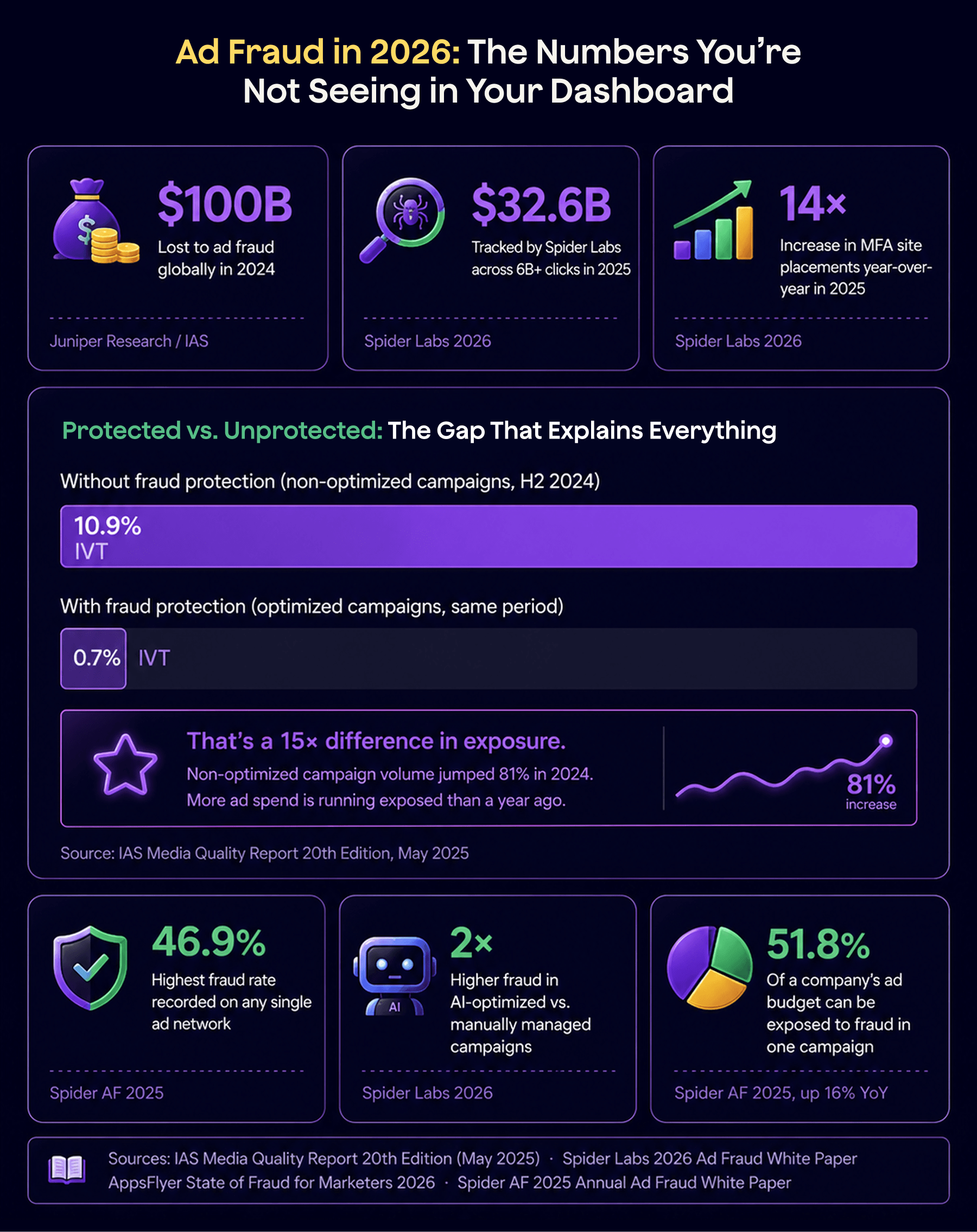
Ad fraud can lead to financial losses, distorted marketing data, and reputational damage.
The gap between the cleanest and dirtiest supply is 83× on Spider AF's whitepaper. The industry benchmark you're using to evaluate performance may already be contaminated. Which brings us to answer the question: what, exactly, you're dealing with?
Not all ad fraud is equal, and not all of it is stoppable by the same method to prevent ad fraud.
How Ad Fraud Shows Up in Your Performance Report
Advertising fraud detection doesn't have its own column in a standard ad campaign report. Fraud shows up as a performance gap: the difference between what the report says and what your digital ads convert in reality, often amplifying ad discrepancy between buy- and sell-side reporting.
Here's what that gap looks like in practice. Discover the signals that flag fraudulent activity before it becomes a campaign effectiveness conversation with your client.
- CTR up, conversions flat or down. The clearest signal. High CTR with near-zero buying activity on a specific source is click fraud in most cases.
- CVR cut in half. Spider AF analyzed 324 companies and found valid clicks convert at 2.54% while invalid clicks convert at 1.29%. Fraudulent conversions dilute your real CVR without appearing as a separate line item. A paid traffic CVR consistently below 1% is worth examining by placement and source.
- Organic conversion is worse than paid. Counterintuitive but documented: organic fraud rate hits 4.06% versus 0.91% for paid channels (Spider AF). Fraudsters route through organic specifically because teams don't scrutinize it. Traffic quality signals are absent from organic benchmarks by default.
- AI campaigns concentrate on new placements. If automated bidding suddenly shifts budget to placements you haven't seen before and those placements produce no downstream results, the optimization loop has learned from fraudulent signals.
One white-label demand-side platform operator in our client network discovered a 7× discrepancy between clicks purchased and clicks counted in publisher reporting. 400 clicks bought, 3,000 counted. A DSP charged the actual ad spend. The rest was publisher-side inflation.
What reports don't show is the damage to what comes next. Fraudulent placements that looked like strong performers have already shaped the model's next bid decisions. The baseline of your next campaign might be built on a mix of real signal and noise.
This is exactly why post-bid measurement and pre-bid filtering do fundamentally different jobs toward identifying ad fraud threats.
Types of Ad Fraud: Ranked from Easiest to Block to Hardest
Every type of ad fraud in this list is active in 2026. The difference between tiers is the detection method.
Easiest-to-block fraud runs on identifiable infrastructure: the same bad IP, data center range, or spoofed user agent. You can catch it with a list.
Hardest-to-block fraud runs on behavior. It looks like a real user until you examine what happens after the click. No list catches it. You need measurement and pattern recognition across sessions.
Understanding which tier your vertical attracts most changes which ad fraud protection architecture you need.
The Obvious Ones: Fraud That Runs on Identifiable Infrastructure
These fraud types operate from the same recognizable fingerprints every time. A pre-bid blocklist catches them before your DSP ever places a bid.
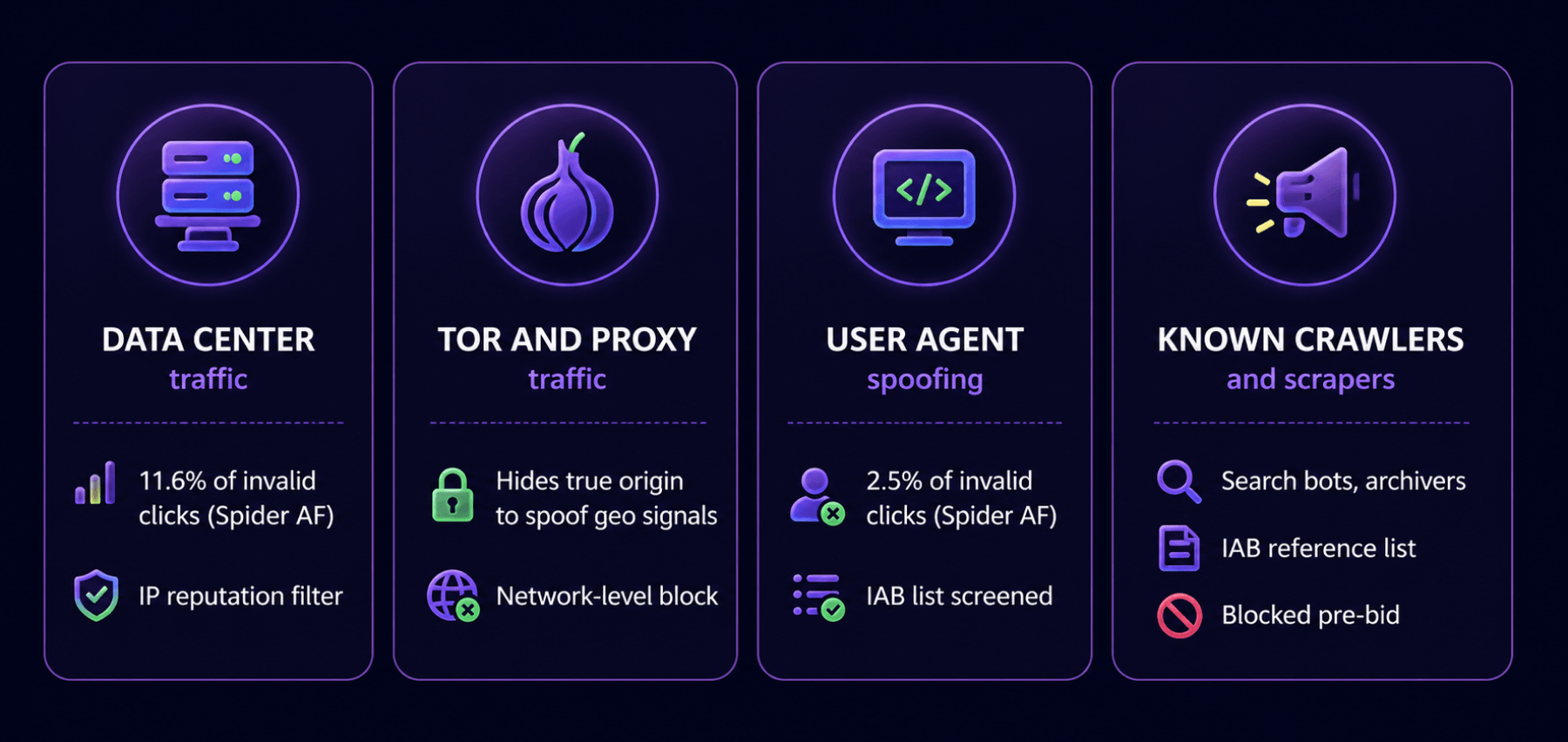
Data center traffic is the simplest case: ad requests coming from server farms, not from someone's phone or laptop. There's no real person at a data center IP. It accounts for 11.6% of all click fraud (Spider AF) and is blocked by basic IP reputation filtering.
TOR and proxy traffic routes requests through anonymizing networks to hide where they originate. Location masking allows fraudsters to disguise their actual location to sell non-valuable traffic at higher prices. The intent is to look like a legitimate user in a target market while operating from somewhere else entirely. Network-level detection catches it.
User agent spoofing is bots presenting fake browser or device identities pretending to be Chrome on a Samsung Galaxy when they're actually a script running on a server. The IAB maintains a reference list of known non-human agents. Screening against it filters out the bots that don't bother hiding.
Known crawlers like search engine bots, archiving tools, and automated scrapers are identified and listed by the IAB. If they're on the list, they're blocked before bidding.
The Harder Ones: Fraud That Looks Like Real Traffic
These fraud types don't stand out. Each individual click, impression, or visit looks plausible. The problem only becomes visible when you look at patterns: what happens after the click and whether the geo makes sense for the placement.
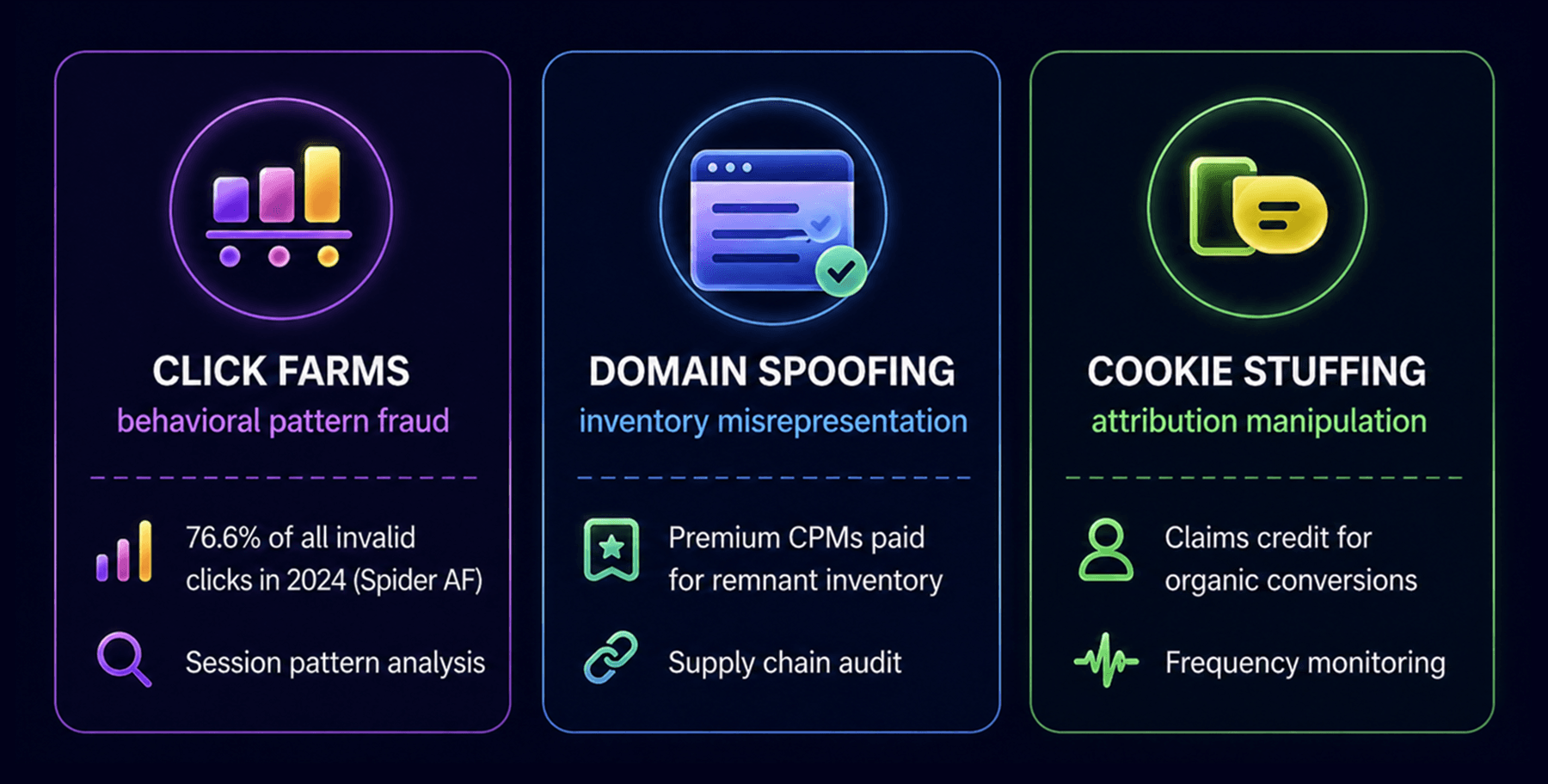
Click farms are the dominant fake traffic type: 76.6% of click fraud in 2024 came from this category (Spider AF).
At the click level, each one looks fine — real device, browser, IP. But bot traffic produces a specific pattern: timing is too consistent, the geo doesn't match what the inventory should attract, and conversion rate is near zero.
Domain spoofing means the inventory you bid on isn't what you paid for. A fraudster tells the DSP their placement is a legitimate publisher — a major financial news site — when the ad actually serves on a low-quality domain they control. You pay premium CPMs, but your ad appears somewhere you'd never have chosen.
Cookie stuffing is attribution manipulation. Cyber criminals claim credit for conversions that were already going to happen. Say, a user visits a site, gets loaded with affiliate tracking cookies without knowing it, and when they later buy something, the bad actor claims the financial gain for that engagement metrics.
The New Problem: Fraud That Is Specifically Built to Defeat Detection
This is the category that makes 2026 different from 2019. These fraud types are designed from the ground up to look identical to real user behavior. Standard blocklists don't catch them. They require a combination of filtering, post-delivery quality measurement, and — in the hardest cases — traffic quality validation at the CRM level.
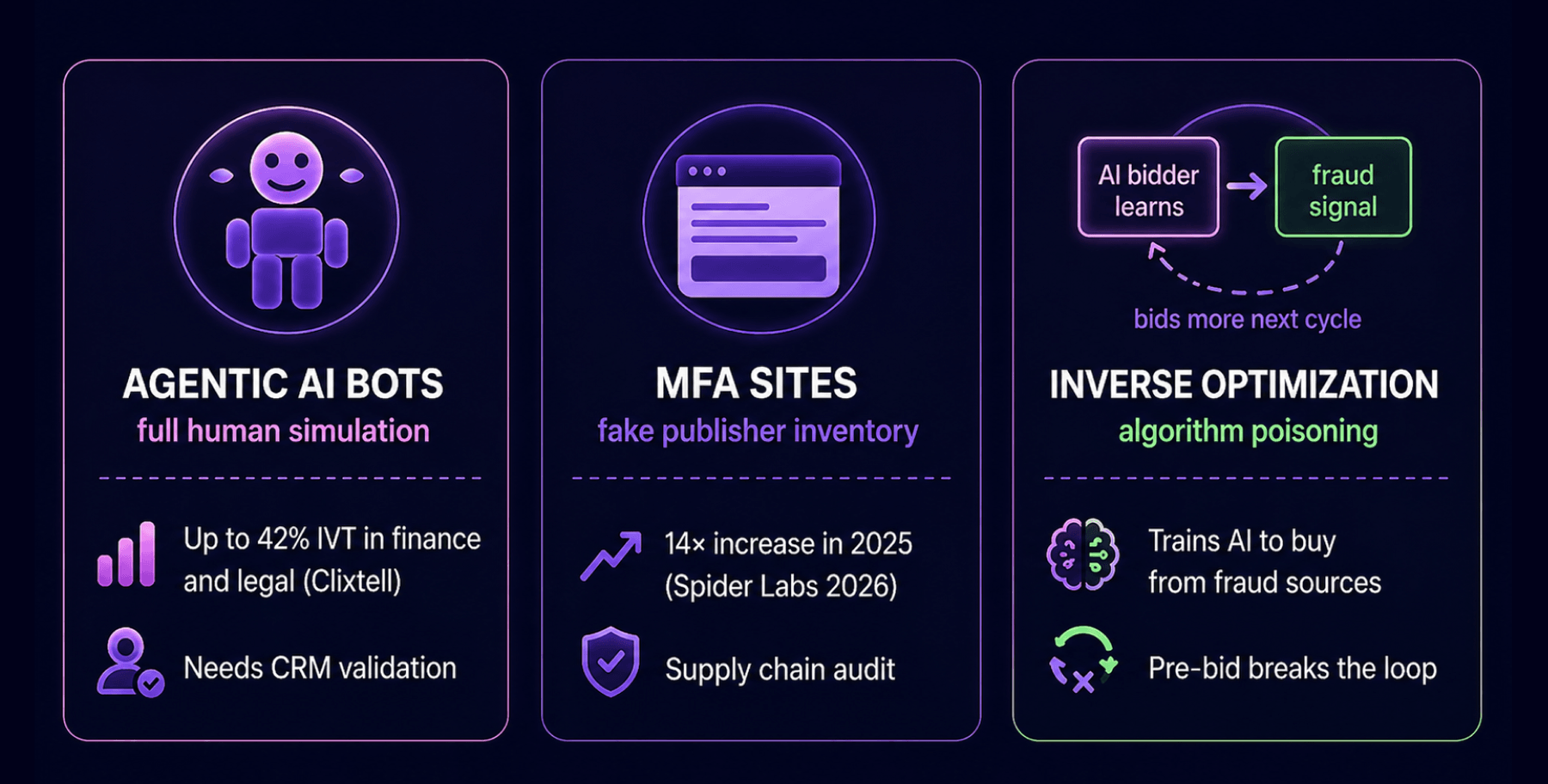
Agentic AI bots simulate human behavior entirely. Those are mouse movements, reading time, scroll depth, hesitation before form submissions, and even form-filling using stolen personal data.
The goal is to generate fraudulent conversions that are indistinguishable from human activity. Finance and legal verticals see IVT rates up to 42% from this technique, as reported by Clixtell.
MFA (Made-for-Advertising) sites are websites that exist solely to collect revenue from ad campaigns. They produce content not because anyone wants to read it, but because having content makes them look like real publishers.
Spider Labs detected a 14× increase in MFA placements in 2025. They pass basic domain quality checks because they use legitimate digital advertising systems. They're not on blocklists by default. New MFA sites can show digital ads for weeks before they're classified.
Inverse optimization fraud damages campaign performance beyond the current budget cycle. Invalid traffic is introduced into AI campaign learning loops as a positive signal — fake clicks, fake conversions, fake engagement events that the algorithm reads as evidence of a high-performing placement.
The fraud type your campaigns are most exposed to depends on the verticals you run. Finance and iGaming face all three tiers simultaneously, and disproportionately the third. Which is why the industry breakdown in the next section matters as much as the protection options.
Post-Bid Ad Fraud Detection: What It Catches and What It Can't Do
Effective strategies for protecting against ad fraud in digital marketing include utilizing AI-powered detection tools, adopting strict blocklists and whitelists, and monitoring campaigns for anomalies. AI and machine learning analyze traffic patterns in real-time to identify bot activity and click farms.
Post-bid fraud detection means continuous monitoring of what happened after your ads were delivered. It's real data which reflects outcomes for each impression served.
There are two ways agencies access post-bid measurement. Through a standalone ad fraud detection software provider like IAS, DoubleVerify, or Pixalate. Or through DSP's in-built post-bid optimization, where the verification is built directly into the platform and influences future placement weighting automatically.
What post-bid measurement gives you regardless of source:
- Viewability analytics — what percentage of served impressions were visible on screen, per MRC standards (50% of pixels visible for 1+ seconds for display; 2+ continuous seconds for video).
- Supply chain length — how many intermediaries sat between your DSP and the final publisher. Three nodes is the quality threshold. More than that, domain spoofing risk and margin extraction increase.
- Placement-level IVT classification — which specific domains and apps generated sophisticated invalid traffic, distinguishing it from general crawlers, available for exclusion in future campaigns. Separating legitimate publishers from fraudulent ones at the placement level is what makes post-bid data actionable rather than decorative.
What it can't do: Post-bid can't recover the budget already spent on fraudulent inventory. In AI-optimized campaigns, it can't undo the learning signal those impressions already generated. By the time the report identifies harmful traffic, the machine learning algorithm has already digested it.
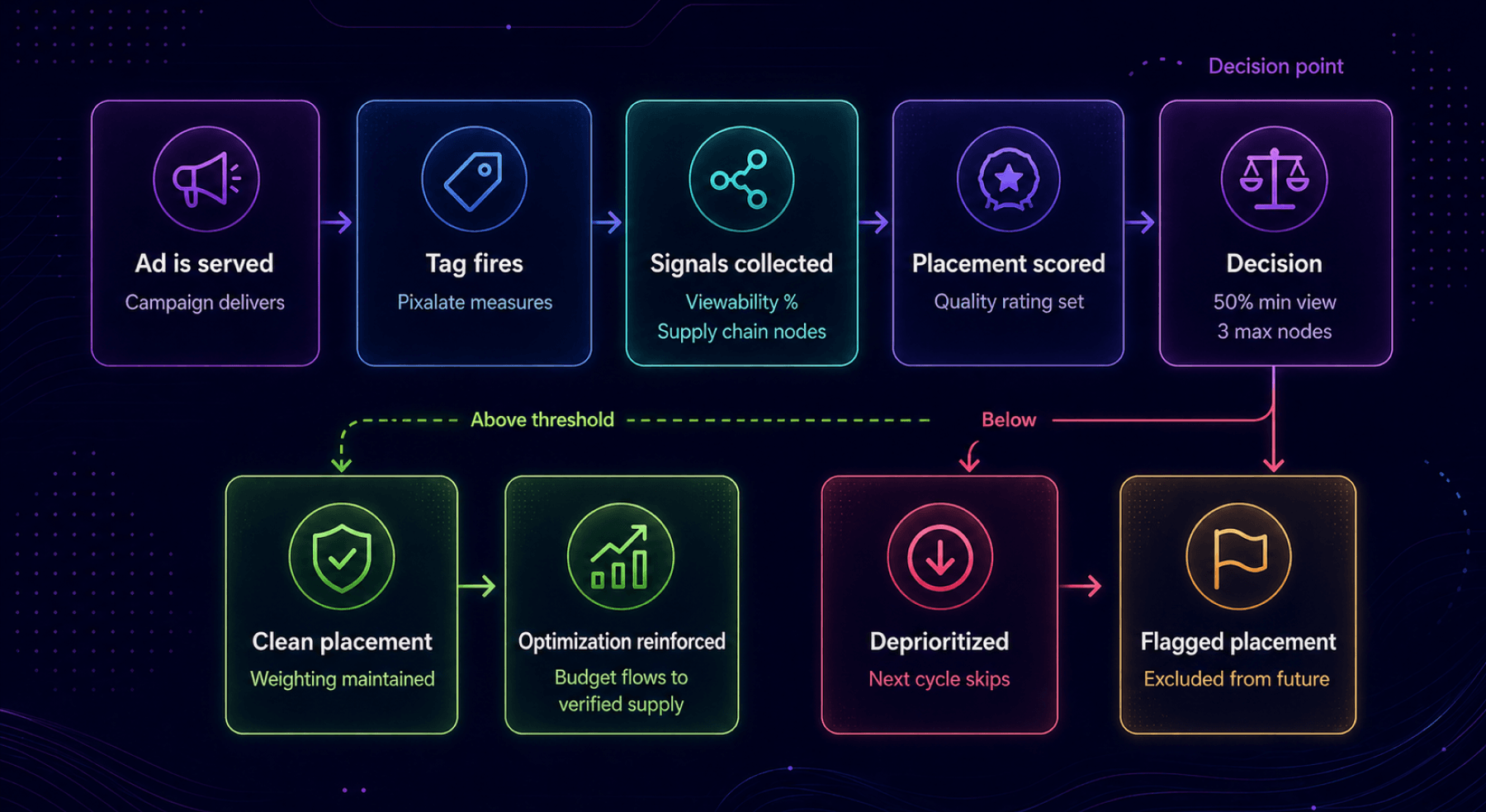
In Epom DSP, post-bid measurement powered by Pixalate is integrated directly into the setup to protect campaigns and can be activated anytime.
After delivery, each placement receives a viewability score and supply chain node count. Placements below threshold are deprioritized automatically. Defaults are 50% minimum viewability and 3 maximum supply chain nodes, adjustable per campaign.
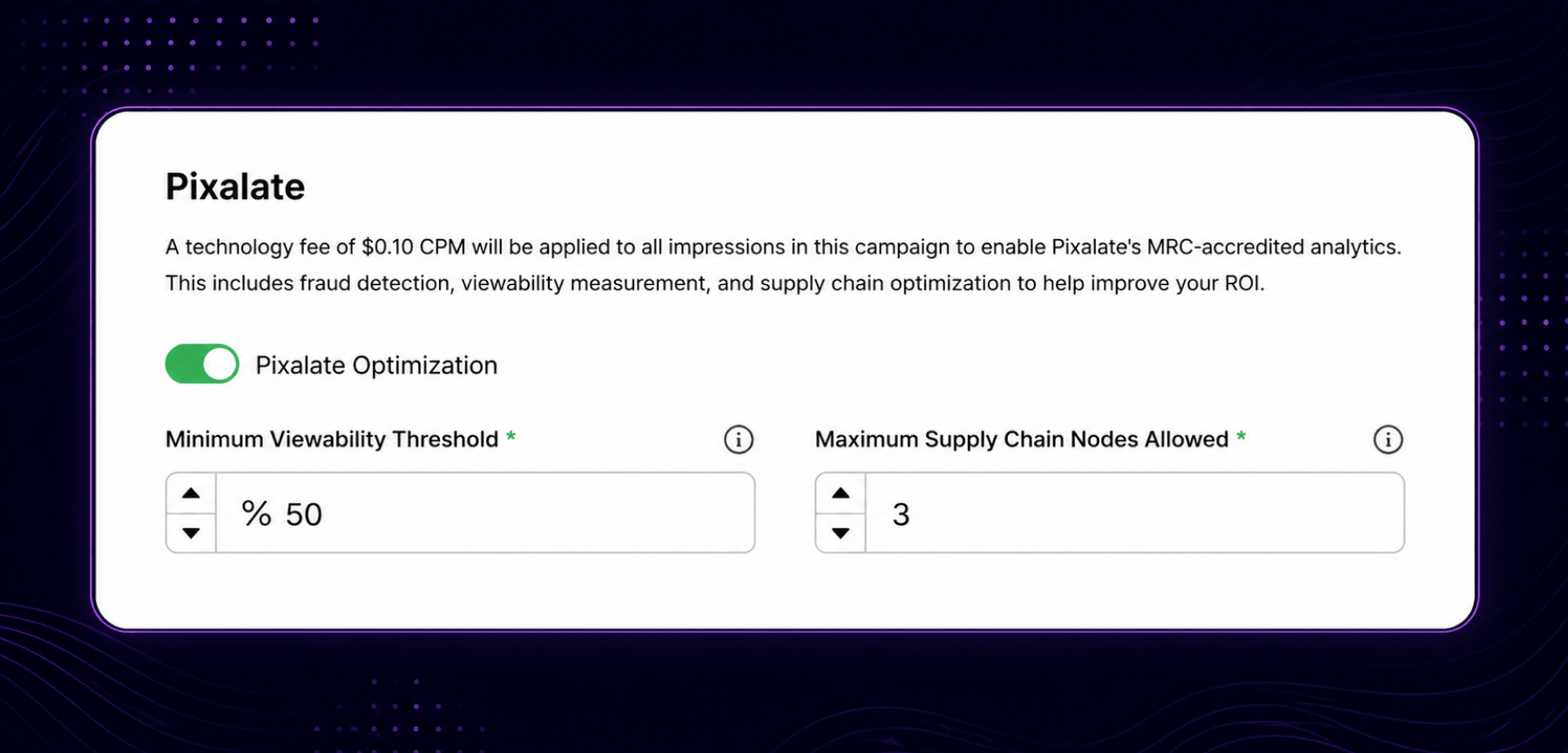
Key tip: this setting can be found under the Optimization tab of your campaign. The result is that your optimization data, over time, is drawn increasingly from verified placements that maintains your brand integrity.
But post-bid still operates after delivery. For what happens before the impression fires, that's pre-bid.
Pre-Bid Digital Ad Fraud Prevention: Why It's Stronger for 2026
Ad fraud prevention at the pre-bid layer means one thing: your DSP checks the inventory before placing a bid. Not after the impression is served. Not after the campaign runs. Before the auction fires — before a dollar leaves the budget.
The IAS data makes the case in one number: campaigns running with fraud protection held at 0.7% IVT throughout 2024. Campaigns without it reached 10.9%.
One group had a filter between their budget and the supply chain. The other didn't. That's a 15× difference in exposure, and it's entirely explained by what happens before the bid is placed.
How Pre-Bid Works Hard for Your Brand Reputation in Epom DSP
Our ad fraud detection partner, Pixalate, maintains continuously updated feeds of domains, apps, and IPs with suspicious activity. It classifies them by fraud type and scores by risk level. Every time you are about to buy an impression, we check it against those feeds before bidding. If it's flagged at the configured risk tolerance, we don't bid.
Think of it as armor you might be wearing in RPG games: light, medium, or heavy depending on the enemy you're facing. Low for the mobs, heavy for the bosses. In Epom it works like this:
- Low — strict filtering, less reach. For brand-sensitive client accounts where quality matters more than volume.
- Medium — balanced. The right starting point for most agency campaigns.
- High (default) — maximum reach with essential safeguards in place. For performance campaigns where scale is the priority.
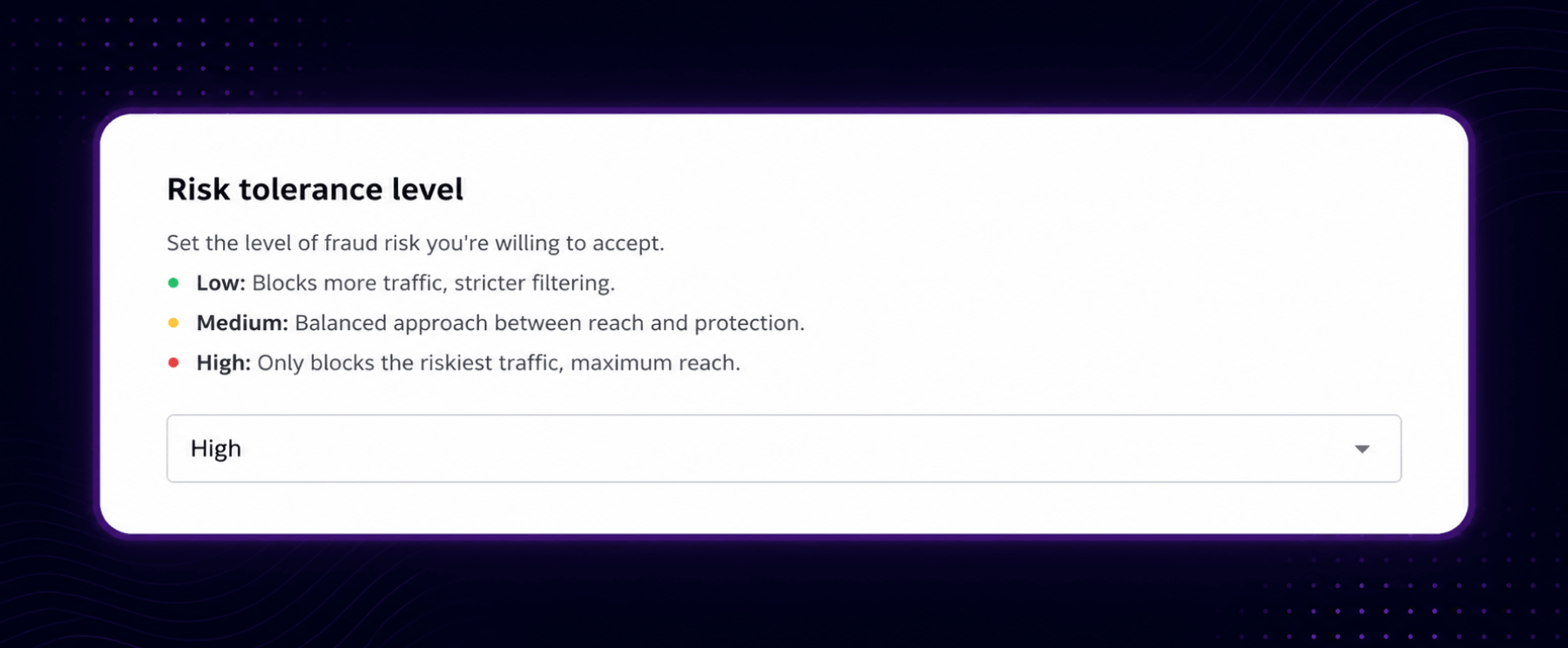
Key tip: this setting can be found under the Optimization tab of your campaign.
Why this matters more now than it did three years ago
MFA sites are the reason. Spider Labs detected a 14× increase in MFA placements in 2025 — AI-generated content farms that look like real publishers until you measure what they deliver. New fraudulent domains appear faster than any static blocklist can track. Pixalate's feeds are updated continuously as new threats are classified, which means pre-bid filtering catches new MFA inventory before wasted ad spend.
For agencies running iGaming and finance accounts, a fraudulent conversion isn't just a fake click. It's a lead that enters the client's CRM, fails to qualify, and generates a conversation you don't want to have. Ad fraud prevention at the pre-bid layer is the only protection that operates before any of that happens.
Run fraud-protected campaigns with high-risk traffic already filtered out by Epom DSP
Create your accountAd Fraud by Industry: Where the Risk Concentrates
Ad fraud doesn't distribute evenly. Fraudsters follow high CPAs, high payout events, verticals where fake conversions are hard to verify quickly but drive high financial gain. The pattern is consistent across every major fraudulent activity research dataset in 2025–2026.
It also maps directly onto Epom's client base. Finance and betting/iGaming together represent roughly 30% of our active white-label DSP clients. Those are agencies and ad networks running campaigns in the exact verticals where fraud concentrates most aggressively. That reality shaped why we built fraud protection into the platform's core infrastructure rather than offering it as an add-on.
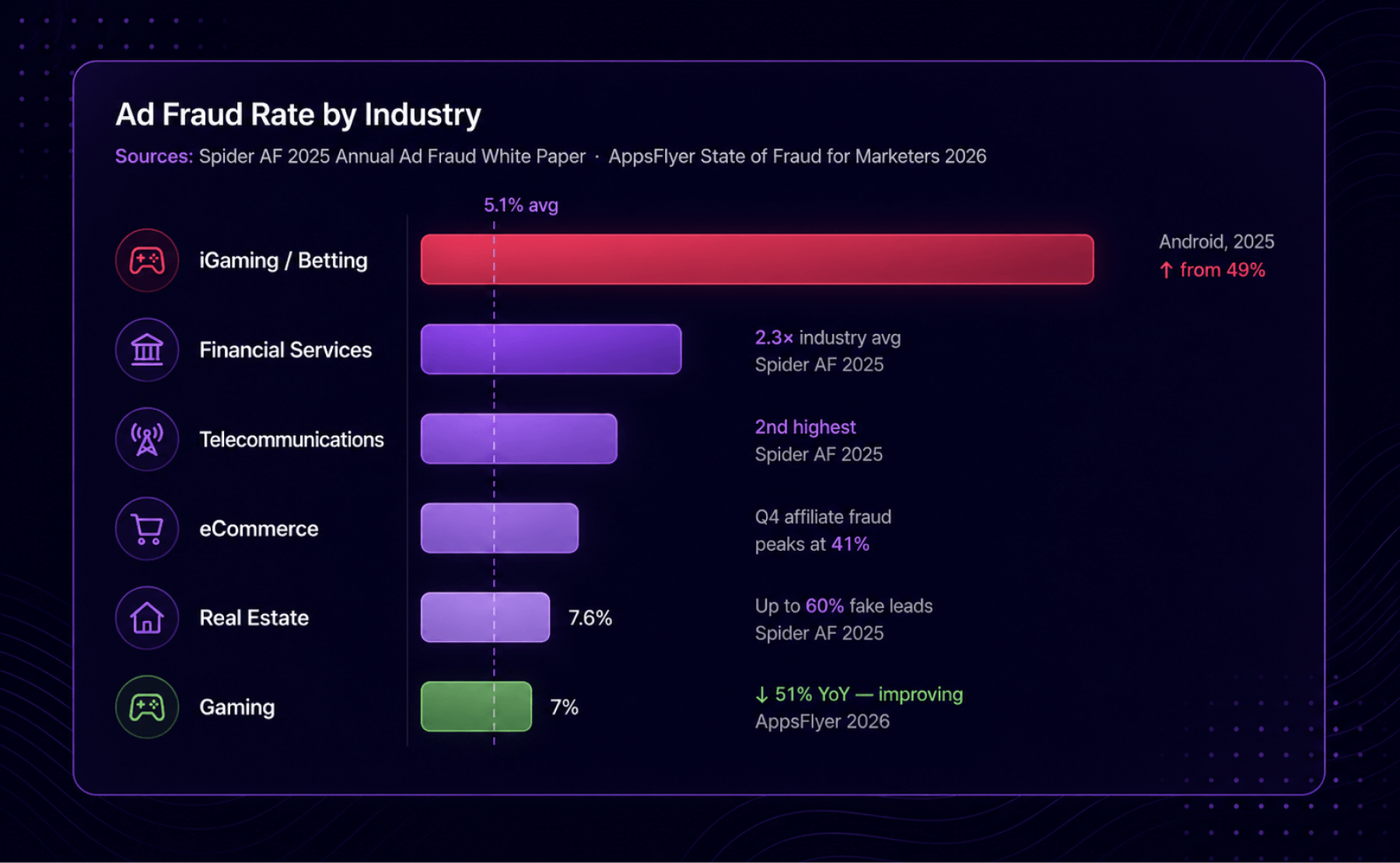
Financial Services — 14.3% Fraud Rate
The highest fraud rate of any vertical in the Spider AF report — 2.3× the overall average of 5.1%. Finance is the primary target because cost-per-lead is high and fake conversions are difficult to distinguish from real ones at the point of conversion.
AppsFlyer's data shows Finance campaigns in mobile environments stuck at 50–53% Real Users Lift for five consecutive quarters. That's roughly one fake acquisition for every real one, consistently, with no improvement.
For agencies running finance campaigns — mortgage leads, insurance sign-ups, investment platforms — the fraud surfaces as a qualification gap. Pre-bid filtering at Low risk tolerance is the starting configuration. Post-bid supply chain monitoring identifies the indirect supply paths where spoofing concentrates.
Sports Betting and iGaming — 59% Fraud Rate (Android, 2025)
Ad fraud protection for sports betting and iGaming campaigns requires a stricter starting configuration than most other verticals for identifying fraud schemes. Gambling mobile ad fraud on Android rose from 49% to 59% year-over-year, peaking at 64% in Q4 (AppsFlyer). At that Q4 peak, Real Users Lift hit 175% — nearly two fake acquisitions per real user.
From what we see across our iGaming and betting agency clients, fraudulent traffic tends to concentrate in specific traffic segments. Ad campaigns setting post-bid thresholds of three nodes maximum consistently identify more problematic placements than those running without it, especially when paired with carefully connected SSP endpoints inside a white-label DSP.
eCommerce — 10% Fraud Rate
Ad fraud protection for eCommerce addresses two distinct fraud types: promo abuse (bots gaming referral bonuses, first-purchase discounts, and offer redemptions) and affiliate fraud where attribution is claimed on organic conversions.
Q4 is the highest-risk period , as shopping fraud rose 31% YoY in AppsFlyer's data on mobile ad fraud, peaking at 41% in Q4 when holiday digital campaigns onboard new affiliate networks with looser controls.
Gaming — 7% Fraud Rate, Improving
Gaming fraud dropped 51% YoY in the affiliate channel, from 29% to 14% (AppsFlyer).
The reason is structural: gaming advertisers enforce KPIs — session depth, retention, level completions — that bots can't fake at scale. Gaming is what other verticals look like when downstream KPI enforcement is consistent and non-negotiable.
Real Estate — 7.6% Fraud Rate
One documented case from Spider AF: a campaign optimizing for "appraisal inquiry completed" saw 50–60% of conversions arriving as fake leads from outside the target country. After implementing MFA site exclusions, fake overseas leads dropped from 65% to 10%.
Telecommunications — 11.1% Fraud Rate
Second-highest in Spider AF's report. High CPAs for contract sign-ups create the same economic incentive structure as finance. Telecom campaigns in Tier-2 and Tier-3 geos (LATAM, MENA, APAC) run at 3–8% IVT even in clean environments per Epom's own traffic benchmarks.
The pattern across all verticals is consistent: fraud concentrates where payout is highest. Which means the ad fraud solution should be vertical-specific, and the starting configuration for a betting agency account is different from a real estate client.
Ad Fraud Solutions: What Every DSP Has & What is Rarity
Every DSP claims to have ad fraud protection. Most decent ones do — through partnerships with IAS, DoubleVerify, Pixalate, or similar providers, and you'll see this clearly when you compare top DSP examples and their core features.
The distinction that matters isn't which provider they're partnered with. It's where in the campaign cycle that protection fires: before the bid is placed, or after the impression is already served and the budget is already spent.
Here's the landscape by tool category.
Programmatic Ad Fraud Detection Software
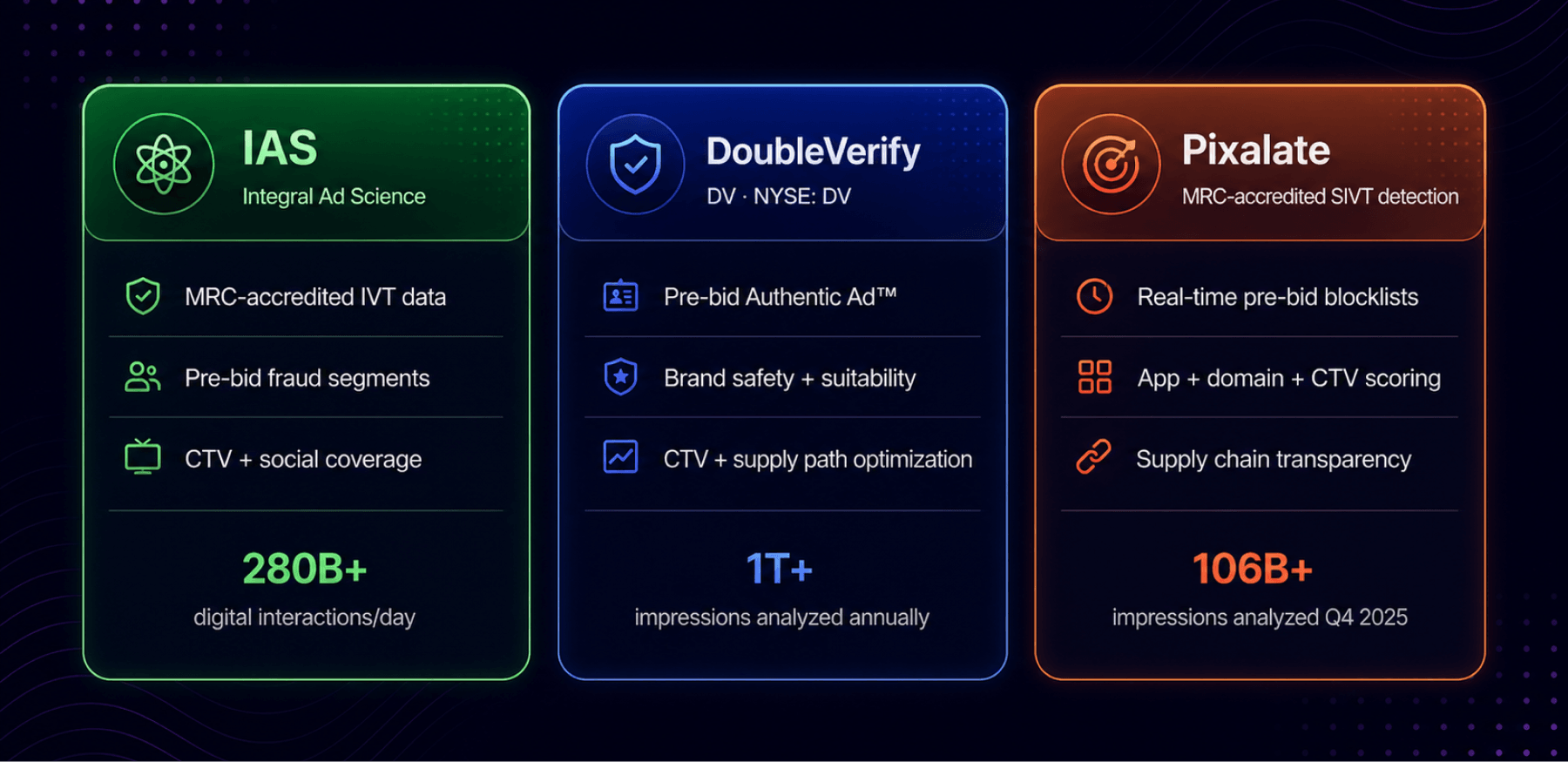
IAS, DoubleVerify, Pixalate measure fraudulent traffic at the impression level across the open web. These are the ad fraud detection tools that produce MRC-accredited IVT data, close that 15× gap between non-optimized and optimized impression, and feed pre-bid blocklist segments into DSPs that support them.
They're the industry standard for programmatic advertising fraud detection. They work best when integrated into a DSP's bid layer, just like Epom partnered with Pixalate to ensure hallmark campaign performance to our clients — and they're a key evaluation point when you choose the best DSP for programmatic campaigns.
Click Fraud Protection Tools
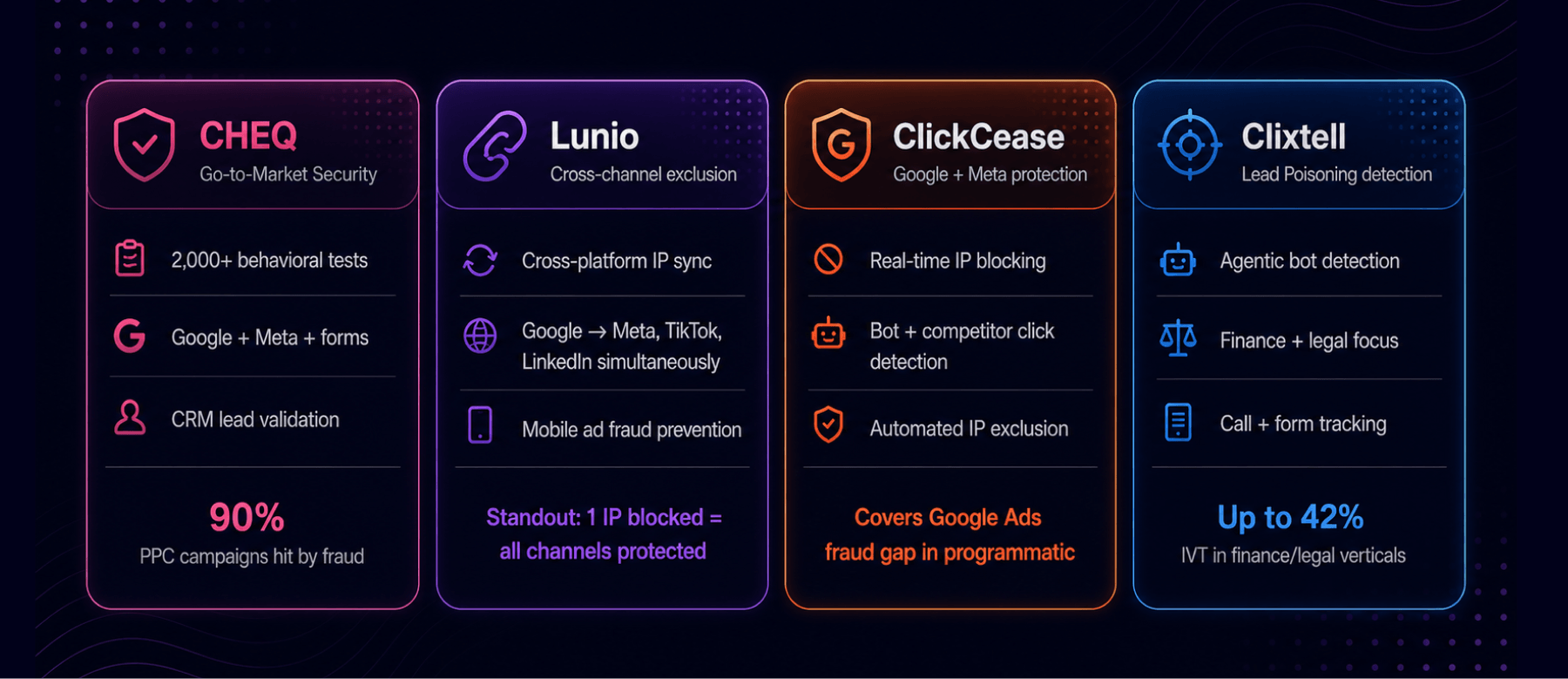
CHEQ, Lunio, ClickCease, Clixtell mostly operate around paid search and social. They're built for Google Ads and Meta ad campaigns, monitoring click-level behavior across PPC channels and automatically excluding invalid IPs.
Lunio's standout is cross-channel intelligence to prevent mobile ad fraud: one invalid IP detected on Google gets excluded across all connected platforms simultaneously, including Meta, TikTok, and LinkedIn.
CHEQ runs 2,000+ behavioral analysis tests per visit. For agencies running paid search alongside programmatic, these tools address a real gap since programmatic verification platforms don't provide real-time monitoring for Google Ads click fraud.
Bot and IP scoring APIs
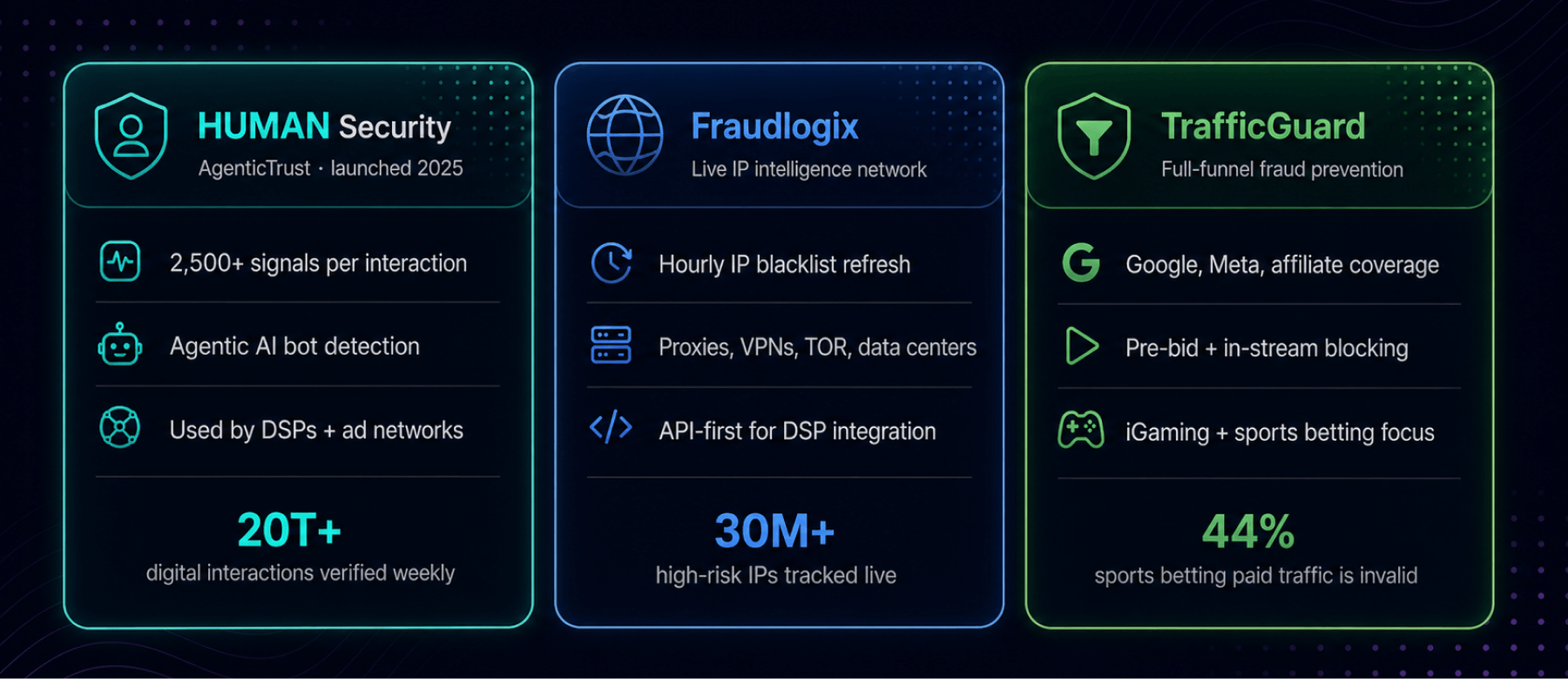
HUMAN Security, Fraudlogix, TrafficGuard sit at the infrastructure level, scoring IPs and traffic sources against large sensor networks.
Fraudlogix maintains a live blocklist of 30M+ high-risk IPs refreshed hourly, covering proxies, VPNs, TOR, data centers, and masked devices.
HUMAN Security focuses on agentic and bot-driven fraud. They launched AgenticTrust in 2025 specifically to address intent-based control across humans, bots, and AI agents. These are more commonly used by DSPs and ad networks building their own protection and willing to maintain brand integrity as a reputable ad business.
CRM-level lead validation
Spider AF or CHEQ for forms hold the level most agencies are missing entirely. Those tools are built specifically for lead gen campaigns where agentic AI bots complete forms and enter the client's CRM as qualified prospects.
Spider AF's Fake Lead Protection validates submissions at the form level before they enter the pipeline, fake leads dropped from 65% to 10% in one documented case.
What's missing from most agency stacks is the right measurement. Programmatic protection at bid time. Click fraud protection on paid search. Lead validation on performance campaigns.
Final Takeaways: Ad Fraud Prevention Beats Ad Fraud Detection
Ad fraud detection tells you what went wrong. Ad fraud prevention stops it before the campaign learns the wrong lesson.
The IAS number is precise: 0.7% IVT for protected campaigns versus 10.9% for unprotected ones. That 15× gap is about one group of campaigns having a filter between their money and the open exchange and the other group not having one.
For agencies, the order of operations is straightforward.
First, confirm your DSP filters at bid time.
Second, match risk tolerance to the client: Low for finance and iGaming, Medium for most accounts, High when reach matters most.
Third, add post-bid supply chain measurement for anything where viewability or placement quality is a client KPI.
Fourth, for lead gen accounts, validate at the CRM level before fraudulent leads enter the pipeline and corrupt the client's sales data.
Ad fraud doesn't stop. The conditions that make it profitable like AI-optimized buying, high CPAs, automated delivery aren't going away. The only variable you control is the level of your protection.
Epom DSP has Pixalate pre-bid filtering and post-bid optimization built in. Run each campaign protected by default, no overthinking it.
Start buying fraud-protected traffic →