
- Programmatic advertising is no longer just for big brands — SMBs can use it, too.
- High minimum spends of $10,000–20,000 per month are typical mainly for individual enterprise DSPs, and not for the entire programmatic market.
- Modern self-serve DSPs allow you to start testing campaigns with a $100 deposit.
- To work effectively in the Open Web, it is important to use bid shading, frequency capping, brand safety, and protection against MFA and click fraud.
- When choosing a DSP, pay attention to transparent pricing, placement-level reporting, flexible purchasing models (CPM, CPC, CPA), and the absence of hidden fees.
The End of Cheap Social Ads: Why SMBs Are Moving to the Open Web
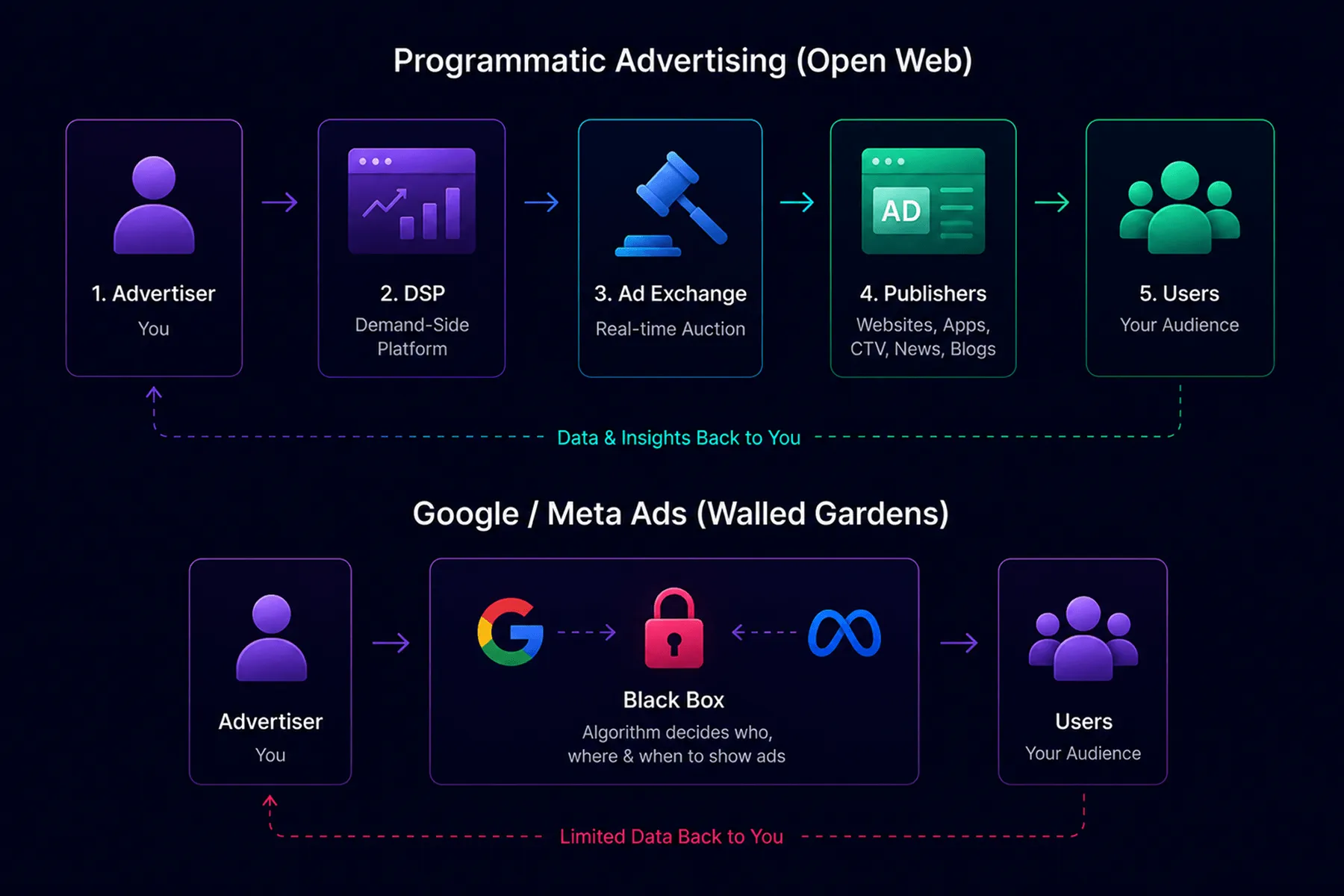
For a long time, small businesses were content with two advertising platforms: Google Ads and Meta. But the rules of the game have changed. Meta’s CPMs are steadily increasing, competition for user attention is intensifying, and automated campaigns like Google’s Performance Max (PMax) are operating more like a “black box”. The algorithm decides who, where, and when to show ads, but it explains its decisions very superficially.
Marketers see costs and bottom lines, but don’t understand which platforms or audiences are performing well. For small teams, this can be a real headache. When budgets are tight, every dollar needs to be spent as efficiently as possible. But if you can’t see site-level data, get placement-level logs, or understand why the algorithm increased spend on a particular audience segment, campaign optimization becomes a guessing game.
Buying ads directly from publishers is no less challenging. As one of Epom customers describes it, this often means constantly exchanging information, sending ZIP files and screenshots.
When SMBs and smaller agencies are looking beyond walled gardens to programmatic media buying, they’re looking for more transparency, granular reporting, and greater control over where their dollars are actually going.
What Is Programmatic Advertising for Small Business?
If you are just starting with this technology, we recommend that you first understand in detail what is programmatic advertising.
To put it simply, programmatic advertising is the automated buying of digital advertising through a single platform instead of negotiating with each publisher separately.
For small businesses, the main advantage is control. For example, in Meta or Google Ads, the algorithms largely decide who to show ads to, where they appear, and how to allocate budget. In programmatic, you get much more control over these decisions: choosing inventory, setting up audiences, controlling display frequency, and analyzing results at a more granular level.
Besides, while social networks limit you to their own ecosystems, programmatic opens up access to the Open Web and more than 30 ad formats. These include native advertising, HTML5 creatives, digital out-of-home (DOOH), connected TV (CTV), audio advertising, video, and other formats. These are the fastest-growing programmatic advertising trends, as advertisers continue to diversify beyond social media.
That is why more and more companies are considering DSP for small business not as a complex enterprise tool, but as a way to gain more control and wider reach.
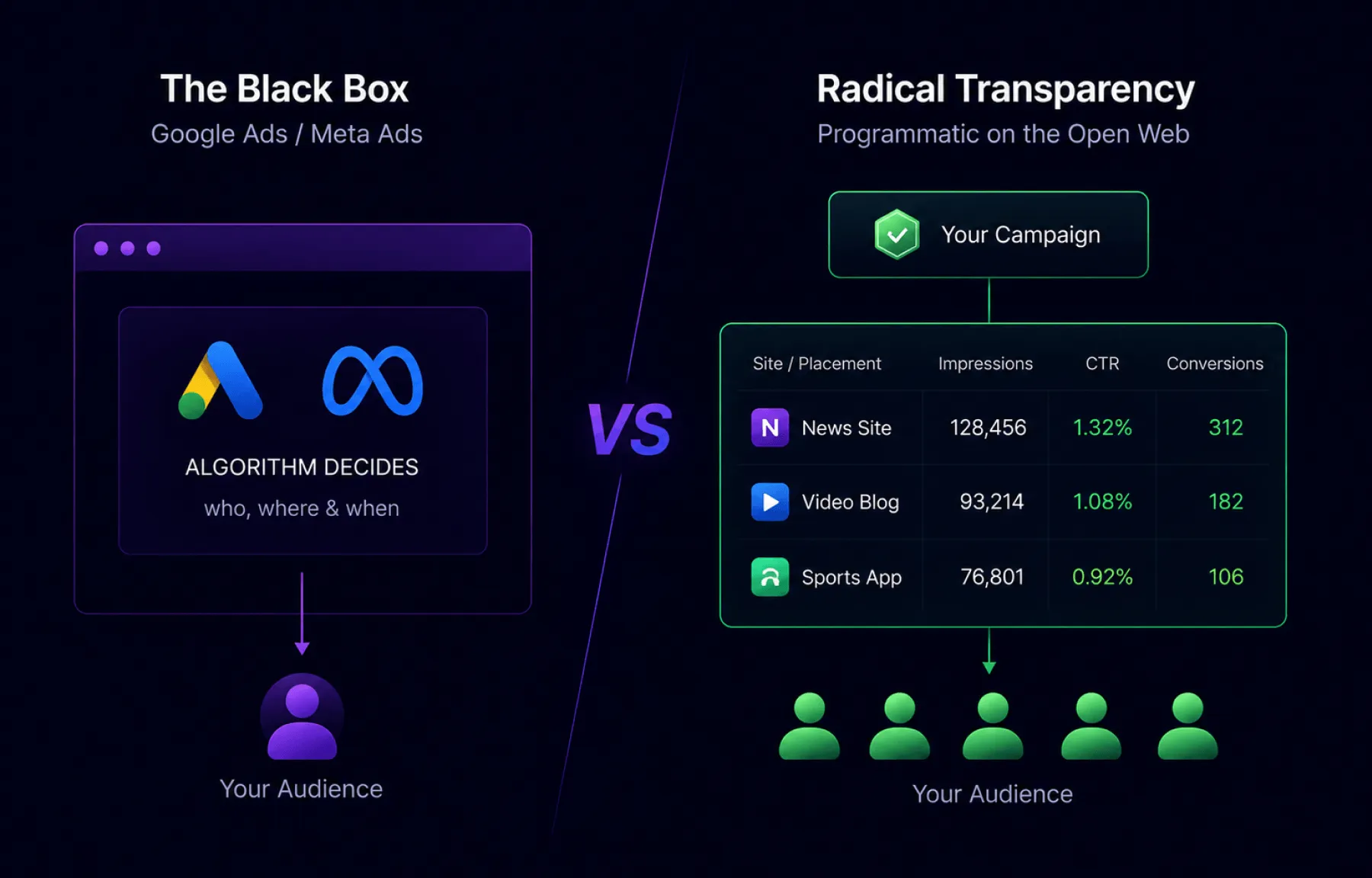
The "Black Box" vs. Radical Transparency
Meta and Google Ads rely on algorithms to make decisions. This convenience turns campaigns into a black box where algorithms obscure the causes of your results.
Programmatic advertising provides transparency. On the open web, you view logs and data to see which sites hosted your ads, which domains brought conversions, and which wasted your budget. This granularity helps you find sites that work and pause those that fail.
For small teams, this eases campaign management. As one of Epom clients notes, they want "one place where we have an overview of what needs to pause, what needs to go live." A self-serve DSP provides an interface to start, pause, and optimize campaigns.
Consequently, you understand what drives your ROAS and CPA. This gives you control over your budget, reducing guesswork and waste.
The Hidden Trap: Why Enterprise DSPs Destroy Margins
Many companies don’t even consider programmatic advertising because they believe it’s only for big brands with six-figure advertising budgets. Others believe that it is cheaper to buy advertising directly from publishers. Each approach has its own advantages, so before choosing, it is worth understanding the difference between direct vs programmatic advertising.
The problem usually isn’t the technology itself, but how it’s traditionally accessed.
Enterprise DSPs serve corporations. They demand minimum spends (the mins) and rely on resellers. Small businesses therefore incur costs before campaigns launch.
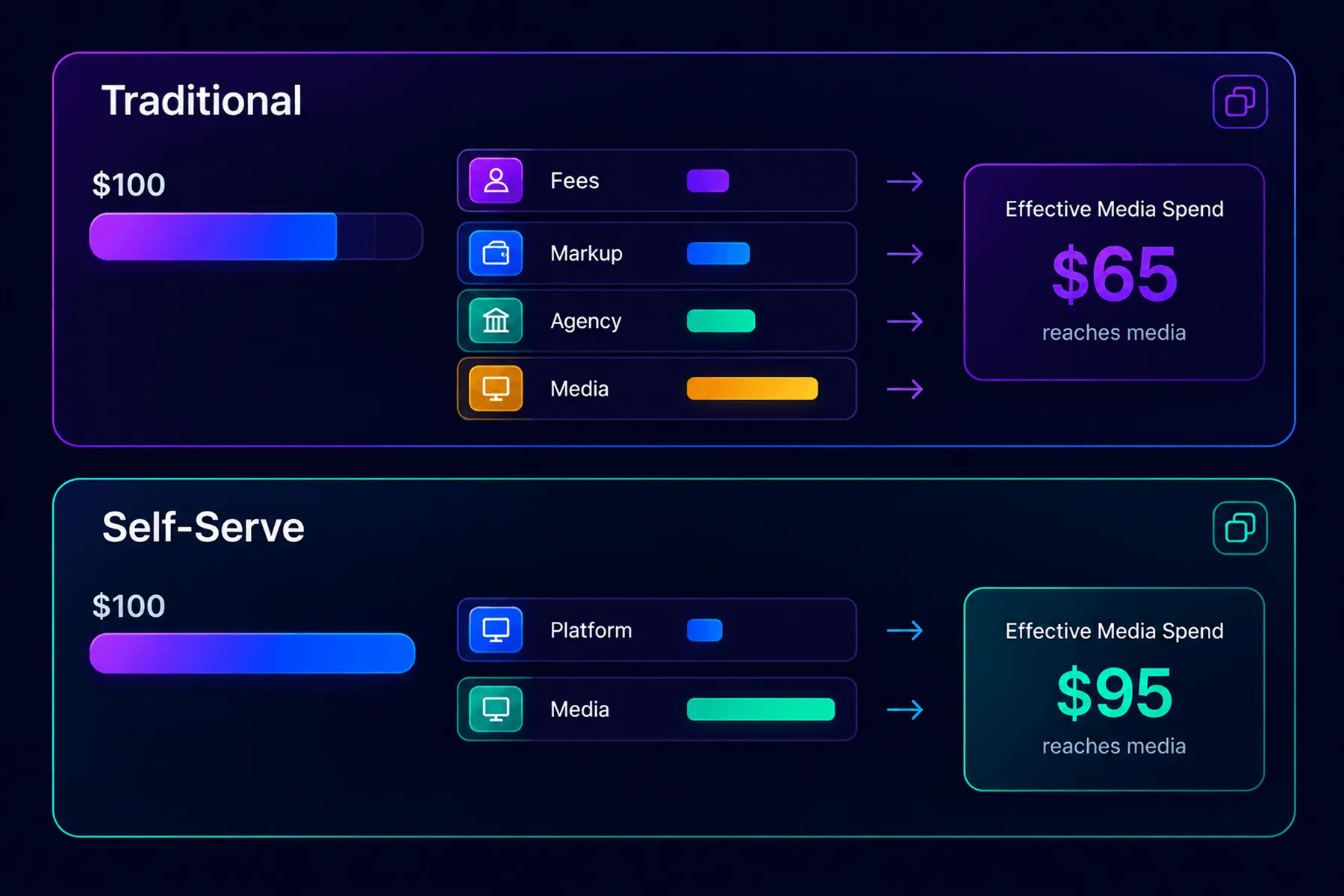
The ad tech tax adds fees that consume budgets. Markups and brokerage fees reduce the money spent buying impressions.
Traditional buying methods make programmatic expensive. Self-serve DSPs let you buy inventory directly. This makes programmatic accessible to small teams, allowing them to invest in advertising.
The Minimum Spend Barrier
Another barrier to small businesses using programmatic advertising is the high minimum spend. Many Tier 1 DSPs are focused on large brands and agency holdings, so they set requirements that are simply unrealistic for SMBs. For example, to work directly with The Trade Desk, companies often need to spend $20,000 per month on advertising. Moreover, access to Google Display & Video 360 (DV360) is usually available only to large advertisers with annual budgets exceeding $5 million. So, many SMBs have to work through resellers or managed services, accepting additional commissions and losing control over campaigns.
However, that doesn't mean the answer to "can small businesses use programmatic" is no. It simply means that some DSPs were built for global brands, not growing businesses. If a platform expects enterprise-level budgets before you can launch your first campaign, you're looking at the wrong solution. But not the wrong advertising channel.
Exposing the "Reseller Tax"
For many small companies, the path to programmatic media buying begins not with direct access to the DSP, but with a reseller. The reseller bypasses minimums, configures platforms, and launches campaigns. This introduces the reseller tax.
Advertisers pay mediation and platform fees that hide on bills. Consequently, portions of the budget miss the auction. Resellers consume 20 to 40 percent of budgets through markups and commissions. Fees absorb funds before they buy media. Resellers are good at guiding beginners, yet obscured pricing distorts performance metrics.
As a result, more and more SMBs and small agencies turn to self-serve DSPs. Instead of paying hidden markups, the company can invest more in impressions, test new audiences, and optimize campaigns. Not only does it help reduce the ad tech tax, but it also gives a clear understanding of where every advertising dollar goes.
Surviving the Programmatic Wild West: 4 Rules for Small Budgets
The Open Web offers more opportunities than closed advertising ecosystems, but it also brings new risks. If you simply launch a campaign without proper settings, part of the budget can go to MFA (Made for Advertising) websites, low-quality traffic, or click fraud. That's why experienced media buyers call this approach "spray-and-pray", when ads are shown anywhere in the hope that something will work.
The good news is you don't have to hire an expensive agency to protect your budget. It's enough to know a few basic rules to launch campaigns confidently, even with a small advertising budget.
Bid Shading: Stop Overpaying in Auctions
Most programmatic auctions today operate on a first-price auction model. It means that if you bid $10 and win the auction, you’ll pay exactly $10. Careless bidding can now quickly increase your costs.
Many modern DSPs use bid shading. This algorithm analyzes historical auction data and tries to determine the minimum bid that’s enough to win. For example, if you’re willing to pay up to $10 but the system decides you can win for $6.20, it automatically lowers your bid. As a result, you get the same impression at a lower price.
It’s especially important for small advertisers. When programmatic advertising budgets for small businesses are limited, even a small overpayment per auction gradually accumulates, reducing the number of impressions bought with the same budget. So, make sure that your DSP supports bid shading.
Frequency Capping: Don't Spam Your Audience
On the open web, advertisers control frequency. But without frequency capping, one person might see your ad dozens of times. Users quickly ignore repetitive ads, draining your budget on the same audience. The campaign scatters money without results.
Frequency capping limits how often a person sees an ad per day, week, or campaign. Brands operating across countries and channels need this control. When a user sees your ad on a news website, a mobile app, and connected TV, the system must count those impressions together. A DSP unifies frequency capping across channels and geographies to pace exposure.
Beating "Made for Advertising" (MFA) and Fraud
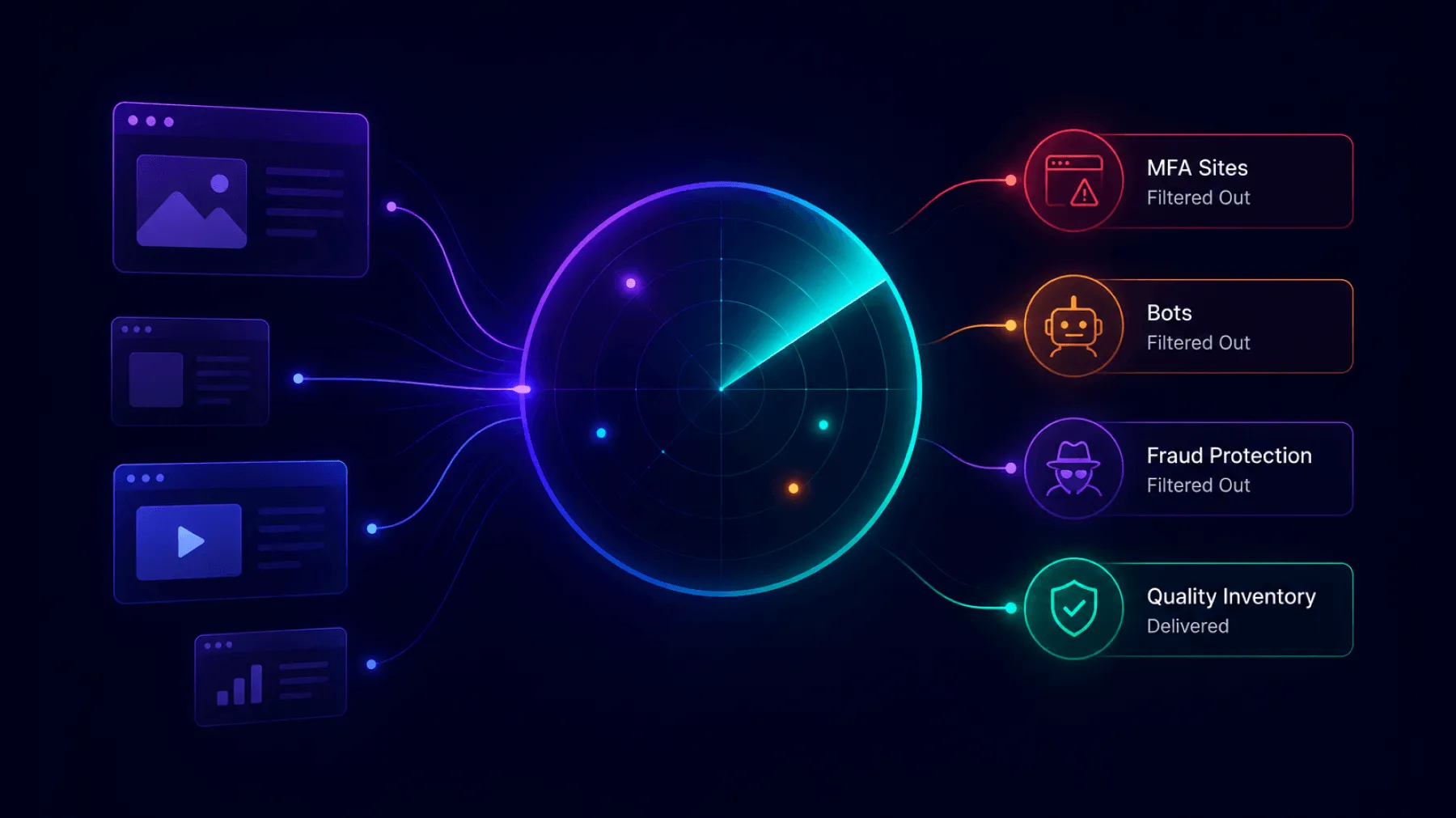
MFA (Made for Advertising) websites have multiplied on the open web. Creators build these sites to harvest ad revenue, filling them with AI content, clickbait, and ad units. They deliver impressions but fail to drive results.
Invalid traffic (IVT) presents a similar threat, draining budgets through bots, automated clicks, and click fraud. Without protection, advertisers pay for impressions that humans never see.
Prioritize pre-bid filters and verification services like DoubleVerify or Pixalate. These tools block bots before you buy impressions.
When choosing a DSP, demand brand-safety controls, pre-bid fraud filtering, verification integrations, and placement logs. Fraud protection is a requirement for any DSP.
Precision Targeting: First-Party Data and Poly-fencing
Precision targeting drives companies beyond Google and Meta. Google Ads limits targeting to cities or kilometer radiuses, but advertisers often need to reach visitors inside a shopping mall or competitor's store.
Polygonal geofencing maps these boundaries. You target people inside a business park or exhibition center, reaching users exactly where they stand. This helps local businesses reduce waste and increase conversions.
An equally powerful tool is First-Party Data (1PD). If you already have a customer base, CRM, or email list, you can upload this data to a DSP to use for retargeting or to create lookalike audiences. Instead of starting a customer search from scratch, you work with people who have already interacted with your business, which helps to lower CPA and increase ROAS.
And if you don’t have enough data yet, that’s not a problem. Many DSPs integrate with audience providers, such as Lotame, which offer ready-made behavioral and interest-based audience segments.
How to Choose a Self-Serve DSP Built for Small Businesses
Once you've decided to give programmatic a try, the next question arises: which platform should you choose?
There are dozens of DSPs on the market, but not all of them are built for small businesses. Check this self-serve DSP comparison — it can save you a lot of time. Some are designed for global brands with multi-million-dollar budgets; but for a small team, it often means unnecessary complexity, hidden fees, and features that they will never use.
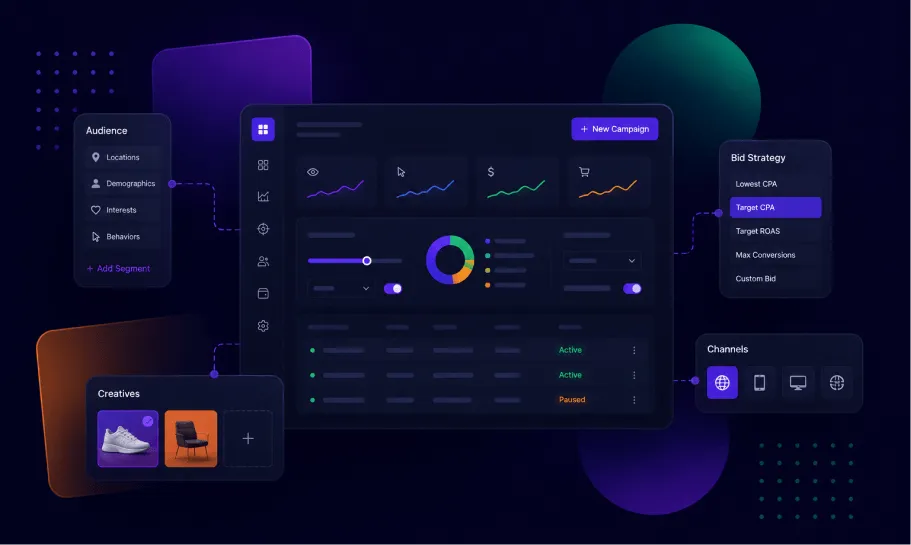
Look not at the number of big names on the client list, but at how well the platform meets your real needs. A good self-serve DSP should allow you to launch campaigns quickly, provide transparent reporting, and scale with your business. It is also important that you can manage the budget, add new creative, or adjust targeting yourself.
Below is a checklist to help you distinguish a platform built for enterprise companies from one that is suitable for small businesses.
The Mandatory Feature Checklist
Before deciding on a platform, make sure it meets this checklist:
- No monthly minimums. You should be able to start with a comfortable budget.
- Transparent CPMs. The platform should clearly show you how much you’re paying.
- Flexible payment models. Support for CPM, CPC, and CPA lets you choose the model that best suits your goals and KPIs.
- Placement-level reporting to optimize your campaigns and explain your results to your customers.
- Built-in fraud protection: pre-bid filtering, brand safety, and other tools.
- Extensive customization options.
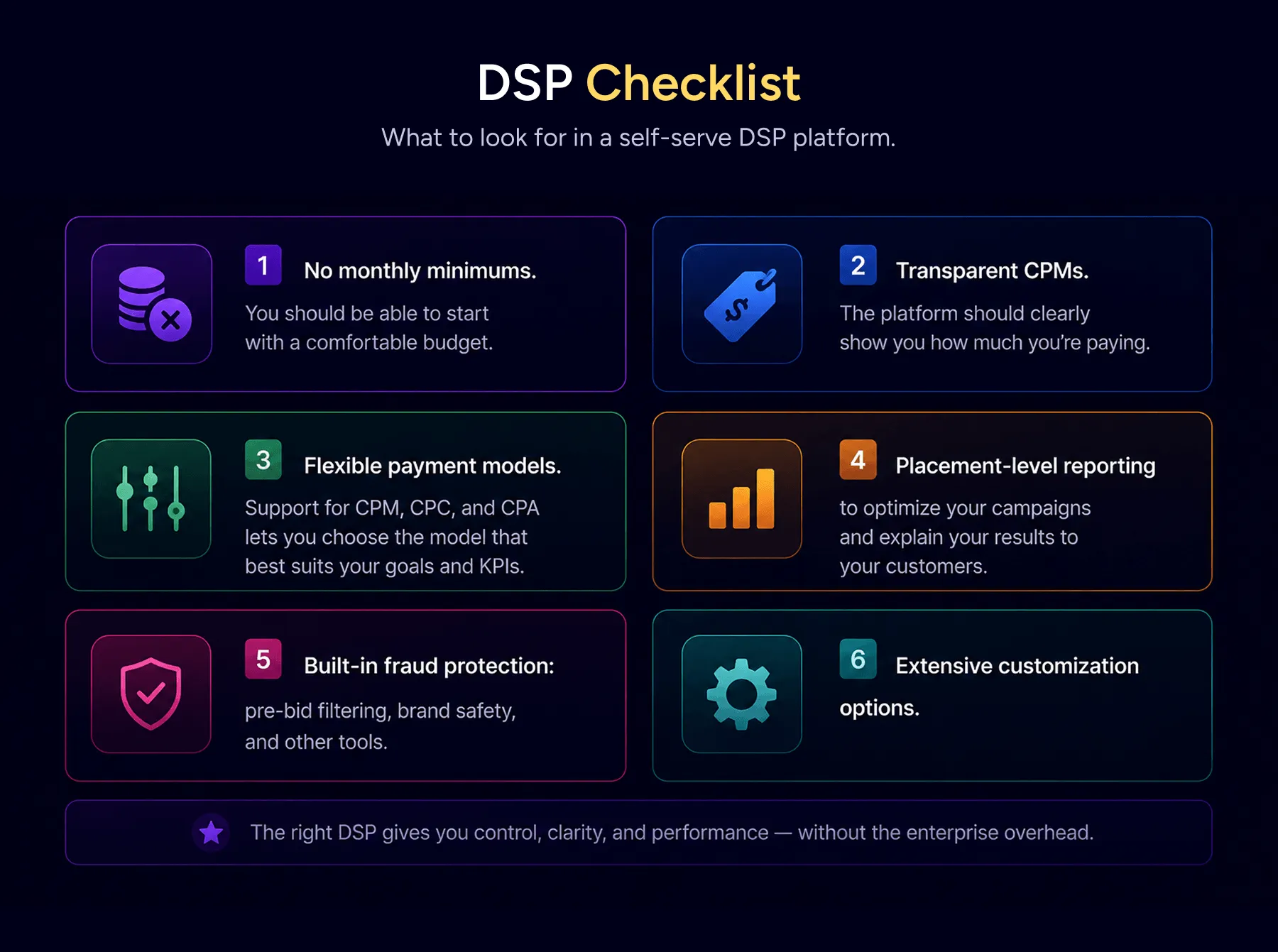
As your business grows, you’ll want to test new formats, traffic sources, optimization rules, and audiences. A good DSP doesn’t limit you to a few basic toggles, but offers hundreds of settings for different scenarios. The best platforms offer 800+ configurable features.
To sum up, the platform should not only run ads today but also remain convenient as you grow.
Epom DSP: The Self-Serve Platform That Fits the Criteria
If you look at the checklist above, it becomes clear that small businesses need more than just a DSP, but a platform without enterprise barriers. That’s what Epom DSP is.
Instead of high monthly minimums, long contracts, and working through intermediaries, Epom lets you start with a $100 minimum deposit. So, companies can test programmatic media buying without significant financial risks, gradually scaling campaigns as their business grows.
At the same time, the affordable entry threshold does not mean compromising on functionality. The platform offers 800+ configurable features, supports placement-level reporting, transparent CPMs, bid shading, and frequency capping, works with First-Party Data, and supports various purchasing models (CPM, CPC, CPA).
Moreover, this DSP's infrastructure is reliable. With over 16 years in ad tech, Epom has built a platform that delivers 99.7% uptime, ensuring campaigns run consistently regardless of traffic volume or the number of active campaigns.
Another advantage is automatic optimization. Using algorithms for bid management and budget allocation, the platform helps advertisers achieve 30–40% higher ROI than manual campaign management.
Start Simple, Scale to White-Label Later
For most companies, it doesn’t make sense to launch your own white-label DSP right away. The key is to learn how to work with programmatic, test different strategies, and understand what works best for your business. Starting with a self-serve DSP is the best choice — and scaling later, when you’re ready.
However, not all DSPs offer this option. In many cases, growth forces businesses to migrate platforms, reconfigure integrations, and train teams. Choose software that supports expansion. Start with a self-serve account and upgrade to a white-label DSP on the same platform.
It is exactly the kind of development that many agencies expect. As one of Epom’s agency clients noted: “I don’t want to have four clients — I would like to build the interface around your solution through API.” In other words, instead of switching to a new platform as the business grows, the agency wants to build its own branded service on already familiar technology gradually.
This path is much easier and less risky than investing in a complex enterprise infrastructure right away.
Step-by-Step: Launch Your First Campaign
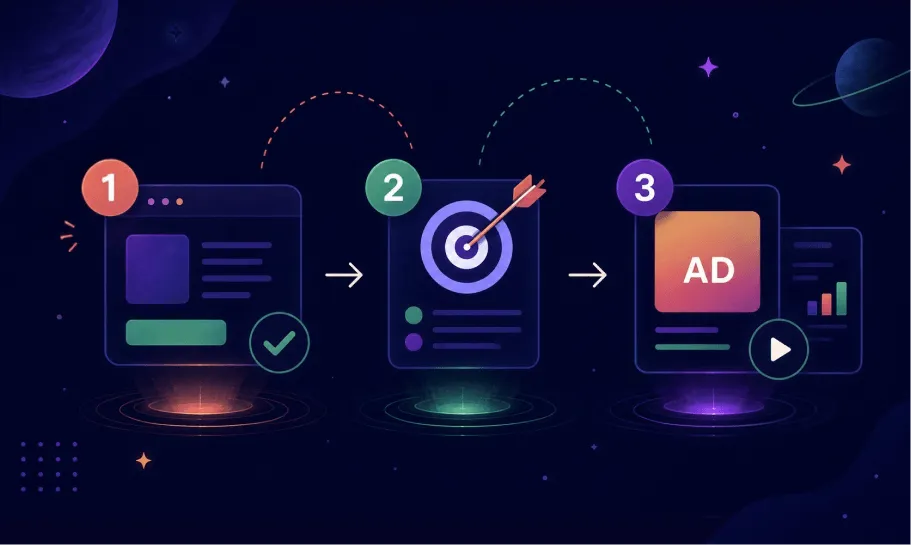
Getting started with programmatic is not as difficult as it might seem, especially with Epom. If you already know your target audience and have creatives, you can launch your first campaign in just a few steps.
1. Fund your account and create a campaign. After registering, simply make a minimum deposit of $100, choose an ad format, and define your campaign goal. It can be increasing brand awareness, driving traffic, or generating conversions.
2. Set up your targeting. Select the desired GEOs, audiences, devices, and ad formats. If necessary, you can use first-party data, ready-made audience segments, poly-fencing, and set frequency capping and brand safety rules to make your budget work as efficiently as possible.
3. Launch your campaign and optimize your results. Once launched, track placement-level reporting, analyze performance metrics, and use tools like bid shading to improve your campaign’s performance gradually. All changes can be made independently, without contacting a manager or lengthy approvals.
Programmatic no longer requires enterprise budgets or complex infrastructure. If you've always wanted to go beyond walled gardens and gain more control over your advertising, now is the time to try it.