

TL;DR:
Ad fatigue is the result of black-box algorithms repeatedly serving the same creative to the same user, driving up CPA while ROAS plummets.
To protect your budget, media buyers must transition from reactive dashboard monitoring to deterministic ad ops:
- The cause: In an ecosystem processing 14.2 trillion bid requests daily, poor delivery logic leads to “session-level burst exposure” (spamming a user multiple times in minutes).
- The lag problem: Relying on end-of-month reporting is obsolete. If CTR degrades, the budget is already wasted.
- The mechanical fix: You must control fatigue at the DSP layer using four rules: real-time banner weighting, strict recency capping (not just lifetime frequency), bid-shading adjustments, and supply-path auditing.
What Is Ad Fatigue in the 2026 Programmatic Ecosystem?
Ad fatigue is a gradual decrease in the audience’s response to advertising due to too frequent exposure to the same creative, message, or offer. People have already seen the ad, understood its content, and no longer pay attention to it. As a result, CTR and conversion rate fall, while CPC, CPA, and other costs continue to grow.
Previously, marketers explained advertising fatigue like this: the audience is tired of the banner, so it’s time to show them a new one. In today’s programmatic world, the problem is more complex. Fatigue can arise not only from outdated creative, but also from the way algorithms buy and distribute impressions in the RTB environment.
According to one industry estimate, in the first quarter of 2026, large SSPs and exchanges together processed approximately 14.2 trillion bid requests per day. However, this number represents the scale of the ecosystem, but not the number of actual impressions. After all, a single request can be sent to multiple auction participants but result in only one impression (or no impression at all). The problem is that with such a volume, even a small error in the delivery logic can quickly lead to overexposure.
For example, a segment responds well at the start of a campaign, so the DSP sends more budget its way. One banner also performs better than the others. The system begins showing it more often, sometimes to the same users. At first, this makes sense. But without frequency caps and recency controls, people may see the banner too many times in a short period. Its performance drops, yet the system keeps buying impressions for it. In Ad Ops terms, the banner has “burned out.”
So, in 2026, ad fatigue is more a sign of a delivery problem that algorithms can deepen — for instance, if they don’t account for the frequency and timing of previous contacts and varying saturation rates across individual segments.
A client of Epom shared with us his observations: “The amount that we are spending is very high towards the traffic that we are getting, but the conversion is very, very low, and the CPAs are very, very high.” The campaign continues to spend the budget and attract traffic, but fails to deliver the necessary business results.
Therefore, fighting marketing fatigue does not start with changing the button color, replacing the background image, or simply choosing another option from the almanac of digital ad formats. First, you need to determine exactly where the oversaturation has occurred: in a specific creative, in the overall message, in the audience, in the placement, or in the delivery logic.
💡 Epom Pro Tip: Dashboards only show what has already happened. If you are waiting for a human analyst to notice CPA spikes, confirm ad fatigue, and manually update the campaign, your budget is bleeding. Fatigue management must be an automated rule at the DSP bidding layer.
The Core Problem: Why Dashboard Monitoring and Creative Rotation Fail
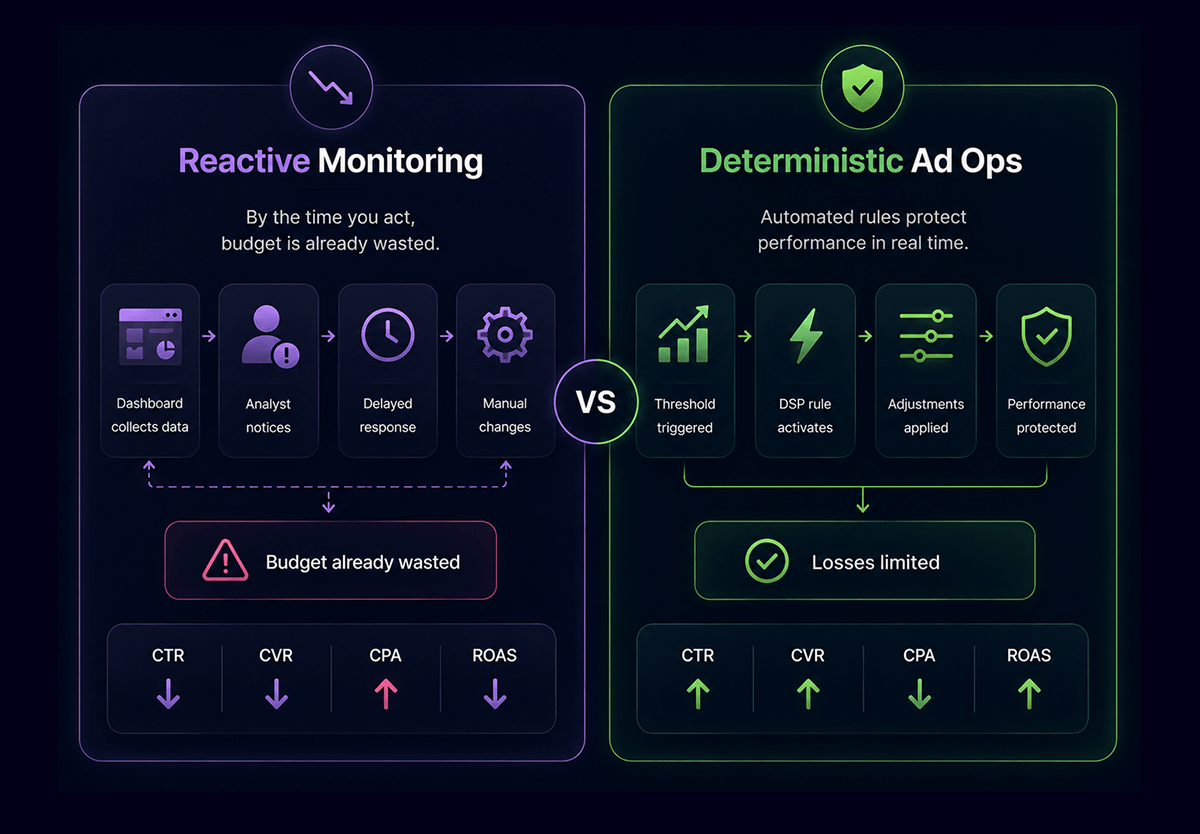
Most recommendations for combating ad fatigue boil down to two steps: monitor dashboard indicators and regularly update creatives. For example, replace banners every two weeks or upload new versions as soon as CTR starts to drop. For a small campaign on Meta or TikTok, this is sometimes enough. But this is a typical walled-garden approach that does not scale well on the open web, where ads are served across many sites and applications, often through different SSPs and across dozens of audience segments.
For instance, one banner may already burn out on a specific site or in a particular GEO, but still work well on other placements. If you simply replace it across the entire campaign, you’ll lose impressions that continue to deliver results. And if you wait two weeks before the scheduled update, creative fatigue will lead to a decline in CTR and further budget waste.
Manual rotation also does not scale well. An Ad Ops manager who handles multiple clients can’t check every combination of creative, placement, device, and audience every day. There are simply too many variables to track by hand. The platform may also allocate most impressions to one banner simply because it performed well at the start. New creatives then receive too little traffic to test properly. They are technically active, but users barely see them. So, having several creatives in a campaign doesn’t mean the platform is actually rotating them evenly.
The dashboard doesn’t solve this problem either. It shows what has already happened. The data comes from different platforms, gets reconciled and included in the report; CTR degradation, CPA spikes, or ROAS decay can last for several days. Then the analyst has to notice the change, confirm it is indeed advertising fatigue, agree on the solution, and manually update the campaign. In the meantime, it continues to work.
One of the Epom clients described this situation very accurately: “Now we have to wait until the end of the month and somebody mails us and says, hey, this campaign hasn’t been performing and I’m like, okay, great. Now you tell me. It’s like four days left in the month.”
When there are four days left in the month, information about poor performance is almost useless. A significant part of the budget has been spent, and the team can only explain to the client what happened. In reality, interactive dashboards are great for analyzing trends, but they should not be the only protection against advertising fatigue.
In the open web, the system should react to signs of ad fatigue while the campaign is running. If the CTR or conversion rate drops below a set threshold, the DSP’s algorithmic bidding rules can lower the bid, redistribute banner weight, apply server-side frequency capping, or pause the problematic source. A person sets the rules, but they don’t have to wait until the end of the month to stop ROAS decay and further budget spending.
How to Fix Ad Fatigue Mechanically at the DSP Layer
A dashboard can show that ad fatigue has already started, but it can’t stop the losses on its own. An Ad Ops manager still needs to check whether the drop comes from a fatigued creative, an overexposed audience, or a weak placement. Then they have to decide what to change and update the campaign manually. In a fast RTB environment, the campaign continues buying impressions throughout this process, so even a few hours of delay can be expensive.
Predefined rules make the response faster. The team decides in advance when the system should take action and what it should do. For example, the DSP can lower the bid or pause a placement if its CTR drops after it has received enough impressions. Frequency and recency caps can also stop the same user from seeing the ad again too soon.
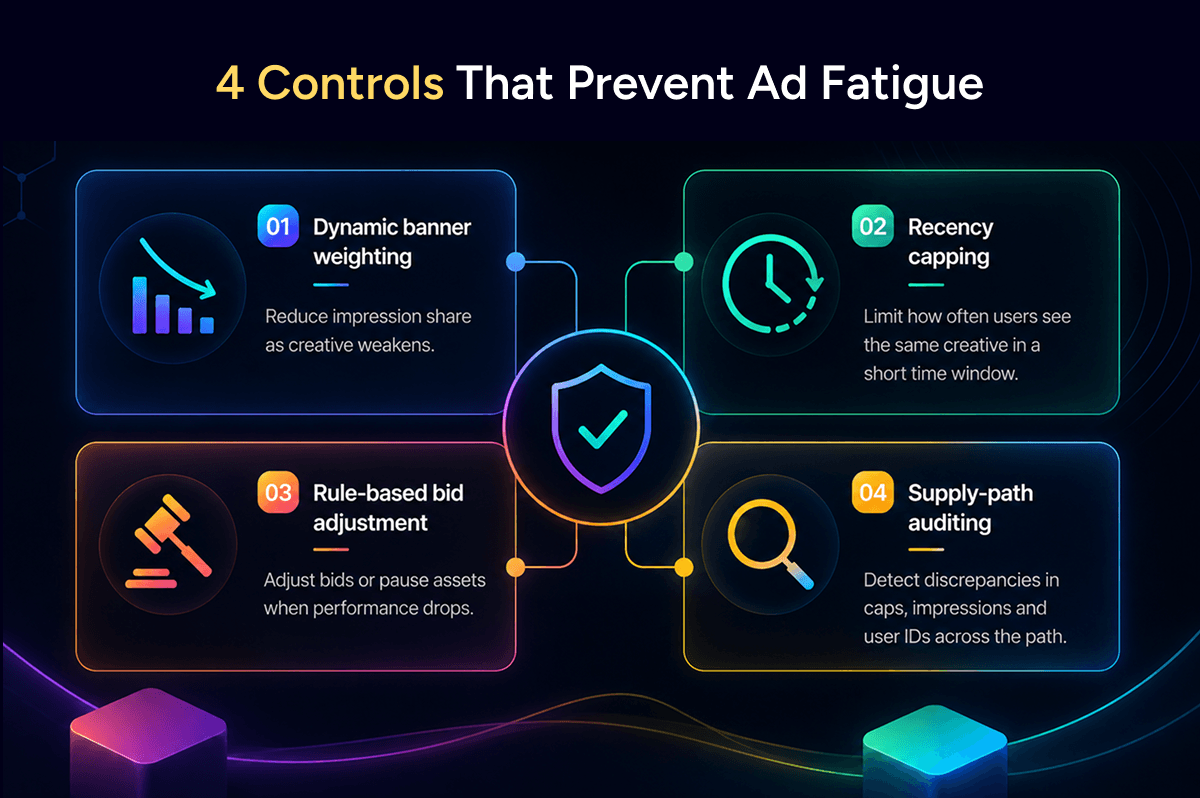
These controls operate at different stages. The DSP decides whether to bid on an impression and how much to pay — and the Ad Server controls which creative to show. Together, they turn fatigue management from a reporting task into an active part of ad delivery. Analytics still helps the team understand what happened, but mechanical controls can limit further spending before a manager reviews the report.
To put this into practice, you need to control four things: which creatives receive the traffic, how soon a user can see the ad again, how much the DSP bids, and whether the same rules are followed across the supply path.
The Deterministic Ad Ops Framework:
Instead of manually pausing campaigns, modern media buyers use deterministic rules to automate fatigue
management.
| Fatigue Trigger | The Algorithmic Risk | The DSP Mechanical Fix |
|---|---|---|
| Declining CTR by Placement | DSP continues routing budget to a historically strong banner that is currently burning out. | Dynamic Banner Weighting: Use Epom I2C algorithms to automatically reduce the impression share of the decaying creative. |
| Session-Level Burst Exposure | Algorithms exhaust a daily frequency cap (e.g., 3 impressions) in under 5 minutes. | Recency Capping: Enforce a strict server-side "cooldown period" (e.g., 1 impression per 3 hours) using 1st-party IDs. |
| Dropping Win Rates | Fatigued creatives lower predicted CTR, causing bid shading to drop bids below the floor price. | Rule-Based Bid Adjustment: Automate bid increases for fresh creatives and pause decayed assets before they tank line-item valuation. |
| Hidden Over-serving | Conflicting publisher caps and cookie resets cause users to see ads beyond DSP limits. | Supply-Path Auditing: Audit bid requests vs. actual impressions, utilizing Epom's 13ms latency logging to spot discrepancy leakage. |
1. Implement Real-Time Banner Weight Redistribution
Teams often treat creative rotation as a regular content refresh. For instance, they prepare several banners and launch them, and after a week or two, manually replace them with new ones. The problem is that creatives don’t burn out on schedule. Even within the same campaign, a banner can lose CTR in one placement and continue to perform well in another.
Planned rotation doesn’t take this into account. If you update a creative too early, you can remove a banner that is still bringing conversions. If you do it too late, it will continue to spend budget after the creative fatigue begins. In addition, the DSP often directs most of the impressions to the early winner. This accelerates its creative burn, while other banners receive too little traffic to test fully.
Therefore, the better practice is to manage rotation based on live performance data. To do this, each creative node in the DSP line item is assigned a numerical weight that determines its share of impressions in the rotation pool. If two banners have a weight of 1, they receive approximately the same amount of traffic. If their weights are 3 and 1, the first creative receives about 75% of the impressions, and the second — only 25%.
At the same time, these values don’t necessarily have to remain unchanged throughout the campaign. For example, in Epom DSP, auto-optimization tracks current CTR signals and the results of creative-placement combinations. If after a sufficient number of impressions, the CTR of a certain combination drops below the campaign baseline, the system can reduce its weight, adjust the bid, or redirect traffic to stronger options.
For example, a banner may still perform well on mobile devices but show a clear decline on desktop. In this case, there’s no need to remove it from the entire campaign — the system can reduce delivery only for the desktop placement. Once the rule is triggered, that weaker combination receives fewer impressions and less budget. This way, the team responds to creative decay in the segment where it appears, rather than replacing the banner everywhere.
2. Enforce Strict Recency Capping (Not Just Total Frequency)
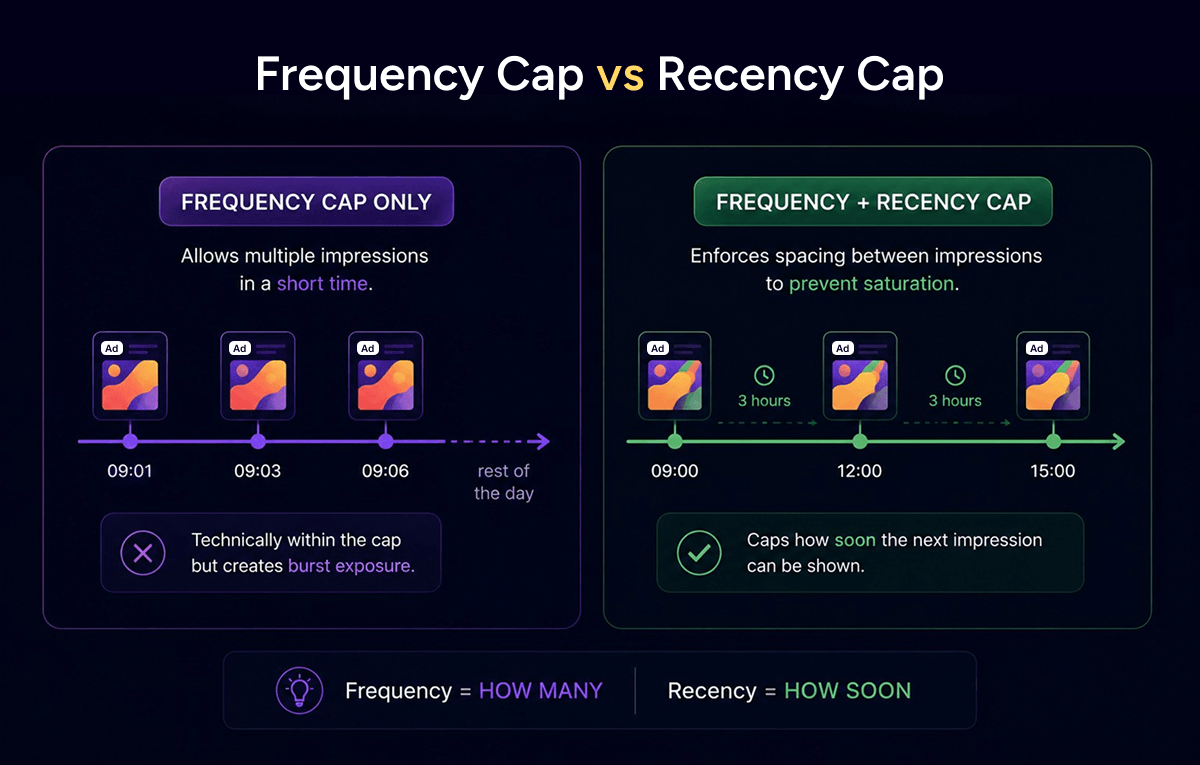
A typical frequency cap answers the question of how many times a user can see an ad. For example, a lifetime cap allows no more than ten impressions throughout the entire campaign, and a daily limit allows no more than three in 24 hours. However, none of these rules specify the interval at which impressions should occur.
A DSP sometimes uses the entire daily limit in one short session (that’s one of the peculiarities of ad delivery). So, a user may open several pages or switch between applications and see the same banner three times in just several minutes. The rules are in place, but such session-level burst exposure accelerates marketing fatigue.
Luckily, there’s another mechanism — recency capping. It controls not the total number of impressions, but the minimum interval between them. For example, the rule “no more than one impression in three hours” prevents the system from using the entire available limit at once. This interval is often called the cooldown period.
💡 Epom Pro Tip: A lifetime frequency cap (e.g., 10 impressions per user) does not stop algorithms from serving all 10 impressions in a single 5-minute session. Pair frequency caps with recency capping (e.g., a 3-hour cooldown interval between impressions) to enforce a pause on aggressive bidding algorithms.
Frequency and recency caps should work together to determine the allowable number of contacts within a specified period and distribute them over time. There is no universal value: ad frequency best practices involve finding the point at which metrics such as CTR, conversion rate, or ROAS begin to deteriorate and setting the cap based on the campaign’s own data.
This task becomes more difficult in a post-cookie environment. If capping relies solely on third-party cookies, the system may not recognize the same user across other browsers or apps. Each new identifier resets the impression count; hence, a user can receive significantly more contacts than the campaign settings allow.
One Epom client formulated this risk well: “Do you have another possibility than cookie-based capping? That’s the most important thing, I think, in order not to spend $10,000 in one minute.” It’s not just about annoying advertising. During a spike in RTB requests, a weak identification mechanism can allow a campaign to buy a large number of re-impressions quickly.
Therefore, cookieless capping should rely on several available levels of identification. For instance, first-party user IDs for authorized visitors, mobile advertising IDs in applications, authenticated identifiers, such as UID2 or ID5, and server-side exposure records. With first-party data integration, the DSP can check contact history before submitting a bid. If the user has reached the limit or the cooldown period has not yet expired, the system skips that bid request.
None of these methods provide perfect human recognition across all devices. However, server-side frequency capping, combined with recency controls, can reduce the number of re-impressions and help combat ad fatigue.
3. Counter Auction Penalties with Bid-Shading
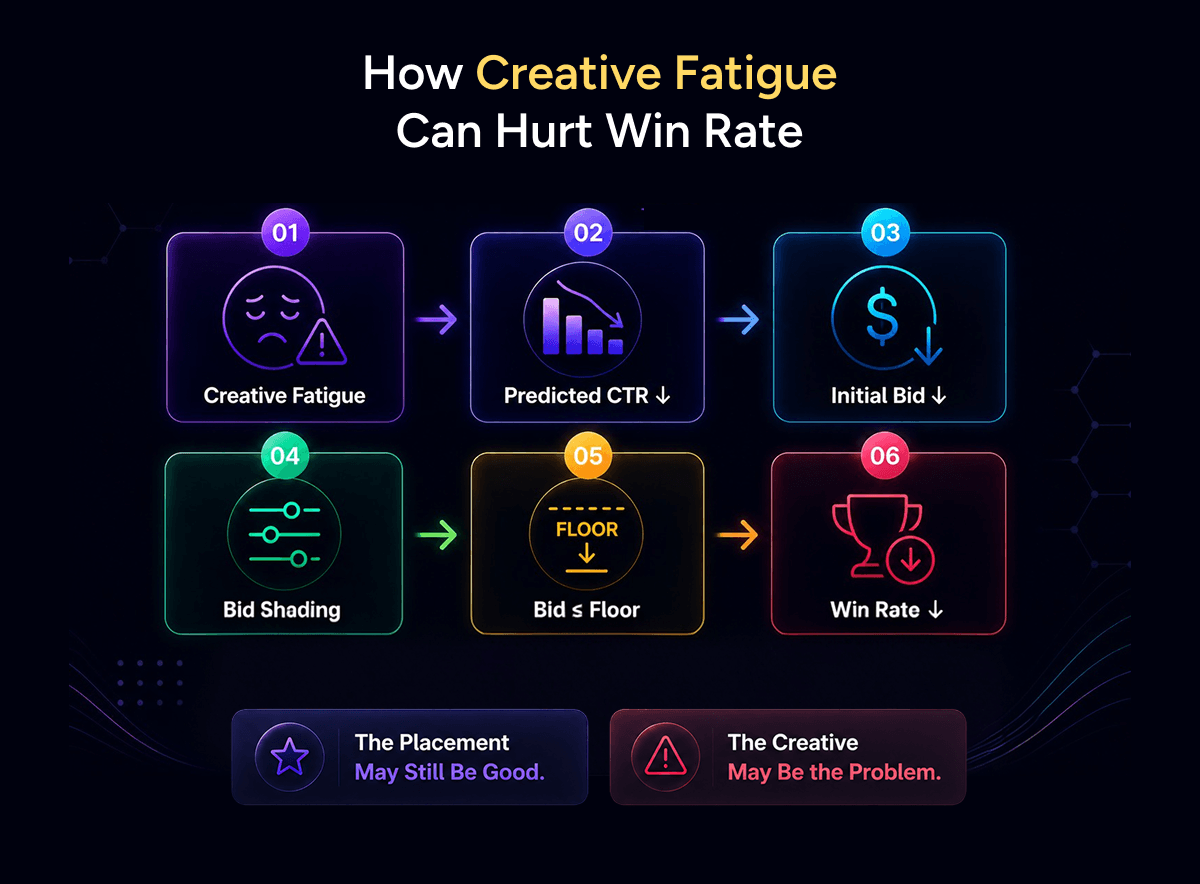
Most ad fatigue statistics focus on the visible consequences: falling CTR, rising CPA, and deteriorating ROAS. But creative fatigue also affects the ad buying process. Changes occur even before the impression is served — at the moment when the DSP decides whether to participate in the auction and what bid to offer.
In performance-based campaigns, this bid often depends on the predicted CTR or predicted conversion rate. If the banner gradually loses engagement, the algorithm reduces the expected value of the next impression. Along with it, the bid also decreases. Because of this, the campaign can start losing auctions on placements that previously brought good results.
💡 Epom Pro Tip: Do not assume all your placement is bad; check if a single burned-out creative is artificially dragging down your win rate.
The problem is not necessarily the inventory or audience. Sometimes only one creative has burned out. But if its results affect the assessment of the entire line item, the DSP may decide that this traffic is no longer worth the previous price. Win rate drops, the campaign receives fewer impressions, and accumulates less new data. The creative team sees a decrease in delivery but does not always recognize that it is due to burnout among creatives rather than poor placement quality.
At this stage, you need to check the bid-shading parameters. Bid shading is mainly used in first-price auctions: the DSP estimates the lowest bid likely to win rather than submitting the full, unshaded bid. In second-price auctions, the winner usually pays a little more than the second-highest bid, so classic bid shading plays a smaller role. The auction type is indicated in an OpenRTB bid request through the at field.
If the predicted CTR lowers the initial bid and shading is too aggressive, the final bid can fall to the bid floor or below. The DSP starts losing eligible inventory, even though only the creative needed replacement. The opposite scenario is also dangerous: trying to maintain delivery with higher bids can inflate the advertiser’s paid eCPM without improving conversions.
Therefore, CTR and CPA should be analyzed together with bid price, bid floor, clearing price, and win rate. If the drop started after creative decay, you should adjust the weight or replace the fatigued banner first, then review the shading. It will prevent a single burned-out creative from lowering the valuation of quality inventory across the entire campaign.
4. Audit Supply-Path and SSP-Level Controls
Even a properly configured DSP cap does not guarantee that users will see an ad at the intended frequency. The reason is other parties that operate between the DSP and the user. They can include ad exchanges, SSPs, publisher ad servers, sometimes even additional resellers. Each of them may apply its own delivery rules and count impressions differently.
For example, the DSP may allow three impressions per user per day, while the publisher ad server has a separate cap for the same ad placement. These restrictions are not synchronized; they simply apply on top of each other. The DSP may win the auction, but a publisher-level rule may still block the impression. As a result, the campaign experiences underdelivery despite its DSP settings being correct.
The report may show that the frequency cap is working. The user’s experience can tell a different story. A DSP may count a browser cookie and an in-app advertising ID as two separate users. Both identifiers receive their own impression limits, even though they belong to the same person. As a result, the ad appears more often than the report suggests.
The DSP, SSP, and publisher ad server may also record the same advertising event differently. Without a shared event ID and consistent counting rules, combining reports from these systems can produce duplicate or mismatched records. It results in double counting and discrepancies among auction wins, served impressions, and recorded impressions.
In walled gardens, it’s especially difficult to pinpoint the source of this problem. The platform shows overall reach, frequency, and delivery, but doesn’t always explain why an additional cap was applied, why a user ID was lost, or why an impression was blocked. One of Epom clients shared with us this frustration: “We want to move away from display and just have native ads on our site. And from Google, there is no support.”
During a supply-path audit, you should compare bid requests, submitted bids, auction wins, and actual impressions. You should also check caps at the campaign, line item, creative, SSP, and publisher levels, and then compare user IDs, time windows, and time zones in your reports.
A transparent ad server/DSP setup helps answer two questions: what is ad discrepancy in this campaign, and where did it occur? Without such an audit, it is easy to mistake a technical issue in the programmatic display infrastructure for ad fatigue in a display campaign and replace a creative that was not actually causing the drop in results.
Moving from Reactive Monitoring to Deterministic Ad Ops
To combat advertising fatigue, it’s not enough to add another dashboard to your ad tech stack. It will help you notice a drop in CTR or a rise in CPA more quickly, but it won’t stop the campaign or change budget allocation. If, after each warning, the manager has to independently check the report, identify the cause, and edit the settings, the process remains reactive.
Deterministic Ad Ops works differently. The team decides in advance what signal indicates possible ad fatigue, how much data is needed to make a reliable conclusion, and what action the system should take. For example, a drop in CTR is not a reason to turn off the banner. But if a creative-placement combination has received enough impressions, its CTR has fallen below the campaign baseline, and the CPA continues to grow, the DSP can lower the bid or pause the source.
Automated rules do not replace the Ad Ops manager. A person sets thresholds, checks data quality, and decides whether the data is sufficient to change the delivery or whether the campaign needs a new message or creative concept. The difference is that the system does not have to wait for the manager to open the report.
So, fighting ad fatigue is becoming a part of the daily work. The dashboard explains what is happening, and the DSP and ad server immediately limit further losses in line with the established rules. It is this transition from observation to execution that helps curb creative decay, audience exhaustion, and ROAS deterioration before they consume a significant part of the budget.