
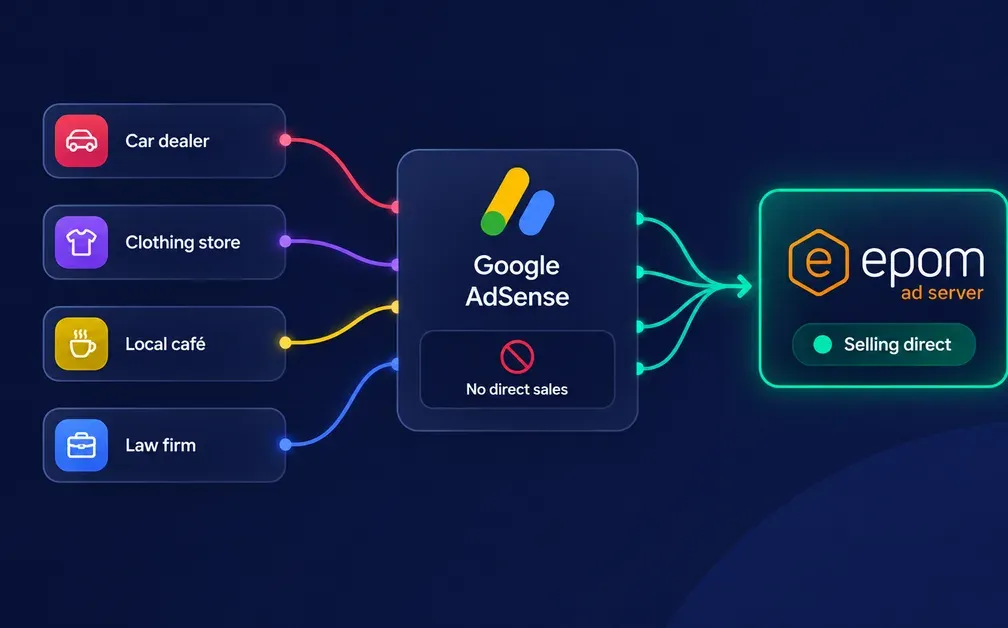
A car dealer from your town emails on a Tuesday: "How much for the banner at the top, for a month?" You name a price, take the payment by bank transfer, paste their image into your theme by hand and set a phone reminder to take it down on the 30th.
Two weeks later they ask for a second version on mobile only. Then the clothing store wants the same slot, and you have no way to rotate the two fairly.
At the end of the month the dealer asks how many people saw the banner. Your theme can’t count ad views, so you send a Google Analytics screenshot of page views and hope it passes for proof. Next to it, an AdSense unit earns whatever Google’s auction pays that day, and Google keeps about a third of what its advertisers spend there.
Swap the car dealer for whoever writes to you. A dive resort emailing a scuba blog. A bookmaker writing to a football tips site, where Google's own ads barely serve. A local law firm writing to a news portal which language content AdSense cannot monetize at all. A software vendor writing a newsletter for accountants. I can go on with the list, since direct is far from being dead.
If that is how it often goes, you do not need another ad network. You need a way to sell, run and report direct deals, with AdSense filling only what you could not sell. In other words, that’s how YOU become an ad network that takes 100% of your direct advertisers payments.
Epom Ad Server runs your direct campaigns, rotates advertisers, sends them reports under your logo and passes unsold impressions to the networks you choose. Start a free trial and load your first advertiser to see how the revenue growth follows.
- An AdSense alternative is any way to earn from your ad space without Google AdSense: another ad network that brings its own advertisers, or your own ad server that sells to advertisers directly and backfills from several networks.
- AdSense keeps about 32% of what Google Ads buyers spend. Publishers receive 80% after the buyer platform's fee, which Google says works out to about 68% overall.
- AdSense has no tools for direct deals. You cannot add your own advertiser, price a slot by country, rotate sponsors or send anyone a delivery report.
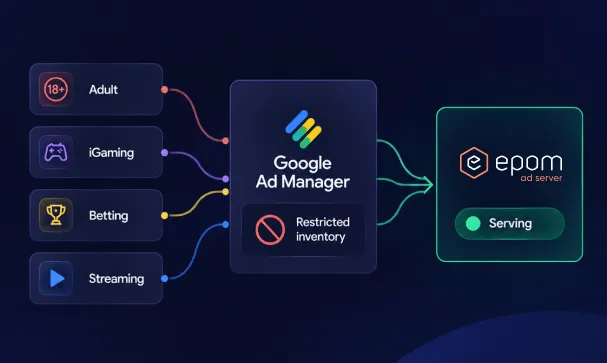
- Google Ad Manager could be the next step, but Google's publisher policies follow you there, direct deals included. Adult sites and unsupported languages are out entirely; gambling gets little Google demand.
- An independent publisher ad server pays for itself through extra direct deals and saved hours. One extra deal of $250 or more a month covers Epom's entry plan.
What Is an AdSense Alternative?
An AdSense alternative is any way to earn from your ad space without Google AdSense.
Almost every list on the first page of Google means one kind: another ad network. Ezoic, Media.net, Adsterra and the rest bring their own advertisers, set their own rules and take their own share. You change landlords, and the lease looks the same.
The other kind is your own ad server, and the two solve different problems.
| Another ad network | Your own ad server | |
|---|---|---|
| Who brings the advertisers | The network | You, plus any networks you connect |
| Who sets the price | The auction | You, per slot, country or deal |
| Who decides what can run | The network's policy team | You |
| How you pay | A share of every sale | A flat monthly fee |
| What your advertiser gets | Nothing from you | A login and a report with your logo on it |
If no one has ever asked you for ad space, you need the first column. If someone emailed you this month, keep reading.
Why Do Publishers Outgrow AdSense?
AdSense is built to fill a page with Google's demand, and it does that well. The complaints start when a publisher wants anything else.
- The cut is larger than it looks. Publishers receive 80% of revenue after the advertiser platform takes its fee. When Google Ads is the buyer, Google's own help page puts the publisher's share at about 68%.
- Bans come without explanations. Google says it cannot share which activity triggered an invalid-traffic action. If an account is disabled for invalid traffic, unpaid revenue is withheld and returned to advertisers where possible. A site that relied on AdSense alone earns nothing from then on.
- Some content is never allowed. Adult or some dating content can never carry Google ads. Gambling is restricted, so Google Ads will not serve it. Pages written mainly in an unsupported language cannot carry Google ad code at all, and Albanian, for one, is not on Google's list.
- And there is no way to sell directly. No advertiser accounts, no fixed-price sponsorships, no reports to forward. That last one is what brings most publishers to us. "We use Google AdSense and some other networks, but now we want to control ourselves," one told our sales team.
It is not only websites. An app team with 15 million downloads wanted a place to "insert our own ads about the related apps" from its group and its brand partners.
Do You Need an Ad Network or an Ad Server?
Three things tell you which side you are on.
- Advertisers already contact you. A local business, a brand in your niche, a partner of a partner. If you can name three companies that asked about ad space this year, you have direct demand, and AdSense cannot sell it for you.
- Your direct revenue would cover a flat fee. An ad server costs money every month. If direct deals bring in less than that, stay on AdSense and handle the odd sponsor by hand.
- Google limits what you can run. Adult content, betting, an unsupported language. If Google's policies already cost you advertisers, its tools will keep costing you them.
If none of the three is true, an ad network is the honest answer. Ezoic and Media.net accept small sites. Mediavine and Raptive pay more but set traffic minimums, so check their current requirements.
7 AdSense Alternatives for Publishers Who Sell Direct
Every tool below can serve your own campaigns. We compared them on five things a publisher with direct advertisers needs: selling and reporting on deals, advertiser logins, backfill for unsold slots, content rules and the way you pay.
Prices come from each vendor's site or public pricing listings, checked in October 2026.
| Tool | Price model | Included volume | Advertiser logins and reports | Advertiser self-serve | Programmatic backfill | Restricted verticals | Tech support and account management | Best for |
|---|---|---|---|---|---|---|---|---|
| Epom Ad Server | Flat fee from $250/mo, no revenue share | 8.5M display + 250K video impressions | Yes | Yes, in the $250 premium package (white-label) | Network tags and passbacks, header bidding | Served: adult, iGaming, any language | Dedicated support on every plan; priority support and up to 2 tutorial sessions a month in the premium package | Publishers with direct advertisers who want backfill too |
| Google Ad Manager | Free up to Google's impression limits | 90M non-video impressions free (US) | No advertiser portal | No | AdSense, AdX (about 20% share), Prebid | Adult banned, gambling restricted | Help center and forums; account management only on GAM 360 (about $8,000/mo) | One mainstream site with a trafficker |
| AdButler | Flat fee from $179/mo | 1M ad requests, 10 advertisers | Yes | Yes, add-on (beta) | Programmatic add-on ($110/mo + per-bid fee) | Check vendor | Email, help desk and phone | Small teams with a few advertisers |
| Broadstreet | From $299/mo (Business plan) | Check vendor | Automated campaign reports | Not marketed | No | Check vendor | Personal email support | Local news, magazines, newsletters |
| Revive Adserver | Free self-hosted, or hosted from $10/mo | Your servers, or 1M ad requests hosted | Basic | No | Plugins | Your rules | Community forum; no vendor support when self-hosted | Small sites with a developer, or on a tight budget |
| WordPress plugins | Free core; Advanced Ads All Access €89/yr | Whatever your hosting handles | Advertiser account via WooCommerce | Selling Ads add-on (WooCommerce) | No | Your rules | Email support with a paid license; forum for the free version | One WordPress site with a few sponsors |
| BuySellAds | Commission on each sale | Per marketplace deal | Yes | Advertisers buy in its marketplace | No | Its rules; you approve each ad | Check vendor | Tech and design audiences without a sales team |
1. Epom Ad Server
Epom Ad Server is a hosted ad server for publishers who sell to their own advertisers. Epom charges a flat platform fee and takes no share of what your advertisers pay you.
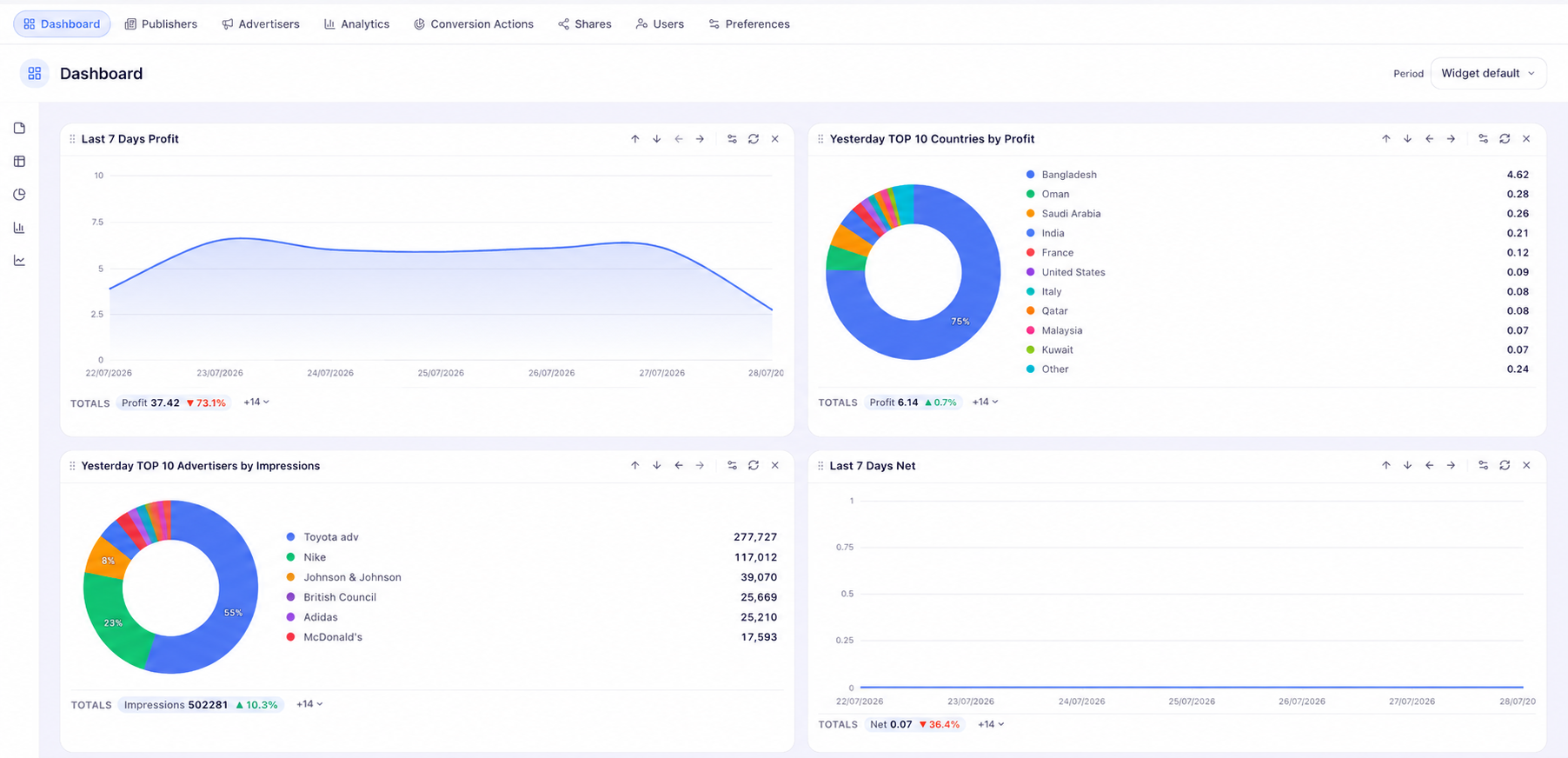
- Keep Google. Sell your own ads on top. Epom serves your direct campaigns first. If you run Google Ad Manager, header bidding bids into it with a single line item, so Google still fills every impression your campaigns don't take. Your floor price is respected and passed on to partners, and the Header Bidding report shows who filled each slot: your campaigns, Google, a partner or nobody.
- Direct deals, your rules. Priority groups and weights decide who wins a slot, so the car dealer and the clothing store can share the top banner in the proportions each paid for. Advertisers pay by CPM, CPC or CPA. An impression limit with even pacing means a monthly package never overdelivers.
- Advertisers see results without emailing you. Give each advertiser a login or a read-only report, or schedule reports to their inbox under your logo. Post-click and post-view conversion tracking shows what the campaign earned them, which makes the renewal conversation shorter.
- Formats and verticals Google won't take. More than 100 ready templates cover native, video (VAST 2.0 to 4.3, with viewability through Open Measurement), interstitials and interscrollers. Adult, iGaming and unsupported languages run like any other site. Heavy creatives are flagged, with the CDN traffic of each one, before they slow your pages.
- Set it up by asking. The built-in AI assistant creates campaigns, adds templates from the library and traces why a creative isn't showing, in plain language.
- EU traffic covered. Epom reads Global Privacy Control signals, checks the IAB consent platform and supports TCF v2.2.
"Sub-accounts, rotation, competitive separation — the setup itself is standard. What these publishers want is maximum control over who appears, and that is why they choose an ad server over a network,"

✓ Choose it if advertisers already contact you and one extra deal a month would cover $250, or Google will not serve your content.
✗ Skip it if you run a small blog with no direct revenue yet. Epom is not the cheapest option here, and AdSense or a WordPress plugin will do until advertisers pay you.
2. Google Ad Manager
Google Ad Manager (GAM) is where most publishers go after AdSense, and for good reason. It is free, it serves direct campaigns, and AdSense plugs straight into it as a demand source. Google's small-business terms allow 90 million free non-video impressions a month in the US, Canada, Australia and New Zealand, and 150 or 200 million elsewhere.
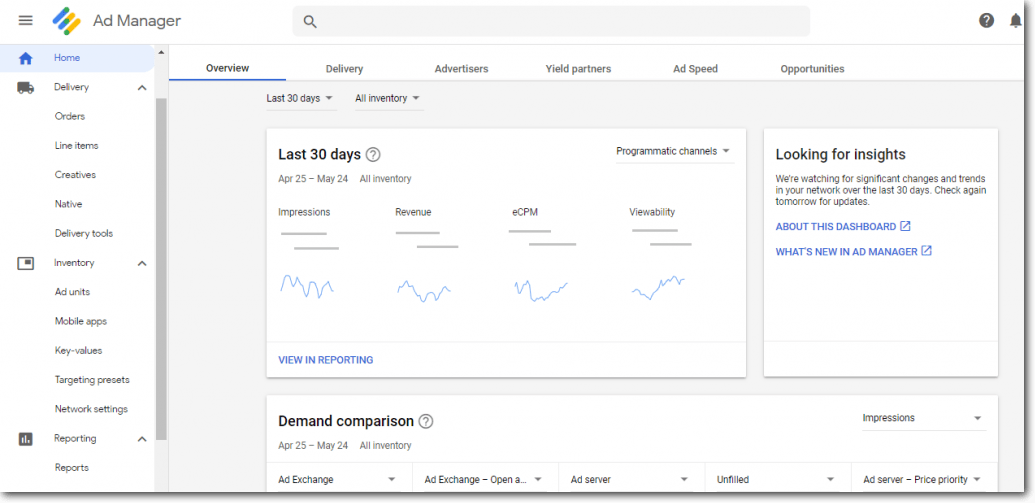
For one mainstream site with someone who knows trafficking, it is a strong choice. It also forecasts inventory, which Epom does not.
Our Epom vs Google Ad Manager comparison covers where the two part ways. For a publisher selling direct, it comes down to five things.
Google's rules follow you inside. GAM's partner guidelines apply Google's publisher policies to every feature, "including traditional reservations". Adult content and languages outside Google's list cannot be monetized, even on deals you sold yourself. Gambling is restricted, so Google's own demand mostly stays away.
An esports media company described the same wall: "Google has its own limitations, in terms of what type of clients that we can run in certain countries. The limitations on running, let's say, iGaming ads, and things that Google might flag as an issue."
Support starts at GAM 360. The free tier comes with a help center. Account management begins at GAM 360, around $8,000 a month. A 25-site music network on GAM told us that when banners stop showing, "we are basically searching blind."
There is no branded platform. GAM has no white-label or advertiser subaccounts, and its terms make you responsible for your advertisers, billing included.
Google takes a cut of programmatic, about 20% on AdX. And your data lives on Google's servers; Epom runs servers in Germany, the US and Asia, and you choose.
You do not have to leave GAM to fix any of this. If you already moved from AdSense to GAM with AdX, add Epom's header bidding. Your sold campaigns take the slot whenever they bid, partner bids compete with Google on price, and AdX keeps the rest.
✓ Choose it if you run a mainstream site with a trafficker on staff.
✗ Skip it if your content sits in a restricted vertical, or you need support and advertiser logins.
3. AdButler
AdButler is a SaaS ad server with published pricing, and the closest like-for-like option to Epom on this list. Its Essentials plan costs $179 a month for 1M ad requests and up to 10 advertisers, according to public pricing listings.
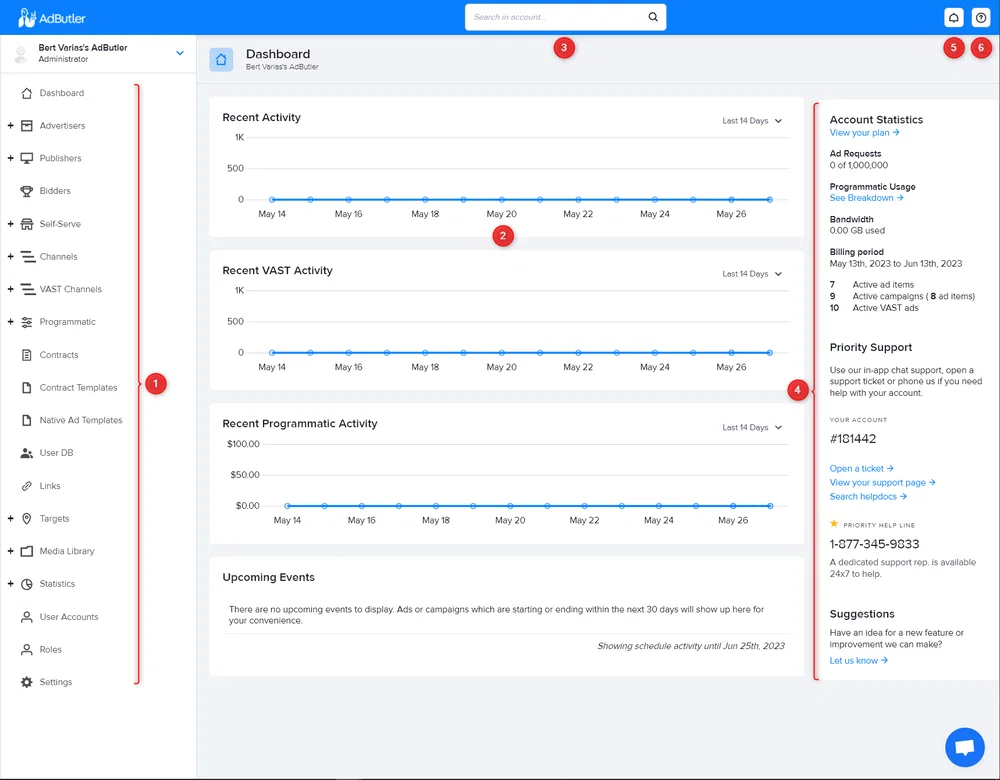
Do the math from your side before you sign up. An ad request is counted every time a slot asks for an ad. A site with 300,000 page views a month and four ad slots sends about 1.2 million requests, already past the Essentials limit, and the Standard plan costs $682 a month for 10M requests.
Ten advertisers covers a few regular sponsors. It does not cover a local portal that sells to dozens of businesses. The self-serve marketplace is an add-on, still marked beta in AdButler's help center, and programmatic is another add-on at $110 a month plus $0.001 per 1,000 bids. Reviewers on Capterra rate its email and phone support highly.
✓ Choose it if you run one site with a handful of steady sponsors and want a public price list.
✗ Skip it if your traffic or advertiser list will outgrow the plan caps. More in our AdButler alternatives guide.
4. Broadstreet
Broadstreet calls itself the ad manager for direct sales, and it is built for local news sites, regional magazines and B2B newsletters. Its Business plan is listed at $299 a month, with personal email support, the full ad format library, in-content units for mobile, automated campaign reports and sponsored content tracking.
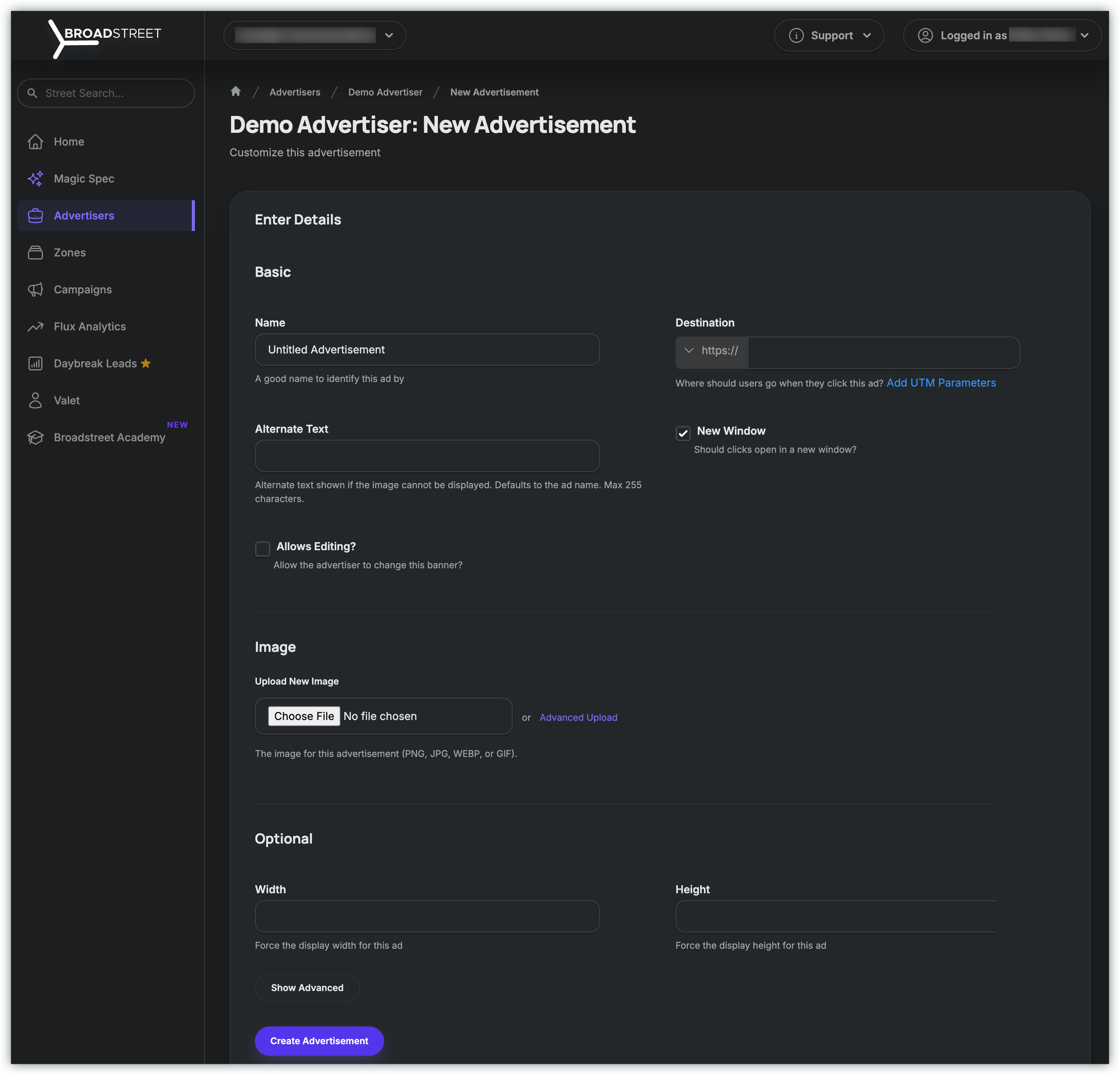
It thinks like a local sales team. Newsletter ad zones, sponsored articles and reports you can forward to a car dealer without editing are the core of the product. Programmatic is not, so AdSense keeps running on the page as a separate script, and you manage two systems.
At $299 it is also the highest entry price among the paid tools here.
✓ Choose it if you run a local title or a newsletter with a sales person who sells packages.
✗ Skip it if you want direct deals and programmatic backfill in the same tool, or your budget is under $300 a month.
5. Revive Adserver
Revive is free and open source. Self-hosted, you run the server, the updates and the security patches yourself, and support is a community forum. That is where Gazeta Express was before it moved: ads displayed correctly 79% of the time, and there was no one to call.
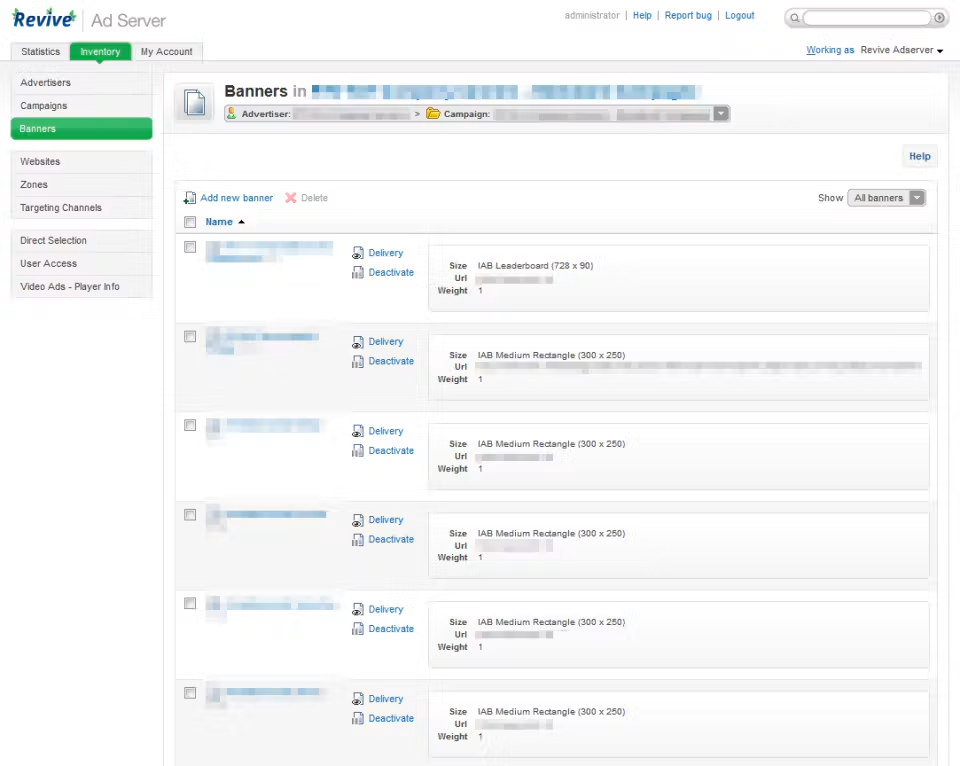
The Revive Adserver Hosted edition starts at $10 a month for 1M ad requests, with the latest version, 24/7 server monitoring and hourly scans for malicious ad code included. Either way, you strictly get the basics: zones, campaigns, targeting and delivery stats. Advertiser reports are plain, and anything beyond that comes from plugins.
✓ Choose it if you have a developer or a tight budget, and your advertisers are happy with basic reports.
✗ Skip it if downtime costs you advertisers, or you need someone to call; more in open-source vs hosted ad servers.
6. WordPress Plugins (Advanced Ads, AdRotate)
If your site runs on WordPress, a plugin is the smallest step from AdSense. Advanced Ads is free, and its All Access bundle costs €89 a year for one site, including Pro, impression tracking, the Selling Ads add-on and a year of support.
Selling Ads turns your site into a small ad shop. It runs on WooCommerce: advertisers pick an ad product priced per day, impression or click, pay by PayPal, Stripe or invoice, and see their ads and purchase history in their account. AdRotate works on a similar free-plus-Pro model.
Everything runs inside WordPress. Tracking and rotation load your own server, each site needs its own license, and reports stay basic.
✓ Choose it if you run one WordPress site with a few sponsors and want advertisers to pay online.
✗ Skip it if you run several sites, your site is not on WordPress, or advertisers expect detailed delivery reports.
7. BuySellAds
BuySellAds is a marketplace that brings advertisers to your site. You list your placements, set the price for each one and approve every ad before it runs, so you keep control of what appears without finding the advertisers yourself.
It is the only option on this list that sells for you. The ad servers above manage advertisers you already have; BuySellAds finds new ones. The price is a share of every deal, put at 25% in a 2019 review, so check current terms, and your site has to pass its review first.
It leans toward tech and design audiences. That is where most of its advertisers buy. If your site is part of that world, BuySellAds also runs Carbon, an invite-only network for developer and design sites, but Carbon has to be the only ad network on the page, so AdSense goes.
✓ Choose it if you run a tech or design publication without a sales team.
✗ Skip it if advertisers already come to you, because you would pay a commission on deals you could close yourself, or your audience sits outside its niches.
Already have advertisers asking? Explore the Epom Ad Server demo and set up your first direct campaign in your own account.
What If Google Will Not Serve Your Content?
For some publishers AdSense was never an option, and Google Ad Manager is not one either.
Before
Gazeta Express is Kosovo's most prominent online news portal, publishing in Albanian. Albanian is not a language Google monetizes, so the team ran its own ads on Revive, the open-source server. Ads displayed correctly 79% of the time, and there was no one to escalate to.
After
Gazeta Express moved to Epom Ad Server in 2015. Language, geo and IP targeting now reach readers split across Albanian and Serbian IP ranges, and more than 200 direct advertisers run on priorities and impression limits.
Ads display correctly 99% of the time, page load speed improved by 137%, and the site serves 2.1 billion impressions a year. Read the Gazeta Express case study.
Language is one wall; content is another. An adult streaming platform, banned by Google's content policy at any volume, runs its video pre-roll and rich media on Epom. "Epom handles adult specifics just perfectly: no restrictions, full freedom on where and how we serve ads," its founder says.
When Does an AdSense Alternative Pay for Itself?
The answer depends on what you do today.
If you already sell direct by hand, like the car dealer in the intro, Google takes nothing from those deals now. The ad server pays for itself in a simpler way: one extra deal of $250 or more a month covers Epom's entry plan. The tool is what makes that extra deal possible.
| Selling by hand | With an ad server |
|---|---|
| One advertiser per slot | Several advertisers rotate on the same slot |
| One price for everyone | Separate prices for mobile, desktop or local readers |
| Screenshots as proof | Delivery reports sent automatically |
| Your evenings spent swapping banners | Campaigns start and stop on schedule |
- If you earn only from AdSense today, moving slots to direct sales also stops Google's cut of about a third. About $780 a month in direct deals covers the $250 plan, and about $1,560 covers it with the premium package.
- If you run Google Ad Manager with header bidding, size your plan by all your traffic, not only by sold impressions. Since Release 153, impressions Google or a partner fills through Epom header bidding count toward the plan by default.
How Do You Run Direct Deals Next to AdSense?
The setup depends on what you run today.
On plain AdSense, without Google Ad Manager. An Epom zone serves your direct campaigns by priority, and unsold impressions go to a network tag or a passback. The simplest setup keeps AdSense code on its own slots and puts Epom zones where you sell direct. If you want Epom to pass unsold impressions to AdSense, check Google's ad-code rules first, because AdSense code cannot be modified.
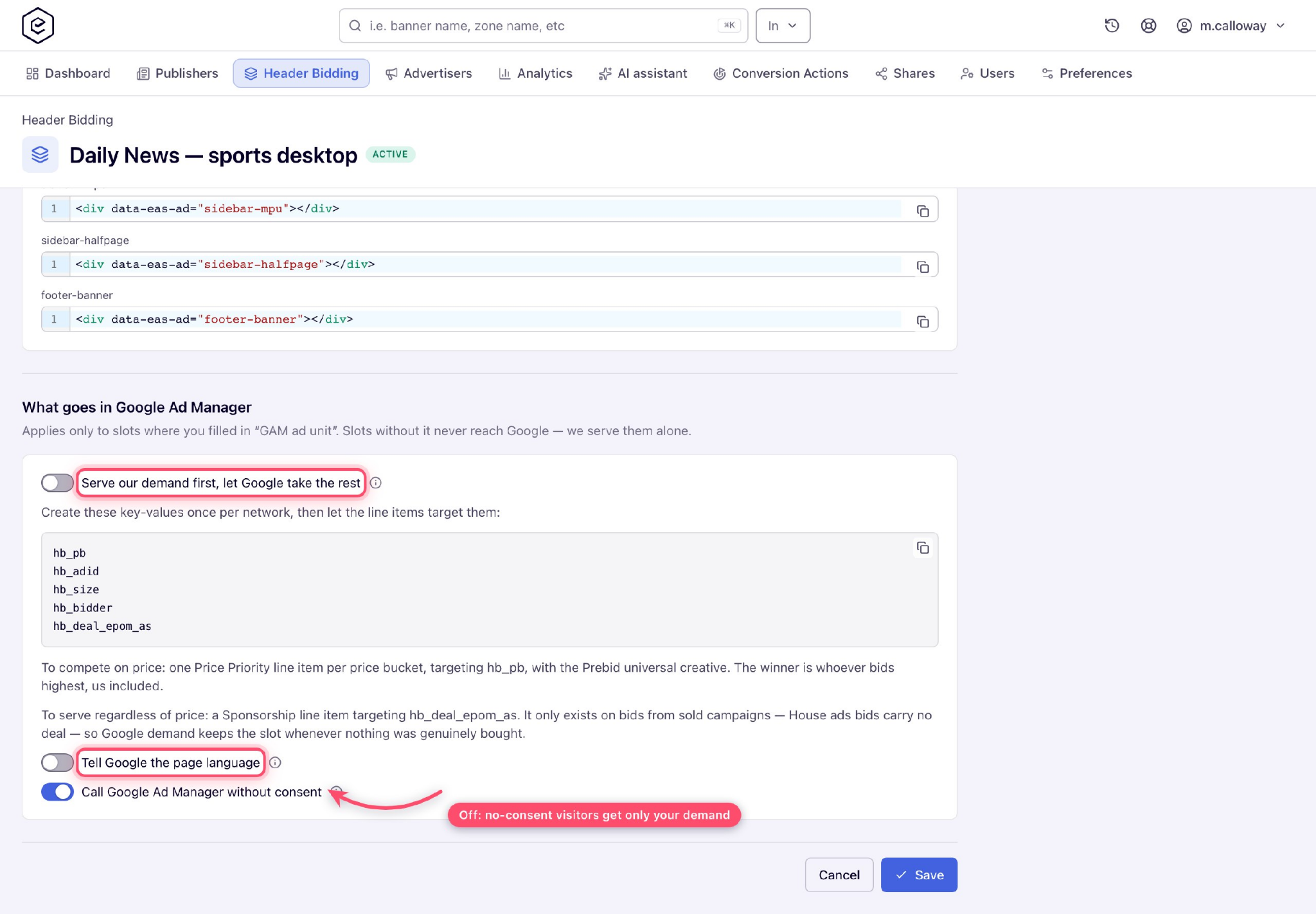
On Google Ad Manager. Since Release 151, Epom runs as a Prebid bidder on your pages, set up with one Sponsorship line item in GAM. Your sold campaigns take the slot whenever they bid, partner bids compete with Google on price, and everything else stays with AdX or AdSense. A Header Bidding report shows who filled each slot.
Either way, the running is lighter than most people expect. In three years of one account's history, a publisher serving 185,000 impressions a month opened a single technical support ticket.
FAQ
Sell Direct First, Let AdSense Fill the Rest
Before anything else, answer one question: did an advertiser contact you this month? If so, you are already running an ad business, and you deserve the tools for it.