
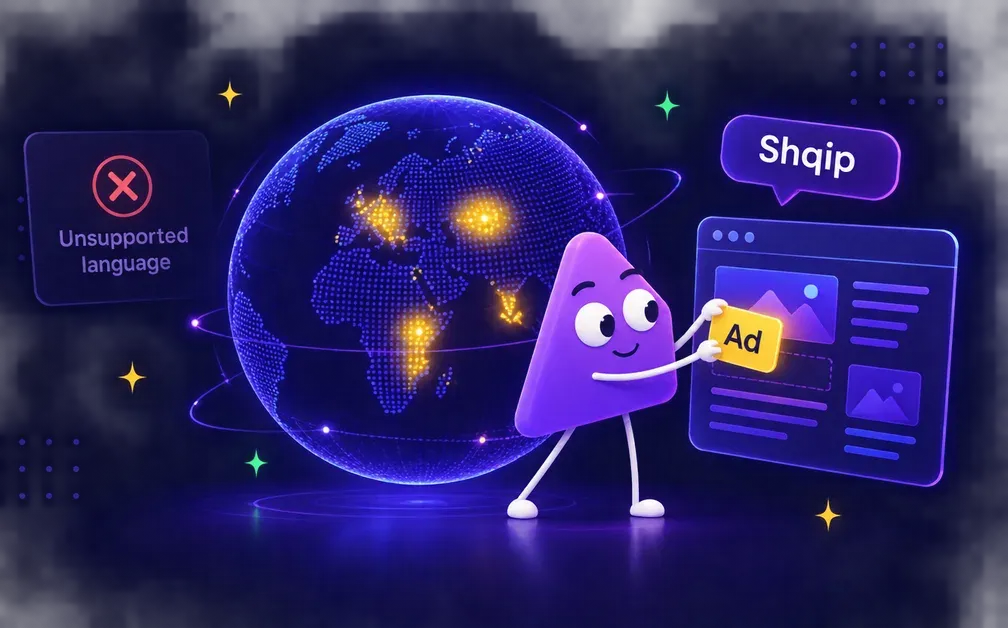
You built an Albanian-language news site, added it to AdSense and pasted the code. The site review comes back with one policy issue, unsupported language, and your ad slots stay empty.
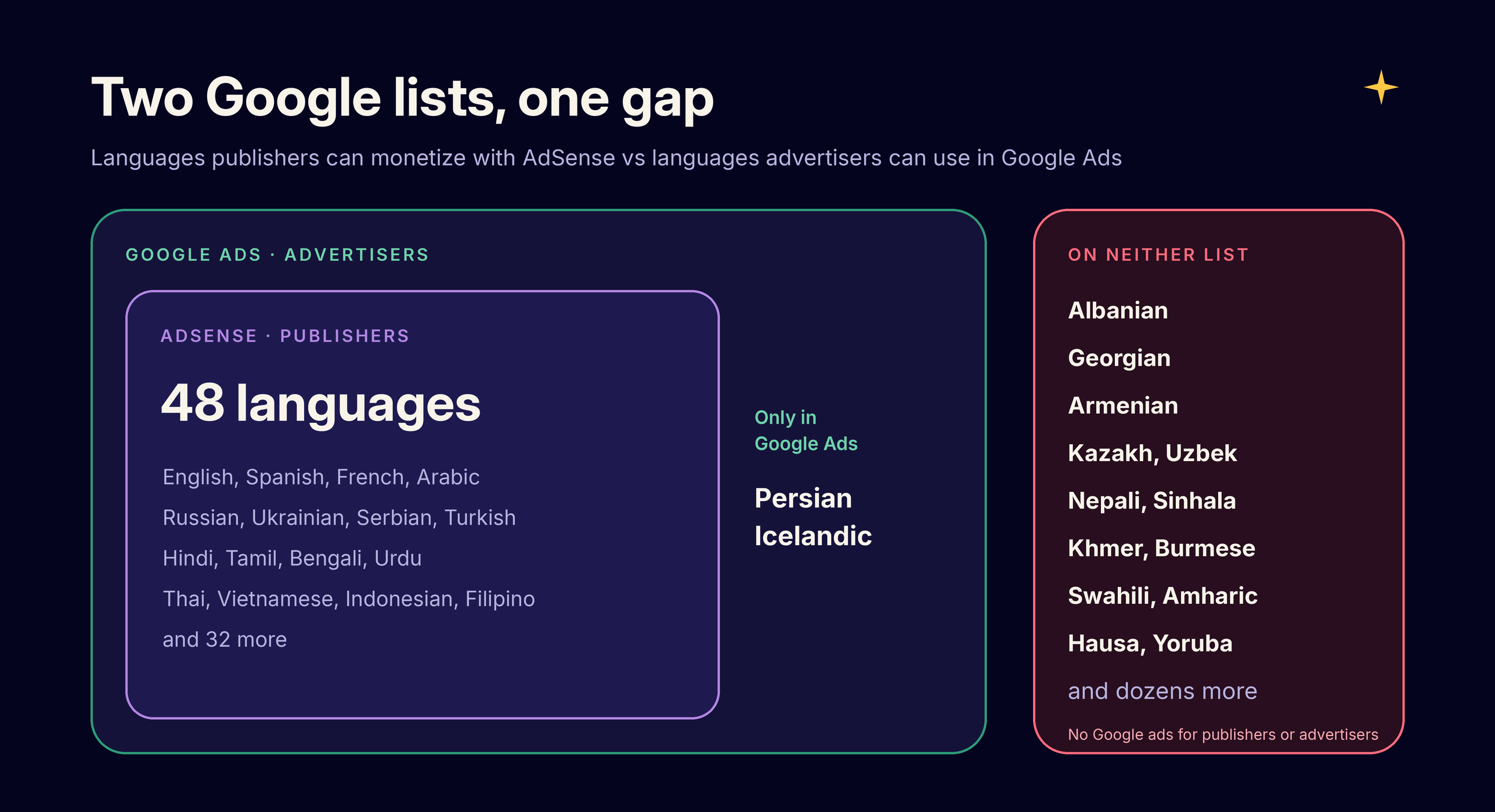
You reread the policy, look for an appeal form and find nothing to fix. It isn't a review decision about your site; it's a list. Google's list has 50 entries, but Spanish and Chinese each appear twice, so it covers 48 languages, and Albanian, Georgian, Swahili and Nepali aren't among them.
Your readers are there, and local businesses want to reach them. This guide is for publishers whose language isn't on Google's list: what the rule means, which languages it covers and how sites in those languages make money anyway.
Already have local advertisers who want your readers? Epom Ad Server serves their ads in any language, with targeting by language, location and device, from $250 a month. Start a 14-day free trial.
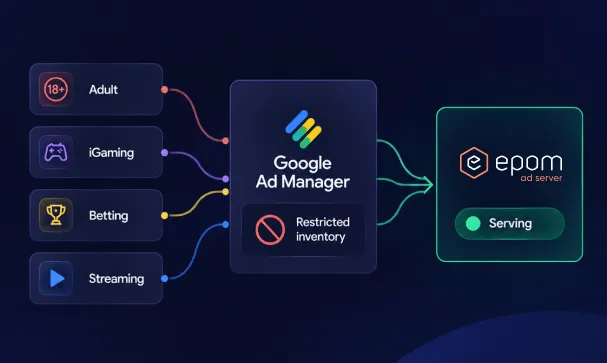
- AdSense unsupported language is a policy, not a review of your site: Google won't show its ads on pages whose main content is in a language outside its list. It applies to AdSense, Ad Manager and AdMob alike.
- The AdSense supported languages list covers 48 languages. Albanian, Macedonian, Georgian, Armenian, Azerbaijani, Kazakh, Uzbek, Nepali, Sinhala, Khmer, Burmese, Swahili, Amharic and many more are missing, so sites in them get the same "language not supported" answer.
- Another ad network won't always fix an unsupported language rejection. Networks that sell through Google's products follow the same rule; others may accept your language but choose the ads and prices for you.
- Most publishers in unsupported languages sell directly. They sign local advertisers and serve the ads through their own ad server, keeping the relationship and the revenue.
- You don't need an ad-ops team to start. An ad server with no language rules and people who help with setup is enough; Epom's entry plan costs $250 a month.
Does Google support my language?
Type your site’s main language to see whether AdSense will show ads on it, and whether advertisers can run Google Ads in it.
What Is the AdSense Unsupported Language Rule?
An "unsupported language" notice means Google won't show AdSense or Ad Manager ads on pages whose main content is in a language outside its supported list. The rule is part of Google's publisher policies, and it applies page by page.
The rule isn't new. According to MonetizeMore, Google stopped approving new sites in unsupported languages in September 2020 and extended the rule to existing sites in 2021.
It also isn't a judgment on your content. A well-run news site and a spam blog in the same language get the same answer, and a bilingual site can still earn from its pages in a supported language.
AdSense Supported Languages: Which Ones Are Missing?
Google's list misses most of the languages spoken across the Caucasus, Central Asia, East Africa and mainland Southeast Asia. Neighboring languages are often supported, which is why the rule surprises so many publishers.
| Region | Not on Google's list | Close supported languages |
|---|---|---|
| Balkans and Europe | Albanian, Macedonian, Bosnian*, Montenegrin*, Belarusian, Icelandic, Irish, Welsh, Basque, Galician, Maltese, Luxembourgish, Faroese | Serbian, Croatian, Bulgarian, Slovenian, Russian, Ukrainian, Catalan |
| Caucasus and Central Asia | Georgian, Armenian, Azerbaijani, Kazakh, Uzbek, Kyrgyz, Tajik, Turkmen, Mongolian, Tatar | Russian, Turkish |
| Middle East and South Asia | Kurdish, Nepali, Sinhala, Odia, Assamese, Sindhi, Maithili, Dhivehi, Persian, Pashto | Arabic, Hebrew, Urdu, Hindi, Bengali, Tamil, Telugu, Marathi, Gujarati, Kannada, Malayalam, Punjabi |
| Southeast Asia | Burmese, Khmer, Lao, Javanese, Sundanese, Cebuano, Hmong, Tetum | Thai, Vietnamese, Indonesian, Malay, Filipino |
| Africa | Swahili, Amharic, Hausa, Yoruba, Igbo, Somali, Zulu, Xhosa, Afrikaans, Oromo, Tigrinya, Kinyarwanda, Kirundi, Malagasy, Shona, Akan (Twi), Wolof, Fula, Lingala, Luganda, Chichewa, Sesotho, Setswana, Tamazight | Arabic, English, French, Portuguese |
Outside these regions, Google's list also misses Haitian Creole, Guarani, Quechua, Aymara and Nahuatl in the Americas, and Samoan, Tongan, Fijian, Maori and Tok Pisin in the Pacific.
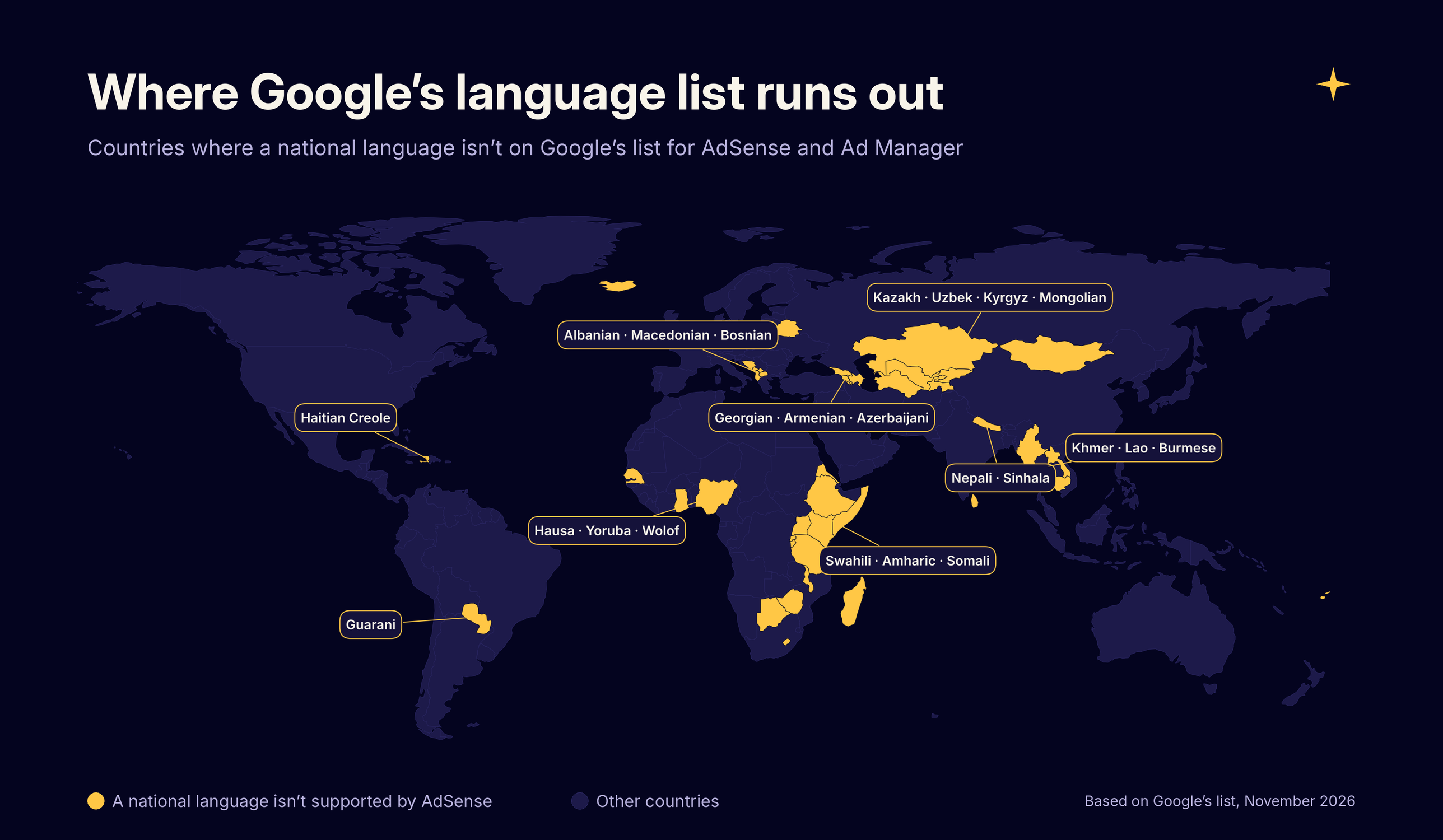
*Bosnian and Montenegrin aren't listed separately. Croatian and Serbian, which are close to both, are supported, but publishers report sites detected as Bosnian being flagged.
Based on Google's list as of November 2026. Check the policy page for changes.
Monetizing Sites in Sinhala, Khmer, Swahili, Nepali, Amharic and Uzbek
These languages come from the markets where publishers search for AdSense most, and none of them is on Google's list. Here's what that means in each one.
Sinhala (Sri Lanka)
AdSense doesn't support Sinhala, but it does support Tamil and English, Sri Lanka's other main languages. A site with Tamil or English sections can show AdSense on those pages and sell its Sinhala pages to local advertisers directly. Sri Lanka had 13.9 million internet users at the end of 2025, 1.5 million more than a year earlier.
Khmer (Cambodia)
Khmer is on neither Google's publisher list nor its Google Ads list, so Cambodian brands that advertise in Khmer can't use Google to reach your readers. For Khmer-language sites, direct deals are the main way to earn from ads. Two in three Cambodians were online at the end of 2025.
Swahili (Kenya, Tanzania, Uganda)
Neither AdSense nor Google Ads supports Swahili, while both support English. Sites that publish in both languages can run AdSense on English pages and sell their Swahili pages to local advertisers. Kenya alone had 18.4 million social media users in October 2025.
Nepali (Nepal)
Nepali isn't on either Google list, although Hindi is. For Nepali-language sites, selling directly to local banks, telecoms and retailers is the main way to earn from ads. Nepal had 16.6 million internet users in October 2025.
Amharic (Ethiopia)
Amharic isn't supported by AdSense or Google Ads, and neither are Oromo and Tigrinya, Ethiopia's other major languages. Local advertisers who want to reach Ethiopian readers in their own languages have to buy space from publishers directly. Only 22% of Ethiopians were online at the end of 2026, but that's still 31.1 million people.
Uzbek and Kazakh (Central Asia)
Neither Uzbek nor Kazakh is supported, but Russian is, and many sites in Uzbekistan and Kazakhstan publish in both. Russian pages can carry AdSense; Uzbek and Kazakh pages need direct deals. Nine in ten people in Uzbekistan, 33.1 million, were online in late 2025.
Will Another Ad Network Fix It?
A local ad network can fill your slots, but if you run a larger media outlet, you'll get far better terms from a small network of your own. Networks that sell through Google's products follow Google's language rule; local networks with their own advertisers will take your language, but they set the prices, keep a cut and decide what your readers see.
The advertisers are stuck too. Google Ads disapproves ads and landing pages in languages its targeting doesn't cover, and Albanian, Georgian, Armenian, Nepali, Swahili and many others aren't on that list either (Google Ads Help).
Where that budget goes: local brands that advertise in those languages still need somewhere to show their ads, and local publishers are where their customers read.
That puts larger publishers in the stronger seat. Instead of joining someone else's network, you can sell your own inventory and that of smaller local sites as your own ad network, keeping the margin and the advertiser relationships. Gazeta Express, below, runs more than 200 advertisers through its own ad server.
How Do You Monetize a Site After an AdSense Unsupported Language Rejection?
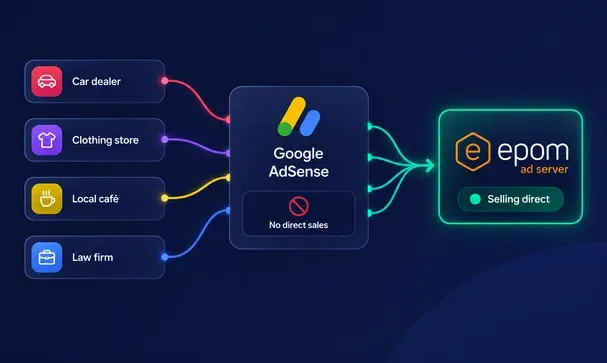
Most publishers in these languages sell ads directly to local advertisers and serve those ads through their own ad server. Banks, telecoms, retailers, car dealers and event organizers already pay to reach readers in your language, and none of them need Google's permission to do it.
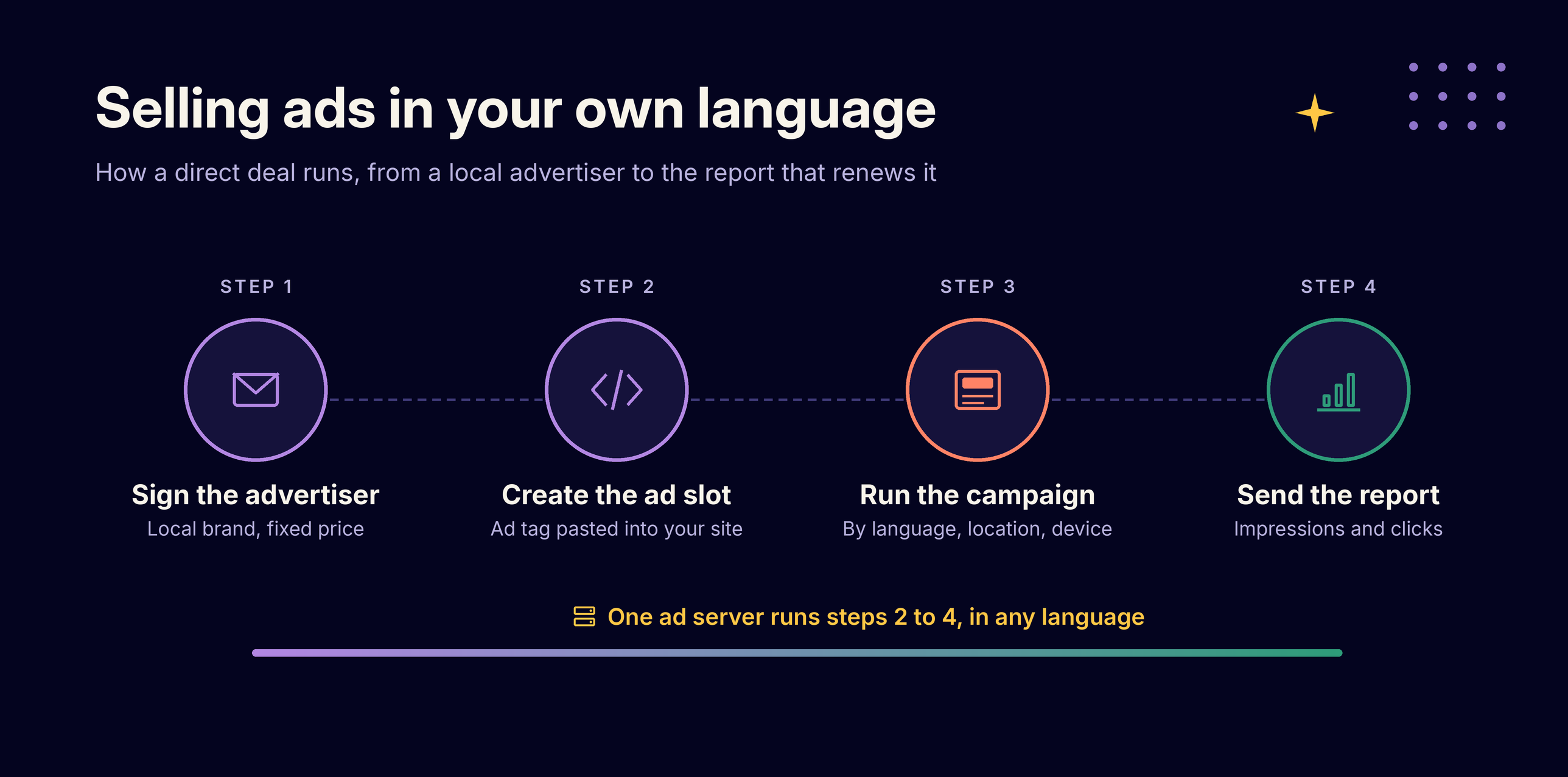
The work comes down to four steps:
- List the advertisers you already know. Start with the businesses that call or email you about placements.
- Create your ad slots once. An ad server gives you a short ad tag for each slot, which you paste into your site or CMS.
- Run each deal as a campaign. Set the dates, the number of impressions sold, and who should see the ad by language, location and device.
- Send every advertiser a report. Impressions and clicks from the ad server show what they paid for.
If you still have unsold slots, you can fill them later with a network that accepts your language. Your direct deals stay first in line.
What Do You Need to Sell Ads on Your Own Site?
You need one tool, an ad server: software that serves your advertisers' ads and counts what they get. Pick one you can run without hiring anyone, that doesn't care what language your readers speak. Check six things:
- No language rules. Nothing on the platform should depend on your language being on someone's list.
- Targeting by language and location. Some markets need more than country targeting; Kosovo, for example, has no IP ranges of its own.
- Priorities and limits for direct deals. Sponsors who paid for a fixed number of impressions should get them, in the right order.
- Reports an advertiser can read. A plain summary of impressions and clicks per campaign is what renews deals.
- People who help you set it up. For most small publishers, this is their first ad server.
- A price your revenue can carry, with room to grow.
How Gazeta Express Monetized Albanian News
Gazeta Express started in Pristina in 2005 and grew into Kosovo's best-known news portal, written in Albanian and read across Kosovo, Albania and the diaspora. Its ad team hit the wall every Albanian-language publisher knows: Google AdSense wasn't an option, and standard tools couldn't even find its readers. Kosovo has no IP ranges of its own, so local readers showed up as Serbian or Albanian traffic.
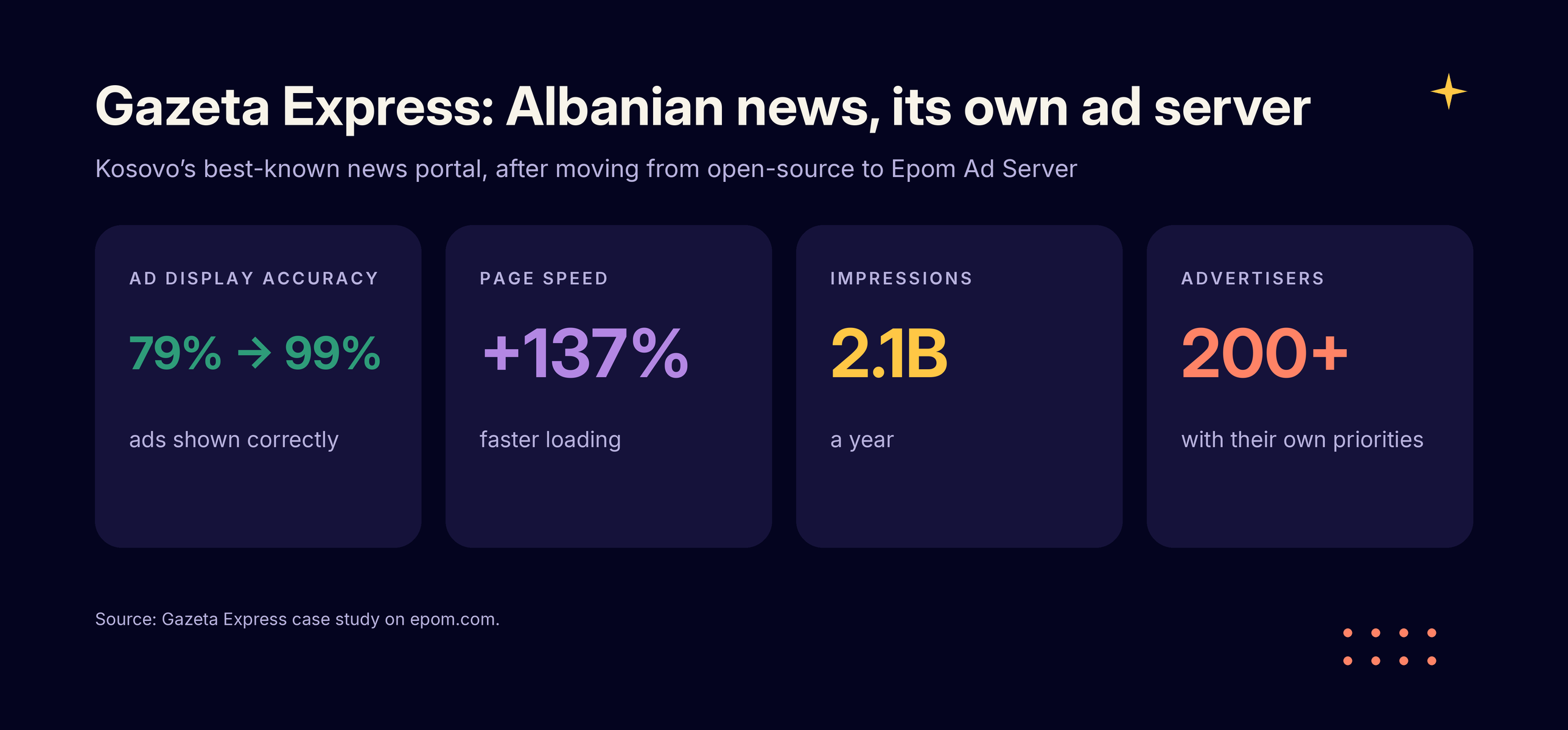
For years, the team ran its ads on a self-hosted open-source ad server. It cost nothing to license, but every problem was theirs to fix, and there was no one to call when ads displayed correctly only 79% of the time.
In 2015, they moved to Epom Ad Server. The team set up targeting by the Albanian language, combined IP and location rules to find Kosovan readers, and brought more than 200 advertisers into one system of priorities and limits.
Today ads display correctly 99% of the time, and pages load 137% faster. Compared with 2018, the site delivers 27% more impressions and a 59% higher click-through rate to its partners, at 2.1 billion impressions a year, for advertisers such as ProCredit Bank, Shell and Toyota.
"During our 6-year partnership with Epom ad server, we've moved away from technology challenges to effortlessly expanding our ad business, offering unique ad formats to our clients."
How Epom Ad Server Works for Publishers in Any Language
- Any language, any region. Epom Ad Server has no language list. You serve ads to readers in Albanian, Georgian, Nepali or any other language on the same terms.
- Targeting that fits your market. Show each campaign by language, country, city, IP range and device, so a local sponsor reaches local readers.
- Direct deals that run themselves. Set priorities, rotation and impression limits for every advertiser, and send each one a report from the platform.
- Help when you start. Every plan includes support from people who set up ad servers every day, so you don't need an ad-ops team of your own.
- A price that starts small. The Light plan costs $250 a month for up to 8.5 million display impressions, and a 14-day free trial covers 30 million.
Ready to sell ads in your own language? Start a 14-day free trial of Epom Ad Server.
What to Do Next If Google Won't Serve Your Language
Google's language list decides where AdSense works, not whether your readers are worth reaching. Local brands that advertise in your language still need to reach those readers, and Google can't sell that space for you.
A practical first month looks like this:
- Check every language on your site. Use the checker above; if some pages are in a supported language, AdSense can still run there.
- List ten local advertisers who already pay to reach your audience on billboards, radio or social media, and start the conversation.
- Write a one-page rate card with your ad slots, monthly prices or prices per 1,000 impressions, and your audience numbers.
- Set up an ad server and run your first campaign, then send that advertiser a report at the end of the month.
- Fill what's left with a network that accepts your language, after your direct deals.
Gazeta Express shows where this leads: an Albanian-language site Google never served, now running more than 200 advertisers through its own ad server.