
A revenue share never shows up as an invoice. The platform keeps its cut before the money reaches you, so the cost hides inside a lower payout.
Google keeps about a third of AdSense display revenue. Managed monetization partners keep 10–25%. On a growing ad network, a 15% share can cost more in one month than a flat-fee ad server costs in a year.
Whether that share is fair depends on what you get for it. A publisher with no advertisers of its own needs an ad network such as AdSense, and the share pays for the buyers. An ad network, operator or publisher that already sells its own campaigns needs an ad server, and a share there is a percentage of its own sales paid for software.
This guide shows what the best-known platforms take, what a share costs at your volume, and where a flat fee becomes cheaper. The calculator below runs your own numbers.
Bringing your own advertisers and paying a percentage for the software? Epom Ad Server charges a flat monthly tier on impressions served, from $250, and takes no share of what you earn. Compare the tiers.
TL;DR
- A revenue share model is a pricing model in which a platform keeps a fixed percentage of the revenue that passes through it instead of charging a fee. In advertising, the platform deducts its share before paying you.
- Published shares for website publishers range from 10% to 49%. AdSense publishers keep about 68% of display revenue overall and 51% of search revenue. Mediavine keeps 10–25%, Raptive 25%, and Playwire 25% of programmatic and 50% of direct sales.
- A share is fair when the platform brings the demand. If you bring your own advertisers and only need ad serving, you pay a percentage of your own sales for software.
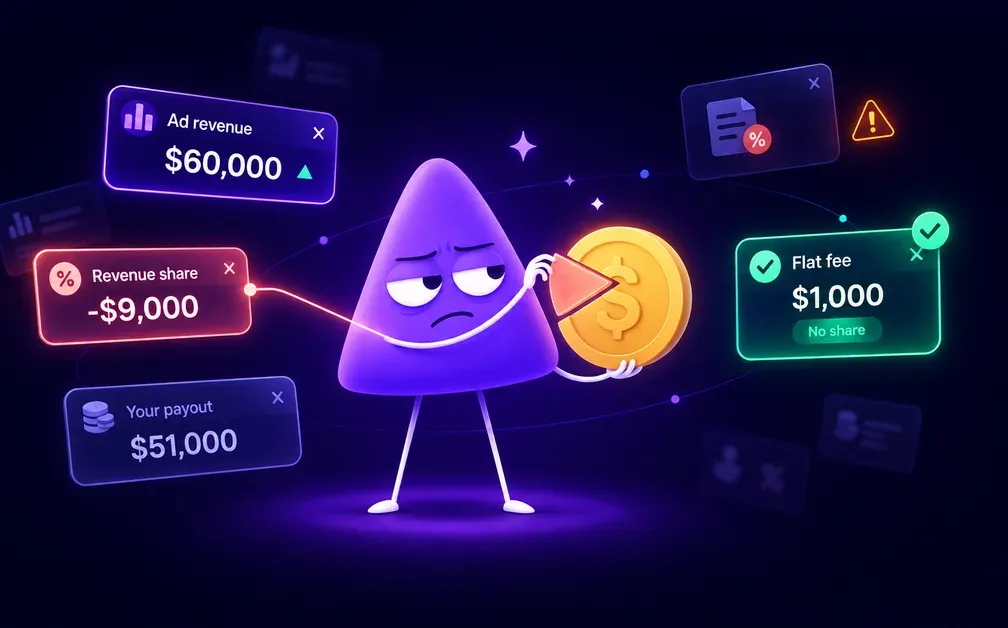
- The cost grows with your volume and your eCPM. At 40M monthly impressions and a $1.50 eCPM, a 15% share costs $9,000 a month. Epom Ad Server's flat tier for that volume costs $1,000.
- A revenue share is cheaper below the break-even: flat fee ÷ share %. Against Epom's $250 tier and a 15% share, that is $1,667 of ad revenue a month.
What Is a Revenue Share Model in Advertising?
In advertising and publisher monetization, a revenue share model is a pricing model in which an ad platform keeps a fixed percentage of the ad revenue that passes through it, instead of charging you a fee. You pay nothing up front. The platform's income rises and falls with yours.
The money moves in one direction. The advertiser pays the platform, the platform keeps its share, and you receive the rest as your payout. Most dashboards show the payout eCPM after the share, so the cut never appears as a separate line.
Shares come in four shapes:
- Flat percentage: one share on all revenue, like Raptive's 75/25 split.
- Tiered percentage: your share rises as your earnings grow, like Mediavine's 75% to 90%.
- Split by channel: a different share for programmatic and direct sales, like Playwire's 75% and 50%.
- Hybrid: a fixed fee plus a percentage, like AdButler's self-serve marketplace add-on at $2,200 plus 3.5% of generated revenue.
Two revenue shares are easy to confuse. The share you pay your platform is a cost. The share you pay your own partners (if you also mediate, not only monetize) is your business model: an ad network that pays sites 70% of what their inventory earns runs on revenue share by design.
You can keep the second without paying the first. An ad server can let you set a revenue share per publisher site while charging you only a flat monthly fee.
Ad Network or Ad Server: Who Brings the Advertisers?
An ad network sells your inventory to its own advertisers and keeps a share. An ad server is software you run your own campaigns on, and it brings no advertisers by default. That one difference decides whether a revenue share is a fair price or a tax. However, some ad servers may provide demand, though you generally have to negotiate this separately from paying for the platform itself.
| Type | Examples | Brings advertisers? | How it usually charges | Fits you if |
|---|---|---|---|---|
| Ad network or monetization partner | Google AdSense, Mediavine, Raptive | Yes | Revenue share, 10–49% (rates below) | You have traffic but no advertisers |
| Ad network and exchange | ExoClick | Yes | Keeps a margin on what advertisers pay; the publisher share isn't published | You sell adult or niche traffic and need buyers |
| Hosted ad server, billed per request | AdButler, Revive Hosted, Adserver.online | No | A fee per ad request | You sell your own campaigns at low volume |
| Quote-based ad server | EXADS | No | Not published; priced by quote | You run your own ad network under your brand |
| Flat-fee ad server | Epom Ad Server | No | A flat monthly tier by impressions served | You sell your own campaigns or run your own network |
The business test is who brings the advertisers. If you need buyers, a network's share pays for demand you can't reach alone, and it's money well spent. If you already sell your own campaigns, the same share pays for demand you don't use. You are renting software at a percentage of your revenue, and that percentage grows every time your sales team closes a deal.
How Much Do Ad Platforms & Networks Take? Revenue Share Rates in 2026
These are the shares each platform publishes on its own help center, terms or pricing page. Where a platform doesn't publish one, we say so.
| Platform | You keep | Platform keeps | Notes |
|---|---|---|---|
| Google AdSense, display | About 68% overall | About 32% | 80% after the advertiser platform's fee; "about 68%" when the buyer uses Google Ads |
| Google AdSense for search | 51% | 49% | Of the revenue Google recognizes |
| Google Ad Manager | Not published | Not published | Google no longer publishes a current figure; the AdX take rate is set in each contract |
| Mediavine | 75–90% | 10–25% | Tier set by annual earnings, for sites launched from 2026 |
| Raptive | 75% | 25% | Covers ad serving fees and discrepancies |
| Ezoic | At least 82% | Up to 18% | Of net display revenue |
| Playwire | 75% programmatic, 50% direct | 25%, 50% | Of net revenue Playwire receives |
| Snigel / Publisher Collective | 80% | 20% | Stated on the company's blog |
Not published by the platform: Freestar, Publift, Monumetric, Taboola, Outbrain, MGID, ExoClick, Adsterra and Google AdX's own take rate. Their terms are set in each contract.
In iGaming the share runs the other way: operators pay affiliates 25–45% revshare on the players they send (StarzPartners, Betsson), and that is the affiliate's income, not a platform fee.
What Does a Revenue Share Pay For?
Every revenue share bundles three things: demand, people and software. The question is how many of the three you use.
- Demand: the platform's advertisers and programmatic buyers fill your slots. This is what AdSense and managed partners sell.
- People: account managers tune floors, layouts and bidders for you.
- Software: the ad server that decides which ad shows where, and counts it.
If you use all three, a share can be a fair trade. A small publisher with no sales team gets demand it couldn't reach alone, and pays only when ads earn.
If you have or planning to have your own advertisers, you are paying a percentage for the software alone. An ad network with direct advertisers, a streaming platform that monetizes video content, or a publisher selling sponsorships to its own industry all fit here. The platform did nothing to make those sales, but takes its cut of every one.
"We don't deal with percentages. Your business is your business, you're making money, right? Epom is a tool that helps you in that, and we offer a transparent model: your revenue is 100% yours, and you pay flat for technology."

A share also ties your bill to your revenue. To bill you a percentage, the platform has to count every dollar you earn and settle it with you each month. Under a flat fee, your bill doesn't depend on your revenue, so you never have to report it to your vendor, and every conversion dollar stays with the network. This counts most for gambling and adult networks, where margins are the business.
How Much Does a Revenue Share Cost You as You Grow?
Take an ad network serving 40M display impressions a month at a $1.50 eCPM. That is $60,000 in monthly ad revenue. At an 80% fill rate, it is also 50M ad requests, the size of the most common published per-request plan.
| Model | Plan | Monthly expense | Yearly expense |
|---|---|---|---|
| Revenue share | 15% of $60,000 | $9,000 | $108,000 |
| Revenue share | 25% of $60,000 | $15,000 | $180,000 |
| Flat fee | Epom Ad Server Growth (40M impressions) | $1,000 | $12,000 |
| Flat fee | Epom Growth, billed annually | $850 | $10,200 |
| Per-request | Adserver.online, 50M-request package | $484 | $5,808 |
| Per-request | Revive Hosted, $0.01 CPM × 50M requests | $500 | $6,000 |
| Per-request | AdButler Advanced (50M requests), before add-ons | $2,988 | $35,856 |
Illustrative scenario. List prices as published on each vendor's pricing page on 25 October 2026; your contract may differ.
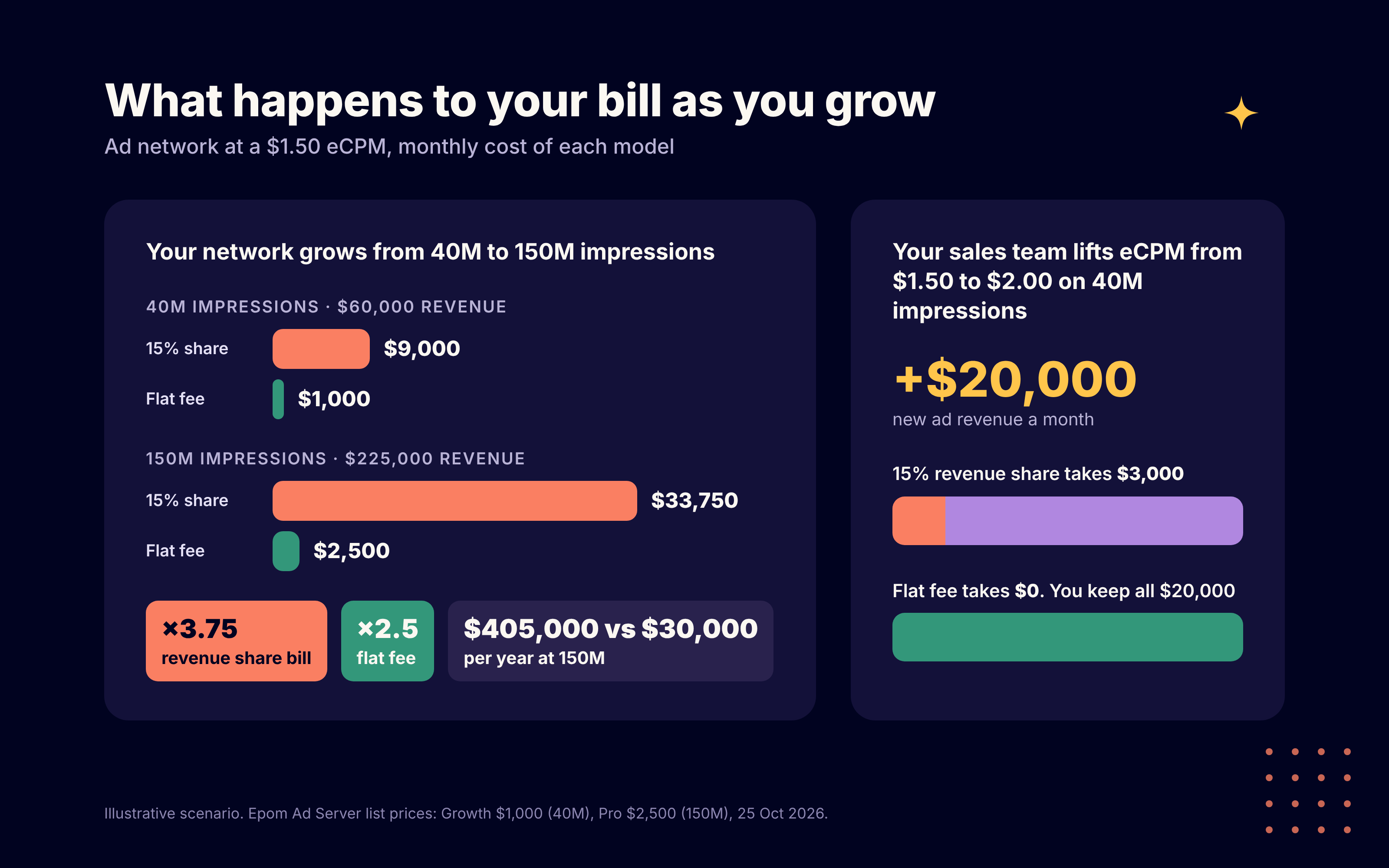
Now let the network grow to 150M impressions at the same eCPM. Revenue reaches $225,000 a month. A 15% share now costs $33,750 a month, or $405,000 a year. Epom's Pro tier for 150M impressions costs $2,500 a month, or $30,000 a year.
From 40M to 150M impressions, the revenue share bill grew 3.75 times. The flat fee grew 2.5 times. Per impression, the flat price fell from $0.025 CPM to $0.017 CPM.
A share also takes a cut of every eCPM gain. Say your sales team lifts eCPM from $1.50 to $2.00 on the same 40M impressions. Revenue rises by $20,000 a month, and a 15% share takes $3,000 of that lift. A flat fee takes none of it.
Per-request plans fall between the two. At 40M impressions, two of them cost less than Epom's Growth tier, and AdButler's costs more.
Their bill rises when your fill rate drops, because unfilled requests count too. Our ad server pricing comparison covers them in detail.
When Does a Revenue Share Model Make Sense?
A revenue share is cheaper while your monthly ad revenue stays below one number: the flat fee divided by the share.
Break-even revenue = monthly flat fee ÷ revenue share %Take Epom Growth as an example at $1,000 a month and a 15% share: $1,000 ÷ 0.15 = $6,667. That number is your line.
- Your network earns $5,000 a month. A 15% share costs $750, less than the $1,000 flat fee. The share wins.
- Your network earns $20,000 a month. A 15% share costs $3,000, three times the flat fee. The flat fee wins.
The table runs the same sum for common shares and each Epom tier.
| Share you pay | Epom Light ($250) | Epom Growth ($1,000) | Epom Pro ($2,500) |
|---|---|---|---|
| 10% | $2,500 | $10,000 | $25,000 |
| 15% | $1,667 | $6,667 | $16,667 |
| 20% | $1,250 | $5,000 | $12,500 |
| 25% | $1,000 | $4,000 | $10,000 |
How to read it: find the share you pay on the left and your tier along the top. Below that monthly ad revenue, the share costs less. Above it, the flat fee does.
In eCPM terms, the bar is low. At the top of each tier, a 15% share beats the flat fee only while your eCPM stays under $0.20 on Light (8.5M impressions), $0.17 on Growth (40M) and $0.11 on Pro (150M). If your eCPM is above that, the flat fee costs you less.
One case shows when a revenue share is the right call. A connected-TV games publisher asked us for revenue share pricing. They expected about 15M monthly video ad requests at a fill rate near 2% and a $5 CPM: roughly 300,000 impressions and $1,500 in monthly revenue.
A 15% share would cost them about $225. Epom's Light tier costs $250, but it covers only 250,000 video impressions, so they would pay Light plus overage, or move to Growth at $1,000. They chose another provider, and on those numbers a share was the cheaper choice. At video volumes this small, the gap is even wider than the display math suggests.
✅ A revenue share fits you if you have no advertisers of your own yet, earn under the break-even above, need the platform's demand and people, or can't commit to any fixed monthly cost.
❌ A revenue share costs you more if you sell your own campaigns, your volume is steady, your eCPM is growing, or you don't want your bill to depend on your revenue.
Monetization Revenue Share Calculator
Enter your monthly impressions, eCPM and the share your current platform takes or offers you. The calculator shows what that share costs per month and per year next to the Epom Ad Server tier for the same volume, which takes no share, and the revenue at which the two cost the same.
Revenue share calculator
See what a revenue share costs you per month and per year, and compare it with a flat Epom Ad Server tier at your volume.
Your revenue share
Epom flat tier, no share
Estimate based on Epom Ad Server list prices. Add-ons and overage are not included.
The formulas behind it:
- Revenue = impressions ÷ 1,000 × eCPM
- Revenue share cost = revenue × share %
- Flat fee = the Epom tier that covers your impressions, minus 15% if you pay annually (above a tier's quota Epom bills overage; the calculator shows the next tier instead)
- Break-even revenue = flat fee ÷ share %
How to Check, Negotiate or Leave a Revenue Share Deal
Before you sign or renew, ask six questions:
- Share of what? Gross revenue, net revenue, or revenue after discrepancies and invalid traffic?
- Does the share change? Tiers by earnings, by traffic, or by tenure?
- Is there a minimum? Some partners add a monthly minimum fee if their share falls below a set amount.
- Are direct sales included? Some contracts take a share of campaigns you sold yourself.
- What data do you get? Log-level data, buyer names and raw impression counts, or only a payout total?
- How do you leave? Notice period, payment holds and who owns your tags and setup.
If you are moving off a share, do it in this order. Pull three months of statements and work out the share in dollars, not percent. Run those numbers through the calculator above. Then test the new ad server on a slice of your traffic before you move direct deals across.
Flat-Fee Ad Serving with Epom Ad Server
Epom Ad Server charges a flat monthly tier based on impressions served. The price stays the same whether your eCPM is $0.50 or $5.00.
| Tier | Monthly | Annual billing (15% off) | Display + mobile web impressions | Video + HTML5 impressions |
|---|---|---|---|---|
| Light | $250 | $212/mo | 8.5M | 250K |
| Growth | $1,000 | $850/mo | 40M | 2M |
| Pro | $2,500 | $2,125/mo | 150M | 7M |
| Enterprise | Custom quote | Custom | Unlimited | Unlimited |
Your bill counts impressions, not advertisers, publishers or user seats. Every tier has the same features, with no caps on advertisers, publishers or users.
You pay net 30, with no setup fee and no upfront payment. Add-ons are billed on top: white-label at $250 a month, premium support at $250, advanced analytics at $500, and AI assistant usage when it runs on Epom's key.
Each tier includes an impression quota and a traffic quota in GB; usage above them is billed at the plan's overage rates. Crossing a quota doesn't move you to a higher tier; you pay overage on the extra volume. Header bidding slots filled by Google or partners count as plan impressions by default. Your eCPM never changes the bill; your volume does.
If your volume lands between two tiers, Epom can price a CPM rate for the gap.
✅ Choose Epom Ad Server if you sell your own campaigns or run your own network, want a cost you can forecast, and want a bill that doesn't depend on your revenue.
❌ Skip it if you need a platform to bring the advertisers. Epom Ad Server do not provide demand out of the box, although we can do it for certain verticals.