
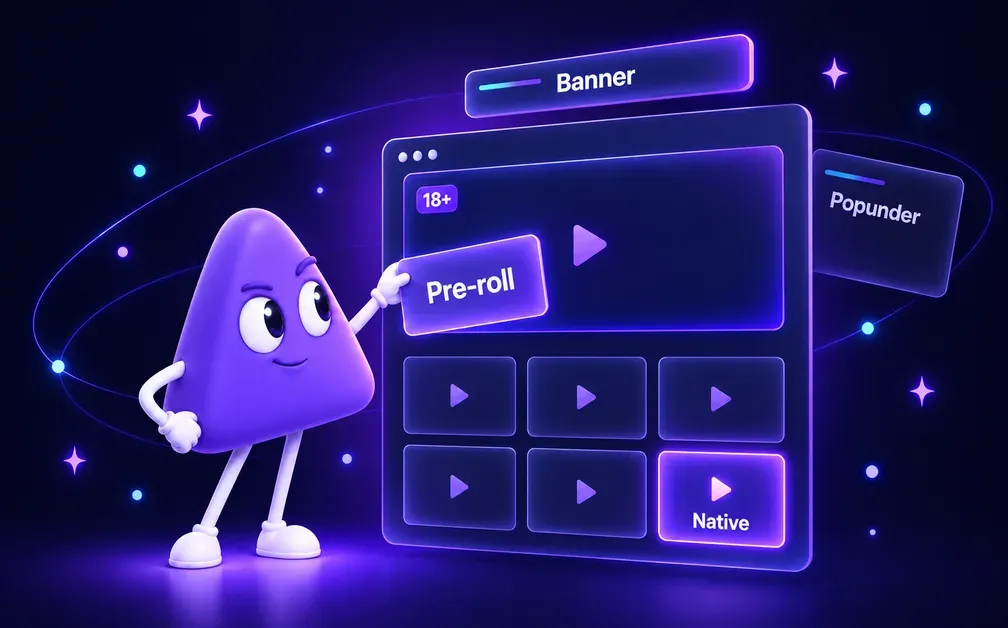
Every adult site is running the same experiment: how much advertising will users accept before they close the tab? Too little, and you leave money on every visit. Too much — a redirect on every click, a fake close button — and the traffic that made the site worth monetizing starts going somewhere else.
Where that line falls depends on your site. A big tube brand keeps its ad setup calm, because its name is what brings users back. A video aggregator can push pre-roll and popunders harder, because its users came for one clip and will put up with a lot to get it. A network working with dozens of publishers has to handle both at once.
This guide covers every format worth running on adult traffic, the placements to prepare for each, and what to watch once they're live, so you can find that line for your own inventory.
Epom Ad Server runs popunders, VAST video, native, interstitials and custom rich media on adult inventory without a policy review. See them running live, or start a free trial and build your first placement.
- Most adult sites already have video inventory. That makes pre-roll the first format to evaluate, though some large tube sites skip it on purpose.
- The right mix depends on your site. Large tube brands tend to run native, banners and GIF creatives and avoid popunders. Volume plays run pops. Networks reselling mixed supply run whatever each publisher accepts.
- Popunder and popup are different products. One opens hidden behind the page, the other is visible and sometimes ships with a fake close button. The distinction decides which publishers will take your tags.
- Your impression count is not a view count. The impression beacon fires on page load, so a footer creative counts even when nobody scrolled to it.
- Format choice limits measurement. Popunders and redirects register no click event, so pixel tracking cannot attribute anything to them.
- Placement decides which advertiser categories you can sell. On the big networks that decision is made for you. On your own server it is not.
What Ad Formats Convert Adult Traffic?
Eight formats do most of the work on adult inventory. A few run on nearly every site; others only earn where the audience tolerates them. The newest, a vertical video feed with ads between clips, already runs on Pornhub's mobile app.
| Format | What it is | Who runs it | Worth knowing |
|---|---|---|---|
| Pre-roll / in-stream video | VAST video before the content plays | Most video sites | Usually the top earner on video sites |
| Outstream video | Video in a page slot, outside the player | Aggregators and networks | Mobile-friendly, no player dependency |
| Popunder / tab-under | Landing page opens hidden behind the active window | Volume-focused sites and networks | Rejected outright by several premium brands |
| Popup / interstitial | Visible overlay, full-screen on mobile | Mixed, mobile-heavy | Fake close buttons are what gets these banned |
| Native static and rollover | Ad unit styled like the surrounding thumbnails | Some premium tube brands | Carries a scam-era reputation, so creative quality matters more here |
| Display banner | Standard sizes, header, footer, in-player, side | Everyone | Includes GIF and video banners, which several large sites prefer |
| Push and in-page push | Notification-style, on-page or subscribed | Networks, less so single publishers | In-page needs no subscription and reaches iOS |
| Vertical video feed | In-stream ads inside a scrollable short-form feed | New, mobile, growing | Pornhub's Shorties runs one after every ninth video |
Which Formats Fit Your Type of Site?
The right mix depends less on the adult as a vertical and more on what kind of site you run. Three setups cover most of the publishers we work with.
Large, well-known tube sites. These run deliberately calm ad setups: native units, standard banners, GIF creatives. Most avoid popunders to protect the experience that brings users back. One large tube site on Epom runs banners and native with GIF creatives, and no pre-roll at all.
What is true for you: your rates depend on reputation more than on how aggressive your formats are, and the formats you turn down are part of what advertisers pay for.
Video aggregators. Pre-roll first, outstream second, popunders where the audience accepts them. The video library is the inventory, so most revenue comes from what plays before the content.
What is true for you: video is the main revenue line and everything else adds to it, so how the player handles ads matters more than how many creative types you offer.
Networks working with many publishers. Here the mix is whatever each publisher agrees to. Some of your sites will take popunders; others will leave if you ask.
What is true for you: your ad server needs to support formats you might never run yourself, because every publisher on your network has a different audience.
A fourth group, high-volume regional networks on simpler sites, runs popunders as the main format, and their users accept it. Moving that mix onto a premium tube site would cost you the publisher.
How Do You Run Video Ads on Adult Sites?
If your pages are full of video, monetizing them with video ads is the obvious move. Pre-roll plays right before the clip the user came for, so it gets their full attention, which is why video aggregators lean on it more than any other format.
The technical requirements are ordinary. VAST 3.0 and 4.0, five to thirty seconds, 1080p recommended, standard player integration. There is no special adult video stack to buy.
Overlay ads render over the bottom third of the player and behave like a banner with a video-shaped audience. Outstream gives you video inventory on pages with no player at all, which matters on mobile.
VAST events are optional, and they depend on the publisher's player firing them. You can serve a million impressions and see 500,000 video-start events in your reports, with nothing wrong. The player did not report the event, or tracking was never enabled for it.
That gap becomes an argument with an advertiser if you have not explained it first. Agree which events are being tracked before the campaign runs, and check that the publisher's player actually fires them.
Video also costs more to serve than display, on most plans materially more per thousand impressions. It still wins on revenue, but the margin is narrower than the rate card suggests. Price it knowing what delivery costs you.
Can I Run Pop-Under Ads on Adult Networks?
Yes, on sites that accept them. Popunders often get confused with popups, though, and publishers treat the two very differently.
A popunder opens the landing page hidden behind the active window. The user clicks something on the site, the content they wanted opens, and the advertiser's page is waiting underneath. They did not choose it and often do not notice it immediately.
A popup is visible. It appears over the content, and the version that gives the format its reputation ships with a close button drawn onto the creative, positioned away from the real one.
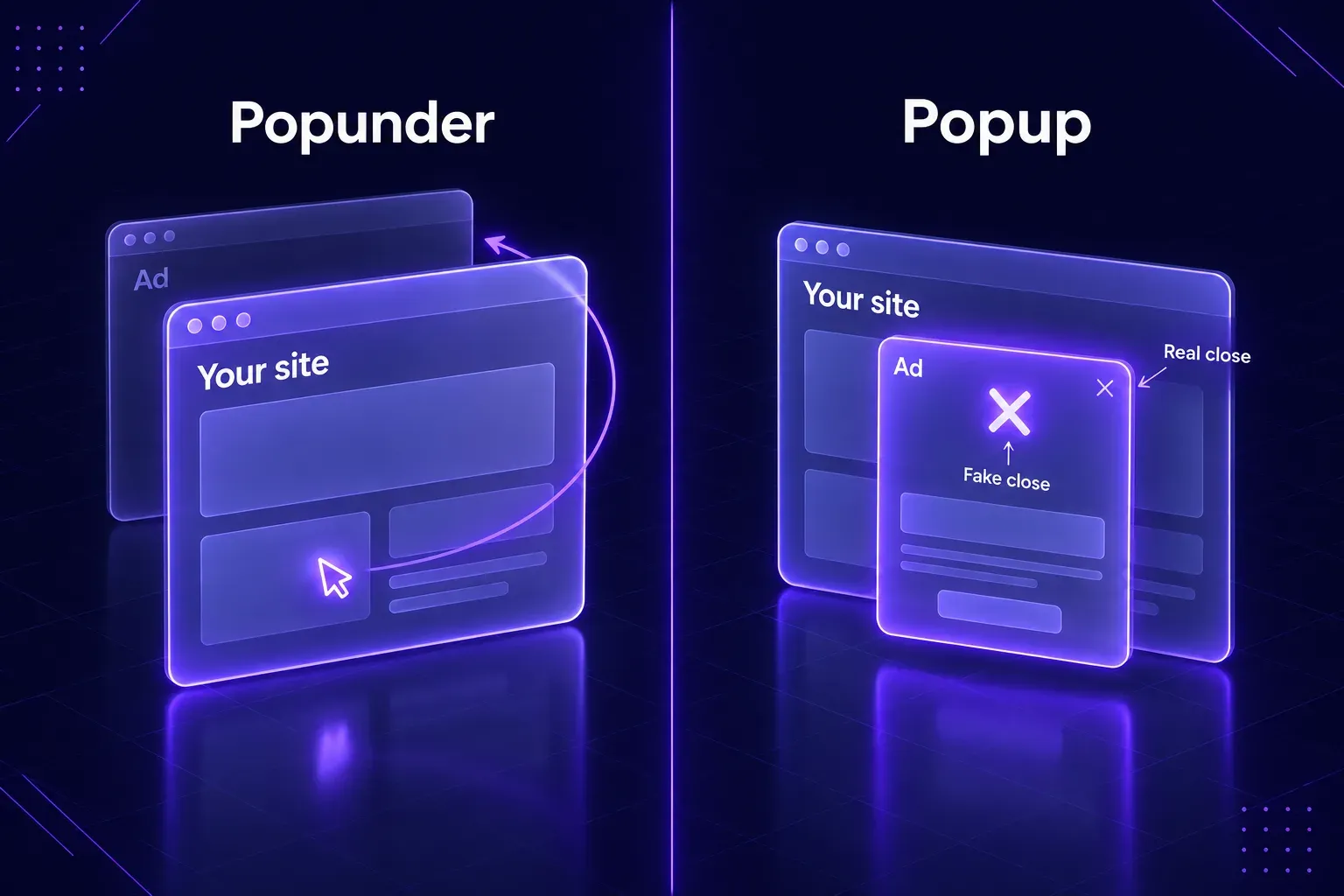
That distinction decides who will work with you. Google's policies require a genuine close control on interstitials and prohibit fake ones, and large adult publishers hold to the same standard voluntarily.
Several premium properties refuse popunders entirely. The user never chose to be redirected, which puts the format outside what they will run.
If you are building supply, treat that as a sorting rule. Pops will fill volume on properties that accept them and will close doors on properties that do not.
The demand side publishes its own limits, which double as a checklist. Commonly prohibited on popunder inventory: JavaScript alerts and exit pops, timed redirects, antivirus-style campaigns, backjacking and looping, auto-downloads, and anything that plays sound or vibrates by itself.
How Often Should Popunders Fire?
Set a frequency cap on every popunder campaign. Without one, the redirect can fire on every click, so the user can't browse your site, and their clicking starts to look like bot traffic.
A cap gives each user a quiet window after a popunder fires — usually between 30 minutes and three hours — before the next one can open.
One side effect to expect: capping slightly widens the gap between your numbers and the publisher's. The publisher counts every request, while your server skips the ones blocked by the cap. That's normal, so explain it to publishers upfront and it won't look like lost traffic.
Which Formats Don't Work on Adult Inventory?
Most formats can earn somewhere in adult. One is a poor fit almost everywhere, and a second works only on the right sites.
- Interscrollers. The unit that expands as you scroll past it, then collapses again. It is built for article text — a reader moving down a page of prose, meeting a full-screen creative in the middle of it. Adult pages are built around thumbnails and video, with no article text for the unit to interrupt.
- Full-screen interstitials on premium sites. They work well on mobile, which is why the placement table below includes them. Large tube brands are the exception, and tend to refuse aggressive full-screen units.
- Native comes with a caveat. It works and it is widely used, and it carries a reputation problem earned when native units on adult sites were largely scams. Creative quality matters more here than in any other format.
What Placements Should You Prepare Before You Sell?
Demand arrives expecting specific sizes. These are the standards the largest adult networks publish, which makes them the de facto spec for the vertical.
| Placement | Size | Device |
|---|---|---|
| Top-right square | 300x250 | Desktop |
| In-player | 468x60, 300x250 | Desktop, tablet |
| Footer | 950x250 desktop, 300x250 mobile | Both |
| Header | 305x99, 300x100 | Mobile |
| Under-player | 305x99, 300x100 | Mobile |
| Interstitial | 300x250 | Mobile |
| Full-page interstitial | 320x480 | Mobile |
| Native static and rollover | 640x360 | Both |
| In-stream and outstream video | 16:9 | Both |
| Vertical feed | 480x854 (9:16) | Mobile |
File limits worth matching: 3 MB for static creatives, 15 MB for video banners, 500 MB for video. Animation should hold each element at least two seconds.
On the large networks, placement determines which advertiser categories you are allowed to sell. Casino and sports betting permitted on the header, the interstitial, in-stream and popunder — but not on the top-right square or the desktop footer. VPN allowed on interstitial, not on native.
Those rules are not yours. They are set by the platform, they change without your involvement, and they quietly cap what a given placement can earn.
On your own server, that decision moves to you. You decide which advertiser categories run on which placements, you set the category rules once, and nobody reclassifies your inventory overnight. For a publisher whose highest-paying demand happens to sit in a restricted category, that is the entire argument.
Running formats a network will not allow on your placements? Book a demo and we will map your inventory against the demand you actually want.
How Much Do Adult Video Ads Cost?
There's no single adult CPM. Rates depend on format, how well-known the site is, geo and device — the same pre-roll slot can earn several times more on a major tube site than on a small one.
We don't publish a benchmark table, because performance varies so much between publishers that an average would describe none of them. The useful benchmark is your own: track earnings by format, placement and geo, and you'll know what your inventory is worth.
Why Do Your Impression Counts Differ From the Publisher's?
They always will, and a number near zero usually means the measurement is wrong.
Ad discrepancy of up to 5% is normal. On popunders, up to 10%.
The reason is the redirect chain. A pop fires through the publisher's redirect, then your server's, then often a third party's, before the landing page loads. At every step the user can close the window, the browser can block the redirect, or antivirus software can decide the chain looks like an attack.
In a long chain, a thousand clicks at the publisher can arrive as six hundred at the advertiser. That is well past the normal band and worth investigating, and the usual cause is a chain with too many steps.
Anything above those bands is worth investigating, and the investigation is two-sided: who counts what, at which moment, on which creative. There is no universal fix.
Does Adblock Waste Your Impressions?
No. Adblock blocks the script call itself. When a user has it enabled, your ad request never reaches the server, so there is no impression to waste and no creative served into a blocked slot. Your reporting does not fill up with delivery nobody could see.
Can you get around it? Not durably. Domain rotation takes a couple of hours before the filter lists update. No ad server circumvents adblock reliably, but here is the article that lists tips to try.
Some sites respond by asking users to disable it, or by gating the content.
Do Ads Slow Down Your Tube Site?
Not if they are served asynchronously, which is worth confirming with any vendor.
Epom ad server’s scripts execute after the page has finished loading, and video is handled by the player afterwards. A page that takes twenty seconds to load was slow before the ad call happened.
Why Isn't Your Ad Format Serving?
The most common support question in this vertical, and roughly four out of five are resolved by pointing at one setting. Work through these in order before escalating.
- The campaign is paused. The most frequent cause, and the easiest to miss on a setup you built last week.
- Geo targeting excludes your traffic. You connected inventory from one market and targeted another. Check what the placement actually receives, not what you expected it to receive.
- Device or OS targeting is too narrow. Mobile-only creative on a desktop placement, or a format the device does not support.
- The requests are being filtered as invalid. Your traffic is arriving, and your quality rules are declining. The security report tells you why.
- The targeting combination excludes everything. Each rule is reasonable alone. Together they describe a user who does not exist.
If none of those is the cause, check whether the creative template itself has broken.
What Happens When a Custom Format Stops Working?
Custom formats — catfish units, corner popups, expandables — depend on browser behavior, so browser updates and policy changes can break them overnight. A unit that rendered fine last quarter suddenly stops collecting what it needs.
On Epom, we maintain these templates and update them when that happens, and we'll customize one when your setup needs something the standard version doesn't do. When you compare vendors, ask what happens six months from now when a browser update breaks a format you rely on.
Can You Measure Conversions on Every Format?
No. If your demand pays on actions, this decides your format mix.
Pixel-based conversion tracking needs a click event. Popunders and redirect-based formats do not register one, so a pixel cannot attribute anything to them. If you sell that inventory on CPA, the conversion is invisible.
Server-to-server postbacks solve it, because they do not depend on the browser at all. The advertiser fires a call to your server when the conversion happens, carrying the identifier you issued at click time. Device, session and timing stop mattering.
That is standard on an ad server you control. It is frequently not available to you when you monetize through a network, because the conversion happens inside their reporting and you receive a payout figure rather than the event.
If your demand pays on impressions, format choice is open. If it pays on conversions, run formats that produce a click event, or run postbacks.
Which Ad Formats to Optimize First in Adult Advertising
In this order.
- If you run video, get it right first. On video sites it is usually the biggest revenue line, and the one with the most ways to misreport.
- Cap your pops. Both for the user experience and because uncapped redirect loops generate traffic that looks fraudulent.
- Decide your popunder position deliberately. It determines which publishers and advertisers will work with you.
- Switch viewability on if you sell to advertisers who measure it. Know the gap before they tell you about it.
- Match the standard placement sizes so demand does not have to make an exception for you.
- Set category rules per placement once, deliberately, rather than inheriting somebody else's.
FAQ
Every format in this article runs on Epom Ad Server, including the ones large platforms restrict. Start a free trial from $250 a month and build your first placement.