


- An adult ad network buys ad space from adult publishers and sells it to advertisers, keeping a cut of the revenue. Mainstream ad tech excludes this inventory in its content policies, so the vertical runs on its own separate set of vendors.
- The pricing model matters more than the rate card. Most adult demand — dating, cam, and offer-based affiliates — buys on CPC or CPA rather than CPM.
- There is no single best “adult CPM or CPC.” It is set by format, site tier, geo, and device, so price per segment instead of chasing one benchmark.
- Up to 3-5 people is enough to launch an adult ad network. Most run on just a few people at start, and separated roles and permissions only become useful in year two. What you need at launch is reachable support.
- The day-one functionality list is short and specific: popunder, native, and VAST video support; OpenRTB backfill; granular geo, device, and carrier targeting; server-to-server postbacks for CPA demand; a white-label advertiser portal; and per-placement traffic-quality reporting.
- Traffic-quality control belongs in the initial setup. Adult inventory carries higher bot and invalid-traffic exposure than mainstream, so the useful configuration scores traffic by risk and reports it per placement.
Adult traffic is high-volume and steadily monetizable, but it is excluded from most of the ad tech built for mainstream advertising: Google Ad Manager won't serve it, and most mainstream DSPs won't connect to it. Instead, it runs on a separate, smaller set of vendors that accept the vertical: ad servers without content restrictions and adult demand-side platforms built for this kind of traffic.
That policy gap is exactly why a small number of large adult ad networks control most of the demand. It is also why publishers running tube sites and cam platforms end up as publishers inside someone else's network instead of running their own.
If that's you, you already know the trade. The network keeps a revenue share of what your inventory earns, and the advertiser relationships on that traffic belong to them.
The technology needed to build an adult ad network is a smaller obstacle than most publishers expect it to be. Ad servers that openly serve this vertical are licensed monthly, with the fee based on impressions served rather than a share of what you earn.
This keeps the platform cost flat as your rates rise. If you already have the traffic, or the advertiser contacts, the infrastructure is the cheapest and fastest part of the business to put in place.
Want to monetize your adult traffic with no revshare taken out of what you earn? That is what Epom Ad Server is built for. See the full functionality in a demo.
What Is an Adult Ad Network?
An adult ad network, also called an adult advertising network, buys ad inventory from adult publishers — tube sites, cam platforms, adult content networks — and sells it to advertisers, keeping a margin on the transaction. The model is the same as any ad network.
What changes is who will work with you. Google Ad Manager and most mainstream demand-side platforms exclude adult content in their content policies. The demand sources, ad servers, and fraud tools available to you all come from a smaller pool of vendors that accept the vertical.
Worth clearing up early: there is a small number of vendors willing to take the vertical, but they are just as sophisticated technically. Ad servers that accept adult inventory run the same popunder, native, and video formats as mainstream platforms, so building a stack from scratch solves a problem a licensed platform has already solved.
How an Adult Ad Network Makes Money
The business is simple to state: you put a price on ad inventory and collect more for it than it cost you to get. What changes between setups is who owns the inventory and who you are selling it to. Let’s review three potential business options here: case A, case B and case C.
A. When the Inventory Is Your Own
There is no revenue share to negotiate, because there is no second party to pay. You set the rate, the advertiser pays it, and the only deduction is the technology fee. This is the position a publisher moves into after leaving a network, with the same inventory and often the same advertisers, minus the share that used to come off the top.
B. When You Resell Other Publishers' Inventory
This is the network business proper. You agree terms with the publisher, then sell their inventory to your advertisers at a higher rate and keep the difference.
Two ways to structure those terms, and they move the risk to different sides:
- Revenue share. The publisher takes an agreed percentage of what their inventory actually earns, so anything you fail to sell costs you nothing.
- Fixed rate per thousand impressions. You owe the publisher whether or not you filled the inventory, which carries real risk and is usually priced lower per impression because of it.
Either way, the publisher doesn't see what you charged the advertiser, which is exactly the position you were in as a publisher inside someone else's network.
C. When the Buyer Is a DSP Rather Than an Advertiser
Direct advertisers pay the rate you negotiated with them. Inventory you pass to connected DSPs works on a floor price instead: you set the minimum you will accept, the DSPs bid, and you keep whatever clears above what you owe the publisher.
| Business Model | Inventory Source | Revenue Mechanic | Risk Profile |
|---|---|---|---|
| A. Owned Inventory | The network operator's own tube or cam sites. | Advertiser pays a direct rate; operator keeps 100% minus flat SaaS tech fees. | Low: No third-party publishers to pay out. |
| B. Reseller (Rev-Share) | Third-party adult publishers. | Operator sells ad space at a markup, paying the publisher an agreed percentage of the yield. | Low: Operator only pays the publisher if the inventory sells. |
| C. Reseller (Fixed CPM) | Third-party adult publishers. | Operator guarantees a fixed CPM payout to the publisher, attempting to sell it to advertisers for a higher margin. | High: Operator must pay the publisher even if the inventory goes unsold. |
| D. Programmatic (DSP) | Owned or third-party publishers. | Inventory connects via OpenRTB to third-party DSPs. Inventory clears to the highest bidder above a set floor price. | Low: Automated yield management with floor price protection. |
Which Pricing Models to Charge Advertisers On
CPM suits advertisers buying exposure and predictable delivery, and it is the easiest to forecast against your own inventory.
CPC and CPA fit the advertisers who dominate demand in this vertical, since dating, cam, and offer-based affiliates are buying clicks and conversions rather than impressions.
Charge on all three. An advertiser who only buys on CPA will not switch to your CPM rate card to accommodate you, and your server needs to bill and report on whichever model each deal is signed under.
Related reading: CPM vs. CPC vs. CPA comparison in detail.
Epom Research: Adult Ad Network CPM Rates
There is no single adult CPM to plan around, and any flat figure averages away the variables that decide it.
- Format. Video, popunder, native, and standard display don't compete on the same scale.
- Site tier. Video CPM on a large, well-known tube site runs several times higher than the same unit on a lesser-known one.
- Geo. Tier-1 traffic prices differently from Tier-3, in the same format on the same site.
- Device. Mobile inventory is cheaper, though dating and cam offers convert better there, which changes what a CPC or CPA buyer will pay for it.
Adult inventory is not discounted by default, either. Dating, cam, and nutra advertisers seek this traffic specifically, and well-known sites command real premiums over anonymous long-tail inventory. The ceiling is set by site reputation and traffic quality rather than by a vertical-wide discount.
What You Need Before You Start an Adult Ad Network
The deciding factor is advertiser contacts. Without them, a network's cut is buying you access you can't get yourself, and staying on ExoClick or TrafficStars is a reasonable trade. With them, you are paying for access you already have.
Most operators arrive with a tube site they already run, or a background in adult, dating, or another network where they know the buyers personally. With neither, spend the time on relationships rather than on platforms.
Team: 1-5 member team is enough. Most live adult networks start with a lean team. Separated roles and permissions become useful once you have staff to separate, which is a year-two problem.
Support matters more than headcount, and the need runs opposite to expectation. An operator new to ad serving follows the default setup and rarely asks for anything unusual. An experienced one arrives with a list of corner cases from their last platform and wants each one solved, which is why reachable technical support does more for a launch than an internal hire.
“The founder who builds an adult network is the adult network himself. We see one-man ad networks succeeding with us, and growing into meaningful scale with time.”

Choosing an Adult Ad Server: What Matters Here
Everything above is a business decision. The rest is technology, and there is only one piece you can't do without: something to host the ads, run the deals, and count what happened. That is the ad server, and in this vertical the list to choose from is shorter than in mainstream.
Whether you license it as a white-label ad network or as a standalone ad server for ad networks, your adult traffic monetization platform has to clear the same checks. Nine things to confirm before signing, in the order they matter here.
| What to check | What good looks like for adult inventory |
|---|---|
| Vertical restrictions | Adult content allowed explicitly, written into the agreement. Most ad servers are built around Google's policy assumptions, and some restrict the vertical after onboarding rather than before. |
| Fraud detection | Fraud categories with a risk score and per-placement reporting, rather than one on/off toggle. Covered in its own section below. |
| Formats | Popunder, native, interstitial, and VAST/VPAID video, supported natively. |
| Fill-rate control | Priority groups plus passbacks, so direct campaigns serve first and unsold requests fall through to the next source instead of being lost. |
| OpenRTB connectivity | Potential to plug in DSPs, not only direct advertisers through endpoints. |
| Affiliate tracking | Click tagging by publisher, placement, and banner, plus server-to-server postbacks from the advertiser on conversion. |
| White-label depth | Your brand on the advertiser-facing side: every login, report, and invoice. |
| Pricing models | CPM, CPC, and CPV billing and reporting, not CPM alone. |
| Data access | Log-level or API access to your own delivery data, with the data terms written into the contract. |
Two of these are worth pressing on in the vendor call. Ask directly what happens if the platform's policy on the vertical changes after you onboard, and ask what the vendor does with your advertiser and audience data.
“Your data is yours” is a contractual commitment rather than something a platform's architecture enforces on its own, so confirm it appears in the agreement and not only on a marketing page.
For build-versus-license economics, with real cost and timeline tradeoffs, see How to Build an Ad Network. That calculation doesn't change by vertical.
Migrating to an Adult Ad Server From a Self-Built System, ExoClick, or TrafficStars
Migration is rarely about scale. Much more frequently it’s about the inability of the current ad tech to handle ad serving the way you need.
“Nobody arrives saying: we were doing 20 million, everything was fine, now it's 3 billion and we can't cope. That doesn't happen. Clients arrive saying this, this and this has worn us down.”
Would you find yourself in those claims?
- Revenue share is too high (the network can take up to 40%)
- Targeting that isn't granular enough
- No OpenRTB connection
- Fraud getting through despite the in-built detection
- Reporting discrepancies nobody can explain
- Some crucial formats can't be launched.
The sources are consistent too, being a self-built system that hit its ceiling, ExoClick, TrafficStars, or a small platform nobody outside the industry has heard of. A meaningful share of operators arrive from nothing structured at all, having run everything manually.
| Where you are | Revenue you keep | Pricing flexibility | Who sets the terms | Common ceiling |
|---|---|---|---|---|
| Publishing inside a large adult network | Share set by the network | Network's model | The network — payout, policy, account status | Format range and fraud tolerance fixed by the platform |
| Self-built system | 100% | Whatever you build | You | Usually under-built on fraud detection and support |
| Your own server on a vendor platform | 100% | CPM, CPC, CPV | Your contract | Vendor policy changes, though it’s rare for explicit adult ad servers. |
Which migration you're making changes what you actually gain — and what becomes your responsibility once you do.
From a self-built system, the gain is tech support that worked with cases like yours for decades, and adult-compatible setup from day one. Expect the migration itself to be the simplest of the three, since you already control your own tags and inventory structure.
From a large network, the edge is massive revenue gain. Traffic decisions the network used to make now belong to you as well as 100% of your revenue.
How to Build an Adult Ad Network: Five Setup Steps
Step 1 — Set up the account structure
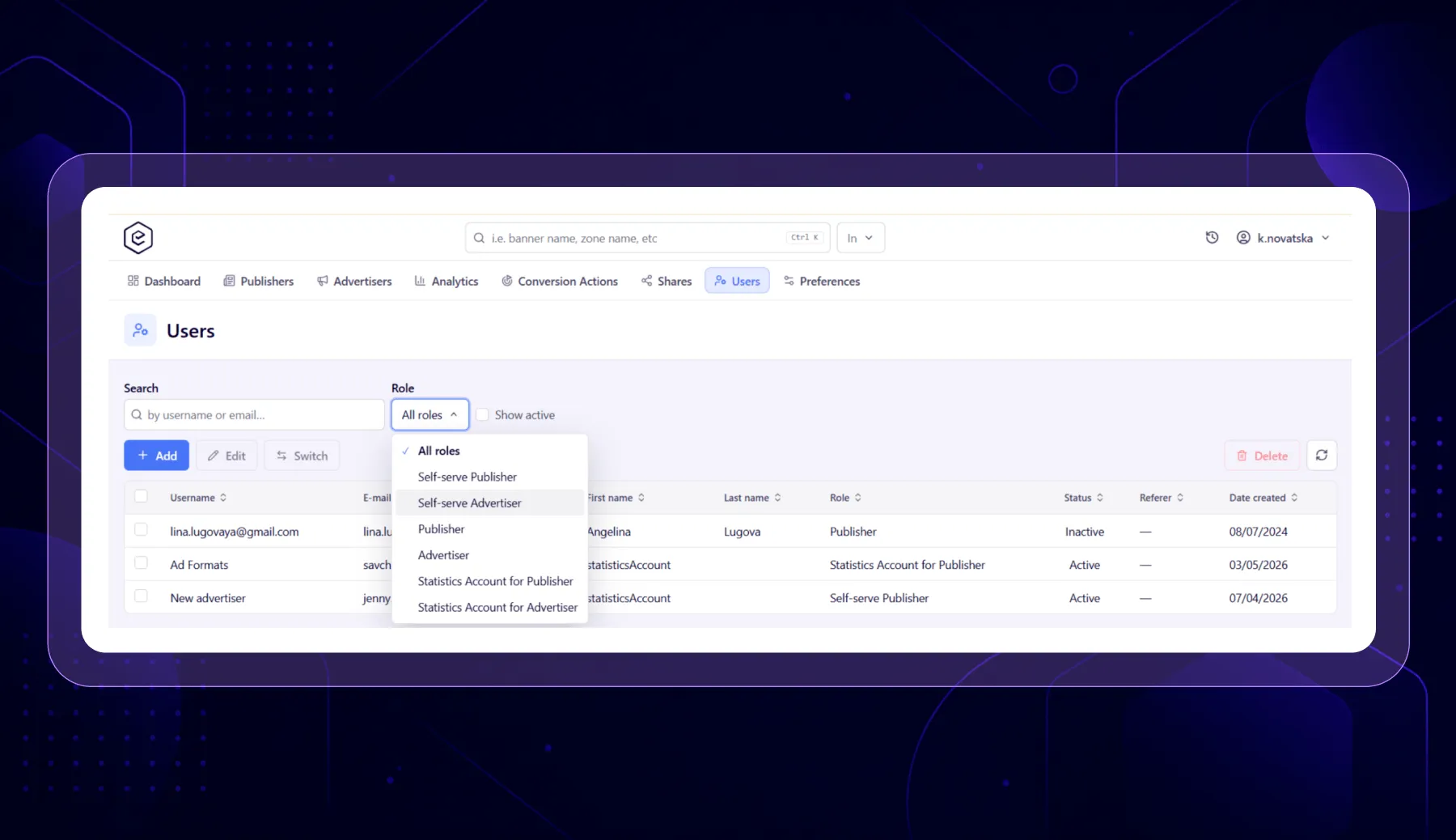
One admin account for you, separate publisher accounts for anyone whose inventory you resell, and separate advertiser accounts for buyers who want to see their own delivery. Internally, your team can share full access; the separation that matters is between you and the outside parties.
Step 2 — Build the inventory
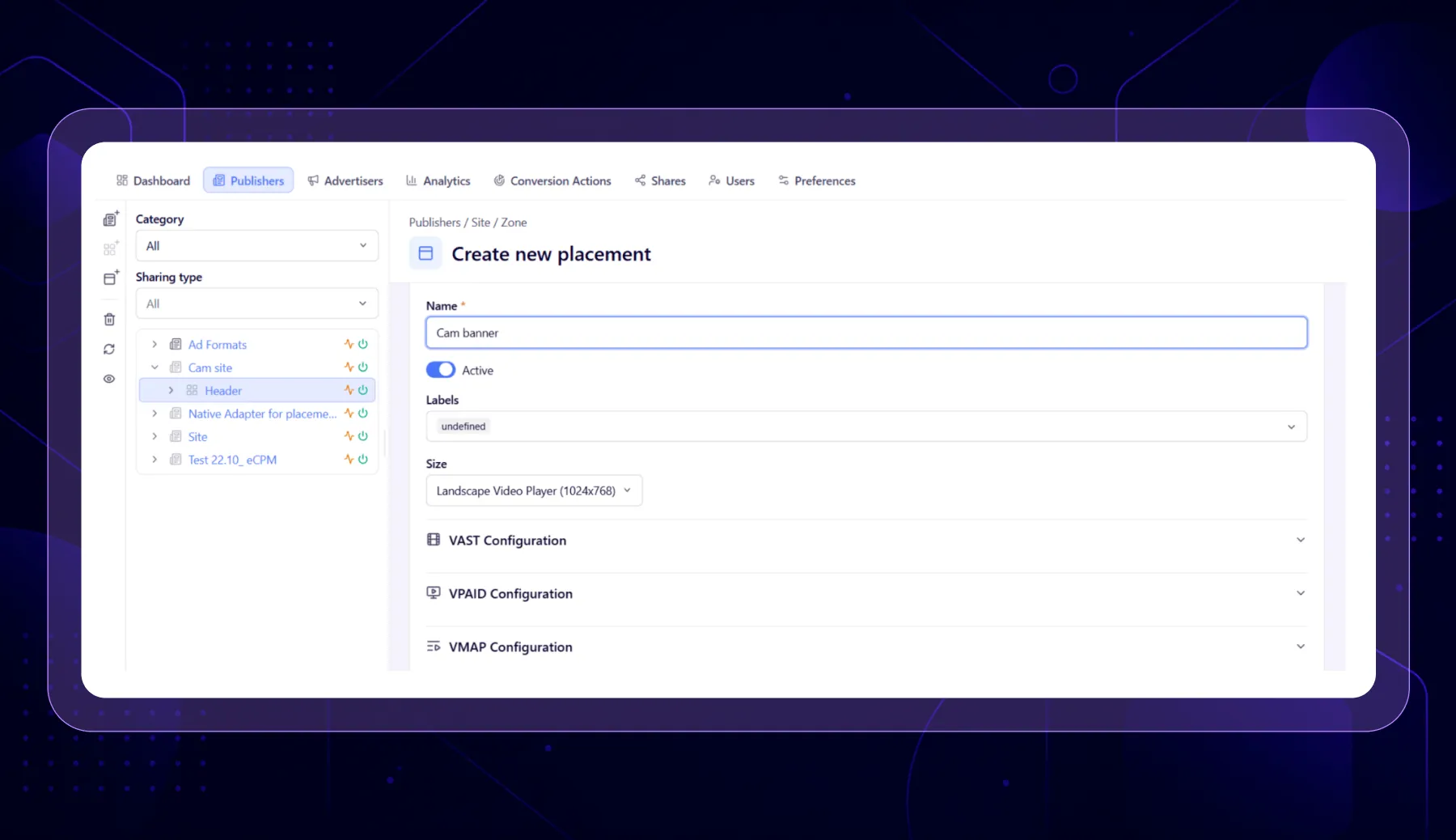
Register your sites, then zones, then placements, and create the ad units for each placement. This is where format decisions become concrete, so the formats section below is worth reading before you build them.
Step 3 — Load your direct demand
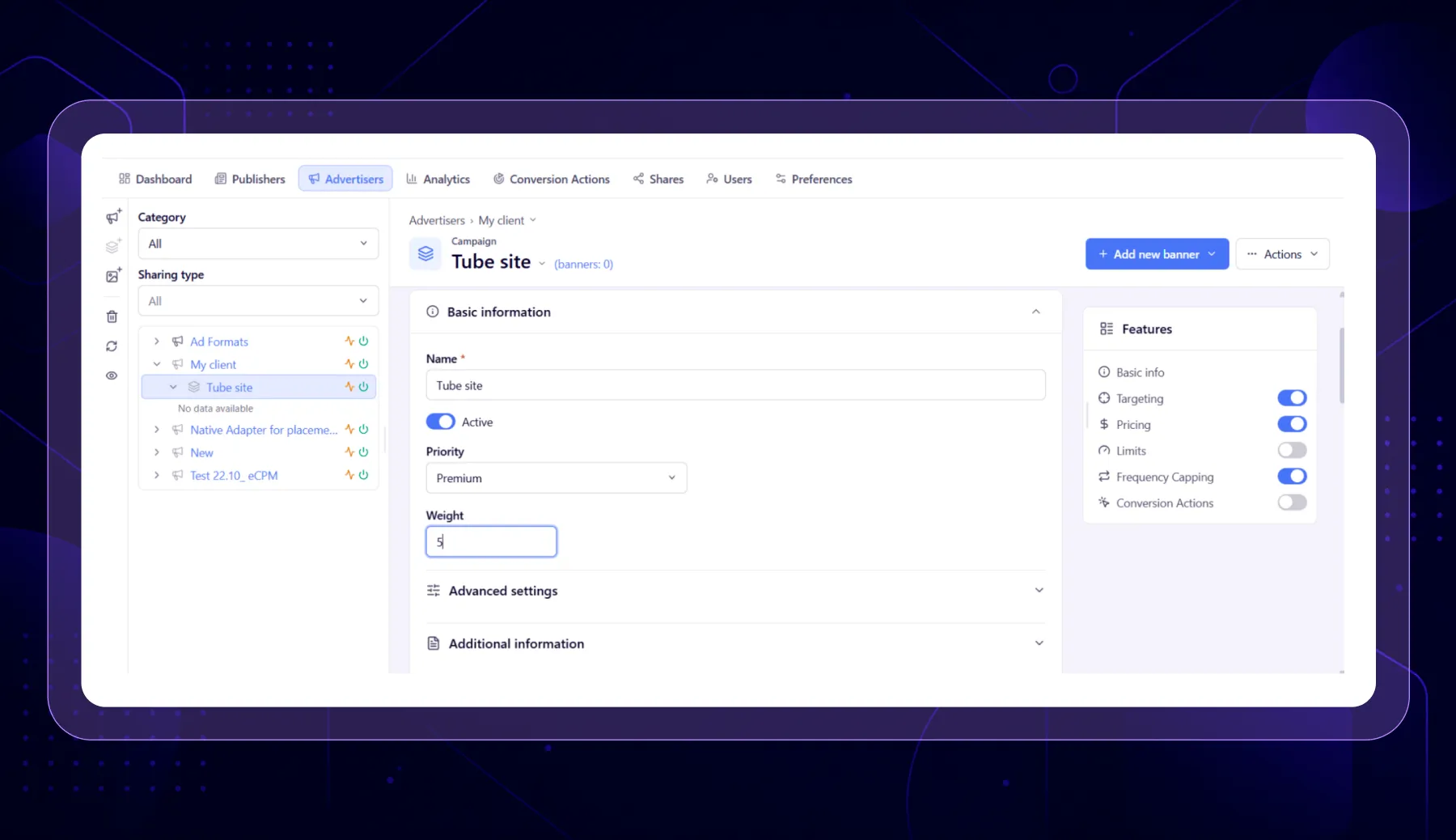
Create a campaign per advertiser, set the frequency cap and budget, and. In Epom Ad Server that is the Premium group, above Standard and Non-guaranteed.
Step 4 — Price by segment
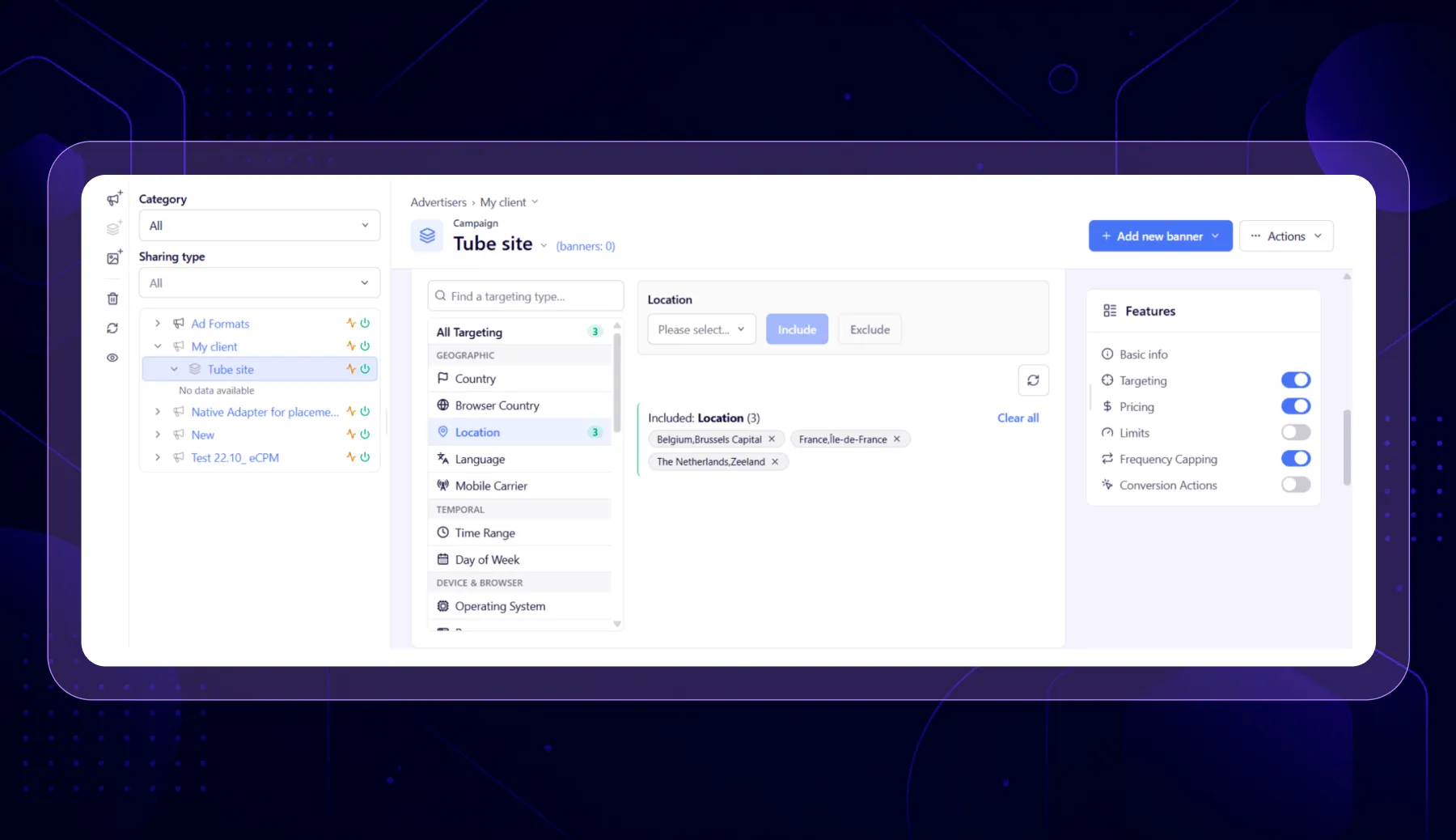
Configure pricing per placement and per campaign rather than one flat rate, using the format, geo, device, and site-tier splits from the pricing section. Support CPM, CPC, and CPA so the demand you can reach isn't limited by your own setup.
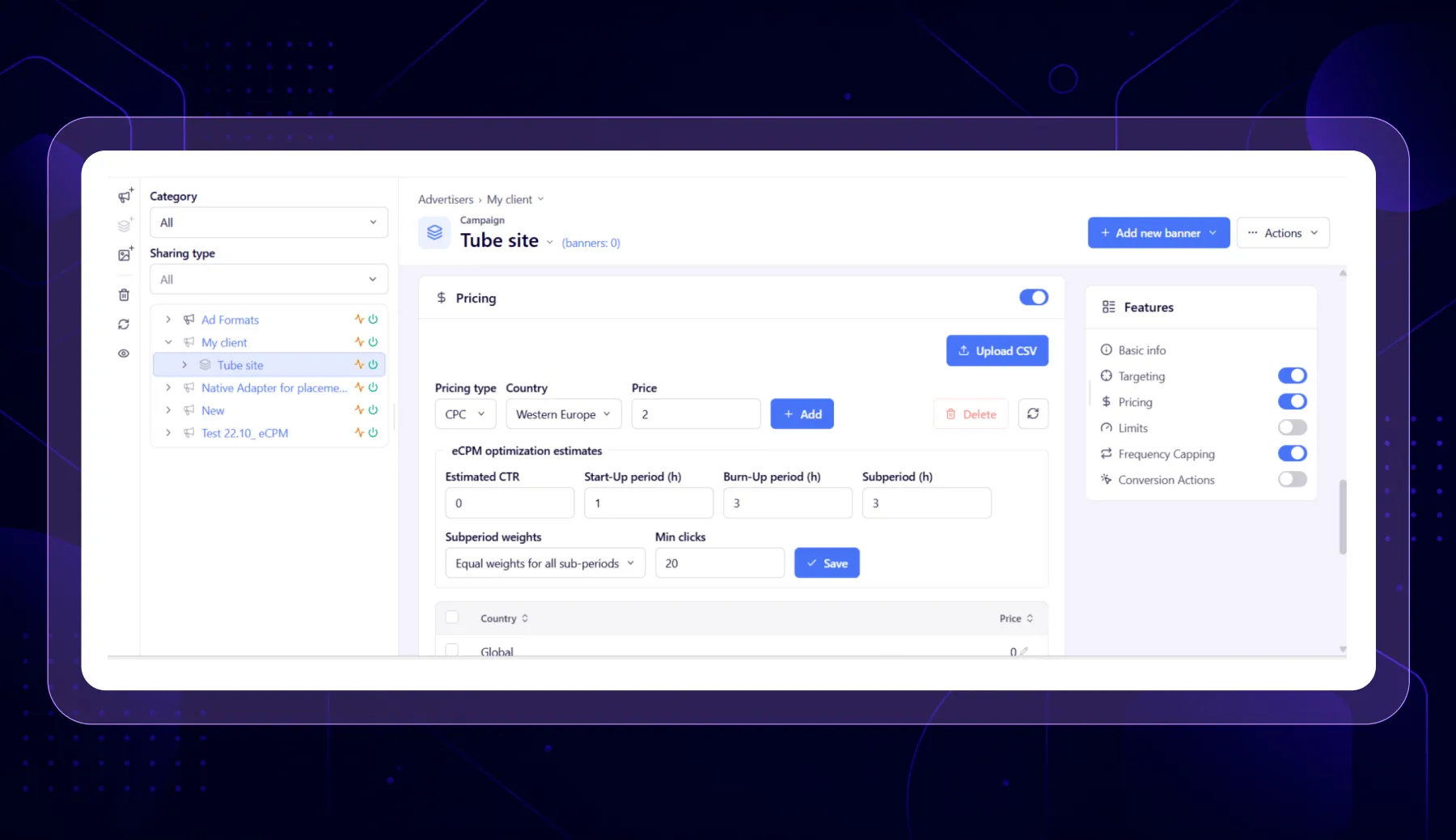
Step 5 — Turn on traffic-quality scoring and reporting.
Either target by risk score to filter up front, or run traffic and read the per-placement report before deciding what to keep. Both are described in the next-but-one section.
Running direct deals and programmatic backfill on the same inventory, without one cannibalizing the other, is entirely possible at Epom. Book a walkthrough of the setup.
Adult Ad Formats That Convert, and Why
Popunders, native widgets, interstitials, and VAST video dominate here, and the reasons matter more than the list.
| Format | Why it works on adult inventory | What to watch |
|---|---|---|
| Popunder | Direct-response format for an audience that came looking for something specific | Burns out users faster than anything else — cap per user and pace delivery |
| Native thumbnail grid | Sits inside the grid the user is already scanning, so it doesn't get skipped like a banner | Creative has to match the site's own thumbnail style to work |
| VAST video | Highest rates of the standard formats, especially on well-known sites | Same player and spec requirements as mainstream video |
| Interstitial | Full-screen attention between page views | Frequency decides whether the user stays on the site |
| Standard display | Easy to fill and reliable as backfill | Lowest rate — use it to hold fill rate rather than to earn |
Adult Video Runs on the Same VAST Standards as Mainstream Video
The formats use the same VAST and VPAID standards and the same player requirements, so a server that handles mainstream video handles this too.
Why Aggressive Formats Work Here and Not in Mainstream
This is direct-intent traffic. The user came looking for something specific and tolerates a level of ad aggression that would drive a mainstream audience away.
“In mainstream you can't run a format that aggressive — you would get banned. Here, the more aggressive it is, the better it works. The only real question is how much of it people will tolerate for the content.”
That makes intensity, rather than format choice, the actual optimization lever. Test how much a given audience absorbs before it leaves, then set the ceiling just under it.
Frequency Capping Is What Keeps Aggressive Formats Working
Popunders burn out a user quickly. Cap impressions per user and pace delivery evenly across the day instead of front-loading a campaign, or you lose both the user and the publisher relationship built on that traffic.
💡 Pro Tip: Because adult traffic is highly direct-intent, intensity — rather than format choice — is your actual optimization lever. Test how many aggressive formats (like popunders) an audience absorbs before bouncing, set frequency caps per user, and pace delivery evenly across the day to prevent audience burnout.
Native Thumbnail Grids Outperform Standard Display
These are ad units styled to look like more content thumbnails inside the grid the user is already browsing, with the same thumbnail shape and caption placement, where the click goes to the advertiser instead of to another video. Because they match the surrounding content rather than interrupting it, they win in exactly the placements where an obvious banner gets ignored.
Running It: Fraud, Discrepancy, and Compliance
Traffic quality issues run higher in this vertical than in most, which is why fraud detection and prevention belongs in the initial configuration and needs to answer three separate questions.
Is the request real? In Epom, for example, every incoming ad request gets scored against known fraud patterns before it counts as an impression. The signals include:
- Datacenter and known-bot IP ranges, updated continuously
- Time zone that doesn't match the claimed geo
- Repeated requests from one IP inside a few minutes
- Mismatched or outdated user-agent and browser versions
- Non-standard interaction patterns
“Fraud is not one problem. It's twenty-five.”

In Epom that means 25 individually tracked fraud categories carrying a risk score, with reporting rather than silent rejection. You can target by risk score to filter up front, or run the traffic and read the per-placement report afterwards, where yesterday's delivery might score 30% risky on one placement and 70% on another, with the reason attached to each.
Then you decide which publishers to keep, which is the practical difference between scoring and a filter you can't inspect.
Do the patterns look right, even when individual requests do? A coordinated bot network rarely trips a per-request rule, and what gives it away is the aggregate pattern across a placement over time, which needs a separate layer of analysis from the request-level check.
Is the creative itself safe? This matters once you connect outside demand, because a creative arriving through a third-party connection can serve your users without you ever reviewing it, a gap the industry has built entire products to close.
Scanning creatives before they win a placement, with the second-place bid filling in when one gets blocked, is what makes it safe to keep adding demand sources.
“Every DSP partner you add brings more demand, but also more exposure. Our new anti-fraud stack means you can grow your DSP list without increasing risk.”
Discrepancy Is Never Zero
Volume, formats, and discrepancy are the three subjects adult operators raise during a platform evaluation, and the first thing to accept about the third one is that zero discrepancy is a red flag rather than a target.
💡 Pro Tip: Zero discrepancy is a red flag rather than a target. If your numbers match perfectly, one side is likely spoofing data.
What actually narrows the gap:
- Cut redirect hops, since every additional redirect between the request and the creative is another place to lose an impression.
- Check when each side counts. Your server and the demand partner may fire the impression at different points in the load sequence, and that difference alone explains a large share of most gaps.
- Align time zones, because two reports covering different day boundaries will never reconcile however clean the delivery is.
- Compare by geo and browser, which shows whether the gap is spread evenly or concentrated in one source, turning a vague complaint into a fixable one.
Compliance and Payment Risk Land on Your Side
Age verification is a publisher responsibility rather than an ad server function. No server can confirm a user's age, or whether they agreed to have their data processed — what it receives is an ad request. The 18+ notice most adult sites show is a deterrent: the page loads either way, the request fires, and the user's answer never reaches the server.
💡 Pro tip: Keep the age gate and the consent notice on the publisher side where regulators look for them.
This matters more when you run your own network on your own traffic, because both roles are yours. The obligation stays with the site, and sometimes the site is you. Keep the age gate and the consent notice on the publisher side where regulators look for them, capture consent through your own CMP, and don't assume the ad server covers either. Requirements vary by jurisdiction, and the geos you choose to serve decide which ones apply to you.
Creative moderation is the part you fully control. Review what serves on your inventory before it serves, particularly anything arriving through a third-party connection.
What Adult Ad Network Success Looks Like at Scale
An adult tube group started on Epom's entry-tier package during a two-week trial in 2019, with its own inventory, its own direct advertisers, and its own pricing.
Seven years later it is still on the same platform, serving 8 to 12 billion impressions a month across display and video, running direct advertisers and third-party demand side by side, and selling on both CPM and CPA. There was no migration in between.
That last detail is the point of the six steps above. Direct campaigns priced per segment, programmatic demand stacked underneath, mixed CPM and CPA pricing — this is what the largest accounts in the vertical actually run, and it scales from an entry package to billions of impressions without a platform change.
At the other end of the range, a small adult site runs on the same infrastructure at a few million impressions a month with no dedicated ad ops hire.