

TL;DR:
- A gambling ad network buys ad inventory from publishers and sells it to casino and sportsbook advertisers, keeping the margin. Building one means licensing the ad server and owning the commercial side.
- Two capabilities decide whether an ad server fits: geo enforcement and multi-event conversion tracking. It has to refuse to serve outside licensed markets, and price registration and deposit as separate paid events.
- iGaming demand buys on CPA per deposit, revenue share on net gaming revenue, or a hybrid. Track360 puts hybrids at around 45% of new Tier-1 agreements, usually a $75–150 CPA plus 15–25% revenue share.
- Betting and casino revenue behave differently, and most operators sell both. A sportsbook keeps only 5–8% of handle as gross revenue, which pushes its advertisers toward CPA; casino revenue is steadier and tolerates CPM.
- A build takes 9–18 months before first revenue; a licensed platform takes weeks. Ad serving is rarely what breaks a launch — partner vetting, payment processing, moderation and bonus-abuse fraud cause more damage.
Roughly 80% of the paid inventory a normal consumer brand can buy is closed to a sportsbook, and about 65% is closed to a casino, according to Track360. Google and Meta ban or gate gambling ads in most regulated markets, and ad servers built on Google's policies may refuse the vertical too.
So gambling money moves through affiliates, partners and specialist networks instead. Demand with nowhere else to go is the business case.
There is another reason for that, often overlooked. Gambling marketing runs on sophisticated targeting and retargeting — VIP segments, churned depositors, casino players cross-sold into sportsbooks — and a walled garden is the worst place to do that. Whatever audience you build there stays there, and someone else's policy decides how far you can go with it.
Running your own ad server moves both the data and the decision to your side.
Building an iGaming network or going in-house? Book a demo and see live how the ad server with interactive ad templates and multi-action tracking would work for you.
What Is a Gambling Ad Network?
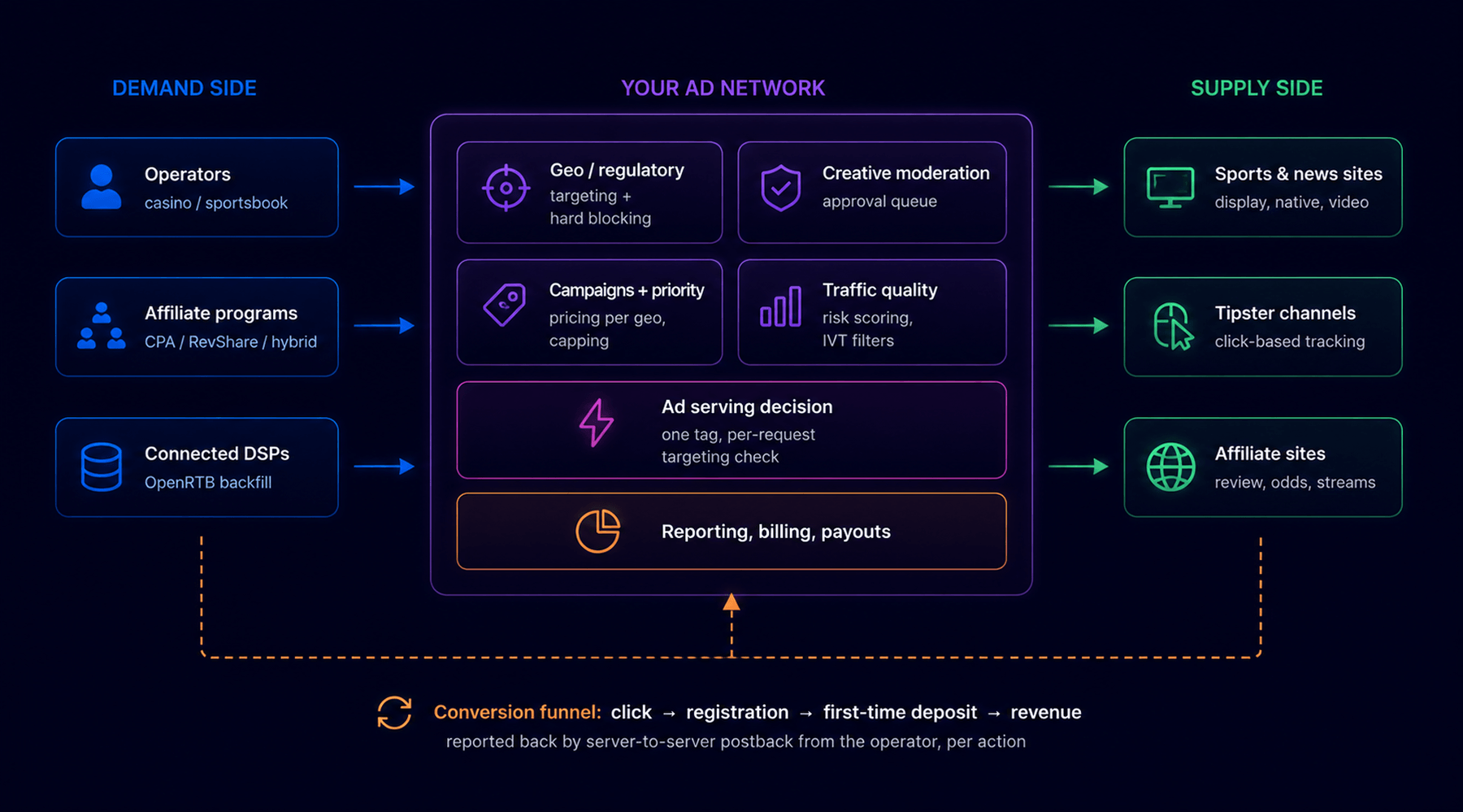
A gambling ad network buys ad inventory from publishers and resells it to casino, sportsbook and affiliate advertisers. The network keeps the margin.
The model matches any ad network. One thing is different: where an ad serves decides whether it is legal, not only whether it performs.
Three kinds of companies might want to build one, for three different reasons.
- An affiliate business moves from middleman to inventory owner. Instead of passing traffic through a tracker for a CPA, you manage publisher inventory directly, sell it on CPM, CPC or CPA, and set your own pricing.
- An ad network delivers what operators struggle to buy anywhere else: relevant converting traffic from publishers already in the vertical, at scale, in formats the walled gardens don't offer.
- A betting or casino operator creates an in-house direct network. Full ops and data ownership, no intermediary markup on every impression, direct relationships with the publishers that actually acquire players, and one place to see what brings users in.
All three get the same protection: white-label technology serves what you decide to serve, so a rule change at Google no longer resets your roadmap. Epom supports all three, with dedicated features for sportsbook and iGaming operators.
How a Gambling Ad Network Makes Money
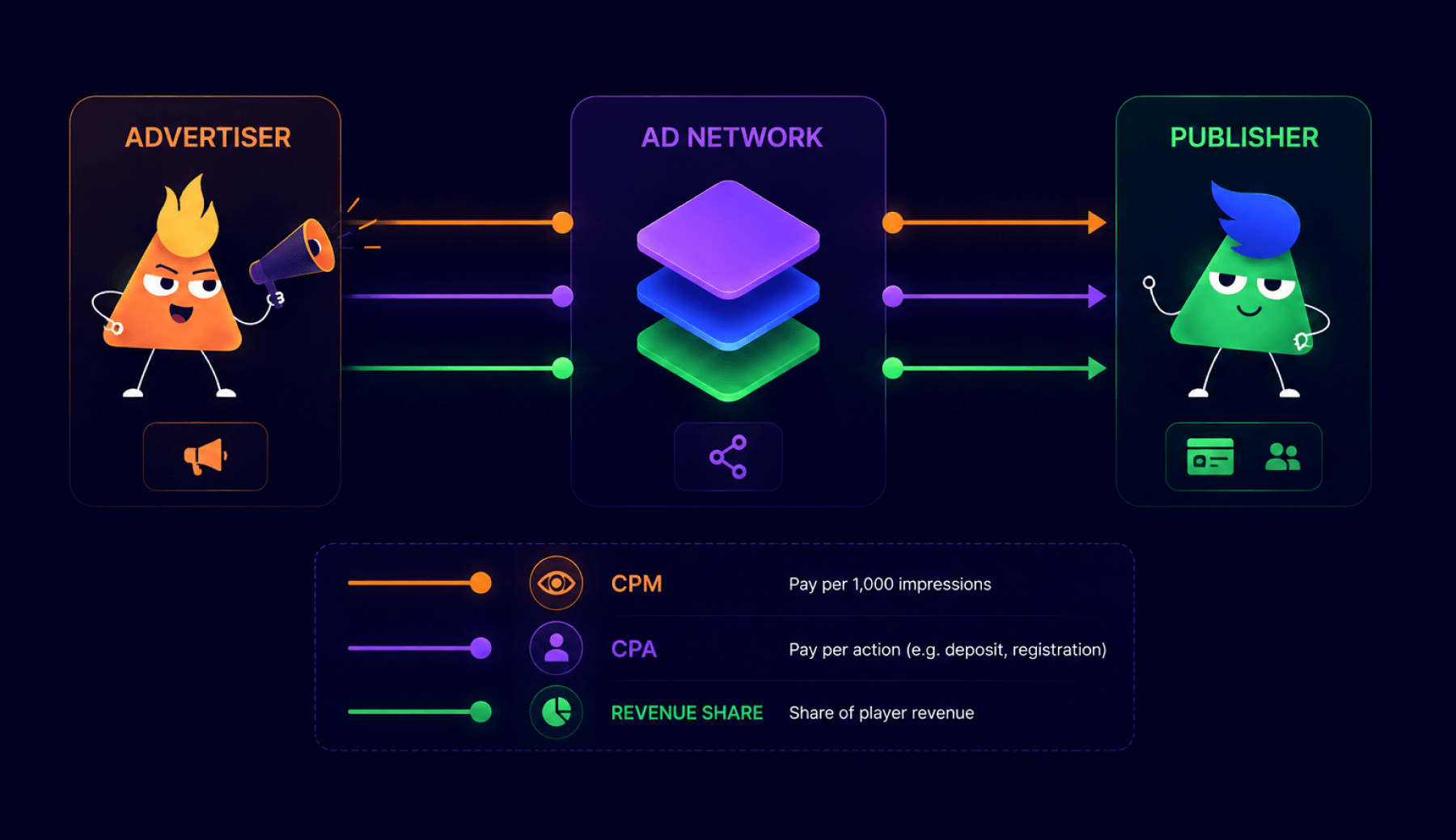
The business is simple: you buy ad inventory from publishers, sell it to gambling advertisers, and keep the difference between the two.
What makes this vertical different is that both sides of that gap can be priced two ways. Which combination you pick decides how much risk you are carrying, and that is worth understanding before you sign anything. Let's look closer.
How Advertisers Pay You
Two kinds of demand, and you will probably end up running both.
- Media deals. An operator or its agency buys impressions or clicks on your inventory. You get paid on delivery, at the CPM, CPC or CPA you agreed, whether or not anybody deposits that week. This is the predictable side of the business and the easiest to forecast.
- Offer deals. You run an operator's affiliate offer across your inventory and get paid for the players it produces — CPA per first-time deposit, revenue share, or a mix of the two.
If you are arriving from affiliate marketing, the second one will look familiar, because it is what you already do. The difference is that you now own the inventory the offer runs on, so the same placement can also be sold on CPM to an advertiser who simply wants to reach.
How You Pay Publishers
Two shapes here as well, and they move the risk to different sides.
- Revenue share with the publisher. They take an agreed cut of what their inventory actually earns, so anything you fail to sell costs you nothing.
- Fixed rate per thousand impressions. You owe the publisher whether or not the inventory earned, which is usually cheaper per impression precisely because you are carrying that risk.
On CPA demand, most networks pass a share of the CPA down rather than paying a CPM. It keeps both sides exposed to the same traffic quality, which tends to make the conversation about publisher quality much easier.
Where Your Margin Comes From
Put the two sides together and four combinations appear. The last column is the one to read carefully.
| You pay publishers | Advertisers pay you | Your margin | Who carries the risk |
|---|---|---|---|
| Fixed CPM | CPM or CPC | Fixed spread per thousand | Low — both sides are known before delivery |
| Revenue share | CPM or CPC | A percentage of billings | Low, and the publisher shares any downside |
| Fixed CPM | CPA or revenue share | Whatever players produce, minus what you owed | Highest — you pay for impressions whether or not anyone deposits |
| Revenue share | CPA or revenue share | Shared upside and downside | Split with the publisher |
The third row is where new networks tend to lose money. You commit to a fixed inventory cost and get paid only on deposits, so a fortnight of poor conversion is a fortnight of paying for traffic that earned nothing.
It is also the most profitable row when the traffic works, which is exactly why it keeps attracting people. Just go in with your eyes open, and ideally not on your first month of volume.
Offer Deal Terms Worth Reading Twice
If you take operator offers, three structures dominate. These come from the operator's affiliate program rather than from a media plan — so if you are an operator going in-house, this is the side of the table you will be negotiating against.
| Model | You get paid | Typical range | Who risks | Suits |
|---|---|---|---|---|
| CPA per first-time deposit | Once, when a referred player deposits and qualifies | Casino Tier-1 $150–400, premium up to €650; sportsbook $50–200 | The operator, who pays before the player proves profitable | New partners, unproven traffic, short campaigns |
| Revenue share | Monthly, as a share of what the player loses | 25–45% standard, 55%+ for top partners; median near 32% per Scaleo | You, since you earn nothing until players monetize | Quality traffic, long player lifetimes, patient cashflow |
| Hybrid | Once on deposit, then monthly | Around $75–150 CPA plus 15–25% NGR | Split between both sides | Most Tier-1 deals — roughly 45% of new agreements |
Two clauses matter as much as the rate itself.
- The qualification gate. A $250 CPA with a $20 minimum deposit is a different product from the same fee with a $50 deposit plus wagering. Pin down deposit size, KYC status and any wagering requirement before you sign.
- The NGR definition. Every operator deducts differently — bonuses, payment fees, taxes, jackpot contributions — so $10,000 gross can reach you as $8,000 net, and a 35% share pays $2,800 instead of $3,500.
💡 Pro Tip: Always demand the exact NGR mathematical formula, not just the percentage, before signing an offer.
- Hold back for reversals. Operators claw back CPAs when a player turns out to be a bonus abuser or a fraudulent signup, sometimes weeks after you have already paid your publisher. Retain a percentage of publisher payouts until the operator's reversal window closes, and get that window written into both contracts.
The breakeven number is the one worth arguing over. Divide the CPA by monthly NGR times your revenue share, and you get the number of months a player has to last before revenue share pays better than the one-off fee. Below that, take the CPA.
What You Need to Start a Gambling Ad Network
A network needs demand it can sell to. An operator going independent already owns the demand and needs everything else. Here are the basics either way:
- Demand access. Relationships with operators. This is a closed ecosystem, and most people who build here arrive from inside it.
- Supply that already runs the vertical. Persuading a site that has never carried gambling to start is close to impossible; compete on terms with publishers already running on the fit sites.
- A jurisdiction policy. Define which markets you will serve, and on whose licence, so you are not discovering a country's rules after the fact.
- Ad serving infrastructure. A gambling ad server handles campaigns, targeting, conversion tracking, accounts and reporting — the part you license rather than build.
What an iGaming Ad Server Has to Do
This list comes from Epom’s own gambling and betting accounts — the things that decide whether a network's platform holds up once real volume arrives, rather than a generic feature checklist. Two of the seven matter more than the rest.
1. Targeting as Geo Enforcement
In mainstream advertising, geo targeting improves performance. Here it keeps you legal, so it has to hold on each request rather than in a media plan.
What to look for:
- country targeting, then location down to region and city;
- include and exclude rules on every parameter;
- IP-range upload for licensed operator ranges;
- verification against a maintained IP database;
- domain targeting, so a tag passed to an unapproved site stops working rather than serving.
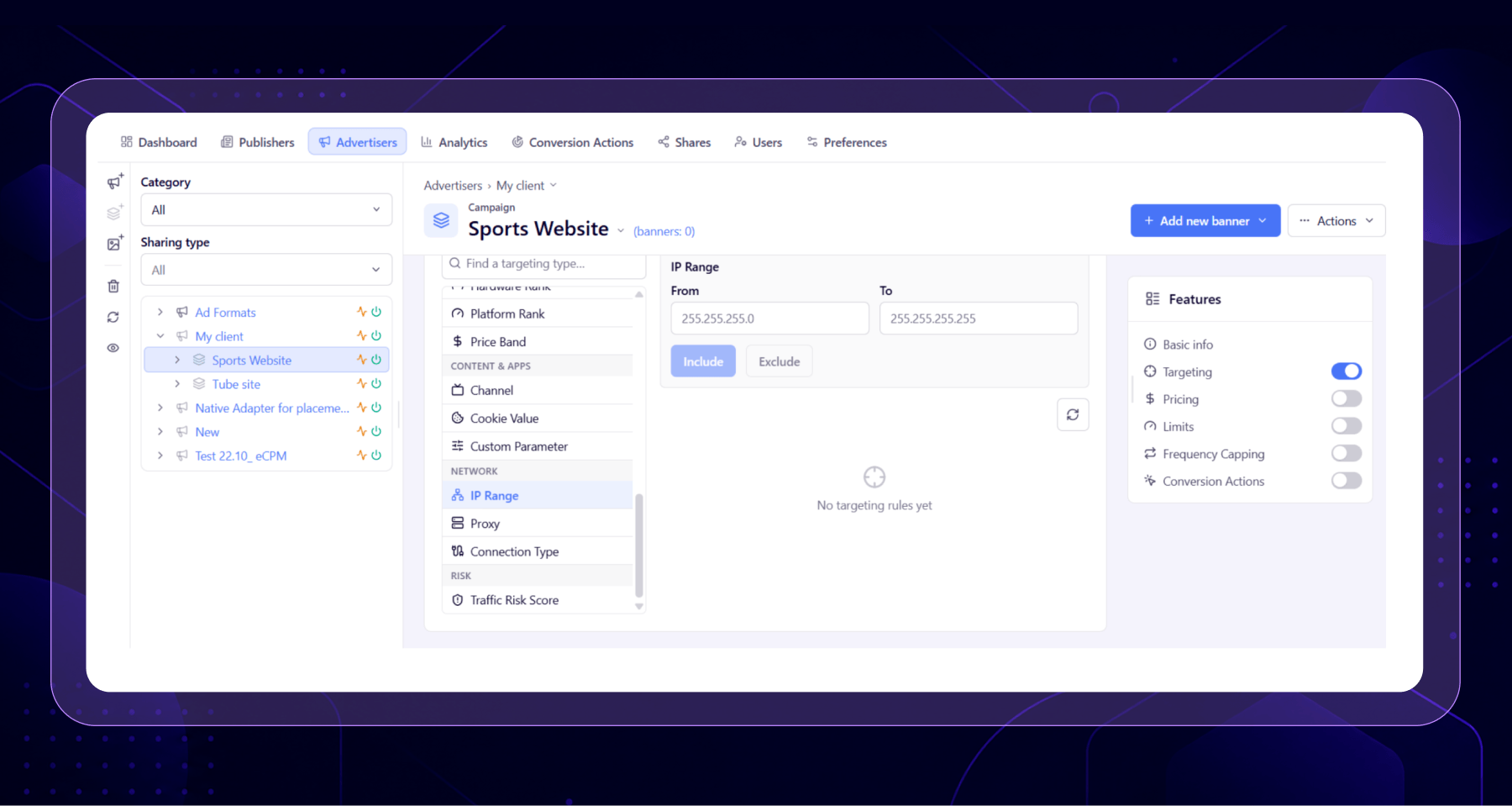
💡 One caveat for your policy: IP-based geo can be defeated with a VPN, and a spoofed location here is a legal problem rather than a wasted impression. Pair the rules with risk signals that catch the mismatch — a time zone that disagrees with the claimed country is the cheapest and most reliable.
2. Multi-Event Conversion Tracking With Per-Action Pricing
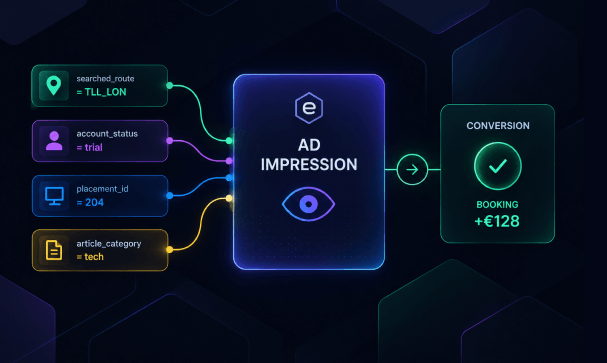
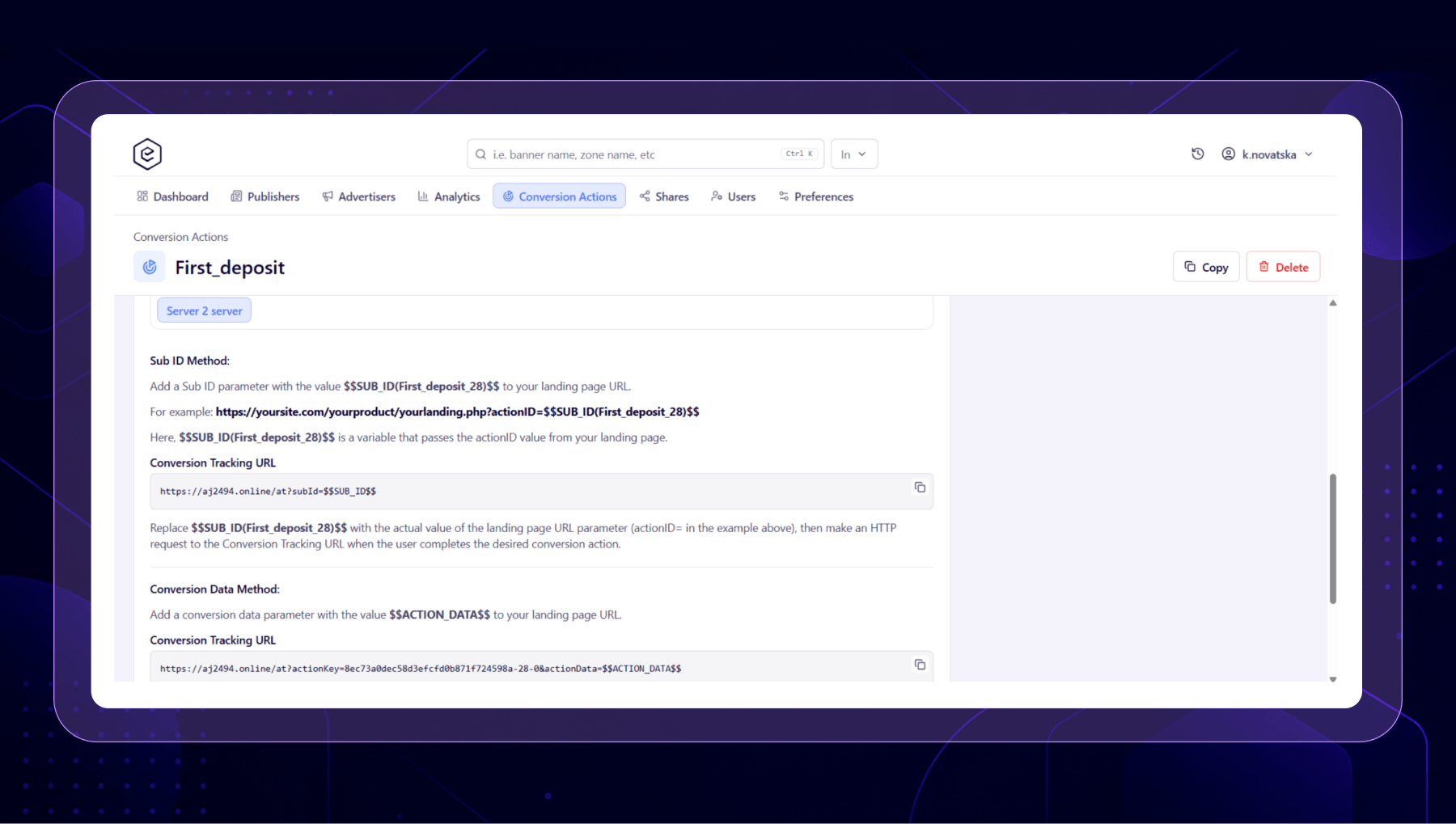
Gambling pays across click, registration, first-time deposit and revenue, and each step needs its own price and its own report.
What to look for:
- named conversion actions rather than one global conversion;
- separate conversion windows per action;
- CPA pricing per action and country;
- server-to-server postbacks;
- per-action notifications so an advertiser's own tracker fires on the same event.
Want to see all of this in the interface rather than on a list? Register a free demo account and click through the geo rules, conversion actions and risk thresholds yourself.
3. Creative Moderation and Categories
Licence references and age statements vary by market, which makes an approval queue a compliance control rather than an administrative one.
What to look for:
- creatives held pending review before serving;
- obligatory fields defined per network;
- category management so restricted advertisers cannot reach unsuitable inventory;
- a permission that pulls a banner from rotation when a moderated field changes after approval.
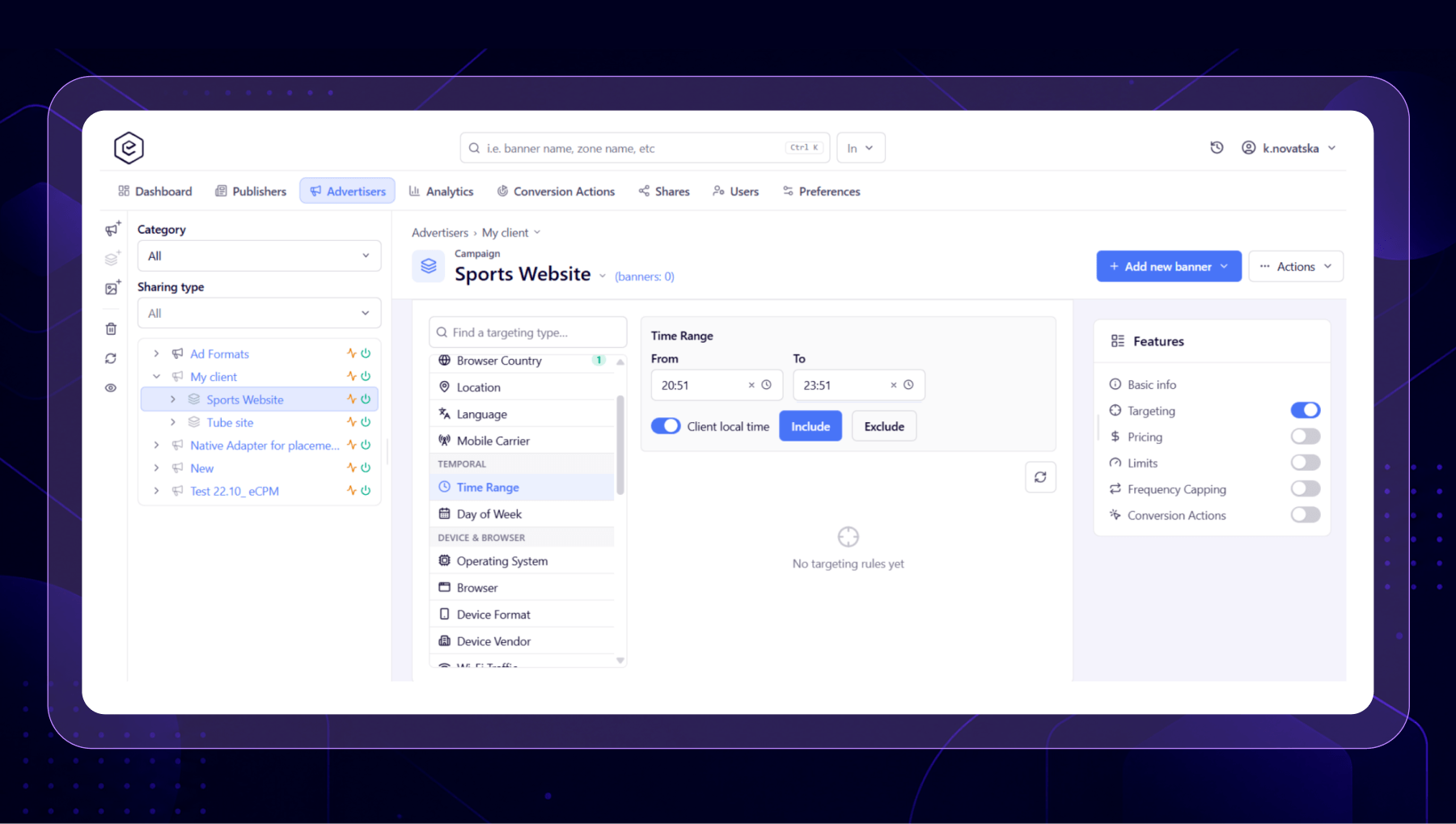
4. Dayparting and Scheduling
Betting demand is event-shaped: a campaign for a Saturday fixture should not spend evenly across Wednesday.
What to look for:
- time-range and day-of-week targeting, evaluated in the user's local time rather than the server's.
5. Capping, Device Targeting and Per-Geo Pricing
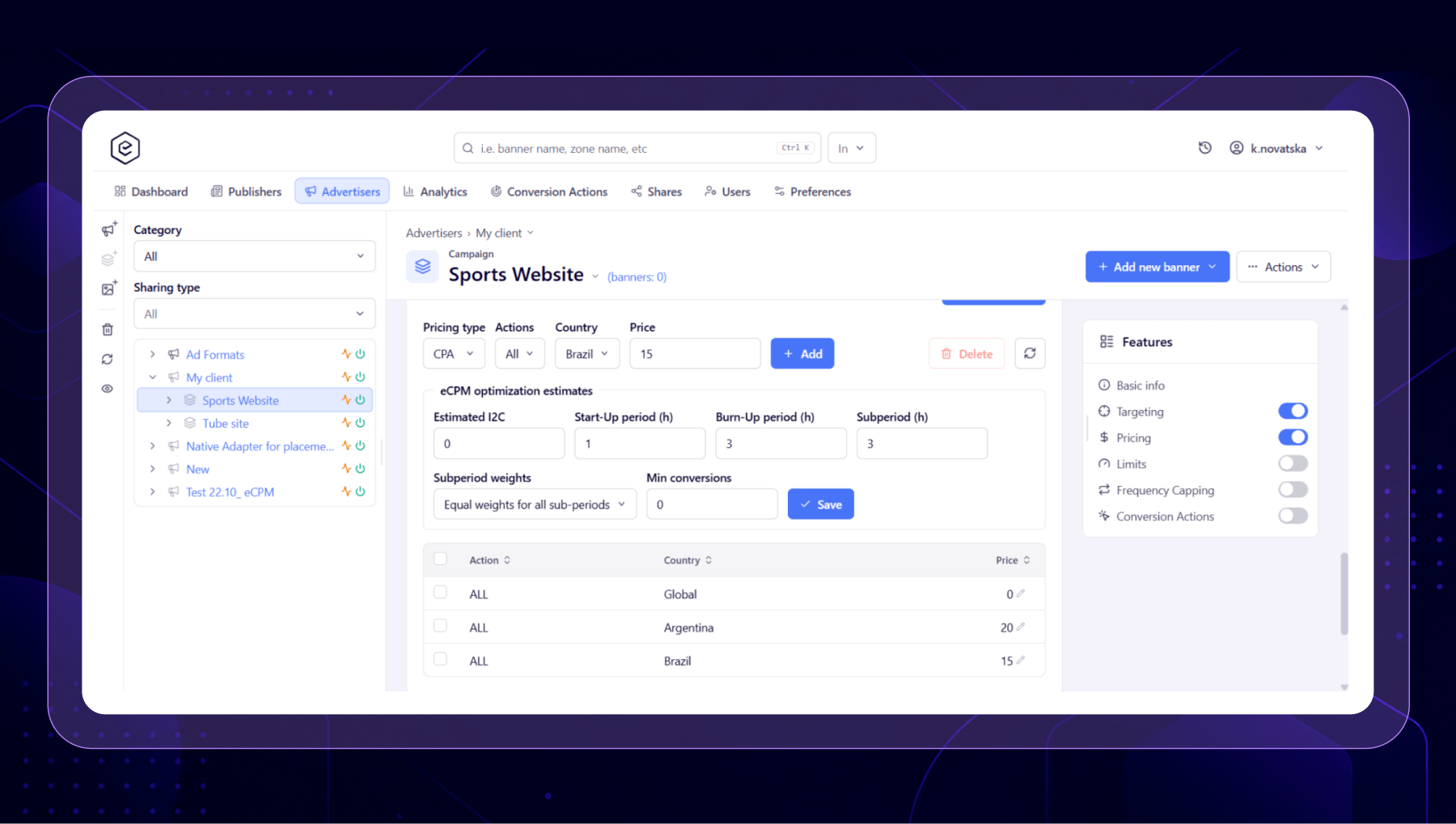
Betting traffic skews mobile and rates differ by market.
What to look for:
- frequency capping per user;
- targeting on device type, OS, browser and carrier;
- pricing set per country rather than one global rate.
6. Ad Fraud Filtering and Traffic Quality
The fraud that costs you here arrives looking like a successful conversion rather than a wasted impression. A bonus abuser and a bot signup pass the same checks a real player does, which is why generic invalid-traffic filtering catches so little of it.
Look for filtering at two points.
Before the ad serves: a risk score on each request, with a threshold you set per advertiser, campaign or banner. In Epom that scale runs 0–100 — accept everything at 0, reject suspicious traffic at 65, reject high-risk at 80 — so you can tighten it for one demanding advertiser without throttling the whole network.
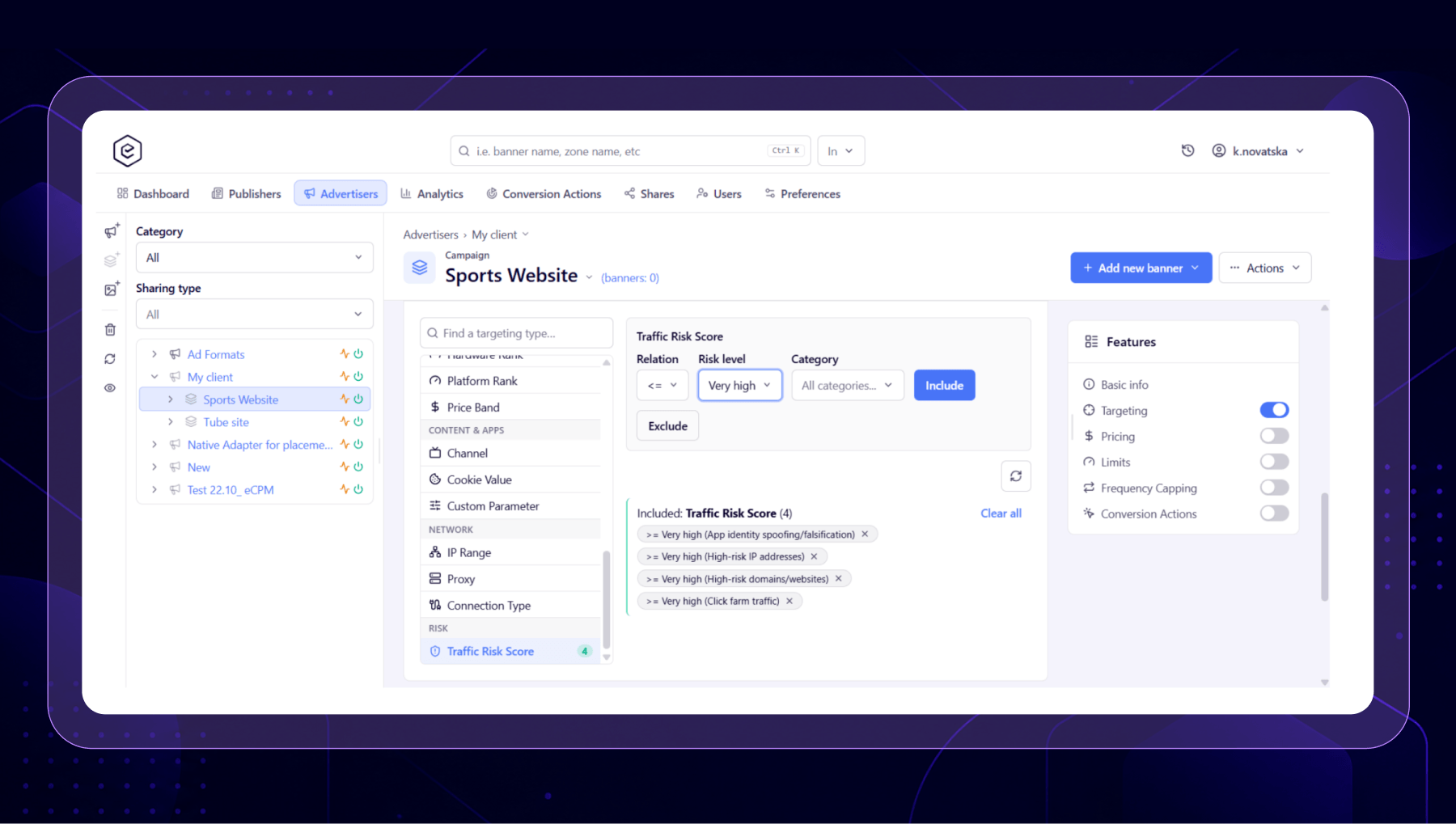
After delivery: per-IP conversion limits to catch repeated qualifying events from one place, IP and user-agent blocklists, and a report that explains why traffic scored as it did, so you can take the evidence to the publisher rather than an accusation.
7. Headroom for In-Play Spikes
Betting traffic does not ramp, it jumps, and a platform that copes with your monthly average may not cope with the ninety seconds after a red card.
Ask how the platform handles a spike, and listen for four things:
- serving nodes you can add as traffic grows;
- targeting checks that run from memory instead of the database;
- impression logging that writes in the background rather than blocking the ad call;
- frequency counters shared across nodes so caps stay accurate when volume jumps.
Then ask what it has actually handled. Good architecture gives you headroom, but the real ceiling depends on how the deployment is sized.
Build vs White-Label, and Who Owns Your Data
This is the decision that sets your launch date.
Building means an engineering team writing an ad server, a targeting engine, a conversion tracker and a reporting stack, then maintaining all four while regulations keep moving.
Licensing means configuring someone else's and spending your time on demand instead.
Custom development on a vendor platform is in-between, and suits teams with genuinely unusual requirements rather than a general preference for control.
| Build from scratch | Custom development | White-label ad server | |
|---|---|---|---|
| Time to launch | 9–18 months | 2–4 months | Weeks |
| Upfront cost | Engineering team, infrastructure, QA | Project fees plus platform | Monthly licence |
| Ongoing cost | Salaries, hosting, on-call | Platform fee plus change requests | Platform fee, priced per impression |
| Maintenance | Yours, including fraud rules and formats | Shared | Vendor's |
| Customization | Unlimited | High | Configuration plus API |
| Regulated-vertical fit | You build geo and moderation controls | Depends on the base platform | Confirm the vertical in writing |
Ad serving is not where a network competes. Your commercial terms, partner quality and market access are the criteria. Ad networks moving onto a white-label ad server report up to 35% lower operational costs, and Epom's own ad network accounts stay an average of 4.5 years.
💡 Routing note for operators: an ad server sells your inventory programmatically but does not buy on RTB for you. Buying traffic via RTB for your own brand needs a demand-side platform alongside the server.
On data ownership. In a regulated vertical your advertiser list, publisher terms and conversion data are the business. Ask what the vendor does with them and seal the agreement with the contract. Log-level access or an ad server API helps you to export all your data anytime and feed it back into your BI tools.
Not sure which side of the build-versus-buy line you fall on? Talk to us about your launch requirements — and we advise you on the next move.
Migrating From a Tracker, an Affiliate Platform, or an In-House Build
Most gambling networks do not start on an ad server. They start on whatever solved their first problem, which is usually attribution, and then outgrow it.
| Coming from | What it does well | Where it stops | What triggers the move |
|---|---|---|---|
| Tracker (Keitaro, Voluum) | Click and conversion measurement, traffic distribution | No ad tag generation, no sub-accounts, no creative moderation, no client access | You want to control ad tags on placements, have all reporting in one place or give clients self-serve access |
| Affiliate platform | Partner payouts and postbacks | Inventory side stays manual; you cannot sell placements through it | You start buying inventory rather than only referring traffic |
| In-house build | Exactly what you specified two years ago | New formats and targeting need engineering nobody has time for | A complex ad format you cannot launch, or your platform shows ad latency with the growing traffic volumes |
| Mainstream ad server (GAM and similar) | Scale and integrations | Restricts the vertical, sometimes after onboarding | Certification revoked, formats blocked, or a policy change you did not choose |
What Usually Breaks During a Migration
Four things, and only the first is technical work on your side.
- Postback URLs are per-advertiser. Every operator updates the endpoint on its own side, which turns a technical migration into a set of commercial conversations.
- Macro and sub-ID mapping differs between platforms, so publisher reporting breaks quietly unless parameters map one to one. Verify a live click end to end per publisher before switching volume.
- Conversion windows rarely match, so numbers will not reconcile for the first cycle and partners will notice. Agree windows and a reconciliation period in advance.
- Nothing exports cleanly. Geo rules, per-jurisdiction creative sets and approval states get rebuilt rather than imported. Budget for it.
The approach that works is a parallel run: keep the old system measuring while a share of traffic moves, compare both sets of numbers on the same days, and cut over per publisher rather than all at once.
Attribution: Why Pixels Fail on First-Time Deposits
The click happens on inventory. The deposit happens inside the operator's product, often days later on another device. A JavaScript pixel tries to bridge that gap from the browser, and four things break it:
- Ad blockers stop the pixel loading, so the conversion never reports.
- Cookies expire before the deposit decision gets made.
- The deposit happens in an app, where there is no browser context to read.
- The journey crosses environments — register in a browser, deposit in the app, and the cookie has nothing to match.
Server-to-server postbacks avoid all four, because they do not depend on the device. The operator stores your click identifier against the player and calls your server when the deposit clears.
How to Structure the Server-to-Server Postback
- Issue a unique click identifier and pass it into the landing URL.
- The operator stores it against the player at registration.
- The operator calls your postback URL when the qualifying event fires, returning the identifier, the event type and ideally the payout.
- Your server matches it to the right action, publisher and placement, and applies the CPA for that market.
Define registration and deposit as separate actions from the start; retrofitting the split means recutting historical reports, and partners will dispute the numbers.
Two settings decide whether your reports reconcile with the operator's.
- Agree conversion windows explicitly, because a deposit three weeks after a click is attributable by your rules and often not by theirs.
- Switch on per-IP conversion limits, since bonus abuse arrives as repeated qualifying events from one place.
Betting & iGaming Ad Formats: What Converts
The gambling creatives that convert best are the ones a user can act inside before they click. What "interactive" means depends on which product you are selling.
- Betting: live odds. A unit showing the current odds for a match in progress beats a static bonus banner, because the odds are the offer. The creative is the product rather than an ad for it.
- Casino: playables. A slot spin or a hand dealt inside the ad unit gets the user playing before they land on the site. By the time they click, they have already tried the thing you are selling.

- personalised bonus offers
- retargeting
- geo-specific offers
- offers built from page context.
Context is the underused one. An example: A reader on a story about a Manchester United transfer sees a unit below the article inviting a bet on United's next match. The page passes a custom parameter into the creative, and it converts better than the same banner served blind.
Retargeting does steady work between events: a returning-player message with a deposit multiplier.
Both interactive formats need an ad server that can serve rich media and pass parameters into the creative at request time. That is where it gets interesting.
Live Odds and Dynamic Creatives Are a Task With an Asterisk
Dynamic HTML5 creatives that pull live odds at request time are the most effective format in betting and the hardest to build. A new network should not start there.
"Ads with live odds built into the creative are historically the best performers for our betting clients. They are also the hardest to build, because the creative has to pull a feed at request time, and you need control over what the creative does to make that work. On mainstream platforms you get per-market certification and creative review instead of that control."

For multi-market campaigns there are two realistic routes on how to build live odds ads.
- A banner per jurisdiction. You produce a separate creative for each market, carrying that market's required wording and licence references, then target each one accordingly. Most operators do exactly this, the same way they make a new banner per language.
- Dynamic HTML5 creatives. One creative that substitutes odds, offers or regulatory text from parameters at request time. Harder to build, cheaper to maintain across many markets.
Either way, creative production stays with you, though rich media templates cover ground before custom development starts. One published data point from Epom client: Adera Agency reported a 35% CTR lift on its iGaming ads after moving to outstream video and skins, alongside 22% better retention.
Want to see what these formats look like running? Browse the live ad gallery for odds-driven units, outstream video and rich media, or see the full format list.
What to Track in the First 90 Days
Eight numbers tell you whether the network is working. Most operators watch three and get surprised by the rest.
- Fill rate by placement, since unsold inventory is the fastest margin leak.
- eCPM by placement and geo, which is what your pricing decisions actually produce.
- Registration-to-deposit rate per publisher — the clearest signal of traffic quality in this vertical.
- CPA reversal rate per publisher and per operator, because it decides your real margin, not the headline rate.
- Risk-score distribution by placement, so quality problems surface before an advertiser raises them.
- Publisher retention, which tells you whether your payouts and payment terms are competitive.
- Advertiser retention, which tells you whether your traffic converts.
- Payment cycle health — days from invoice to cleared funds, on both sides.
Compliance, and What Not to Underestimate
Compliance note. Gambling rules vary by jurisdiction, inventory source and partner type, and they change. Licensing, permitted creative wording, responsible-gambling messaging and age verification are market-specific. Nothing here is legal advice: have your policy reviewed by counsel in every market before launch.
Four things break launches more often than ad serving.
- Partner quality. Know where supply traffic originates, and whether the demand you resell is something the publisher could get direct on better terms.
- Payment operations. Networks here rent payment infrastructure rather than build it, and providers turn over constantly. Expect higher fees, long settlement delays, and processors that disappear mid-cycle. Budget for the churn.
- Internal moderation. Somebody reviews creatives against each market's rules, automated queue or not. Most regimes want the same elements: an age statement, the licence reference, and a responsible-gambling line.
- Fraud that looks like conversion. Fake signups arrive as successful events, which makes them harder to catch than invalid impressions. Risk scoring and conversion-per-IP limits are the defences.
Two Gambling Networks That Scaled
Here are two short stories from the Epom clients running gambling and betting ad networks.
From a tracker to a network
One betting-focused media operation ran on Keitaro, an affiliate tracker. It could measure clicks, but not serve ads, moderate creatives, or give clients self-serve access, so growth stalled where those things start to matter.
It trialled Epom in June 2025, went live in July, has roughly doubled monthly impressions in its latest month, and now resells inventory to its own clients rather than only tracking it.
From a trade-show handshake to 220M impressions
A casino brand's partner operation met Epom at SIGMA in September 2024 and went live within three weeks on a package covering 57 million monthly impressions. Twenty-two months later it serves over 220 million a month, after growing more than fourfold month over month in its latest scaling period, and it moved to a higher plan tier without changing platform.
Ready to run premium player acquisition at the rates you control with your own iGaming ad network?