
TL;DR:
Programmatic campaign optimization is the ongoing process of using real-time performance data to improve how your ad campaigns buy, target, and convert. The most common causes of wasted ad spend are wrong bid prices, untested creatives, and unreviewed traffic sources. Inside Epom WL DSP, you fix these through WinRate analysis, A/B creative testing, source-level blacklisting, bidding rules, and bid modifiers. Conversion tracking is not optional: without it, you cannot connect campaign data to real business outcomes. Machine learning and automation handle the mechanics, but a human still needs to set the strategy, review the data, and make the calls.
"Without data, you're just another person with an opinion." W. Edwards Deming said that decades before programmatic advertising existed. It has never been truer than it is right now.
- According to Statista, global programmatic ad spend reached $640 billion in 2025 and is forecast to approach $800 billion by 2028.
- According to eMarketer, programmatic accounted for nearly 9 in 10 digital display ad dollars worldwide in 2025.
That is an enormous volume of budget moving through automated systems, and most of it is being spent without enough attention to what the performance data is actually saying.
Programmatic campaign optimization is the process of reading that data and acting on it. It is not a one-time setup task. It is an ongoing process: check the numbers, find what is not working, fix it, and check again.
This article covers how to do that inside Epom DSP, from the first bid price check to advanced bidding rules, bid modifiers, and conversion tracking. Whether you are running your first programmatic campaign or trying to improve campaign performance on an existing one, the steps below are directly actionable.
In this article, we're diving into the dynamic universe of ad campaign optimization. We'll unveil what it is, why optimization is a must, and how it can turn your advertising campaigns into ROI-boosting, audience-engaging powerhouses.
Why Is It Important to Optimize Your Ad Campaigns?
Remember this: No campaign works if you launch it and walk away.
Think of it like training. A new gym member sees results early because any effort beats none. But lifting the same weight for a year produces nothing. Campaigns work the same way. The initial setup gets you started. Programmatic campaign optimization is what produces actual results over time.
Here is why ad campaign optimization matters in practice:
- Better return on ad spend. Constant analysis and adjustment keep your budget focused on impressions that convert. Return on ad spend improves because you stop paying for what does not work.
- Lower ad spend. Showing ads to the wrong audience is expensive. Audience targeting based on performance data cuts that waste by moving budget toward segments that respond. This reduces CPC and CPA, making your campaigns cost-effective.
- Improved campaign performance. Refining your creative assets, calls to action, and audience segments lifts CTR and conversion rates over time. Based on Epom observations, campaigns that go through at least two rounds of creative testing in the first week consistently outperform those running a single untested creative.
- Competitive edge. In programmatic advertising, speed of optimization matters. Advertisers who act on performance data faster reach better placements at better prices. Advertising optimization in programmatic is different from other channels because the feedback loop is immediate. You do not wait for a weekly report. You check the data, make a change, and see the result within hours.
- Better audience experience. Ads that are relevant to the person seeing them do not feel like interruptions. Contextual targeting and audience segmentation make that relevance possible. It builds trust rather than eroding it.
Most performance problems in programmatic come from skipping steps, launching without a blacklist, ignoring WinRate, or running one creative. Programmatic strategy optimization means treating each of those steps as non-negotiable.
Ad Campaign Optimization In Epom WL DSP: Essential Steps
Checking the Bid Price and WinRate
If you are asking how to optimize a campaign that is already live, start with two numbers: WinRate and the breakdown by traffic source. Those two data points will tell you where the budget is going and whether it is being spent at the right price.
What is WinRate? Basically, it's the ratio between Bids and Wins, where Bids reflect incoming traffic that matches your targeting, and Wins show your actual impressions gained in the open auction.
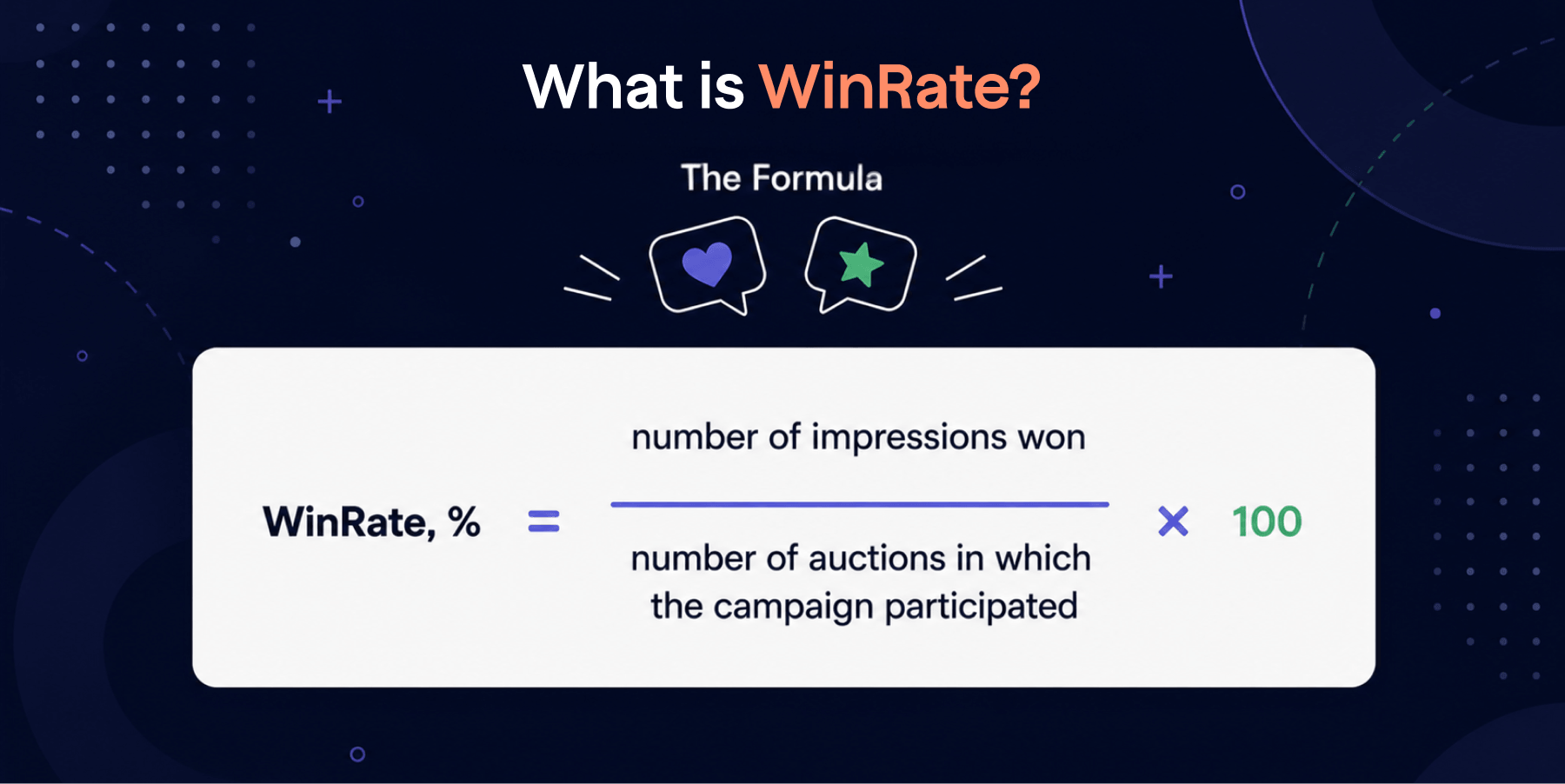
The WinRate metrics can help you to understand if you are buying traffic with the sufficient Bid Rate:
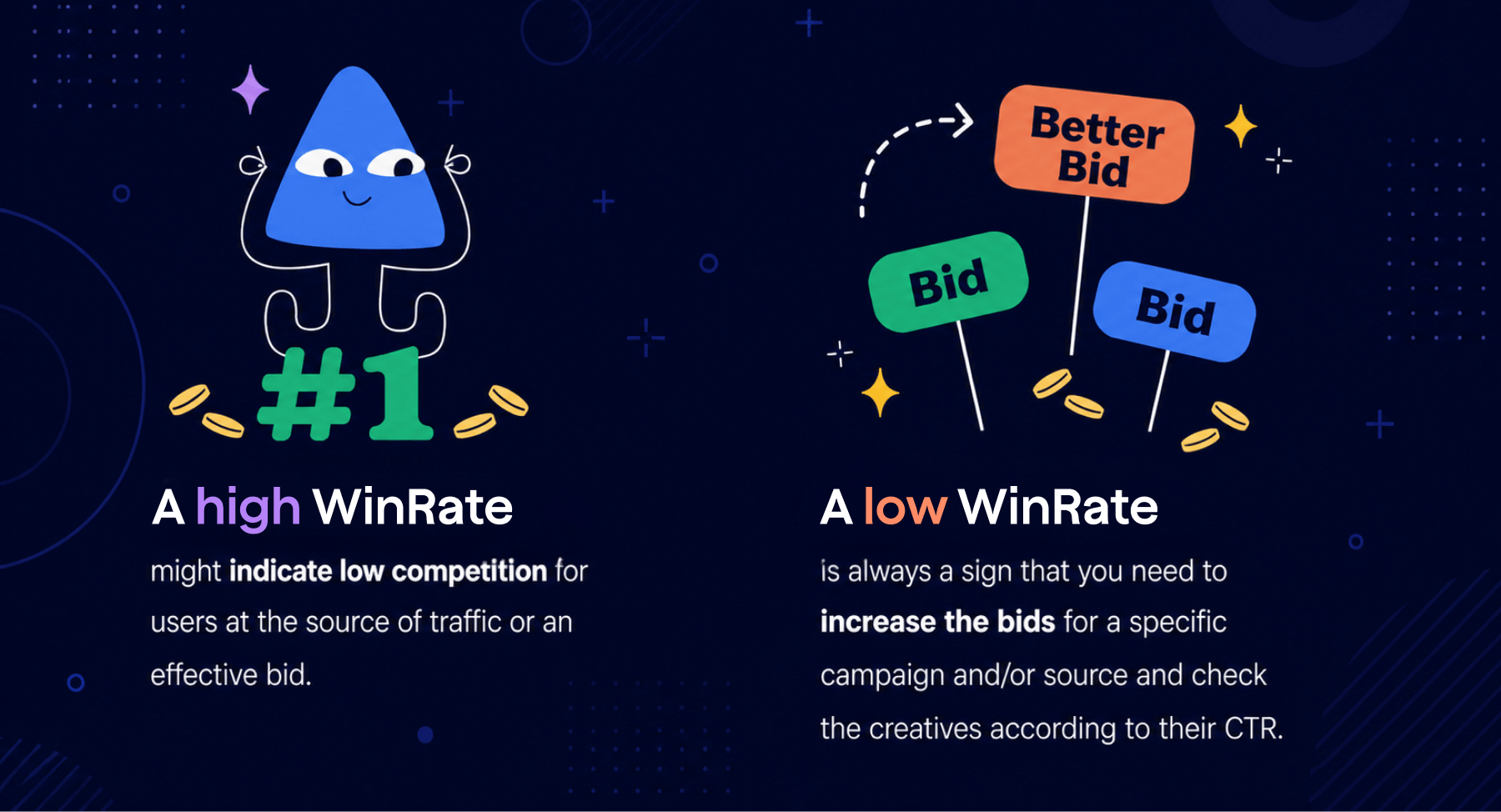
There are two reasons for low WinRate. The first one is the SSP policy. If you see that the campaign got enough Bids and no Wins, this possibly indicates your ad campaign is blocked by traffic sources due to the policy. Yet, if you are sure your ad campaign is compliant, then the reason is low Bid Price.
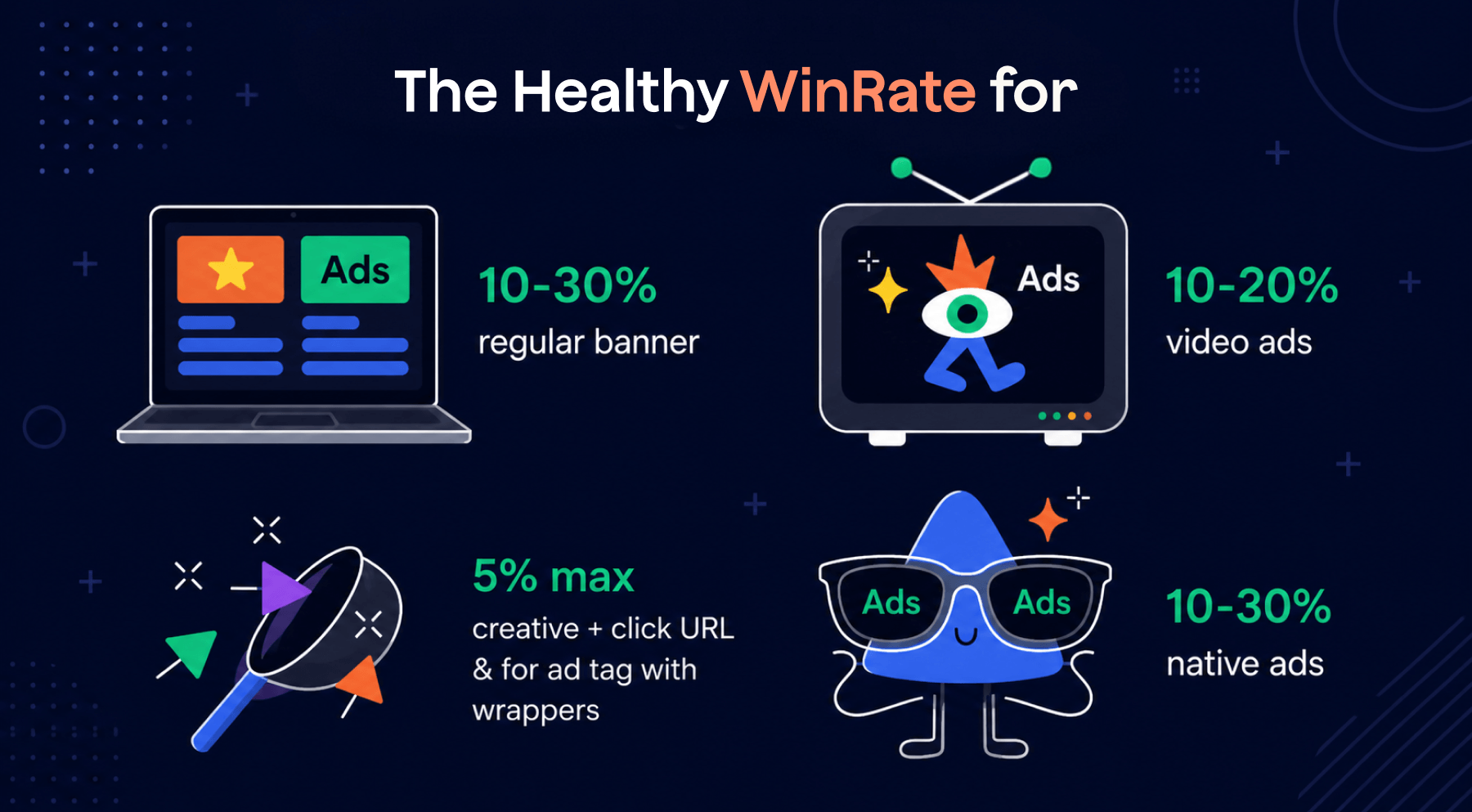
So, this is an indicator that shows where your Bid Price is on the market today.
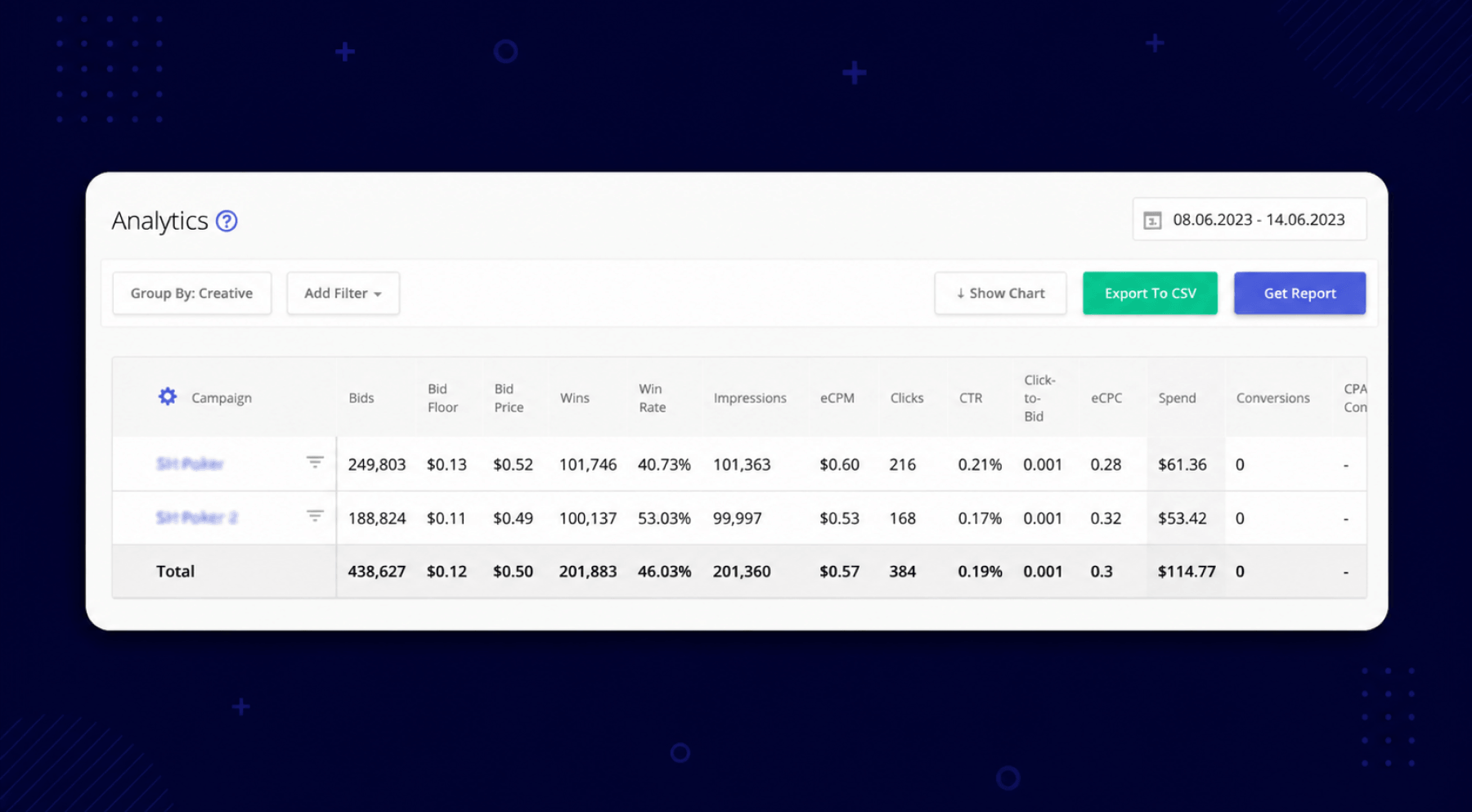
Let's check an example. Imagine this is your ad campaign on the screenshot below. It demonstrates that you are getting almost half of the traffic that SSPs can provide, which is good, actually. At the same time, you can notice that the Bid Price is higher than average on the market.
Of course, it's absolutely up to your strategy, and you can even increase your Bid Rate to get all of the traffic, but if you want to move further with an efficient Bid Price, you can lower it.
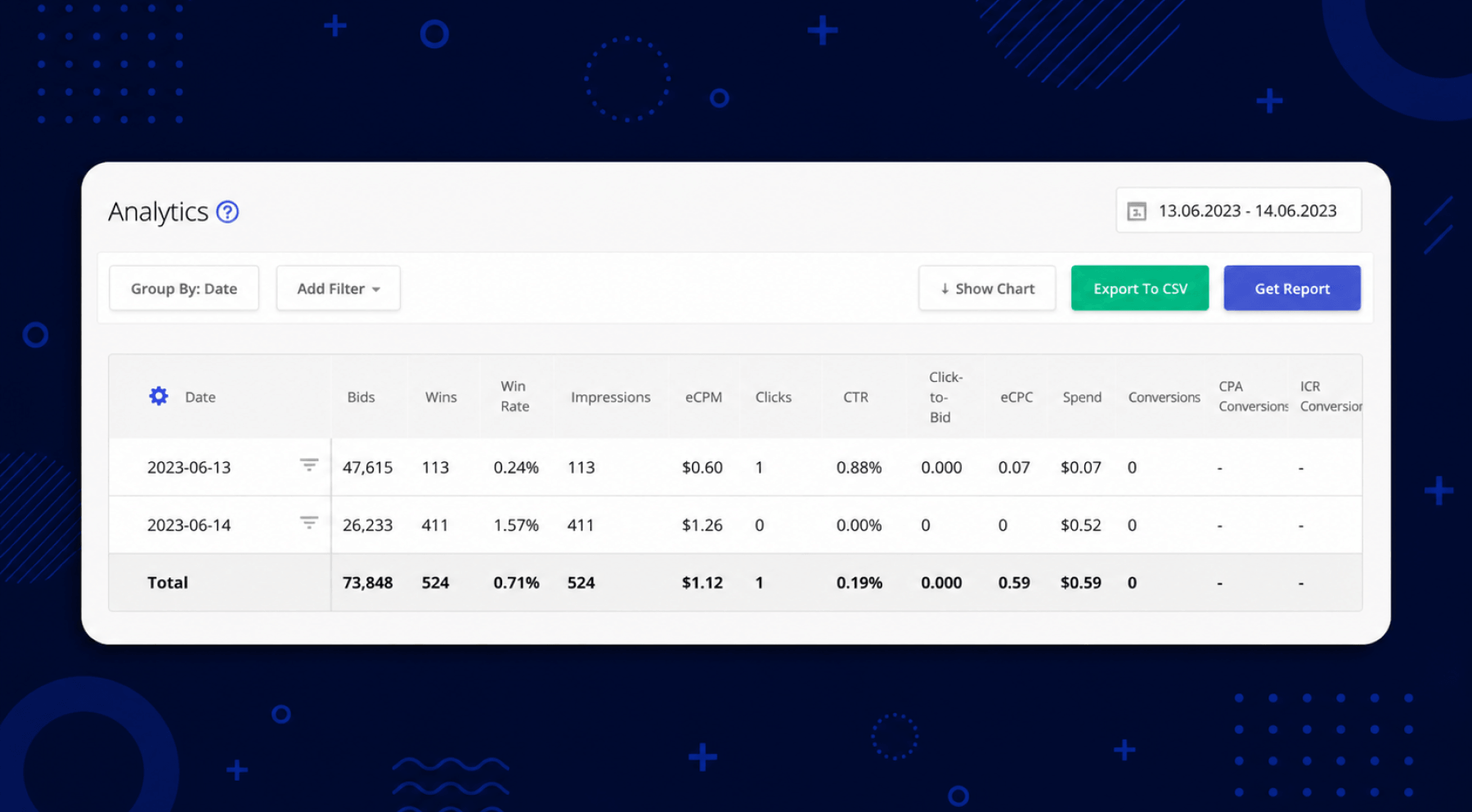
The next case shows us that the client is not winning enough volumes, which is definitely connected with the Bid Price.
Here, two options are available: increase the Bid Price or arrange more cheap traffic sources, but that will affect the quality of traffic the client gets.
We recommend checking this metric a few hours after the campaign goes live and monitoring it once every few days, as the situation on the market might change rapidly.
A/B Creatives Testing
Effective ad campaigns don't go by default, as you need to deliver messages using effective creatives. So, there is a need for some preparations. To launch a campaign that will bring you measurable results, you need to test your creatives first.
It's an efficient and common practice to test a few same-size creatives with different messages, CTAs, and colors to find out what image and text will make your dollar earn more and bring the best result on the specific traffic source/ad format. Consider using at least 3 different creatives for launching your first ad campaign.
For example, if you are running a mobile display ad campaign, it would be great to use three 320x50 banners, three banners for interstitial ads, and three banners of 300x250 size simultaneously.
For a mobile video campaign, you can add three horizontal videos with different messages and the same three videos but in a vertical orientation.
After at least one day running you will be able to analyze how your ads are performing and which creatives it's better to use.
If, from experience or other traffic sources, you know what metrics (for example, CTR) you want to achieve, you can set up the Bidding Rule in Autopilot that will pause the underperforming creatives automatically.
Check out a detailed Help Center article with step-by-step guidelines.
You go to Autopilot -> Bidding Rules -> Create New Rule, and follow our example:
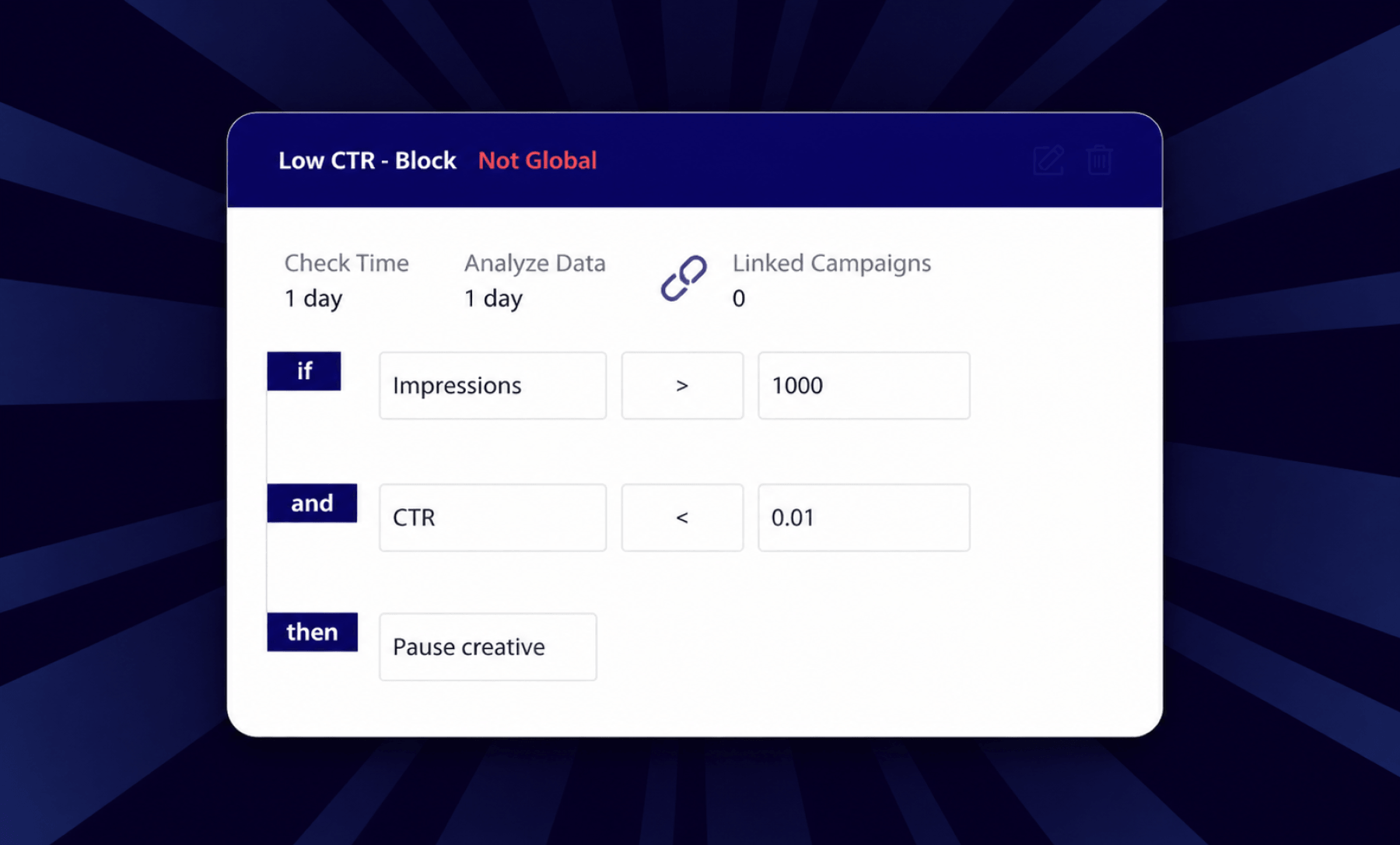
Feel free to play with the conditions to elaborate and adjust your own strategy.
Checking Breakdown by App/Site URL/Site ID
After your campaign is live for a while, you must check where you bought your first ad impressions and do initial optimization by sub-sources, as there will be only success with optimization.
Don't just launch a campaign and expect results. You need to optimize each advertising campaign, analyze, look for options and adjust it accordingly again and again.
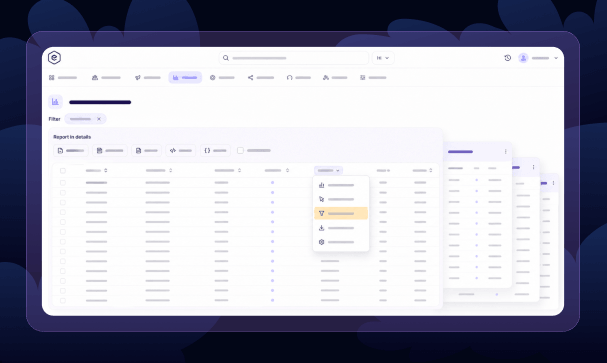
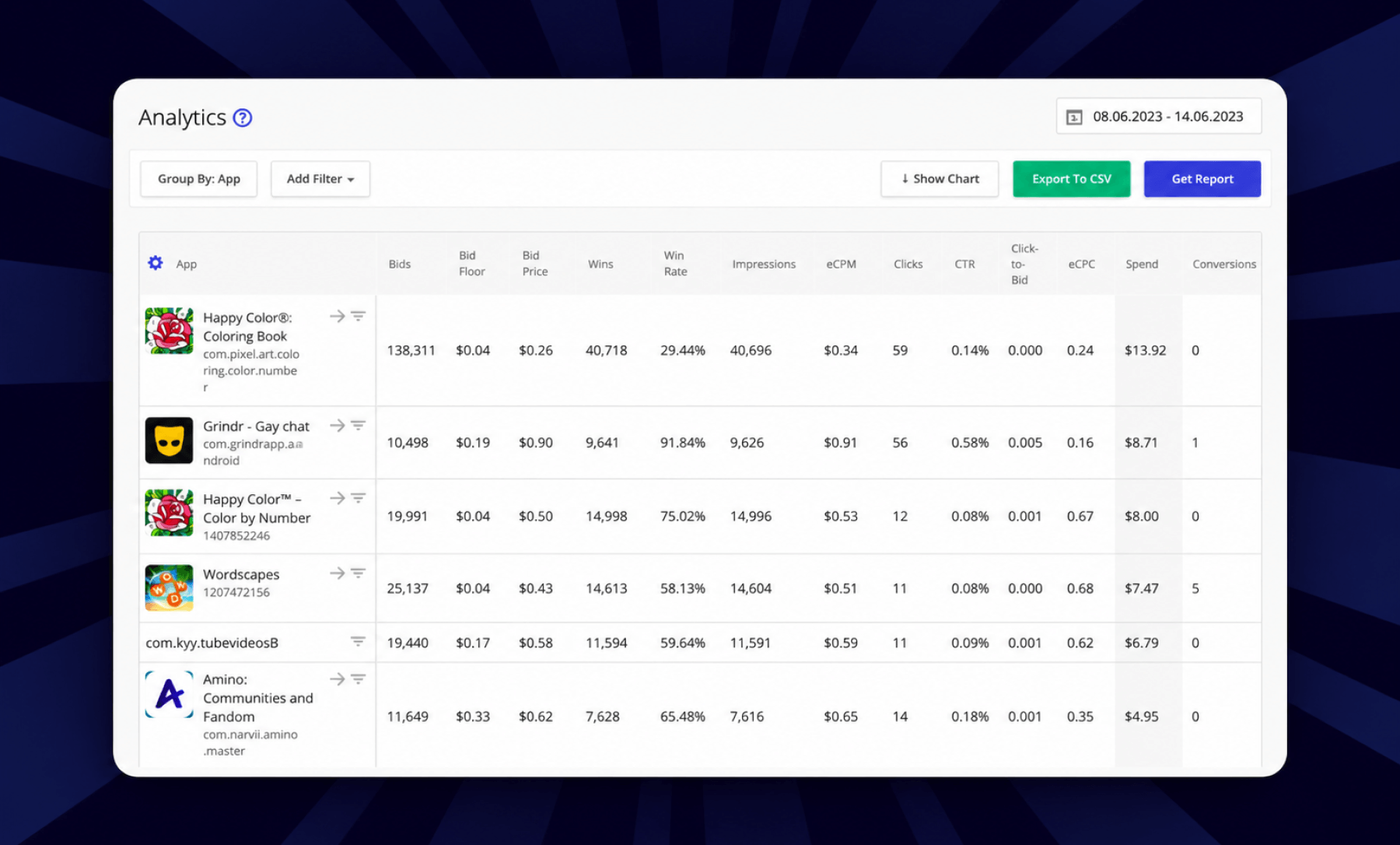
Let's imagine you're buying traffic from mobile applications and looking for conversions. You go to the Analytics tab and group your data by an App. Let's check first few apps:
Blacklisting Sources Manually Using Filters
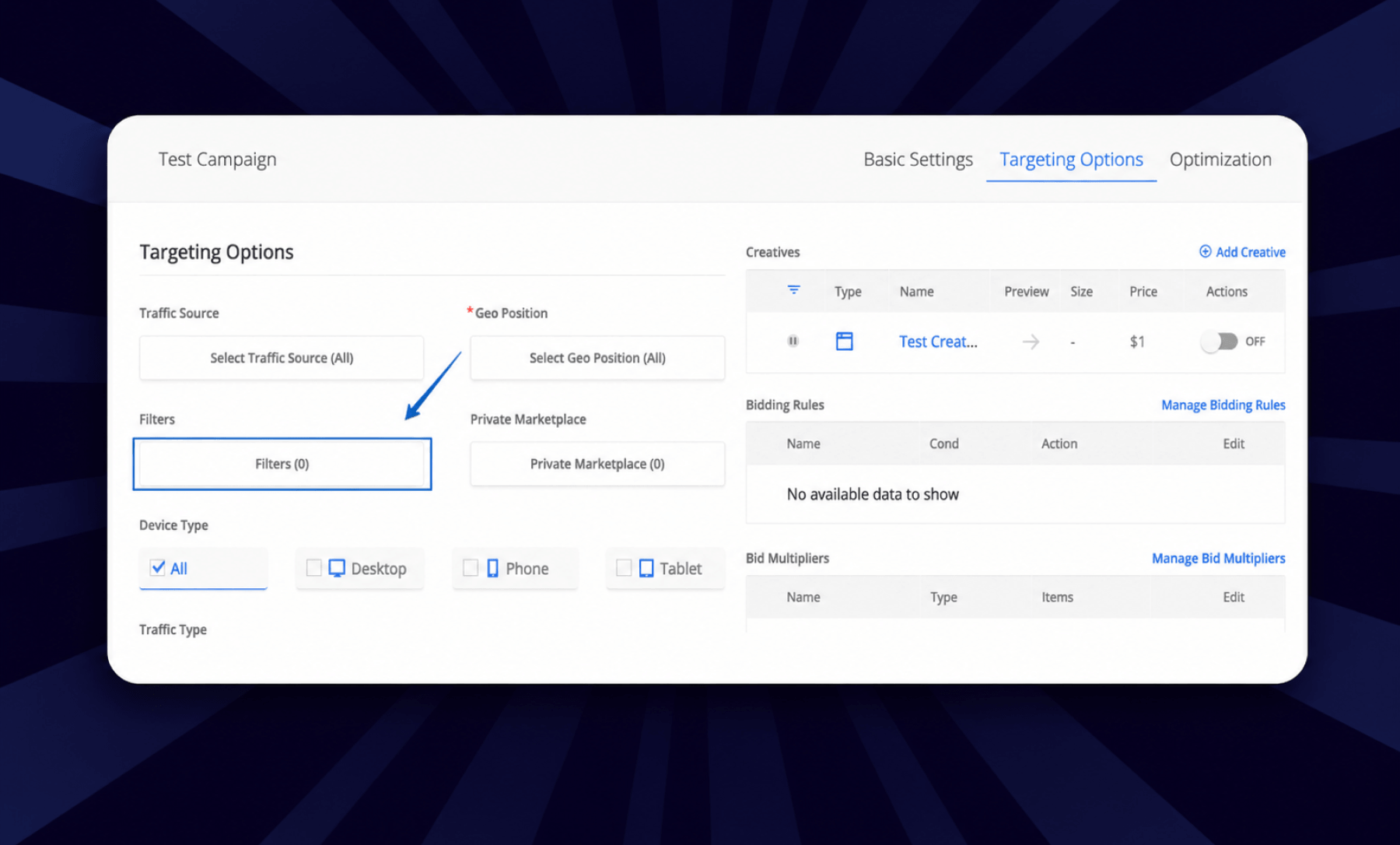
Not all the mobile apps from the list above might perform as you expect. In this case, it's reasonable to create a filter that will act as a blacklist and deal with the low-performing apps. Thus, you choose the best sources and, applying filters to your ad campaign, omit those apps from selling you traffic.
Start running and optimizing your programmatic campaigns directly in Epom DSP.
Full visibility on every placement, bid, and creative.
What Else to Do with an Ad Campaign to Win or Advanced Optimization Tips
Set Up Conversion Tracking
Setting up conversion tracking is like having a money detector for your ads. It tells you exactly where the gold is hiding.
If the goal of your advertising campaign is any kind of action, then setting up conversion transfer is a must. You won't see any results without it there, and even our almost all-mighty CSM team won't be able to assist you in optimizing traffic with our tools.
Again, we have to repeat that like a mantra – optimize your ad campaigns. If you only want to launch a campaign, do nothing, put 0 effort into it, and say "It doesn't convert," here's one recommendation for you: just don't start. Things won't work that way.
Note that to track conversions in Epom WL DSP, you need to have a tracker on your side or advertiser's. Epom is not a tracker as it is, but logs the actions from 3rd party trackers. You can integrate Epom WL DSP with the mobile measurement partners (MMP), for example, Appsflyer, Adjust, Kochava, etc.
Find a detailed step-by-step guide on how to do this in the video tutorial below.
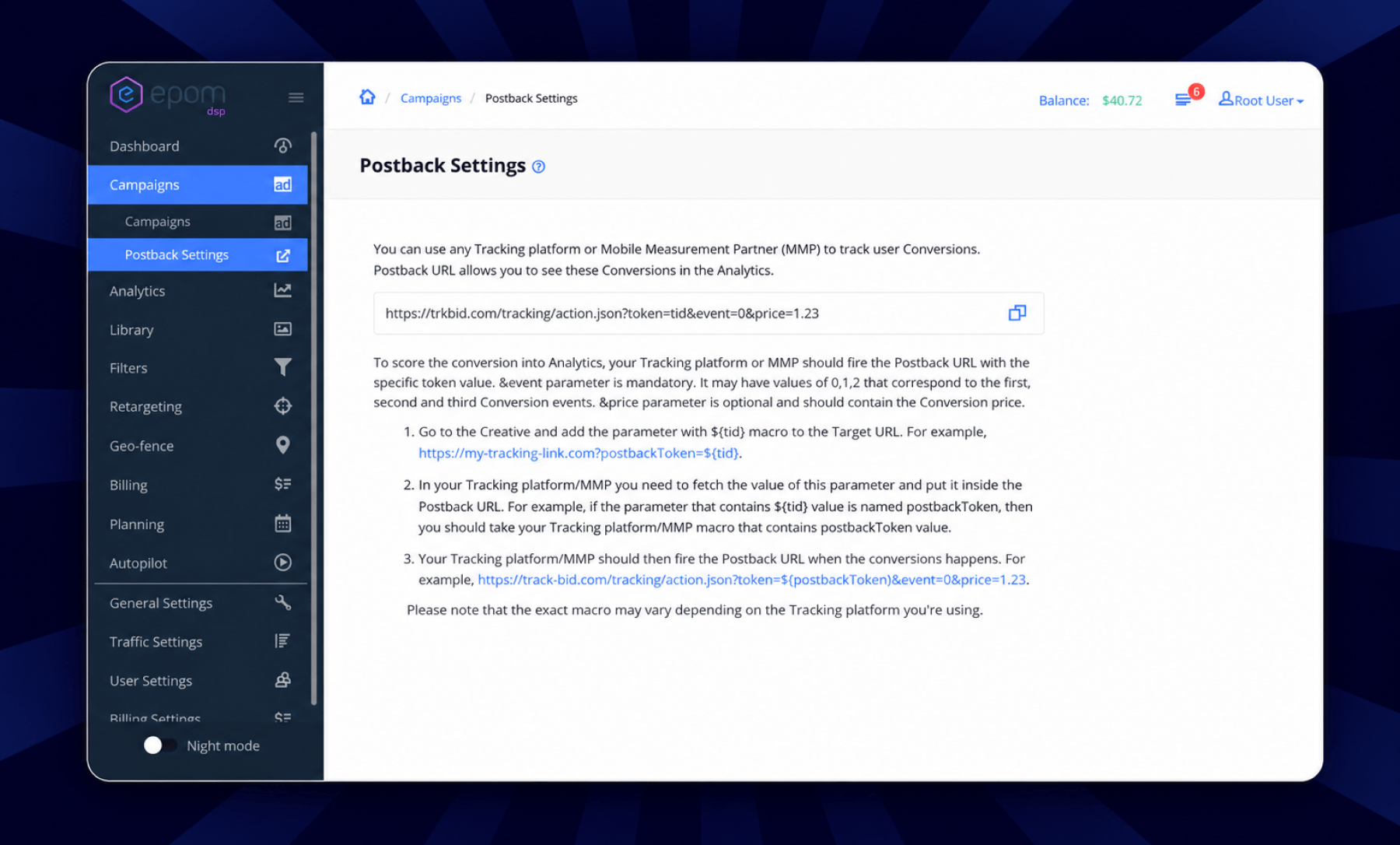
Analyze User Flow and Set Up 3 Events for Tracking & Optimization Using our Postback URL
Postback URL tracking helps to track and measure the success of online campaigns and allows you to attribute conversions to the ads that brought users to your website or app.
Dive deep into your user's journey. Analyze it and find those moments when they turn from window shoppers into paying customers. Then, set up event tracking with Postback URLs to catch those pivotal actions.
Epom WL DSP supports 3 Actions that can correspond to any events you want to track, such as, application Installs and in-app post-install activities.
Optimize Pre-landing Page to Heat Up the User Before Desired Action
Give your audience a taste of what's to come, build excitement, and handle objections. A well-optimized pre-landing page can make your final destination a real party. On push and native ads, pre-landing pages really help to get conversions.
There are many spy tools on the market where you can check out what competitors are doing and implement similar pre-land strategies to see how everything will work. For example, Adplexity is the most popular, but there are a few more. Note that this should be done by the agency/advertiser's team.
The conversion will drop if users are immediately directed through a push notification to the landing page. Therefore, pre-landers are used to improve the performance of campaigns.
Tip: With the help of our Postback URLs, you can track whether users click on your pre-lands and optimize traffic using these metrics, as well.
This is possible if you host the pre-land yourself and can add a script with a Postback URL to it. So, we highly recommend setting this up for effective optimisation and budget saving.
Set Up Bidding Rules for Blacklisting and Whitelisting
Block the underperformers – they're the party poopers. Whitelist the stars – they're the life of the ad party. Your budget will thank you.
When the campaign is launched, you can check the analytics in Epom WL DSP, break down the statistics by site URL or app, and see what traffic you bought and where.
You might see some sites or apps where you spent a dollar but didn't get the expected performance (for example, low CTR, no conversions, conversions are very expensive, etc.).
In this case, you have to create a filter, add these sites or apps to it, and blacklist it within the selected campaign. You can do this manually for the first time and then set up the rule, which will automatically add all new non-performing sources to this filter due to your metrics.
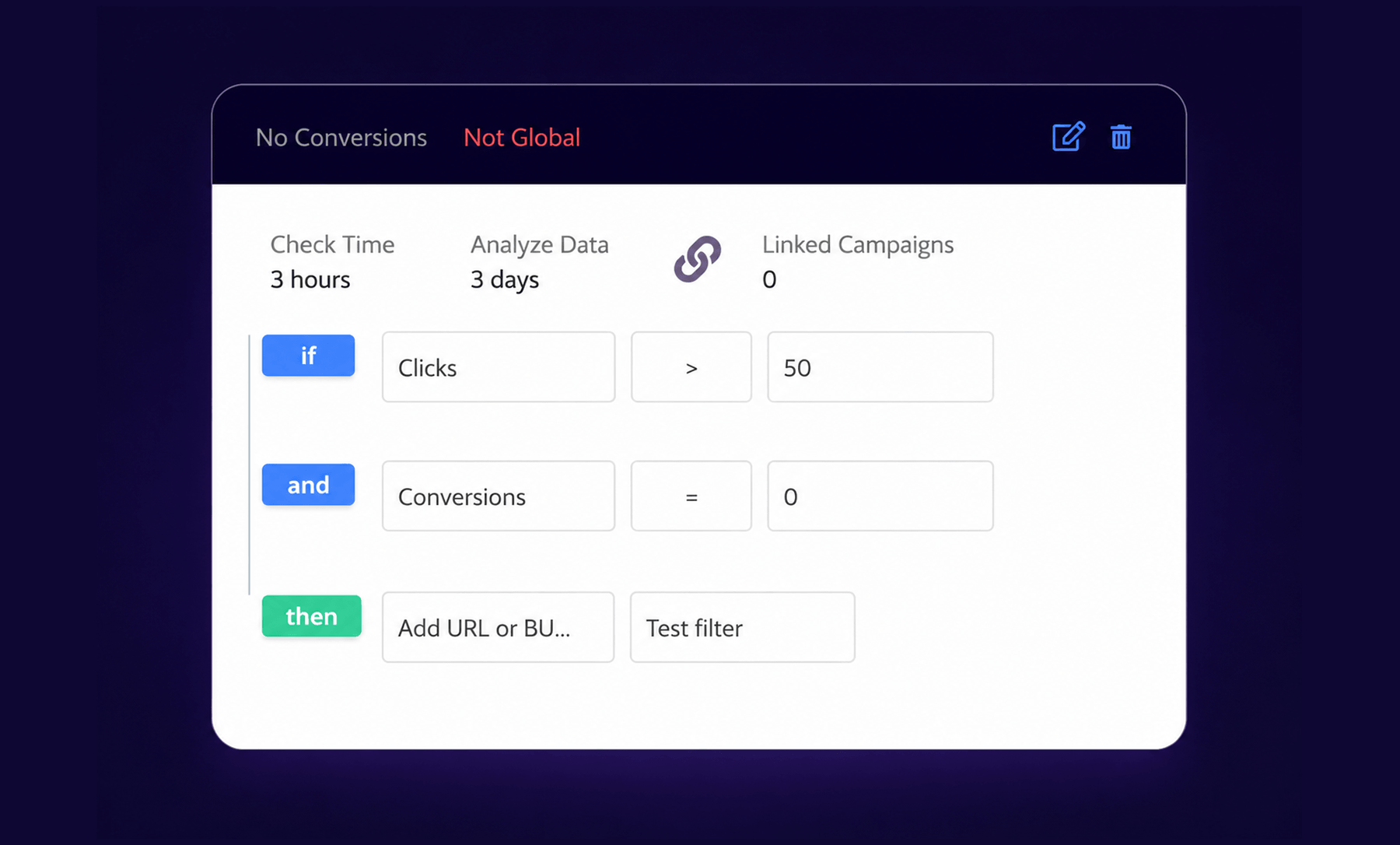
You can do the same with sites/apps where the client has received the desired performance.
Add the super-performing sources automatically to the filter and then use it somewhere else to boost results. For example, create another campaign with a higher bid and target only this filter with good sources there.
Set Up Bid Modifiers
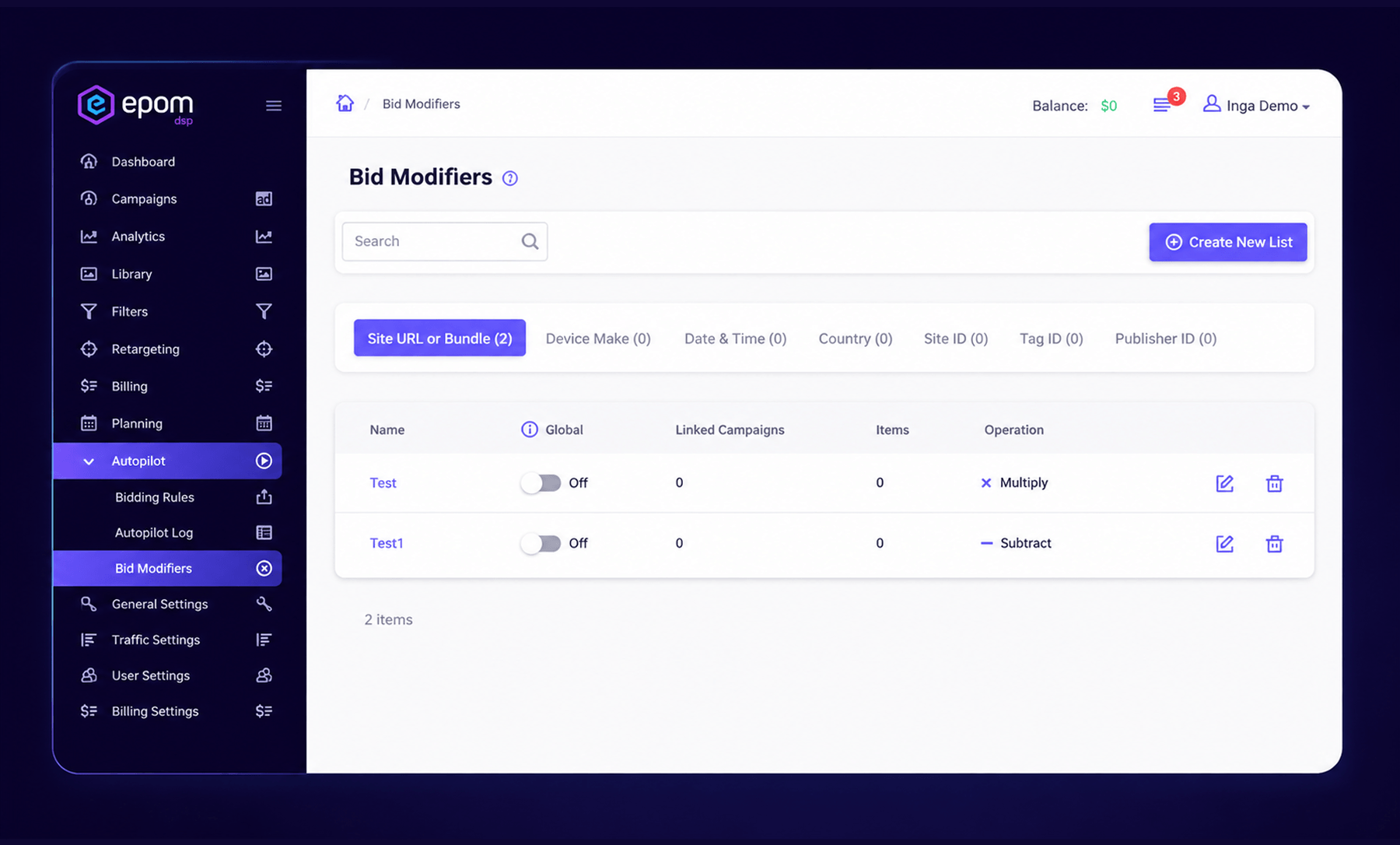
Use bid modifiers to turn up the heat on high-converting segments and cool it down for the less effective ones. It's like cranking up the volume on your favorite tunes at just the right moments.
Epom WL DSP allows you to manage the bidding adjustments by specific conditions effectively and user-friendly. With it, you can apply various multipliers to the bids, considering your traffic source.
The Fundamentals of Ad Campaign Optimization
A few things to keep in mind before you go.
The core principle of advertising optimization has not changed: spend more on what works, spend less on what does not. What has changed is how fast you can act on that logic inside a modern DSP. Besides, programmatic campaign optimization is not a single action. It is a combination of ongoing decisions across several areas:
- Audience targeting and segmentation. Use first-party data wherever possible. First-party data is becoming the most valuable input for audience segmentation as third-party cookies phase out. Segment your audience by behavior, demographics, and interests. The more specific the segment, the more relevant the message.
- Creative testing. Different creative assets produce different results across different traffic sources and ad formats. Test consistently. Pause what fails. Scale what works. Dynamic creative optimization (DCO) can automate part of this by serving personalized ad variations based on user data in real time.
- Bid management and bidding strategies. Use bidding rules and bid modifiers to automate budget allocation toward high-performing sources and away from low-performing ones. AI algorithms can adjust bids based on real-time performance data, but the strategy behind them is yours to set. WinRate analysis, source blacklisting, and bid modifiers are not isolated tactics. Together, they form a complete programmatic strategy optimization loop that runs continuously as long as the campaign is active
- Attribution models. Connect your campaign data to real business outcomes. Multi-touch attribution distributes credit across all touchpoints in the customer journey, giving you a more accurate picture of what is actually contributing to conversions. Without attribution, you are optimizing against incomplete data.
- Ad fraud monitoring. Ad fraud is a real cost. Bots simulate human traffic and inflate ad impressions, draining budgets without producing results. Blacklisting non-performing sources, using brand safety tools, and working with verified supply partners are all part of managing this risk.
- Predictive analytics and machine learning. Modern programmatic technology uses machine learning to refine audience targeting, adjust bids, and shift budget toward better-performing channels automatically. This does not replace human judgment on campaign strategy and campaign objectives. It speeds up execution once the strategy is set.
As an Epom DSP specialist puts it: "The campaigns that fail are almost always the ones where the setup was good, but nobody looked at the data for two weeks. Optimization is not the complex part. Looking is."
Wrapping Up
Ad campaign optimization in Epom WL DSPs isn't just about numbers and algorithms; it's about making your ad campaigns a thrilling journey. It empowers advertisers to maximize their ROI, improve cost efficiency, and constantly refine their strategies for better ad performance.
Knowing how to optimize a campaign comes down to building a repeatable process: check bids, review sources, test creatives, set rules, and repeat. The order matters because each step informs the next.
Programmatic campaign optimization is a skill that compounds over time. Every round of data analysis, every blacklist update, every bidding rule you configure makes the next campaign faster to set up and cheaper to run.